A forever puppy in a black tailcoat: cheerful, friendly, energetic and incurably playful. The Flat-Coated Retriever is the “Peter Pan” of dogs, keeping its youthful zest for life; a wonderful family companion and hunter, shadowed only by a high cancer risk.
Apartment · not suitableKidsCats · with caveatsOther dogsBeginners · with caveats
The Flat-Coated Retriever, or Flat for short, is a true aristocrat and a tireless enthusiast in the canine world. Its elegant silhouette, glossy black or liver-coloured coat, and perpetually wagging tail invariably capture attention. But beneath this refined exterior lies an incredibly cheerful, energetic, and devoted companion, whose zest for life never fades, even in maturity. This dog is an ideal choice for active individuals and families who are ready to dedicate time to their four-legged friend. Learn more on Tvaryny.
The Flat-Coat is not just a handsome dog, but also an exceptionally intelligent and hard-working partner. Originally bred for retrieving game from water, it has retained its outstanding working abilities while earning a reputation as a 'versatile dog', capable of excelling in numerous disciplines, from search and rescue to therapy work. Its friendly nature and boundless love for people make it a superb family pet that gets along wonderfully with children and other animals.
Interesting Facts About the Breed
The Ever-Wagging Tail: A hallmark of the Flat-Coat is its tail, which is in constant motion. The dog's mood can easily be gauged by the power and frequency of its wag.
A "Dual-Purpose" Dog: Throughout their history, Flat-Coats have successfully combined a career in the show ring with work in the field, a rarity for many breeds.
Saviour of the Breed: After the Second World War, the breed was on the brink of extinction. It was thanks to the efforts of a few dedicated enthusiasts that the population was restored.
The Flat-Coat Smile: Many Flats have a comical habit of "smiling" by lifting their lips to show their front teeth when they are happy or greeting their owner. This is not a sign of aggression, but an expression of joy.
History and Origin
The history of the Flat-Coated Retriever is closely linked with the development of gundog breeding in 19th-century Victorian England. Like most retrievers, its roots trace back to Newfoundland, Canada, from where the so-called 'St. John's Water Dogs' (smaller Newfoundlands) – the ancestors of all modern retrievers – were imported. These dogs were renowned for their love of water and their skill in retrieving downed game.
In Great Britain, these dogs were crossed with other breeds to enhance specific qualities. A key figure in the breed's creation was Mr S.E. Shirley, founder of The Kennel Club in the UK. In the 1860s, he began a focused effort to breed a retriever with a straight coat, which at the time was known as the 'Wavy-Coated Retriever'. To create the Flat-Coat, breeders used Irish Setters (to improve scenting ability and add elegance), water spaniels, and possibly Border Collies to increase intelligence and obedience.
The goal was to produce not just an effective gundog, but also an elegant companion. By the end of the 19th century, the Flat-Coated Retriever was the most popular retrieving dog at shows and field trials in Britain. However, in the early 20th century, its popularity began to wane, giving way to breeds like the Labrador Retriever and the Golden Retriever. Despite this, dedicated enthusiasts preserved the breed, and today, while not the most numerous, Flat-Coats have a stable following of admirers worldwide.
What Does a Flat-Coated Retriever Look Like: Breed Standard and Appearance
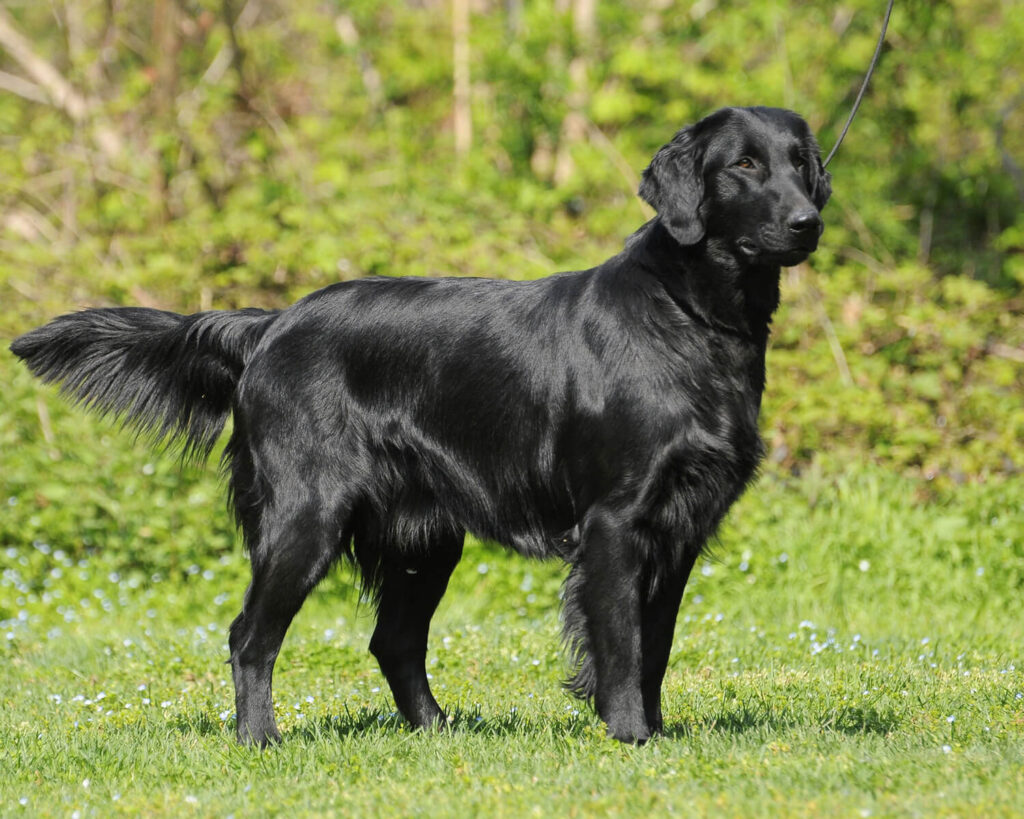
The Flat-Coated Retriever is the epitome of strength and elegance. It has a harmonious yet powerful build that speaks to its purpose as a hardy gundog, capable of working on both land and water. Its appearance combines functionality with beauty.
Head: Long and clean-cut, with a slight, barely perceptible stop. The skull and muzzle are of roughly equal length. Jaws are strong with a perfect scissor bite.
Eyes: Medium-sized, almond-shaped, dark brown or hazel. The expression is very intelligent and friendly.
Ears: Small, drop ears, set not too low, lying close to the head.
Body: The chest is deep and quite broad, with well-developed fore-ribs. The back is short, strong, and level. The loin is powerful.
Tail: Short, straight, and well-feathered, but not bushy. The dog carries it cheerfully but not curled over the back. It acts as an extension of the topline and is constantly in motion.
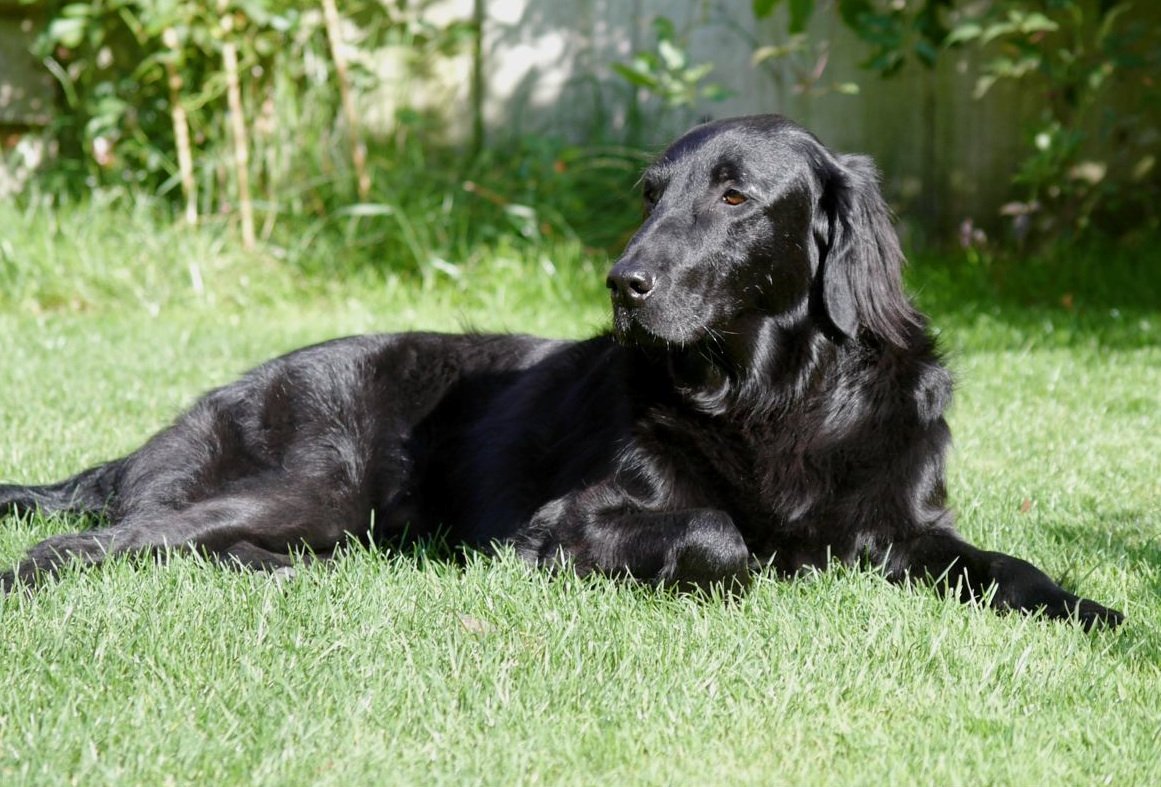
Coat: Dense, of fine to medium texture, with a good lustre. As the name suggests, it should be as straight as possible, though a slight wave is permissible. There is beautiful feathering on the legs and tail. The undercoat is dense and soft, providing protection from harsh weather and cold water.
Colour: Only two colours are permitted – solid black or solid liver.
Characteristic
Description
Height at withers (dogs)
59–61.5 cm
Height at withers (bitches)
56.5–59 cm
Weight (dogs)
27–36 kg
Weight (bitches)
25–32 kg
Lifespan
8–12 years
Character and Temperament
The Flat-Coat's character is one of its most outstanding features. They are often called the "clowns of the dog world" or the "Peter Pans" of the canine kingdom, a nickname they have truly earned. Flats mature very slowly, retaining a puppy-like innocence, playfulness, and enthusiasm throughout their lives. Even in its senior years, a Flat will be delighted to chase a ball or go for a swim.
Key Character Traits:
Cheerfulness and Optimism: This is a dog that is always in a good mood. Its tail almost never stops wagging, expressing boundless joy in its interactions with the world.
Sociability and People-Oriented Nature: The Flat adores its family and thrives on being the centre of attention. It does not tolerate loneliness well and can suffer from separation anxiety if left alone for long periods. This is not a dog that will be happy living in a kennel.
Friendliness: They are exceptionally friendly towards everyone, including strangers, other dogs, and other animals. Aggression is completely out of character for this breed. This makes them poor guard dogs, as they would more likely 'lick an intruder to death'.
Sensitivity: Despite their boisterous energy, Flats are very sensitive dogs. They respond poorly to shouting and harsh training methods. They need to be handled with a gentle but consistent approach.
Intelligence and Eagerness to Please: These are very clever dogs that learn quickly and are always eager to please their owner. This makes the training process enjoyable and effective, provided the right methods are used.
The Flat-Coated Retriever is an excellent choice for families with children, as it is patient and playful. However, due to its energy and size, it might accidentally knock over a small child, so their interactions should always be supervised.
Pros and Cons of the Breed
Like any breed, the Flat-Coated Retriever has its advantages and disadvantages. It is important to assess them objectively before getting such a dog.
Pros
Cons
✅ Incredibly friendly nature: Gets on wonderfully with all family members, children, other dogs, and even cats.
❌ High energy needs: Requires at least 1.5–2 hours of active walks daily. Not suitable for couch potatoes.
✅ High intelligence and easy to train: Quickly grasps commands and is eager to please its owner.
❌ "The eternal puppy": Matures slowly; can be overly boisterous and clumsy for the first 3–4 years of its life.
✅ Optimism and cheerfulness: This dog literally radiates positivity and can lift anyone's spirits.
❌ Prone to separation anxiety: Suffers greatly when left alone; not suitable for people who spend a lot of time away from home.
✅ Versatility: Excels in many dog sports (agility, obedience, flyball) and in working roles.
❌ Health issues: Has a genetic predisposition to certain types of cancer, which shortens the average lifespan.
✅ Elegant appearance: A beautiful, glossy coat and graceful build make it a star at any dog show.
❌ Needs a lot of attention: This is not a dog that will lie quietly in a corner. It demands constant interaction.
Training and Socialisation of a Flat-Coat
Thanks to their high intelligence and eagerness to please, Flat-Coated Retrievers are rewarding pupils. However, their sensitivity and slow maturation require a special approach. Training must be based on positive reinforcement: praise, treats, and toys. Any harshness or shouting can frighten the dog and undermine its trust in you.
Early socialisation is critically important. From puppyhood, introduce your Flat-Coat to a wide variety of people, sounds, places, and other animals. This will help it grow into a confident and well-balanced dog. Due to their natural friendliness and energy, it's important to teach them from an early age not to jump up at people in greeting.
Training sessions should be short, interesting, and varied to keep the dog engaged. Flats excel in obedience, agility, and other sports, which are excellent outlets for their energy and help to strengthen the bond with their owner. They are also among the best gundogs, alongside other retriever breeds such as the Curly-Coated Retriever, the Labrador Retriever, and the Nova Scotia Duck Tolling Retriever.
Care and Maintenance
Although the Flat-Coat is a gundog used to open spaces, it can adapt to life in a city flat on one crucial condition: a sufficient level of physical and mental stimulation. Without this, its boundless energy will find a destructive outlet.
Grooming and Coat Care
The Flat-Coat's coat doesn't require complex grooming, but it does need regularity. It is recommended to brush the dog 1–2 times a week with a suitable brush or comb to prevent mats, especially in the "feathering" (the longer hair on the legs, tail, and under the chest). During seasonal shedding (spring and autumn), this should be done more frequently, perhaps daily. Bathe the dog only when necessary, usually once every 2–3 months, using a mild dog shampoo. Over-bathing can dry out the skin and coat. It is also important to regularly check and clean the ears, as their drop shape can trap dirt and lead to infections. Don't forget to trim their nails every 3–4 weeks.
Exercise and Activity
This is the most critical aspect of keeping a Flat-Coat. This dog needs long, vigorous walks every single day. A simple stroll on the lead around the block will not suffice. The ideal routine is a combination of:
Active games: Retrieving a ball or frisbee.
Swimming: Flats adore water, and swimming provides an excellent full-body workout.
Jogging: A fit, adult dog can make a great running companion.
Dog sports: Agility, flyball, canicross, and obedience are all fantastic ways to channel their energy constructively.
In addition to physical exercise, the Flat-Coat needs mental stimulation. Learning new commands, playing scent games, and using puzzle toys will help keep its mind sharp and prevent boredom.
Nutrition
Feeding: How to Feed a Flat-Coated Retriever?
Health and risks
Flat-Coated Retriever Health: Common Conditions
Frequently Asked Questions (FAQ) · 5
Do Flat-Coated Retrievers shed a lot?
Yes, Flat-Coats do shed, especially heavily twice a year during their seasonal moults. Regular brushing will help to manage the amount of hair in your home, but you won't be able to eliminate it completely. This breed is not suitable for people with allergies.
Is a Flat-Coat suitable for a first-time owner?
A Flat-Coat can be a first dog, but only for a very responsible, patient, and active person. Their high energy needs, sensitivity, and slow maturation can be a challenge for a novice. It is crucial to be prepared to devote a lot of time to training and exercise.
Can a Flat-Coated Retriever live outside in a kennel?
Absolutely not. This is a highly social, people-oriented dog. Keeping it in a kennel, isolated from the family, will lead to serious behavioural problems, depression, and destructive behaviour.
How much does a Flat-Coated Retriever puppy cost?
The cost of a puppy from a responsible breeder can vary significantly depending on the pedigree, the parents' titles, and the breeder's reputation. It is important to understand that a low price often means corners have been cut on the health and welfare of the dogs. More to the point, the purchase is the smallest part of it — food, veterinary care, grooming and insurance across the dog's life weigh far heavier.
Is a Flat-Coat a good guard dog?
No. A Flat-Coat might bark to announce the arrival of visitors, but its friendly nature makes it completely unsuited for guarding duties. It is far more likely to greet any stranger with unrestrained joy.
Videos of the Flat-Coated Retriever
FAQ
Why is the Flat-Coated Retriever called “Peter Pan”?
Because it keeps its playful, youthful character well into adulthood — a cheerful, irrepressible breed in no hurry to “grow up”.
What does the Flat-Coated Retriever suffer from?
The main shadow is a high predisposition to cancer (especially histiocytic sarcoma); its risk in the breed is estimated at 20–25%.
Is the Flat-Coated Retriever good for a family?
Very — one of the friendliest and most playful retrievers, wonderful with children and animals; the key is enough exercise.