Group 5 · spitz and primitive · Spain (Canary Islands)
Podenco Canario
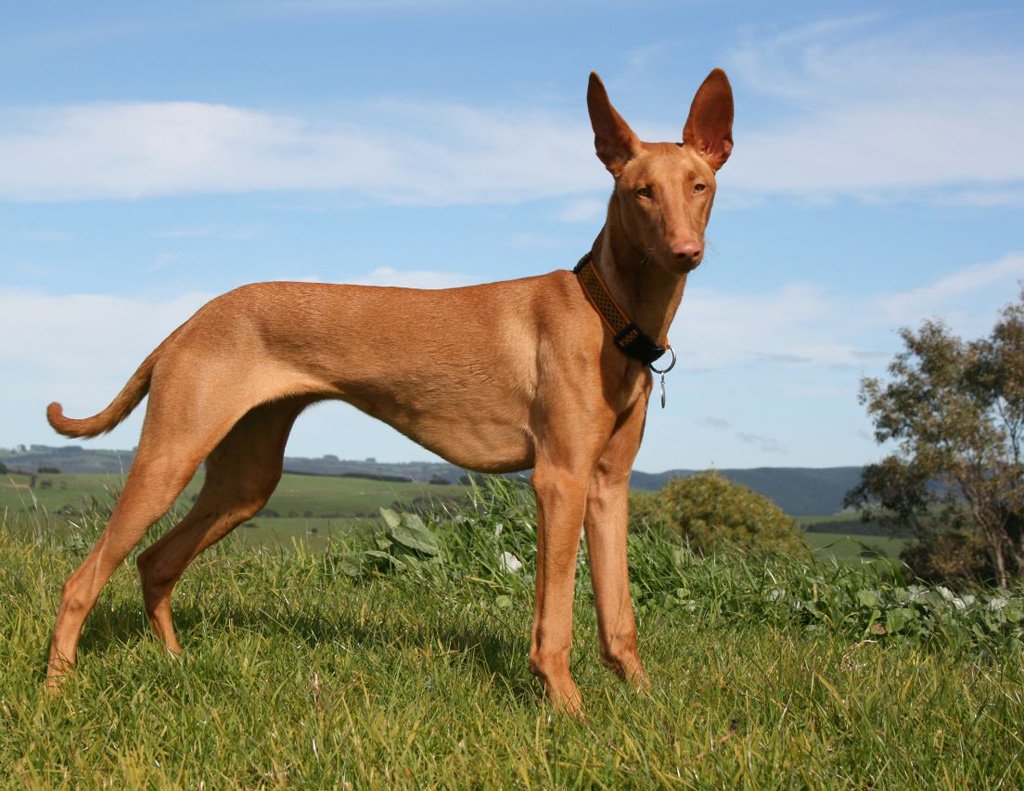
The Podenco Canario is a lean, extremely hardy hunting dog of the Canary Islands. The FCI places it not among sighthounds but in Group 5 (Spitz and primitive types): by the standard it finds rabbit in rock and stone walls by nose and ear as much as by eye, and while working the scent it must neither bark nor seize the game. This is an athlete for active owners: a very strong hunting instinct (careful with cats), a need for long exercise, a secure fence. The short coat without undercoat handles heat well and cold badly.
Hardy: the standard describes hunting from dawn to nightfall
Works by nose, ear and eye at the same time
Sheds little, minimal grooming
Not aggressive to people, usually sociable with other dogs
Cons
Very strong hunting instinct (dangerous for cats)
High exercise needs — not a flat dog without real effort
Independent: bred to work on its own initiative
Copes poorly with cold: no undercoat, thin skin
Size
ToySmallMediumLargeGiant
Compatibility
Apartment · not suitableKids · with caveatsCats · not suitableOther dogsBeginners · with caveats
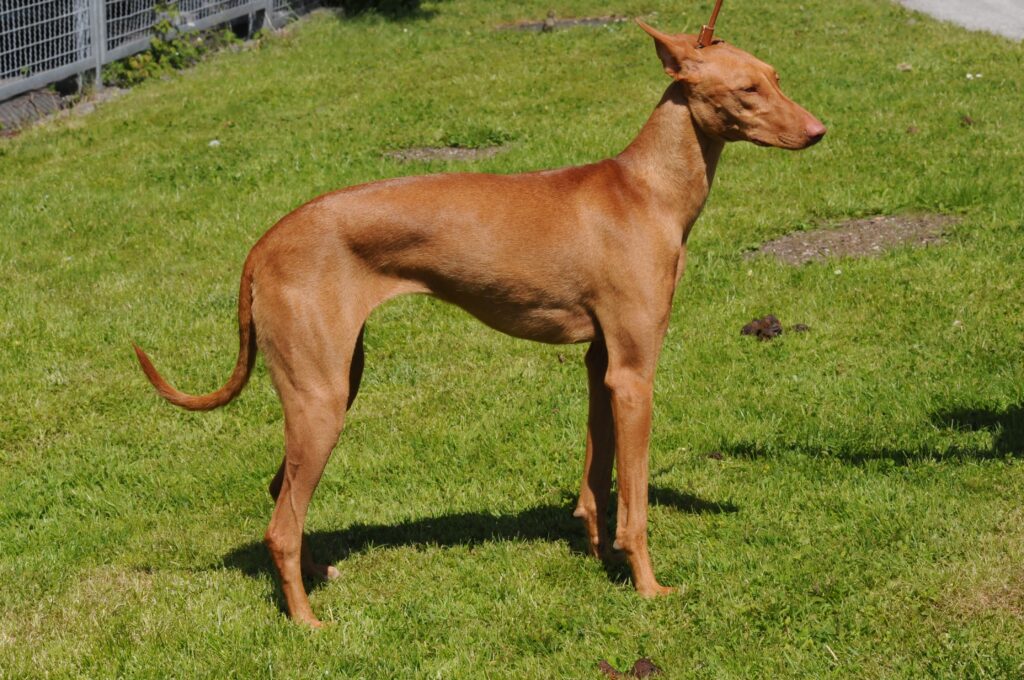
The Podenco Canario, also known as the Canarian Warren Hound, is an elegant and extraordinarily hardy hunting dog of the Canary Islands. FCI-Standard No. 329 describes a dog of medium size, "built on longish lines", slender, light and extremely resistant, whose muscle contractions are visible through the skin and whose ribs, spinal column and hip bones show because there is no layer of fat over them. Its work is rabbit: in rock, in stone walls, in volcanic tubes and in thorny scrub. The standard states plainly that this is mainly a tracker dog, one that must neither bark nor catch the game while it is working by scent. Unlike sighthounds in the narrow sense, the Podenco Canario does not hunt by eye alone — the standard credits it with "his prodigious nose, his sight and hearing" in the same breath. More hunting breeds in our catalogue at Tvaryny.
Podenco Canario at a Glance
Podenco Canario at a Glance · 8
Origin
Spain (Canary Islands)
Standard
FCI No. 329; the official authentic language of the standard is Spanish
FCI recognition
accepted on a definitive basis 24.06.1987; the current edition of the translations was published 03.11.1999
FCI group
Group 5 (Spitz and primitive types), Section 7 (primitive type — hunting dogs), without working trial
Height at withers
males 55–64 cm; females 53–60 cm. The standard separately allows deviations of 2 cm above the maximum and 2 cm below the minimum
Weight
the FCI standard sets no weight at all; reference books quote about 20–25 kg
Lifespan
reference books give 11–14 years; no breed-specific longevity study has been published (see the health section)
Use
rabbit hunting, including with a ferret — a method authorised on the islands; companion dog
Interesting Facts about the Podenco Canario
The standard forbids barking at work. The "Utilization" section says outright that while working by scent the dog must neither bark nor catch the game. Few hunting standards state a behavioural requirement so unambiguously.
Hunting with a ferret. The same section mentions a method authorised on the islands: the dog works in tandem with a ferret that bolts the rabbit from its burrow. The podenco usually takes the rabbit in its mouth.
The standard measures the head in centimetres. "Head of medium length of 21 to 22 cm" is unusually specific for a breed standard; so are the distance from hock to ground (about 18 cm) and the amount by which the thoracic perimeter exceeds the height at the withers (5–8 cm).
The lowest inbreeding in its company. Across a comparison of eight Mediterranean breeds the Podenco Canario showed the lowest inbreeding coefficient FIS (−0.02957) — lower than any of the others, the mainland Spanish podencos included (Research in Veterinary Science, 2023).
A mitochondrial haplotype of its own. The study of five Canarian breeds (Animal Genetics, 2013) first described haplotype A33+, which proved to be exclusive to the Canarian Warren Hound.
Dogs in the islands' name — but not this breed. Pliny the Elder writes that the island of Canaria was named for a multitude of dogs "of huge size", two of which were brought to King Juba II. The Podenco Canario is a dog of medium size, and the ancient notice contains no breed name at all.
History and Origins of the Breed
The Podenco Canario is almost always presented as a direct continuation of the dogs of ancient Egypt. That claim is worth taking apart bone by bone, because it is really three separate things: what the standard says, what the research showed, and what the breed is credited with. All three follow, kept apart.
What the standard says — and why that is a registry's position, not an established fact
The "Brief Historical Summary" of FCI-Standard No. 329 asserts that the Podenco Canario is "a dog of Egyptian origin" — the Spanish original says de origen faraónico, of pharaonic origin — which was probably imported to the Canary Islands by the Phoenicians, the Greeks, the Carthaginians "and the Egyptians themselves". The standard then adds that it is "one of the most ancient breeds in existence, because we find numerous vestiges (engravings, statues, bas-reliefs) in the tombs of the Pharaohs and in the museums of the Louvre or the British Museum", and that "this breed dates back about seven thousand years".
Notice two things inside the document itself. The first is the hedge: the standard writes "probably imported", not "imported". The second is the word "because": the antiquity of the breed is derived from the existence of museum images of dogs of a similar type. That is a closed circle — the artefact serves as proof of descent, while the artefact itself says nothing about the breed, since no Egyptian relief is captioned "Podenco Canario". An FCI standard is a primary source for what is written in it — measurements, angles, colour, faults — but its historical section and its evaluative phrases are the position of a registry, not the outcome of research.
It is also telling that the standard's "about seven thousand years" and the "3400 BC" that circulates in popular breed descriptions are two different figures that do not agree with each other (seven thousand years ago is roughly 5000 BC). The figure 3400 BC has a biography of its own, and it is not a canine one: that is precisely the date early 20th-century Egyptology gave for the accession of Menes and the beginning of the dynastic period. James Breasted's A History of Egypt lists in its own contents "The Accession of Menes, 3400 B. C." and "The first Two Dynasties, 3400–2980". A century-old chronological milestone found its way into breed descriptions and, along the way, turned into "the age of the wall paintings".
What the research showed
Unlike many "ancient" breeds, the Podenco Canario has in fact been included in genetic studies — and in more than one.
San José and colleagues (Italian Journal of Animal Science, 2017). 21 microsatellite markers from the standard ISAG panel; 30 Podenco Canario from six owners, 37 Podenco Ibicenco, 61 Podenco Valenciano, 30 Podenco Andaluz and 27 German Shepherd Dogs as an outgroup. The most probable number of genetic clusters was four, and each breed fell into its own: of 206 Podencos analysed, 205 (99.51%) were assigned to the cluster of their own population. Fst distances between the Podenco Canario and the rest: 0.05350 to the Valenciano, 0.07025 to the Andaluz and 0.07565 to the Ibicenco.
Perini and colleagues (Research in Veterinary Science, 2023) — the first attempt to cover eight Mediterranean hound-like breeds at once: 272 dogs, including 30 Podenco Canario, plus 29 German Shepherds as an outgroup; 16 microsatellites and 223 sequences of the mitochondrial control region. The Podenco Canario showed the lowest inbreeding coefficient in the sample (FIS = −0.02957) at an observed heterozygosity of 0.70; the highest inbreeding was in the Cirneco dell'Etna (0.07050).
Suárez and colleagues (Animal Genetics, 2013) — a study of the Canarian breeds specifically: Canarian Warren Hound, Canary Island Mastiff, Garafiano Shepherd, La Palma Rat-Hunter and El Hierro Wolfhound. The authors identified 168 alleles at autosomal microsatellites and 16 mitochondrial haplotypes; three haplotypes were newly described and each proved exclusive to a single breed — among them A33+, exclusive to the Canarian Warren Hound. Their conclusion was that mitochondrial haplotypes discriminate poorly between breeds, whereas autosomal markers allow a clear clustering of each population.
Now the part that matters most — how the authors themselves phrase their conclusion about Egypt, with their own caveats attached. The 2023 paper states verbatim: "None of populations/breeds selected in this study can be classed as native to Egypt, yet they still closely resemble the ancient iconic Egyptian dogs, not only for their phenotypic traits, but also as indicated in this study by the potential genetic links as is being suggested by haplotype sharing." The authors do not close the case: the abstract of the same paper says that "there is not enough evidence from this study to exclude completely the potential of an ancient common relationship". That is a hedge, and it is part of the fact: the work does not refute an ancient relationship, it shows that its own material contains no evidence for one.
Another conclusion in the same paper is deliberately two-sided: the absence of geographic or breed-related structure in the maternal lineages, the authors write, could indicate either that most of these breeds derive from the same ancestral stock and retain ancestral maternal lineages, or that extensive introgression occurred during breed formation. And then comes the sentence that is the scientific answer to the legend: the lack of clear patterns in the distribution of mitochondrial lineages "corroborates the general idea that the origin of dog populations/breeds is to be considered as a recent event, arising from mixed ancestral stock". On the neighbouring page the same authors add an external argument: whole-genome SNP data indicate that, even if the genetic foundations of these breeds reach into the more distant past, their separate formation as breeds occurred within the last two hundred years or so.
An honest boundary is needed here. The best-known debunking study — the one that showed the Pharaoh Hound and the Ibizan Hound to be recent re-creations — did not examine the Podenco Canario: it dealt with other breeds. Carrying its conclusion across to the Canarian podenco would be the very error the legend itself begins with. For the Podenco Canario the evidence base is different and narrower: the three studies above, none of which finds Egyptian roots in it, and none of which has the material to rule such roots out.
What the oldest text about the "islands of dogs" actually says
The only ancient source behind the whole story of the archipelago's name is Pliny the Elder, Naturalis Historia, Book VI, § 205, where he relays the report of an expedition sponsored by King Juba II of Mauretania. The Latin reads: proximam ei Canariam vocari a multitudine canum ingentis magnitudinis — ex quibus perducti sunt Iubae duo, that is, "the one next to it is called Canaria, from the multitude of dogs of huge size, two of which were brought to Juba".
What follows from this text is exactly what it says, and no more. First, the island is named after dogs of huge size — whereas the Podenco Canario is a dog of medium size, and that is precisely how the standard classifies it. Second, Pliny says nothing about a breed: he writes simply canes. Third, this is a retelling of somebody else's report — Pliny is relaying Juba, not describing what he saw. And fourth, a detail that the retellings usually lose: Pliny records no human population on the islands and notes that they lay beyond the Roman sphere of influence in North Africa, a point the modern work on the chronology of the archipelago's settlement makes explicitly.
The canine etymology is not the only one, either. The same Pliny, in Book V, § 15, names a North African people called the Canarii — so called, by his explanation, because they share the food of that animal — while Claudius Ptolemy in his Geography mentions a Cape Gannaria on the African coast. The modern chronology paper cites both threads as competing explanations of the name. In other words, the name "Canaria" is two thousand years older than any explanation, and the explanation that ties it to this particular breed appeared when the breed itself did.
When people — and dogs — actually reached the islands
This is probably the firmest foothold in the whole history of the breed. In 2024, PNAS published a consolidated chronology of the human colonisation of the Canary Islands: the authors assembled 713 radiocarbon determinations from 217 sites, put them through a chronometric hygiene protocol (170 dates fell into the first reliability class, 412 into the second) and built Bayesian models. Their findings: the Romans most likely discovered the archipelago around the 1st century BCE; Berber (Amazigh) groups from western North Africa first set foot on the island closest to the mainland somewhere between the 1st and 3rd centuries CE; and Roman and Berber societies did not live on the islands at the same time. The single-phase model puts the beginning of Berber settlement at 295–340 CE (95% highest probability density), Lanzarote at 70–240 CE, Tenerife at roughly 155–385 and El Hierro at 170–330.
The consequence is direct: dogs could only have reached the Canaries together with people, and people settled there in the first centuries of the Common Era. Seven thousand years of a settled Canarian breed do not fit that chronology. The same paper, incidentally, lists dogs among the introduced species whose impact is linked to the extinction of endemic island fauna — the lava mouse Malpaisomys insularis, the lava shearwater Puffinus olsoni and the Canary Islands quail Coturnix gomerae. That is arguably the oldest solid trace of the dog on the archipelago, and it is a story about ecology rather than about pharaohs.
The quarry is worth remembering too: the rabbit is not native to the Canary Islands but introduced, and the conservation literature treats it precisely as an introduced herbivore there. A rabbit specialist cannot be older than the rabbits.
The official biography of the breed, by contrast, is short and exact. The FCI recognised the Podenco Canario on a definitive basis on 24 June 1987, the official authentic language of the standard is Spanish, and the current edition of the translations was published on 3 November 1999. The Spanish breed club (Club Español del Podenco Canario, Gran Canaria) appears in directories from the mid-1980s onward. At state level the breed is anchored by Spanish Royal Decree 558/2001: the Podenco Canario is on the list of Spanish dog breeds together with a description of its prototype, and the official register names the Government of the Canary Islands as the competent authority for its breed club. The Podenco Canario is related to the other Mediterranean podencos — such as the Podenco Ibicenco (Ibizan Hound) of the Balearics and the Portuguese Podengo — but relatedness here means a neighbouring cluster rather than a shared studbook: the genetic distance between the Canarian and the Ibizan podenco (Fst 0.076) is one of the larger ones within this group.
How numerous the breed is can be read from the only published registration figures — the statistics of the Spanish Royal Canine Society (RSCE) for entries in the Book of Origins. Over five years the Podenco Canario produced 43, 43, 20, 20 and 53 entries (2018–2022), 179 in total. For comparison, the same table gives the Podenco Ibicenco 558 entries over the same years, while the grand total across all breeds for 2022 was 64,488. In its own homeland, in other words, this is a rare breed with a two-digit annual registration — and that is where most of the gaps in the data on its health come from.
What the Podenco Canario Looks Like: Standard and Appearance
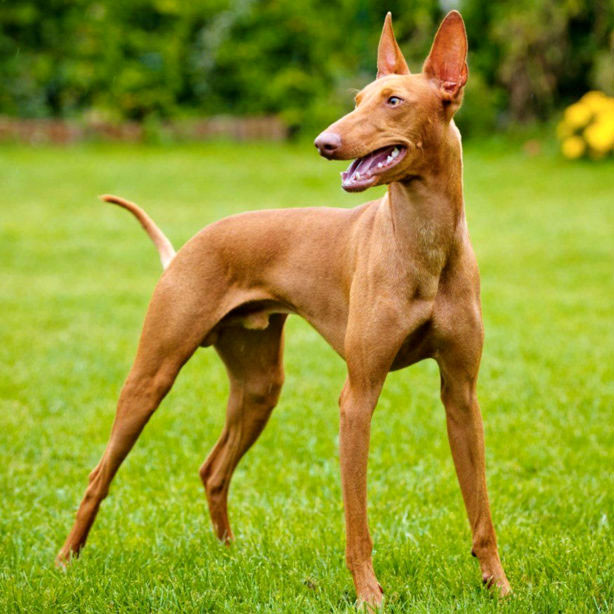
Standard No. 329 is unusually concrete: it fixes not only proportions but angles and centimetres. The head is an elongated truncated cone 21–22 cm long, with parallel cranial-facial axes. The thoracic perimeter exceeds the height at the withers by 5–8 cm. The hock stands about 18 cm from the ground. The angles: scapula-humeral about 110°, humeral-radial about 140°, coxal-femoral about 110°, femoral-tibial about 120°, and the angle of the hock about 130°.
Skull and muzzle: the skull is longer than wide, flat, with a prominent occipital crest; the stop is barely marked. The muzzle is large and prominent, shaped like a blunt cone.
Nose: large, flesh-coloured, in harmony with the colour of the coat, with moderately open nostrils. The standard provides for no pigmentation darker than flesh colour.
Eyes: oblique, small, almond-shaped, more or less dark amber — the intensity depends on the colour of the coat. The expression, in the standard's words, is "intelligent and full of nobleness".
Ears: quite big, broad at their set on and ending in a point. They rise and are carried pricked, slightly divergent, when the dog is excited; at rest they tip backwards.
Body: a strong back with well-developed musculature; the loin a little elongated; the chest well developed but not coming down to the elbow; ribs oval; the underline drawn up, "without being as whippety as the Galgo".
Tail: rather low set, round, reaching a little lower than the hock; carried hanging or raised in a sickle shape; the tip is usually white. A rolled-up tail is listed among the important faults.
Feet and dewclaws: cat-feet, generally slightly turned outwards, with firm oval pads. There are no dewclaws on the hindquarters.
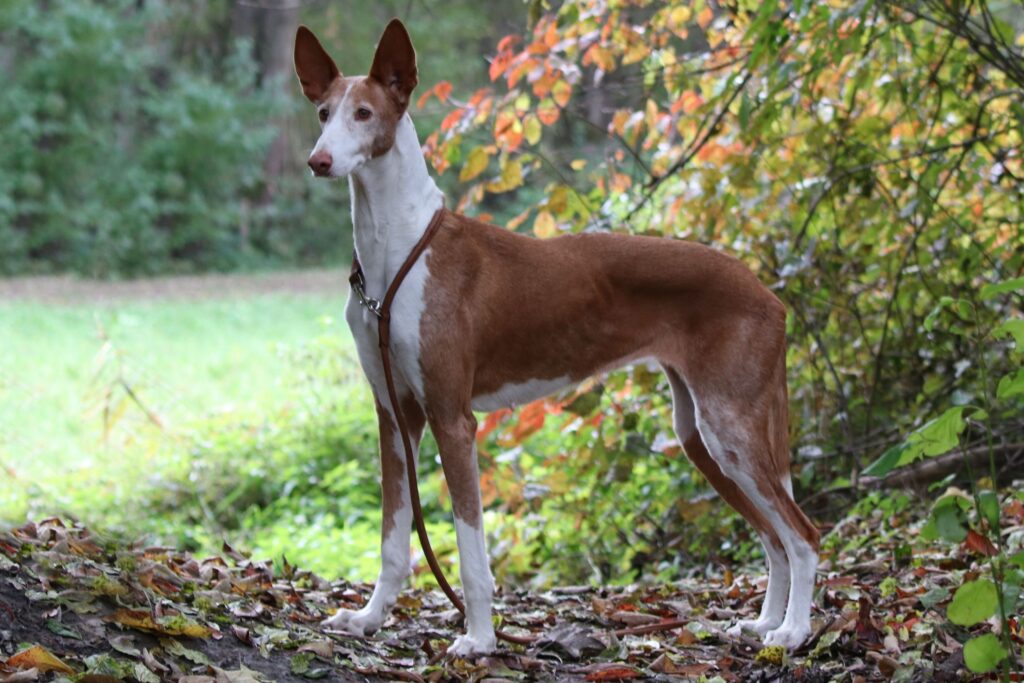
Coat and colour: smooth, short and dense. The colour is "preferably red and white", the red running from orange to dark red (mahogany), and the standard adds: "all combinations of these colours". It establishes no preference for a particolour pattern over a solid one.
Height at withers is given separately by sex: males 55–64 cm, females 53–60 cm. Then comes the paragraph that gets lost in retellings most often: because of the different terrains where the dog lives and hunts, "these average sizes may vary; so one may accept deviations of 2 cm above the maximum size and 2 cm below the minimal size, as long as the subjects in question correspond to the archetype of the breed". This matters to an owner reading the figures: there are two separate scales, one for dogs and one for bitches, not a single combined one. The merged range "53–64 cm" that circulates in breed descriptions describes neither sex — its floor is taken from the females and its ceiling from the males, and no document contains such a range.
The standard sets no weight whatsoever — and that is not a slip of translation but a consistent feature of the documents about this breed. The French edition of the FCI standard heads the section "TAILLE ET POIDS", size and weight, and then gives nothing but centimetres of height. Spain's Royal Decree 558/2001, which contains the official racial prototype, has a section headed "XII. Estatura y peso" — height and weight — and likewise gives only height by sex and the 2 cm tolerance. The UKC standard has a Height section and no Weight section at all. The RSCE breed page does not mention weight once. So the figure of "about 20–25 kg" that circulates in breed descriptions comes not from registry documents but from reference literature and the sites of canine associations that do not maintain this breed; we keep it on the card as a reference figure and label it as exactly that. Note that those sources do not agree among themselves either: one of them, for instance, gives 22 kg for males and 20 kg for females separately.
The faults the standard calls important include a head that is excessively broad, a stop that is too marked, pendulous lips, absence of premolars, prognathism, ears too divergent, a flattened chest, a protruding sternum, a rolled-up tail, hocks that are too low or cow-hocked, and crossing of the fore and hindlegs at the walk. Aggressive or overly shy dogs, and any dog clearly showing physical or behavioural abnormalities, are disqualified.
One detail for anyone who reads the standard in several languages: describing temperament, the Spanish original says Noble, nunca agresivo — noble, never aggressive. The English and French translations render this as "imposing" / "imposant". That is not the same meaning, and on contested points about this breed it is the Spanish text that should be consulted: it is the official authentic language of the standard.
Three registries, three different cards for one breed
Comparing what the registries publish about the Podenco Canario reveals three things worth knowing in advance.
The classification does not agree. The FCI places the breed in Group 5 (Spitz and primitive types), Section 7. The American United Kennel Club, which recognised the Podenco Canario on 1 July 2006, places it in the "Sighthound and Pariah Dog" group — effectively among sighthounds and pariah dogs. These are different systems and neither is "wrong"; but a single sentence beginning "the breed belongs to…" will not do here.
The disagreement over height is only rounding. The UKC gives height in inches: males 21.5–25, females 21–23.5. Convert the FCI centimetres and you get 21.65 · 25.20 · 20.87 · 23.62 inches — the UKC took the same numbers and rounded them to the nearest half inch. That is the same data in a different rounding, not a different opinion about the breed.
The non-numeric field, however, genuinely diverges. The Spanish RSCE breed page prints "Sometida a prueba de trabajo" — subject to a working trial — in its classification line, while the FCI's own nomenclature for the same breed states the opposite: not subject to a working trial. The conflict is not between organisations but between a registry's shop window and the document.
Another example of a fact drifting in retelling comes from that same UKC standard. Its history section reproduces the FCI historical paragraph almost verbatim, hedge intact ("ancestors were probably brought…"), but it renders the description of the work like this: "It hunts rabbits and ferrets by sight, scent and sound." In the FCI original the ferret is not quarry but a working partner: "Is also used in hunting, combined with the ferret, method of hunting authorised on the islands." The hunting rules of the Canary Islands confirm this directly: the current hunting-season order (Orden of 26 June 2025, BOC of 30.06.2025) permits a ferret to be used for rabbit hunting only when it is muzzled and only when the hunter is accompanied by "perros podencos canarios" or other dogs used for furred game.
Temperament and Behaviour
The standard describes the temperament in four words that deserve a literal reading: courageous, nervy, agitated, and of an enthusiastic dynamism; noble, never aggressive; attached with abnegation to his master; stoically putting up with the most rigorous days without the least sign of fatigue. "Nervy" here is not a diagnosis but a working characteristic: a dog that spends the day reading a rock face by nose and ear lives at a high level of readiness.
In domestic life this produces a recognisable portrait. The Podenco Canario attaches itself to its family and can be reserved with strangers — not out of aggression but out of caution. It will not make a guard dog: aggression towards people is atypical for the breed, and it tends to save its voice for a signal. The standard in fact demands the opposite of barkiness — while working by scent the dog must neither give tongue nor seize the game, and those are the dogs that were selected for over centuries.
With other dogs the podenco usually gets on well: it is used to working in a pack. Its hunting instinct, however, is very strong and directed at small moving prey. A cat, a rabbit, a hamster or a guinea pig will be read as work, not as housemates. Living with a cat is possible only with very early and thorough socialisation, and even then they should not be left unsupervised. With children the podenco is usually patient and playful, especially if it grew up with them, but because of the dog's speed and strength an adult should supervise interaction with small children.
Pros and Cons of the Breed
Pros and Cons of the Breed · 6
Pros
Cons
✅ A hardy working dog: the standard describes hunting from dawn to nightfall
❌ Requires very high daily exercise
✅ Works by nose, ear and eye at once — a rare combination
❌ Very strong hunting instinct, dangerous to small animals
✅ Minimal grooming for the short coat
❌ Inclined to follow quarry — a secure fence is essential
✅ Devoted to the family, gentle indoors
❌ Independent in training: bred to work on its own initiative
✅ Not aggressive towards people, usually sociable with other dogs
❌ Not the best choice for an inexperienced owner
✅ Copes well with high temperatures
❌ Copes poorly with cold: no undercoat and thin skin
Training and Socialisation
The Podenco Canario is quick-witted, but training it means working with an independent partner rather than an executor. The breed was selected for centuries to work ahead of the hunter and make its own decisions: to find a rabbit in the crack of a stone wall, to sort out a volcanic tube, and to do it without giving tongue. Such a dog sees no point in obeying a command simply because it was given. Training should be consistent, short, varied and built on positive reinforcement; harsh methods will not deliver and will destroy trust. The Anglo-Russian Hound has similar traits and likewise needs an approach of its own.
Early socialisation is essential. A puppy should be introduced to different people, sounds, surfaces, places and other animals from its first weeks at home — this works directly towards the "nobility without aggression" the standard asks for, and towards reserve rather than fright in unfamiliar surroundings.
The recall deserves separate attention. A dog that has seen or heard quarry will readily ignore any command — that is not disobedience but the very thing the breed was created for. So the recall is trained over years, with a high-value reward, and never against a fresh scent; and letting a podenco off the lead in an unfenced area is not advisable at all. A long line and an enclosed field give the same freedom without the risk.
Care and Housing: What an Owner Should Know
Keeping a Podenco Canario comes down to one line in the standard: this dog "is capable of hunting from dawn to nightfall". It is not a dog that will be happy lying on a sofa all day.
Exercise. The benchmark is at least an hour and a half to two hours of hard movement every day, and that does not mean a quiet walk on the lead. Running alongside a bicycle, long runs, frisbee, lure coursing and the chance to run free in a large securely fenced area all work well. Work for the nose matters just as much: scent games, tracking, kibble scattered in grass. The breed was made to read terrain by scent, and without that work the dog is bored even after a long run. Without enough exercise a podenco becomes destructive, anxious and unmanageable.
Housing. The best option is a house with a large, well-fenced garden. The fence needs to be high — two metres as a guide — and free of anything that can serve as a step: the podenco jumps well, and the standard describes a dog that negotiates rock ledges professionally. Flat living is possible only if the owner is prepared to give up a great deal of time every day to active, lengthy outings.
Grooming. Caring for the short coat is simple: once a week with a rubber brush to lift the dead hair. Bathe as needed; a wipe-down with a damp cloth will often replace a conventional bath. Check and clean the ears regularly — they are large and open, so dust and grass seeds get in easily — and keep the nails short. Check between the toes after walks through dry grass as well.
Heat and cold. The standard notes specifically that the dog endures high temperatures easily, a consequence of selection for work in the Canarian climate. The other side of that coin is cold: a short coat with no undercoat and thin skin is not enough for a northern winter.
The legal status of a hunting dog in the breed's homeland
This is not an abstraction; it determines the fate of many podencos in Spain. The national animal welfare act (Ley 7/2023 of 28 March 2023, in force since 29 September 2023) removes hunting dogs from its own scope in Article 1.3(e): "Likewise excluded shall be hunting dogs, rehalas and auxiliary hunting animals. All of them are regulated and shall be protected by the corresponding European, state and regional rules in force, applicable to them outside this law."
The Canarian regional animal protection act (Ley 8/1991 of 30 April 1991, which remains in force) in turn puts hunting outside its own scope in Article 3.1: the first item on its list of exclusions is "a) Hunting". A working podenco in the Canaries therefore falls outside the coverage of both the national and the regional companion-animal legislation, and its position is governed by hunting rules instead. For a reader considering a dog of this breed from Spain, that is the central practical circumstance: the position of a working podenco is set by hunting law, not by animal welfare law. The same hunting rules, incidentally, cut the other way too: the hunting-season order classes dogs, cats and ferrets as companion animals and excludes feral ones from the list of permitted quarry.
Nutrition
Nutrition: Key Recommendations
Health and risks
Health: Typical Conditions and Prevention
Frequently Asked Questions · 6
Is the Podenco Canario a sighthound? Not under the FCI classification. The breed sits in Group 5 (Spitz and primitive types), Section 7, not in Group 10, the sighthounds. Names such as "Canarian greyhound" are settled usage reflecting outward resemblance rather than classification. The practical difference is real: the standard describes a dog that finds its quarry by nose and ear, not one that merely pursues it by eye.
Does the breed really come from ancient Egypt? That is what the historical section of the FCI standard asserts, and it hedges itself — "probably imported". The studies in which the Podenco Canario took part found no Egyptian roots: the 2023 paper states that none of the breeds examined can be classed as native to Egypt — but the same authors note that their data are not enough to rule out an ancient common relationship entirely. Besides, people settled the Canary Islands in the first centuries of the Common Era, so a permanent island population of dogs cannot be older than that.
What are the height and weight of the Podenco Canario? The standard gives height separately by sex: males 55–64 cm, females 53–60 cm, with a 2 cm tolerance either way. It sets no weight at all; reference books quote about 20–25 kg, and that is a reference figure rather than a normative one.
Can a Podenco Canario live in a flat? In theory yes; in practice only with a very disciplined owner — at least an hour and a half to two hours of hard exercise daily plus work for the nose. The ideal setting is a house with a large, securely fenced garden.
Can a Podenco Canario live with a cat? It is risky. The hunting instinct is very strong and aimed precisely at small moving prey. Cohabitation is possible only if the puppy grew up with the cat from a very early age, and even then they should not be left unsupervised.
Do they shed much, and do they bark a lot? Shedding is minimal: a short coat with no undercoat, and a weekly brush is enough. The podenco is not a barky breed — it gives tongue to flag something unusual, and the standard in fact requires silent work on the scent.
Video about the Breed
FAQ
Is the Podenco Canario a sighthound?
Not under the FCI classification: the breed sits in Group 5 (Spitz and primitive types), Section 7, not in Group 10, the sighthounds. Names such as "Canarian greyhound" are settled usage reflecting outward resemblance. The practical difference is that the podenco finds its quarry by nose and ear rather than only pursuing it by eye.
Does the breed really come from ancient Egypt?
That is what the historical section of the FCI standard asserts, and it hedges itself — "probably imported". The studies in which the Podenco Canario took part found no Egyptian roots; at the same time the authors note their data are not enough to rule out an ancient common relationship entirely. People settled the Canary Islands in the first centuries of the Common Era.
What are the height and weight of the Podenco Canario?
FCI-Standard No. 329 gives height separately by sex: males 55–64 cm, females 53–60 cm, with a 2 cm tolerance either way. It sets no weight at all; reference books quote about 20–25 kg, and that is a reference figure rather than a normative one.