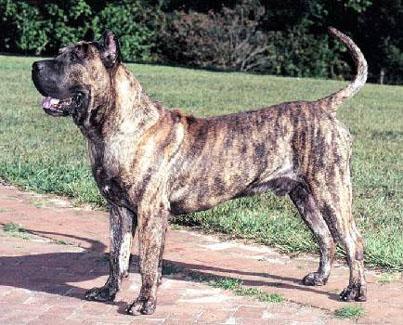
A powerful island guardian with stony calm: confident, devoted, reserved and fearless. The Presa Canario (Dogo Canario) is a powerful molosser of the Canary Islands with its signature black mask; affectionate with its own, it needs a confident owner, early socialisation and firm training.
Apartment · not suitableKidsCats · with caveatsOther dogs · with caveatsBeginners · not suitable
The Dogo Canario, also known as the Perro de Presa Canario, is a breed that embodies power, confidence, and boundless devotion. Its formidable appearance can be deceptive, as behind a stern exterior lies a balanced and calm dog that becomes a gentle friend to its family. However, one should not forget its protective instincts, which make it an unparalleled guardian. This detailed overview will help you understand all the nuances of this unique dog's character, care, and training. Find out more on Tvaryny.
To become the owner of a Presa Canario, you need to possess not only physical strength but also a stable, strong character. This dog requires a leader who can earn its respect and channel its energy in the right direction. Only under such conditions will the Dogo Canario reveal its best qualities and become the most loyal companion one could ever wish for.
Dogo Canario: A Brief Overview of the Breed
Dogo Canario: A Brief Overview of the Breed · 12
Breed Name
Perro de Presa Canario (Dogo Canario)
Country of Origin
Spain (Canary Islands, specifically Tenerife and Gran Canaria)
Period of Emergence
Modern type restored in the 1970s-1980s
FCI Classification
Group 2 (Pinscher and Schnauzer, Molossoid, Swiss Mountain and Cattle Dogs), Section 2.1 (Molossoid, Mastiff type). Standard No. 346.
Purpose
Guard dog, companion, historically – herding and fighting dog.
Lifespan
9–11 years
Height (at withers)
Males: 60–66 cm Females: 56–62 cm
Weight
Males: 50–65 kg Females: 40–55 kg
Temperament
Calm, confident, devoted to family, wary of strangers, strong protective instinct.
Coat Care
Minimal
Activity Level
Medium, requires daily walks and exercise.
Tendency to Drool
Medium to High
The Dogo Canario and Its Relatives
The Dogo Canario belongs to a large family of Molossers, among which there are many interesting breeds with similar, yet unique, traits. For example, it is often compared to another Spanish dog – the Ca de Bou. Although both breeds are guardians, the Ca de Bou is slightly smaller and has a slightly different head shape.
With its protective temperament and robust stature, the Presa Canario shares traits with the South African Boerboel, which was also bred to protect farms. However, the Dogo Canario typically has a more pronounced "stern" appearance. If we compare it to the Dogo Argentino, the latter has an immaculate white coat and was primarily created for hunting large game, which influenced its character. Powerful guardian dogs such as the Anatolian Shepherd Dog are also its "colleagues" in work, although they belong to the group of herding dogs and have a different manner of behaviour. In contrast to these serious guardians, there are also large but good-natured breeds, such as the Landseer, which once again highlights the uniqueness and multifaceted nature of the canine world.
Interesting Facts About the Presa Canario
"Dog Islands": The very name "Canary Islands" comes from the Latin "Insula Canaria," meaning "Island of Dogs," due to the large number of wild dogs that lived there.
Island Symbol: In 1991, the government of the Canary Islands recognised the Dogo Canario as the natural symbol of Gran Canaria.
Two Names – One Breed: There is some confusion with the names "Presa Canario" and "Dogo Canario." Historically, "Presa" (meaning "to seize," "to hold") – is a functional working dog. "Dogo" – is more of an exhibition type. Today, the FCI standard unites them under the name Dogo Canario.
Silent Guardian: The Dogo Canario is not prone to barking without reason. It only makes its presence known when it deems it absolutely necessary, and its deep, low bark is very convincing.
Film Star: Dogs of this breed have appeared in several films, including "Ocean's Eleven," where they demonstrated their impressive appearance.
History of the Dogo Canario's Origin
The history of the Dogo Canario is deeply rooted in ancient times and is inextricably linked to the Canary Islands, which, according to one version, received their name precisely because of the large dogs (from Latin canis – dog) that lived there. It is believed that the ancestors of today's Presa Canario were the local "Majorero" dogs (Bardino Majorero), which were crossed with Molossers brought to the islands by Spanish conquistadors.
For centuries, these dogs were used for guarding livestock, protecting property, and even for dog fighting, which was popular in Europe until the mid-20th century. It was specifically for fighting that the blood of English Bulldogs and Mastiffs was added to the local dogs, which gave the breed even greater ferocity, power, and the characteristic brindle colouring. When dog fighting was officially banned in Spain in the 1940s, the popularity of the Dogo Canario sharply declined, and the breed found itself on the verge of extinction.
The revival began only in the 1970s, thanks to the efforts of a group of enthusiasts and breeders led by the renowned American cynologist Dr. Carl Semencic, who "discovered" these dogs for the world. Spanish breeders actively worked to restore the population, selecting the best representatives that had survived on farms. In 1989, the breed received official recognition in Spain, and in 2001, it was provisionally recognised by the Fédération Cynologique Internationale (FCI), gaining full recognition in 2011. Today, the Dogo Canario is the national symbol of Gran Canaria.
Breed Standard and Appearance
The Dogo Canario is a medium-sized Molosser, with straight lines and a proportionate build. Its appearance exudes strength and confidence. It is a functional dog, whose body structure is ideally adapted for guarding.
Head: Massive, compact, cuboid in shape (brachycephalic type). The skull is broad and flat. The stop is pronounced, but not abrupt. The muzzle is short, approximately 40% of the total head length, with a broad base. The lips are thick, but not overly pendulous.
Eyes: Slightly oval, medium to large in size. Colour – from dark chestnut to medium chestnut, depending on the coat colour. The gaze is calm, but attentive and stern.
Ears: Medium-sized, set wide apart. If the ears are not cropped, they hang naturally at the sides of the head. In countries where it is permitted, ears may be cropped to give a more imposing appearance and to prevent injuries.
Body: Rectangular, slightly longer than the height at the withers. The neck is strong, muscular, with a double dewlap. The topline is straight, the croup slightly raised. The chest is broad and deep, ensuring a large lung capacity.
Tail: Thick at the base, tapering towards the tip. At rest, it hangs down; in motion, it rises in a saber shape.
Coat: Short, harsh, without undercoat, tightly adhering to the skin. Slightly rough to the touch.
Dogo Canario Colouring
Colouring is one of the characteristic features of the breed. An obligatory element is the black mask on the muzzle, which should not rise above eye level.
Colour Type
Description
Brindle
All shades from warm dark brown to very light grey or fawn. The main colour is fawn or sandy, with transverse dark stripes.
Fawn
All shades, from intense sandy to light deer-fawn.
Sandy (Arenado)
Light shades of fawn.
White markings on the chest, throat, base of the neck, and on the toes are permissible, but they should be as minimal as possible.
Character and Temperament of the Presa Canario
The Dogo Canario's character is a unique combination of calmness and imposing strength. It is a dog with an innate sense of dignity and a balanced psyche. It never shows aggression without reason, but is always ready to defend its territory and family.
Relationships with Family: For its owners, the Presa Canario is a gentle and obedient companion. It forms deep bonds with all family members and treats them with great affection. This dog can be surprisingly patient with children it has grown up with, perceiving them as part of its "pack". However, due to its size and strength, any interaction with small children should be supervised.
Attitude Towards Strangers: The Dogo Canario is naturally wary of strangers. It will not bark unnecessarily, but its low, deep bark is a serious warning to anyone approaching its territory. It observes strangers carefully and only reacts in the event of a real threat.
Interaction with Other Animals: Early and proper socialisation is key for this breed. Dogo Canarios can show dominance and even aggression towards other dogs, especially those of the same sex. It is necessary to accustom the puppy to interacting with other animals from a young age to avoid problems in the future.
Not suitable for beginners. Requires an experienced and confident owner.
Devotion to family. Very gentle and loving with its own.
Requires intensive socialisation. Without it, can be aggressive towards strangers and animals.
Stable psyche. Balanced and calm, not prone to hysteria.
Strong and stubborn. Can be difficult to train if leadership is not established.
High intelligence. Learns quickly if the right approach is found.
Tendency to dominate. Will constantly test boundaries.
Simple coat care. Does not require frequent grooming.
High need for physical exercise. Cannot thrive without active walks.
Good health. Rarely gets ill with proper care.
Drooling. Like many Molossers, can drool.
Training and Education: How to Find the Right Approach
Training a Dogo Canario is a process that requires patience, consistency, and a deep understanding of the breed's psychology. The main rule is – you must become an undisputed leader for the dog, whom it will trust and respect. This must be done not through force and cruelty, but through confidence and fairness.
Early socialisation is the foundation for raising a well-adjusted urban dog. From 2–3 months of age, the puppy should be introduced to various sounds, places, people, and calm, well-behaved dogs. This will help it grow up confident, rather than timid or aggressive.
During training, use positive reinforcement methods (treats, praise), but be firm in your demands. Dogo Canarios are very intelligent and quickly understand what is required of them, but their stubbornness can be an obstacle. Sessions should be short, interesting, and regular. The owner must be prepared for the fact that this dog's character develops slowly, sometimes up to 2–3 years of age.
Care and Maintenance
Despite its size, the Dogo Canario does not require complex care. The main thing is to provide it with proper living conditions and a sufficient level of activity.
Living Conditions: The ideal option for a Presa Canario is a private house with a well-fenced area where it can roam freely. Keeping it in a flat is possible, but only on condition of daily long and active walks (no less than 2 hours a day). This dog is not suited for life on a chain.
Grooming: The short coat does not require special care. It is sufficient to brush it once a week with a rubber brush to remove dead hairs. The dog should only be bathed when necessary, 1–2 times a year, using special shampoos for short-haired breeds.
Ear, Eye, and Nail Care: Regularly inspect the ears and eyes for dirt or inflammation. Trim the nails every 3–4 weeks if they do not wear down naturally.
Nutrition
Dogo Canario Feeding: Key Recommendations
Health and risks
Health and Typical Diseases of the Breed
Frequently Asked Questions About the Breed (FAQ) · 5
Is the Dogo Canario suitable for a beginner? No, absolutely not. This is a breed for experienced owners who understand the psychology of dominant dogs and are ready to dedicate a lot of time to education, training, and socialisation. A beginner simply will not cope with its strength and character.
How much does a Dogo Canario puppy cost? The cost depends on the parents' pedigree, their titles, and the kennel's reputation. One should be wary of overly cheap offers, as this may indicate health or documentation issues. Expect to wait: established breeders have their litters spoken for well in advance.
Do they drool a lot? Yes, like most Molossers with massive jaws, Dogo Canarios are prone to drooling, especially after drinking, eating, or during hot weather. Future owners should be prepared for this.
How does the Dogo Canario get along with children? With its own children, with whom it has grown up, the Dogo Canario is usually very gentle and patient. However, due to its enormous size and strength, any interaction with children must be strictly controlled. Such a large dog should not be left alone with a small child.
Can a Dogo Canario be kept in a flat? It is possible, but highly undesirable. A dog of this size and energy needs space. If you do decide to keep it in a flat, be prepared for daily, very long (2–3 hours) and intense walks in any weather, so that the dog can expend its energy.
Video about the Breed
FAQ
Is the Presa Canario suited to a novice?
No — a strong, dominant guarding molosser; it needs experience, confident training and early socialisation to channel the guarding instinct.
Is the Presa Canario aggressive?
Towards the family, devoted and reserved; the guarding instinct makes it wary of strangers. Without proper training and socialisation, the breed's strength is dangerous.
Is the Presa Canario good with children?
With its own family, yes — it is devoted and level-headed; because of its strength, supervision with small children and early socialisation are needed.