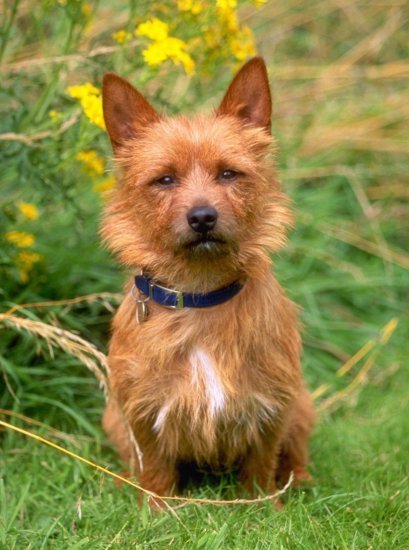
A small Australian daredevil with inexhaustible energy — lively, clever and devoted: cheerful, friendly to its own and a fearless ratter. The Australian Terrier is a compact, short-legged terrier bred to tackle vermin and snakes; a joyful family friend for active people, it hides real terrier spark and feistiness toward other animals beneath a cute exterior.
ApartmentKidsCats · with caveatsOther dogs · with caveatsBeginners
The Australian Terrier is a small but courageous dog with a huge heart and an endless supply of energy. This spunky and clever companion is a wonderful addition to any family, bringing joy and fun into the home. These dogs are incredibly loyal and friendly to their owners. It's impossible to be bored with them around, as they always find a way to entertain you. Their active and playful nature makes them a perfect fit for people who lead an active lifestyle. However, behind that cute exterior lies a true terrier—fearless and sometimes scrappy with other animals, so walks require extra attention. You can find out more about the breed later in this article, and even more on Tvaryny.
They love to play, dig holes (it's their instinct!), and be the center of attention. Australian Terriers are generally good with children, especially older ones, but they demand to be treated with respect. For this reason, it’s a good idea to get one when your kids are old enough to understand how to behave around animals. This little hunter was bred to work on farms and still retains its working qualities, making it an excellent watchdog that will always alert you to strangers with a loud bark.
Australian Terrier: Key Breed Information
Australian Terrier: Key Breed Information · 12
Breed Name
Australian Terrier
Country of Origin
Australia
Time of Origin
19th Century
FCI Recognition
Group 3 (Terriers), Section 2 (Small-sized Terriers). Standard No. 8.
Life Span
12–15 years
Height at the Withers
9–11 inches (23–28 cm)
Weight
13–18 lbs (6–8 kg)
Temperament
Energetic, brave, clever, loyal, alert, stubborn
Primary Purpose
Companion, hunter of small rodents and snakes
Coat Care
Moderate, requires regular brushing
Shedding
Minimal
Activity Level
High
Fun Facts About the Australian Terrier
First National Breed. The Australian Terrier was the first dog breed developed and officially recognized in Australia.
Snake Slayer. One of the main "jobs" of these terriers on farms was not only to catch rats but also to hunt dangerous venomous snakes, a task they excelled at thanks to their agility and bravery.
Protective "Ruff." The thick and harsh hair around their neck forms a kind of ruff, which protected the dog from snake and rodent bites during encounters.
The Topknot. The soft topknot on their head, which contrasts with the harsh hair on their body, not only gives them a cute look but also protects their eyes from dust and sun.
Two Colors. The breed has two main coat types: blue and tan, and solid sandy or red. Interestingly, blue-colored puppies are born almost black.
History of the Australian Terrier
The history of the Australian Terrier is closely tied to the European settlement of the Australian continent in the 19th century. The colonists needed a small yet resilient and fearless dog capable of protecting farms and mining settlements from rats, mice, and, most importantly in Australia, venomous snakes. The foundation for this new breed was built on various terrier types imported from Great Britain.
It's believed that ancestors of breeds such as the Cairn Terrier, Skye Terrier, Dandie Dinmont Terrier, and also the Irish and Yorkshire Terriers were involved in the selection. From each of them, the Australian Terrier inherited the best traits: courage, a sturdy build, a harsh coat that protects against bad weather and bites, and a tireless hunting instinct. The Yorkshire Terrier likely had a special influence, giving the Aussie its characteristic blue-and-tan coat. However, unlike its more decorative cousin, the Australian Terrier has retained its working qualities and a more robust build.
The first records of dogs resembling modern Australian Terriers date back to the 1820s. Initially, they were called "Rough Coated Terriers." The breed quickly gained popularity in Australia due to its versatility and lack of fuss. In 1887, the first breed club was founded in Melbourne, and by 1899, its official standard was approved. The Australian Terrier became the first breed to be officially recognized in Australia. International recognition came later: the British Kennel Club recognized the breed in 1933, and the American Kennel Club in 1960. Today, the Australian Terrier is not a widely known breed outside of its homeland, but it is valued for its wonderful character and loyalty.
Breed Standard and Appearance
The Australian Terrier is a sturdy, low-set dog of a longer-than-tall build, who looks much stronger than his small size would suggest. His appearance indicates endurance and a readiness to work. The main feature is the harsh, straight coat that forms a characteristic "ruff" around the neck and an "apron" on the chest.
Breed Standard and Appearance · 12
Body Part
Description According to the FCI Standard
General Appearance
A sturdy, low-set dog of a longer-than-tall build, with a characteristic terrier expression.
Head
The skull is long, flat, and of moderate width. The stop is defined but not abrupt. The muzzle is strong and powerful, equal in length to the skull.
Nose
The nose is black and small in size.
Eyes
Small, oval-shaped, and dark brown. Set wide apart. The eyes have a keen and intelligent expression.
Ears
Small, erect, pointed, and free of long hair. Set high on the skull and mobile.
Bite
Scissor bite. Jaws are strong.
Neck
Strong, of good length, slightly arched, and smoothly transitioning into the shoulders.
Body
The back is straight, and the top line is level. The chest is moderately deep and broad. The loin is strong.
Tail
Traditionally docked. In countries where this is prohibited, it remains a natural length. Set high and carried vertically.
Limbs
Forelegs are straight and parallel, with well-developed bone. Hind legs have well-developed muscles and moderate angulation. Feet are small, cat-like, with strong black nails.
Coat
Double: a harsh, straight, and dense outer coat about 2.5 inches (6 cm) long, and a short, soft undercoat. The hair on the muzzle, lower part of the limbs, and feet is short. There is a characteristic topknot on the head.
Color
Blue and Tan: Steel-blue or dark gray-blue with rich tan markings on the face, ears, underside of the body, and legs. Solid Sandy or Red: Any shade from sandy to red. White patches on the chest or feet are a fault.
Character and Temperament
The Australian Terrier's character is a vibrant mix of courage, intelligence, stubbornness, and boundless loyalty. This is truly a "big dog in a small body." They are incredibly sociable and love being the center of their family's attention. They are ready to participate in all household activities, whether it's watching TV or working in the garden. At the same time, they are very alert and always ready to announce the arrival of guests with a loud bark, which makes them excellent watchdogs.
Aussies are very smart and quick to learn, but their innate independence and stubbornness can be a challenge for an inexperienced owner. They were bred to make their own decisions, so don't expect blind obedience. Their hunting instinct is very strong. They will fearlessly chase cats, squirrels, and other small animals. This hunting passion is what makes them similar to tireless hunters like the German Hunting Terrier, although the Aussie is more geared towards a companion role.
Relations with other dogs can be tense. Australian Terriers are prone to dominance and will not back down from a fight, even if the opponent is much larger than them. Early and proper socialization is critically important for this breed. On the other hand, they can coexist peacefully with dogs they grew up with. Despite their energy, they are not as hyperactive as some other terriers. If you compare them, for example, to the more family-oriented Soft Coated Wheaten Terrier, the Aussie has more pronounced "guard dog" and hunter traits. They are devoted to one owner or family and can be somewhat wary of strangers.
Australian Terrier Pros and Cons
Australian Terrier Pros and Cons · 6
✅ Pros
❌ Cons
Compact Size: Ideal for apartment living.
Prone to Barking: Can be very "vocal" watchdogs.
Loyalty and Love for Family: Becomes a true member of the family.
Stubbornness and Independence: Requires patience in training.
Low Shedding: The harsh coat sheds very little with proper care.
Strong Hunting Instinct: May chase cats and other small animals.
Good Health: no one has studied this breed systematically, so no list of hereditary diseases exists for it — that is a gap in the data, not evidence of health.
Requires Early Socialization: Can be aggressive towards other dogs.
High Intelligence: Quickly learns new information.
Tendency to Dig: Can turn your yard into a digging field.
Excellent Watchdog: Always alerts you to danger.
Requires Significant Physical Exercise: Not suitable for inactive people.
Training and Socialization
Training this breed is an interesting but also challenging task. Their sharp minds allow them to quickly grasp commands, but their innate stubbornness makes them constantly test their owner. The key to success is patience, consistency, and positive reinforcement. Training sessions should be short, dynamic, and fun; otherwise, the dog will quickly get bored and refuse to cooperate. For treats and praise, the Australian Terrier is willing to do a lot.
It's very important to establish clear rules and boundaries from day one. This dog needs to understand who is in charge. Early socialization is absolutely essential. Introduce the puppy to different people, sounds, places, and other (well-behaved) dogs. This will help you raise a balanced and self-confident dog. Their stubbornness and hunting instincts are very similar to the traits of other small terriers, such as the Australian Silky Terrier, which, by the way, is a close relative but with a more decorative appearance and a softer coat.
It is practically impossible to train them to not chase cats—it's an instinct ingrained over centuries. Therefore, it's best to keep your dog on a leash during city walks. They are also prone to fighting with other dogs, so they need constant supervision at dog parks. Obedience training and dog sports will help you build a bond with your pet and make them more manageable.
Care and Maintenance
The Australian Terrier is a fairly low-maintenance dog, but its care has its own specific features related to its coat, energy level, and temperament.
Grooming. The Australian Terrier's harsh coat doesn't require complex care, but it does need regularity. It should be brushed 2–3 times a week with a metal comb to prevent tangles and remove dead hair. You should only bathe the dog when it's dirty, as frequent washing can dry out the skin and make the coat too soft. Important: This breed's coat should not be clipped with clippers, as this spoils its texture and color. To maintain the proper texture, professional hand stripping (plucking out dead hair) is recommended 2–4 times a year.
Physical Exercise. This is a very energetic breed. They need daily long walks (at least 1–1.5 hours a day) with the opportunity to run off-leash in a safe area. Aussies love active games, fetching, and frisbee. They also excel in dog sports like agility or obedience, which helps channel their energy and intelligence in a positive direction.
Living Conditions. Thanks to their compact size, Australian Terriers adapt well to apartment life, provided they get enough daily exercise. However, the ideal option for them would be a house with a securely fenced yard. The fence must not only be high but also buried deep in the ground, as these dogs are master diggers and can easily tunnel their way out.
Nutrition
Nutritional Recommendations
Health and risks
Health and Hereditary Diseases
Frequently Asked Questions (FAQ) · 5
Does the Australian Terrier shed a lot? No, this is a low-shedding breed. With regular brushing (2–3 times a week) and periodic hand stripping, the amount of hair in the house will be minimal. This makes them a good choice for people with allergies.
Is the Australian Terrier suitable for families with small children? They can get along well with children, especially if they grow up together. However, they are best suited for families with older kids (7–8 years and up) who understand how to handle a dog properly and respectfully. Due to their terrier nature, they will not tolerate rough handling.
Can they live in an apartment? Yes, Australian Terriers adapt well to apartment life. The main condition is providing enough daily physical and mental exercise. Without it, they can become destructive and noisy.
Do they get along well with other pets? It's tricky. They have a very strong hunting instinct, so cats, hamsters, rabbits, and other small animals are potential prey for them. Coexistence is only possible with very early socialization. They can also conflict with other dogs over dominance, so introductions should be gradual and supervised.
How much does an Australian Terrier puppy cost? The cost of an Australian Terrier puppy from a professional breeder can vary significantly. The price depends on the pedigree, the parents' titles, the kennel's reputation, and the region. A cheap puppy sold without papers almost always costs more in the end: the screening the parents never had shows up later at the vet.
Video About the Breed
FAQ
Is the Australian Terrier good for a family?
Yes — a cheerful, devoted dog, friendly to its own people and good with children, ideal for active families; the keys are attention and activity.
Does the Australian Terrier get on with other animals?
With care — beneath the cute exterior is a true ratter, fearless and at times feisty with other animals; walks near small animals need attention.
Is the breed suited to a novice?
Yes — a clever, quick-to-learn and compact dog, comfortable in an apartment too; the key is to channel the terrier spark through training.