


| Height | 30–42 cm |
| Weight | 12–18 kg |
| Lifespan | 12–15 years |
| FCI group | not FCI-recognized (German local type) |
| Origin | Germany (Black Forest) |
Exact ratings
Common health issues
Nutrition
The Wälderdackel, also known as the Schwarzwälder Bracke or Forest Dachsbracke, is a unique breed of scent hound that was developed and remains most common in the mysterious Black Forest (Schwarzwälder) region of southern Germany. This dog is a skilled hunter capable of tracking a blood trail and flushing birds for the gun, but with the right approach, it can also become a devoted, albeit stubborn, family pet. learn more on Tvaryny.
The Wälderdackel: a brief breed overview
| Origin | Germany (Black Forest region) |
| First mentioned (standard) | 1987 (founding of the association) |
| Group | Scent hounds, Dachshunds (not FCI recognized) |
| Life span | 12-15 years |
| Height at withers | 10-16 inches (26-40 cm) |
| Weight | 17-33 lbs (8-15 kg, depending on type) |
History of the breed: from Celts to modern times
The origins of the Wälderdackel are tightly interwoven with the history of the Black Forest region itself. The breed has deep roots in practical application, yet it hasn’t received broad international recognition as a separate breed to this day, remaining a local treasure for German gamekeepers. Within the large family of German dachshunds, it is just one of many varieties that has preserved its authenticity thanks to the region’s isolation.
About thirty years ago, in 1987, a specialized society was founded to promote the breeding of the Wälderdackel. The organization’s goal was to preserve the unique genotype of the “forester’s dog.” Interestingly, since white spots often appear in the Wälderdackel’s coat (which is considered a fault in standard dachshunds), cynologists see the ancient Celtic Bracke among its ancestors. This links them to other ancient European breeds.
Selection was carried out rigidly and pragmatically: weak dogs, unable to withstand hours of traversing mountainous terrain or working in cold weather, were weeded out. Only the most resilient remained. Unlike the situation with the show Dachshund, which is often bred as a couch-loving pet, the Wälderdackel avoided decorative degeneration. Today, the local distribution of the breed doesn’t limit its representatives solely to the role of a four-legged hunter. The Wälderdackel has established itself as an excellent family dog for active people, though it is still greatly loved and valued by rural rangers.
What the Wälderdackel looks like: detailed description
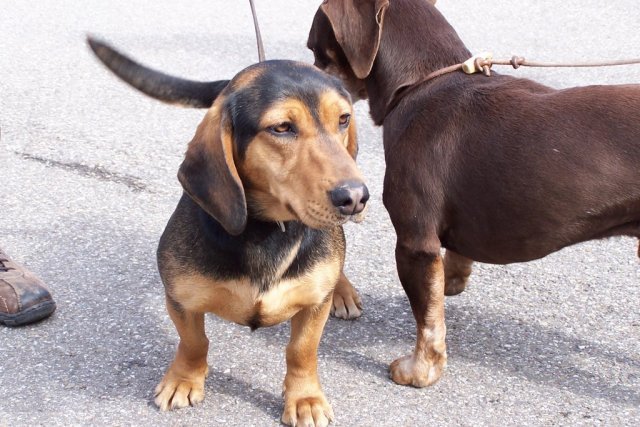
The specific appearance of the dachshund, thanks to which it cannot be confused with any other dog, has its own peculiarities in the Black Forest variety. These four-legged helpers were bred for centuries for combined hunting: both above ground and in burrows. Consequently, the Wälderdackel is a lively, low-slung dog with short but sturdy limbs and an elongated muscular body.
Here are the main exterior characteristics:
- Head: Oval shaped, proportional to the body. The muzzle is elongated, providing the excellent sense of smell necessary for tracking work.
- Ears: Soft, broad, hanging down, fitting closely to the cheekbones. This protects the ear canal from debris and branches while working in thick undergrowth.
- Eyes: Almond-shaped, dark, revealing an intelligent, attentive, and sharp gaze.
- Tail: Long, thick at the base and tapering toward the end. The dog carries it happily but does not curl it over the back.
- Coat: Short, dense, fitting closely to the body, with a well-developed undercoat that protects against bad weather.
The coloring can be very diverse, distinguishing them from the strict standards of other clubs. Chocolate, honey, and red colors are permitted, often with white markings on the chest, paws, and muzzle (a “mask”), as well as brindle and black-and-tan variants.
Character: temperament and behavioral traits
The Wälderdackel’s character is a complex cocktail of hunting passion, boundless loyalty, and innate stubbornness. They tend to bond strongly with one owner (usually the one who hunts or walks with them), yet they happily welcome guests and the rest of the family.
Relations with family and children
These dogs get along well with other household pets, especially if raised together. They are inquisitive and interested in everything new. However, they are not often recommended for families with very small children. The reason lies in their willful behavior and the vulnerability of the dog’s long spine – a child’s careless play could cause the animal pain, to which the dachshund might react aggressively in self-defense.
Guard qualities
This hunting breed fears nothing and is ready to courageously enter a fight even with an opponent that exceeds it in size. Of course, this is no Kunming Wolfdog, created for serious police work and detaining intruders, but the Wälderdackel can fulfill the duties of a “doorbell”: an observant watchman with a loud voice. Their ringing bark can be heard at the slightest, even insignificant excuse. The dog is distrustful of strangers and reacts loudly to any suspicious noise behind the door.
Hunting qualities of the Wälderdackel
It is on the hunt that this dog truly reveals its full potential. In the dense forests of the Schwarzwald, versatility is required of a dog. If the Hanoverian Scent Hound specializes exclusively in the blood trail of ungulates, then the Wälderdackel is a jack-of-all-trades (or rather, paws).
| Type of hunting | Specifics of the Wälderdackel’s work |
|---|---|
| Burrow hunting | Thanks to its small size, it penetrates fox and badger burrows, flushing the beast out for the shot. |
| Tracking work (Schweißarbeit) | Has an excellent nose, capable of following an old blood trail of a wounded animal (boar, deer). |
| Driven hunt (Stöberjagd) | Works with voice, pursuing hare or roe deer, driving them toward the line of shooters. The loud barking allows the hunter to orient themselves in the thick forest. |
This dog works “with voice” (spurlaut), which is critically important for dense woodland. The hunter always knows where the dog is and in which direction the game is moving.
Health and typical diseases: what to look out for
Caring for the breed
At work, the Wälderdackel adapts easily to any terrain, and in domestic life, it proves to be a fairly undemanding, “Spartan” dog. However, it cannot be called a classic apartment dweller for whom a 15-minute walk is sufficient. Unlike calmer, exotic breeds such as the Cretan Hound, the Wälderdackel requires active work for its nose and muscles.
Hygiene and coat
The short coat of this active pet is cleaned just once a week with a special mitt or brush. This helps remove dead hair and massage the skin. Ears require regular inspection and care: cleaning the visible part of the ear canal with a lotion recomended by a veterinarian. Hanging ears are poorly ventilated, so fungal infections often develop there.
It is important to trim the Wälderdackel’s nails every two weeks if they are not worn down naturally on asphalt or stones. Long nails lead to improper paw posture, which in turn ruins the gait and strains the joints.
Safety at home
In the family circle, the Wälderdackel displays its playful nature, but it is important to ensure the dog does not overexert itself with vertical jumps. The peculiarities of the Wälderdackel’s spine may react with disc displacement to a sudden jump from a sofa. Therefore, it is best to place a special inclined plank – a ramp – next to a high armchair or bed that the dog is allowed to climb on.
Training and socialization: taming the temper
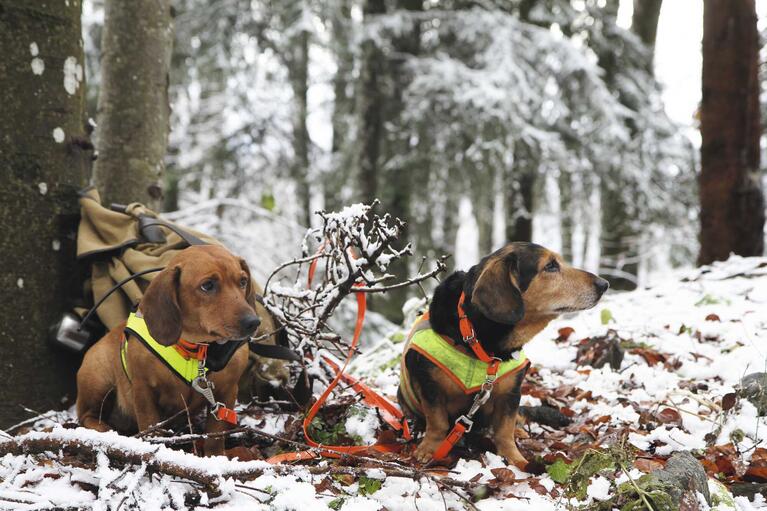
You shouldn’t take the education of a Wälderdackel lightly, thinking that the dog’s small size makes it harmless. The breed has good potential for coexisting with humans, but developing this will require persistent effort from the owner. Training sessions with the pet should be conducted regularly, not just on occasion.
Representatives of the Wälderdackel breed respond to training in a specific way. They are smart but have no desire to obey blindly. A hunting dog, accustomed to making independant decisions in a burrow face-to-face with a predator, will rely more on its own instincts than on mechanical commands from the master.
Tip: If it is not possible to entrust the dog to a professional breed-specialist, you will have to find strong motivation. The positive reinforcement method works best. Harshness with a dachshund will only lead to the dog withdrawing into itself or starting to snap.
When the owner runs out of patience, it is better to handle the pupil’s behavior with humor rather than irritation. Remember that the dachshund’s stubbornness is the flip side of its courage.
Nutrition: key recommendations
Pros and cons of the breed
Before getting a Wälderdackel, it is worth weighing all the pros and cons, as this dog will not suit everyone.
Pros:
- Compactness: Convenient size for transport and keeping in the house.
- Health: With proper care, they live a long time (up to 15-16 years).
- Intelligence: Very sharp and inventive dogs.
- Versatility: An excellent companion for vacationers, mushroom pickers, and hunters.
Cons:
- Loudness: They love to bark, often without serious cause.
- Stubbornness: Difficult to train for novices.
- Hunting instinct: May run off after a cat or squirrel, ignoring commands. They dig holes in the yard.
- Back health: Require caution and prevention of spinal problems.
Interesting facts about the Wälderdackel
- Name: The word “Bracke” in the name indicates a relationship with hounds, although outwardly the dog looks more like a dachshund. It is a unique hybrid of functionality.
- Weather: Unlike smooth-haired standard dachshunds, which get cold, the Wälderdackel is better adapted to snow and rain thanks to the denser undercoat and harsher coat characteristic of this type.
- Singing: Many owners note that these dogs don’t just howl, but “sing,” changing the pitch of their voice when they hear music or a siren.
Frequently Asked Questions (FAQ)
Is the Wälderdackel suitable for an apartment?
Yes, but only on the condition of long walks (minimum 1.5 – 2 hours a day) and active games. Without exercise, the dog may start ruining furniture.
Do they shed?
Yes, shedding is moderate and seasonal (spring/fall). The hair is short but sharp like needles, so it can get stuck in upholstery.
Can they be let off the leash in the city?
It is categorically not recommended. Upon seeing a hunting object (even a plastic bag flying in the wind), the dachshund can “turn off its ears” and run straight under a car.
- An excellent nose, a master of the blood trail
- Hardy and undemanding
- Devoted, even-tempered with the family
- Robust health overall
- Headstrong, independent at work
- A strong hunting instinct
- Loud — gives tongue on the trail
- A long back — protect from strain (IVDD risk)
| Alpine Dachsbracke | Westphalian Dachsbracke | Drever | |
|---|---|---|---|
| Height | 34–42 cm | 30–38 cm | 30–38 cm |
| Energy | 3.5 | 4 | 3.5 |
| Apartment | 2.5 | 2.5 | 2.5 |
| Beginners | 2.5 | 2.5 | 3 |
Why is the breed called a “forest dachshund”?
Is the breed officially recognized?
Is the Forest Dachsbracke suitable for a family?
German local type (Schwarzwälder Bracke / Wälderdackel)
For apartments · For kids · For beginners · Active · Smartest · Hypoallergenic · All rankings →