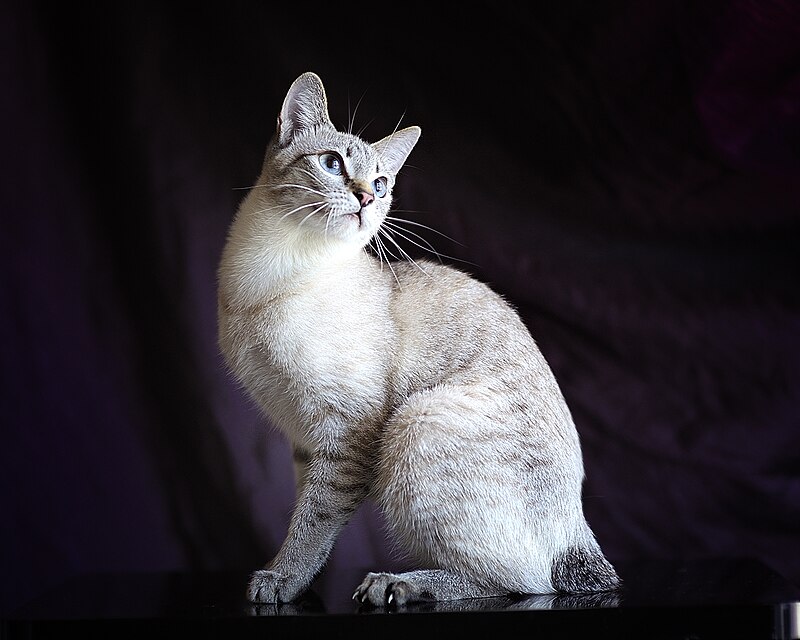
Southeast Asia (Thailand and neighboring countries); standardized in Russia
Mekong Bobtail
A blue-eyed point with a “pom-pom” tail and a dog's soul — clever and devoted: active, sociable, “dog-like” and people-oriented. The Mekong Bobtail is a natural Asian aboriginal breed with colorpoint markings and its signature short “pom-pom” tail; strong, clever and healthy, it bonds deeply with its family, loves fetch and a leash, catches mice beautifully and behaves more “dog-like” than cat-like.
“Healthy” here means no mass syndrome, not no risk
Sociable, good with children and dogs
The short coat needs almost no care
Cons
Active — needs play and attention
Dislikes being left alone for long
Keeps its hunting instinct
Attached — needs company
Size
ToySmallMediumLargeGiant
Compatibility
KidsDogsOther catsBeginnersTime alone · with caveats
The Mekong Bobtail isn't just a cat with an exotic name and a unique short tail. This breed boasts an ancient history tracing back to the royal palaces of Siam and possesses a one-of-a-kind, almost "dog-like" personality. With their striking blue, almond-shaped eyes and classic colorpoint coat, these elegant felines captivate with their loyalty, intelligence, and sociable nature. Unlike many other breeds, the Mekong Bobtail has retained traits from its aboriginal ancestors, including robust health and a long lifespan. They are active, playful, easy to train, and eager to be full-fledged family members, following their humans around and getting involved in everything. Their short coat, with virtually no undercoat, requires minimal grooming, making them even more appealing companions. To find out more about these fascinating felines, check out Tvaryny!
Mekong Bobtail: A Quick Breed Overview
Mekong Bobtail: A Quick Breed Overview · 11
Characteristic
Description
Origin
Southeast Asia (Thailand and neighboring countries); standardized in Russia
Date of Origin / Recognition
Ancient aboriginal breed; WCF recognition — 2004
Lifespan
15–18 years (often 18–20+)
Height at Withers
~10–12 inches
Weight
Females 7.5–10 lbs; males 9–13 lbs
Temperament
Very intelligent, "dog-like" character: loyal, sociable, playful, curious, affectionate, communicative
Grooming
Very low (minimal brushing)
Activity Level
Moderate / High
Tail
Short ($\le$ ¼ body length), with kinks / knots; unique pattern for each cat
Compatibility with Kids
Good
Compatibility with Other Pets
Good (with proper socialization)
What Does a Mekong Bobtail Look Like?
The Mekong Bobtail is a medium-sized cat, elegant yet muscular and sturdy, with the characteristic features of oriental cats but without the extremes of modern Siamese.
Body: Medium length, rectangular, sleek but muscular with a sturdy bone structure. The back is nearly straight, with the hindquarters slightly raised.
Legs: Medium height, slender with oval paws. The hind legs are slightly longer than the front legs. A distinctive trait: The skin on their back paws doesn't adhere tightly, so their claws don't fully retract and may make a "clicking" sound when they walk on hard surfaces.
Tail: Short (no more than 1/4 of the body length), composed of a combination of bends and kinks, covered in fur that can form a "pom-pom" or "tuft" at the end. Unique to each cat.
Head: A soft, modified wedge shape with rounded contours. The top of the head is nearly flat. The profile has a gentle curve just below eye level (a "Roman" nose). The muzzle is oval with a strong chin.
Ears: Large, wide at the base, set high and relatively wide apart, slightly tilted backward with rounded tips.
Eyes: Large, almond-shaped or "lemon-shaped" (the upper lid is almond-shaped, the lower is rounded). They are set slightly slanted. The color is an intense blue; the brighter, the better.
Coat: Short, glossy, and silky, lying close to the body with virtually no undercoat. It may feel cool to the touch.
Color:Only colorpoint. This means a light body with darker markings (points) on the face (mask), ears, paws, and tail. All known point colors are acceptable: seal point (dark brown), blue point (bluish-gray), chocolate point (milky-chocolate), lilac point (pinkish-gray), red point (red), cream point (creamy), as well as tortoiseshell variations (tortie point). Important: The breed standard does not allow any white spots or medallions.
Grooming a Mekong Bobtail is very simple, making them an excellent choice for busy people.
Coat Care: The short, close-lying coat with almost no undercoat requires minimal maintenance. Brushing it once a week with a soft brush or a grooming mitt is sufficient to remove dead hair and maintain its shine. They shed very little.
Bathing: Not needed frequently, only as necessary.
Claw Care: Trim their claws regularly, especially if the cat lives indoors. A scratching post is important, although Mekong Bobtails are not usually prone to destructive scratching of furniture.
Ear and Eye Care: Periodically check the ears for cleanliness. Their eyes typically don't require any special care.
Dental Care: Regular teeth brushing is important for the prevention of dental diseases.
Travel Tolerance: Mekong Bobtails often handle travel and changes in scenery well, and can be trained to walk on a leash, which is a major advantage.
Fun Facts About Mekong Bobtails
Royal Roots: The ancestors of Mekong Bobtails lived in the courts of the kings of Siam.
Good Luck Charm: In Thailand, these cats were considered symbols of happiness and prosperity.
Unique Tail: No two Mekong Bobtails have exactly the same tail—the combination of kinks and bends is individual to each cat.
Clicking Claws: Due to the special skin structure on their hind legs, their claws don't fully retract and may make a clicking sound when they walk.
"Dad" Cats: Male cats of this breed often help the mother cat care for the kittens.
"Rolling Skin": A characteristic reaction of the skin on their back when petted.
The History of the Mekong Bobtail: A Legacy of Siamese Kings
The roots of the Mekong Bobtail stretch back to ancient Siam (modern-day Thailand), where ancestors of these cats lived in royal courts and monasteries. They belong to the same group of indigenous Southeast Asian cats as Siamese, Burmese, and Thai cats. Ancient manuscripts and artworks frequently depict oriental-type cats with colorpoint coats and distinctive short, kinked tails.
In Thailand and neighboring countries (Burma, Laos, Cambodia, Vietnam), all located along the Mekong River, these cats were quite common. The short, knotted tail was not considered a defect. On the contrary, legends claimed that princesses used these cats' tails to hold their jewelry while bathing, which is how the tails supposedly got their unique shape. These cats were valued for their intelligence, loyalty, and were considered good luck charms.
When Siamese-type cats began arriving in the West in the 19th and 20th centuries, European and American breeders focused on developing cats with perfectly straight tails. Any kinks or knots were considered a serious flaw and a sign of poor breeding. Because of this, the native cats with naturally short and kinked tails were largely overlooked by Western cat fanciers.
The breed's revival and standardization began largely thanks to the efforts of Russian enthusiasts in the late 20th century. Cat breeders, notably Olga Mironova, took an interest in the short-tailed, colorpoint cats imported from Southeast Asia. They started a preservation and breeding program, aiming to establish the unique traits of these animals.
Initially, the breed was known as the "Thai Bobtail." However, to avoid confusion with the Thai cat breed (which represents the older, long-tailed Siamese type) and to highlight the breed's ancestral geographical origin (the Mekong River basin), a new name was proposed. In August 2004, the World Cat Federation (WCF) officially recognized the breed under the name Mekong Bobtail.
Today, the breed is also recognized with "Preliminary New Breed" status by the American association TICA but has not yet been recognized by other major international organizations such as CFA, FIFe, or GCCF.
The Mekong Bobtail's Unique Tail
The tail is the breed's main distinguishing feature. It must be short, visible, but no longer than one-quarter of the cat's body length. Its structure is unique to each individual and consists of kinks, bends, and knots formed by malformed or fused vertebrae (a minimum of 3 vertebrae). The tail may be straight at the base with kinks further down, or it may be bent along its entire length. It must be mobile at the base. The short tail is the result of a natural mutation that does not affect the cat's overall health and is different from the genes that cause taillessness in Manx cats or the pom-pom tail in Japanese Bobtails.
Mekong Bobtail Personality: A Cat with a Dog's Soul
Mekong Bobtails are known for their unique temperament, which is often compared to a dog's due to their loyalty, social nature, and trainability. Like their Cornish Rex cousins, they're super affectionate and intelligent!
Loyalty and Affection: They are incredibly loyal to their owners, often choosing one "main" family member to follow everywhere. They love to be close and get involved in all household activities.
Talkative: Mekong Bobtails are quite vocal, but their voices are typically softer and more melodic than modern Siamese cats. They use a wide range of sounds to communicate. They are known for their habit of maintaining "eye contact" with people.
Intelligence and Trainability: These are very smart cats. They easily learn various commands and tricks, can be taught to fetch, and can even walk on a leash.
Curiosity and Playfulness: They are active and love to explore their surroundings and play with toys and people. They maintain their playful nature well into old age.
Sociability: They generally get along well with children and other pets (cats, dogs), provided they are properly socialized. They are not aggressive.
Parental Instincts: A unique trait is that male cats often actively participate in the care and raising of kittens.
Cleanliness: They are very neat cats and meticulously groom themselves.
"Rolling Skin": Some owners note an interesting habit: when a Mekong Bobtail is stroked along its back, the skin may visibly "roll" or bunch up.
Thanks to these traits, the Mekong Bobtail becomes not just a pet, but a true friend and companion.
Training and Socialization
Their high intelligence and "dog-like" personality traits make Mekong Bobtails very trainable.
Learning Commands and Tricks: They easily learn various commands, can be taught to fetch objects, walk on a leash, and respond to their name.
Training Methods: Positive reinforcement works best—praise, affection, games, and sometimes treats. They are sensitive to their owner's tone of voice and mood.
Socialization: Early socialization is crucial for developing their wonderful social skills. Introduce the kitten to different people, sounds, and other animals.
Interactive Games: Due to their curiosity and intelligence, they need mental stimulation. Offer them puzzle toys and set aside time for interactive play.
Pros and Cons of the Mekong Bobtail Breed
Pros and Cons of the Mekong Bobtail Breed · 7
Pros
Cons
Unique "dog-like" personality: loyal, communicative, easy to train.
Needs a lot of attention and companionship, can suffer from loneliness.
High intelligence and cleverness.
A rare breed, can be hard to find a kitten.
Very robust health and longevity.
Limited recognition by major cat fancier organizations (other than WCF, TICA).
Minimal coat care and low shedding.
Can be too "needy" for people who prefer a cat's independence.
Elegant appearance: blue eyes, points, short tail.
Requires mental stimulation to prevent boredom.
Gets along well with children and other animals.
Handles travel well, can walk on a leash.
Nutrition
Mekong Bobtail Diet: Key Recommendations
Health and risks
Mekong Bobtail Health: The Robustness of a Natural Breed
Frequently Asked Questions (FAQ) · 5
Why does the Mekong Bobtail have a short tail? Is it harmful? The short tail is the result of a natural genetic mutation that affects the development of the tail vertebrae. It is composed of kinks and knots. This trait is not harmful and typically causes the cat no discomfort or health issues.
How is the Mekong Bobtail different from the Japanese Bobtail and Thai Cat?
From the Japanese Bobtail: They have a different tail structure (a "pom-pom" in the Japanese cat), a different body type, and the Mekong Bobtail only has colorpoint coats without white, while the Japanese Bobtail can have any color, often with white.
From the Thai Cat: The main difference is the tail (short in the Mekong, long in the Thai). Otherwise, they are very similar in body type and color.
Is it true that Mekong Bobtails are like dogs? Yes, their personality is often described as "dog-like" due to their high intelligence, loyalty, trainability (fetching, walking on a leash), communicative nature, and desire to follow their owner around.
Do they require complicated care? No, caring for a Mekong Bobtail is very simple, especially their coat, which sheds very little. They need standard care for their claws, ears, and teeth.
Do Mekong Bobtails have health problems? This is one of the healthiest breeds with a strong immune system and a long lifespan. Health is generally robust, but no breed-wide list of hereditary diseases has been compiled — “not described” means “not studied”, not “not there”. Ask the breeder for the parents’ test results.
FAQ
What is the Mekong Bobtail?
It is a natural Asian aboriginal breed with colorpoint markings and a short “pom-pom” tail, widespread in Southeast Asia (the Mekong river basin) and standardized by the WCF; it resembles the Siamese but with its signature short tail.
Is the Mekong Bobtail's short tail healthy?
Yes — unlike the tailless Manx, the Mekong Bobtail's “pom-pom” tail gene is NOT linked to spinal defects; it is a healthy, sound, long-lived breed, and each “pom-pom” tail is unique in shape.
What is the Mekong Bobtail's character?
A clever, “dog-like” cat: it is devoted to its family, follows its owner, plays fetch, loves a leash and company, is good with children and dogs, so it copes poorly with long solitude.