An ancient Iberian tracker with a gentle heart — hardy and tireless: calm, devoted, fearless before game and friendly to dogs. The Spanish Hound (Sabueso Español) is one of the oldest breeds of the Pyrenees, a multi-purpose working dog for hunting and trailing; gentle at home, in the field a tireless tracker that does not back down even before a boar.
Apartment · not suitableKidsCats · with caveatsOther dogsBeginners · with caveats
The Spanish Hound, or Sabueso Español, is one of the most ancient breeds on the Iberian Peninsula, with a history that spans centuries. This dog, which has preserved its genetic purity for a long time, is the embodiment of the perfect hunter. These are versatile animals known for their excellent health, stamina, and easy-to-manage care. Spanish Hounds have a unique set of working qualities that allow them to be used not only for hunting small and large game but also for police and tracking work. It’s important to understand that these dogs are absolutely not suited to being a lap dog or a "couch companion" and require constant, intense physical and mental activity. They thrive best in the hands of experienced hunters living in rural areas. Find out more about all aspects of this unique breed on Tvaryny.
Spanish Hound: A Brief Breed Profile
Spanish Hound: A Brief Breed Profile · 14
Breed Name
Spanish Hound (Sabueso Español)
Country of Origin
Spain
Origin Period
Middle Ages, first mentions in the 13th-14th century
FCI Classification
Group 6 (Scenthounds and Related Breeds), Section 1.2 (Medium-sized Scenthounds).
Height at the Withers
Males: 20.5–23 inches; Females: 19–21 inches
Weight
44–55 lbs
Lifespan
11–13 years
Primary Purpose
Hunting small game (hares, foxes, wild boar)
Temperament
Calm, courageous, independent, stubborn
Attitude to Children
Reserved, not recommended for families with small children
Attitude to Other Animals
Strong hunting instinct, requires early socialization
Exercise Needs
Very high
Grooming Difficulty
Low
Training Difficulty
High
What to Feed a Spanish Hound
The diet of a working dog must be energy-rich, balanced, and high-quality. A Spanish Hound's diet must cover its high energy expenditure, especially during the hunting season.
Type of Food
Recommendations
Important Notes
Ready-made dry food
Choose high-quality super-premium or holistic food for active medium to large breeds.
Protein content should be no less than 25–30%, fat – 15–20%. Avoid foods with corn, wheat, and soy.
Natural diet
The basis of the diet (50–60%) should be lean raw meat (beef, poultry) and offal. You can also add cereals (rice, buckwheat), fermented dairy products, vegetables, and fruits.
Requires careful balancing of vitamins and minerals. It's essential to add fish oil and vitamin complexes. You should not give them hollow bones.
Additional products
Eggs (1–2 times a week), boneless sea fish, seasonal vegetables, and greens.
For joint health, foods containing collagen (cartilage, ears) are beneficial.
Forbidden foods
Sweets, smoked, spicy, or fatty foods, chocolate, onions, garlic, grapes.
Human food from the table can be harmful to a dog.
The approach to feeding is similar to what is used for other active hounds, for example, the Istrian Shorthaired Hound or its wiry-coated counterpart, the Istrian Coarse-haired Hound, who also require a lot of energy for their work.
Interesting Facts About the Spanish Hound
Royal Recognition: As mentioned, the breed was described in detail in King Alfonso XI's "Book of the Hunt," making it one of the oldest documented hound breeds in the world.
Unique "Canto" Voice: Hunters can distinguish many different intonations in the Spanish Hound's bark. There are special terms to describe its "song" at different stages of the hunt: searching for a trail, chasing, and cornering the game.
Two Size Types: Historically, there were two types of Spanish Hounds. The larger one, "de Monte," was used for hunting large game. The smaller one, "Lebrero," specialized in hares. The modern FCI standard describes a single medium type, but size differences can still be found.
Police Service: Thanks to their phenomenal sense of smell and persistence, Spanish Hounds are successfully used by the Spanish Civil Guard (Guardia Civil) to search for people in rubble and to detect drugs and explosives.
Sad Look – Not a Character Indicator: The melancholic expression in their eyes, emphasized by their long ears, does not reflect their inner state. It's simply an anatomical feature. On the hunt, this dog transforms into a spirited and brave fighter.
History of the Spanish Hound
The history of the Sabueso Español is as ancient and mysterious as the landscapes of the Iberian Peninsula. The first written records of these dogs can be found in the famous "Book of the Hunt" ("Libro de la Montería de Alfonso XI"), written by King Alfonso XI in the mid-14th century. Even then, Spanish Hounds were described as invaluable companions in the pursuit of bears, wild boar, and deer. They were prized for their incredible stamina, superb sense of smell, and their characteristic melodious voice.
Several theories exist regarding the breed’s origin. The most probable version is that their ancestors were Celtic hounds who arrived in what is now Spain with Celtic tribes. Another theory suggests they are descendants of Phoenician dogs brought by traders. The influence of French hounds, particularly the St. Hubert Hound (Bloodhound), is also a possibility, as evidenced by their pendulous ears and a tendency for wrinkled skin.
For centuries, the breed developed in isolation, preserving its unique working qualities. However, in the 19th and 20th centuries, the Spanish Hound faced serious challenges. Changes in hunting methods, social unrest, and a government ban on hunting with large packs of dogs led to a catastrophic decline in their population. The breed was on the verge of extinction.
A revival began in the mid-20th century thanks to the efforts of enthusiasts and hunters who understood the value of this unique heritage. They began a meticulous effort to restore the breed's numbers, selecting the best representatives that had survived in the remote mountain regions of northern Spain. Thanks to their work, the Spanish Hound population is stable today, and the breed was recognized by the Fédération Cynologique Internationale (FCI) in 1957.
Breed Standard and Appearance
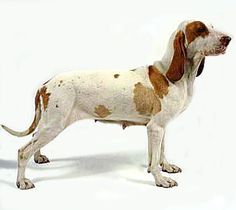
The Spanish Hound is a medium-sized dog with a robust, elongated body, which speaks to its endurance rather than its speed. Its appearance is harmonious and functional, with every feature serving its purpose as a hunter.
General Appearance: A dog of rectangular lines, strong but not heavy. It has a melancholic, noble facial expression.
Head and Muzzle: The head is long, with a slightly convex skull and a smooth transition to a long muzzle. The muzzle is not pointed. The lips are thin, with the upper one slightly covering the lower. The nose is large, with well-opened nostrils, typically black or dark brown.
Eyes and Ears: The eyes are medium-sized, almond-shaped, and predominantly dark brown. The gaze is sad, calm, and dignified. The most characteristic feature of the breed is its very long, thin, and soft ears. They are set low, hang freely, and twist like a corkscrew. Their length extends well past the tip of the nose.
Body and Limbs: The neck is muscular, with a small dewlap. The chest is deep and wide, providing ample room for the lungs. The back is straight and long, and the loin is short and strong. The limbs are powerful, with strong bones and compact, "cat-like" paws.
Tail: Set at a medium height, thick at the base and tapering to the tip. When at rest, it hangs down; in motion, it may be raised like a sabre, but never curls over the back.
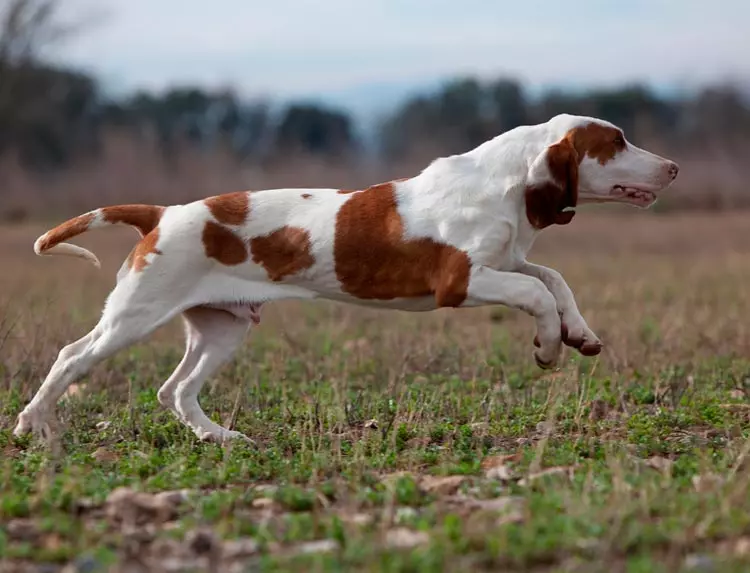
Coat and Color: The coat is short, dense, close-fitting to the body, and glossy. The main color is white with patches. The patches can be orange, lemon, or reddish-brown. They are irregularly placed. Ticking is acceptable. Sometimes the patches are so large that the dog appears orange with white markings on the neck, muzzle, chest, and paw tips.
Character and Temperament
The character of the Spanish Hound is a direct reflection of its purpose. This is not the kind of dog that will fetch slippers or play with a ball in the yard. Its element is the forest, the field, and the scent of game. Off the hunt, it shows calmness and composure, but there is always a certain distance in its behavior.
Hunting Instincts. This is the alpha and omega of its nature. The Sabueso Español is a tireless pursuer. A unique feature is its vocal work. When it finds a trail, it begins to emit a special, melodious, and very loud bark that hunters call "canto" (song). This "song" changes depending on how fresh the trail is and what kind of game it is. It is an extremely brave dog and can work independently on large game like wild boar.
Relationships with Family. Despite its devotion to its owner (it usually chooses one person), the Spanish Hound is not an openly affectionate dog. It's not one for cuddles or tenderness. It is a proud and independent dog that values its personal space. It will be a faithful assistant, but not a companion in the traditional sense. Its stubbornness and independence make it a challenging pet for a novice owner.
Behavior with Children and Other Animals. Due to its independence and lack of need for close contact, the Spanish Hound is not the best choice for families with small children. It won't tolerate being pestered. Its hunting instinct poses a serious threat to cats, rodents, and other small household pets. Even early and proper socialization can't always suppress these millennia-old instincts. With other dogs, especially other hounds, it usually gets along well, as it is accustomed to working in a pack.
Pros and Cons of the Breed
Pros and Cons of the Breed · 6
Pros
Cons
Outstanding hunting qualities: An unrivaled sense of smell, stamina, courage, and a unique voice.
Not suitable as a companion: Independent, not openly affectionate, and keeps its distance.
Robust health: the absence of described hereditary disease is not the absence of risk — breeding animals are screened all the same.
High exercise needs: Requires hours of active work, not just walks.
Low-maintenance grooming: Short coat doesn't require complex care.
Prone to escape: When following a scent, it may ignore commands and run off.
Calm temperament at home: When given sufficient exercise, it is quiet indoors.
Difficult to train: Very stubborn and independent, not prone to unquestioning obedience.
Loyalty to one owner: Forms a strong bond with the hunter.
Not suitable for apartment living: Needs space and a rural lifestyle.
Noble and unique appearance.
Strong hunting instinct, dangerous to other animals.
Training and Education
Training a Spanish Hound is a task for an experienced, patient, and very persistent person. Its independence and stubbornness create significant difficulties. It's practically impossible to teach it something without its own consent. It will periodically ignore commands if they conflict with its own intentions, especially if it has picked up a scent.
The key to success is establishing a bond and mutual respect. The owner must become the undisputed leader for the dog, but act with consistency and fairness, not with force. Harsh training methods are absolutely unacceptable with this breed – they will only lead to increased stubbornness and a loss of trust.
The most important command is "Come!". The owner must dedicate maximum attention to practicing this from a very early age. However, even a perfectly trained dog may ignore it in the heat of the hunt. Therefore, it should only be let off-leash in safe areas, far from roads.
Early socialization is mandatory to teach the puppy to react appropriately to strangers, sounds, and other animals (that it won't be hunting). But, as noted, a complete suppression of hunting instincts should not be expected.
Care and Maintenance
Caring for a Sabueso Español is not complicated, but it has specific requirements related to its lifestyle.
Living Conditions. It is strongly advised against keeping this dog in a city apartment. Confinement to four walls is a form of misery for it. The ideal conditions are a country home with a large, securely fenced-in yard or kennel. The fence must be high and without any places to dig under, as these dogs are prone to escaping if they catch an interesting scent.
Grooming and Coat Care. The Spanish Hound's short coat does not require complex grooming. It's enough to brush it once a week with a rubber brush or grooming mitt to remove dead hair. You should only bathe the dog when it's absolutely necessary. After each hunt, it's crucial to thoroughly inspect the skin, paws, and ears for ticks, cuts, splinters, and other injuries.
Ear Care. This is the most important aspect of care. Long, pendulous ears are poorly ventilated, which creates ideal conditions for the growth of bacteria and fungi. This can lead to ear infections and other inflammations. It is necessary to regularly (1–2 times a week) inspect and clean the ear canal with a special lotion. Any redness, unpleasant odor, or excessive discharge is a reason to consult a vet immediately.
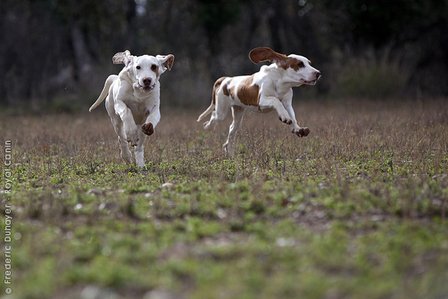
Physical Activity. This is the key need of the breed. A Spanish Hound needs more than two short walks on a leash. It needs a daily opportunity to run freely for several hours, preferably in a forest or field where it can use its sense of smell. The ideal exercise is regular hunting. If the dog is not used for its intended purpose, it will become unhappy and may develop destructive behavior and health problems.
NutritionHealth and risks
Health and Typical Ailments
Frequently Asked Questions (FAQ)
Is the Spanish Hound suitable for a family with children?
No, it's a poor choice. The dog is not a playful or affectionate companion. It is reserved and values its space, so it may be impatient with small children.
How much exercise does it need?
A great deal. This isn't just a few short walks, but a daily, multi-hour activity, preferably with the opportunity to run freely and use its sense of smell. Ideally, hunting. Without this, the dog will suffer.
Do they bark a lot?
At home, with sufficient exercise, they are quite quiet. But on the hunt or when they catch a scent, they are very vocal. Their bark is melodious but loud and can be heard from a long distance.
Can a Spanish Hound be kept with a cat?
This is extremely risky. They have an extraordinarily strong hunting instinct, and a cat or other small animal will most likely be viewed as prey. It's not worth the risk.
Is the care of their ears complicated?
The care is not complicated, but it requires strict regularity. Weekly cleaning is mandatory to prevent serious infections, which are the main health problem of this breed.
Video about the Breed
FAQ
What is the Spanish Hound used for?
A multi-purpose working dog: it hunts small and large game (up to boar), and thanks to its excellent nose it is also used for police and trailing work.
Is the Spanish Hound good for a family?
Yes — at home a gentle, devoted and calm dog, friendly to other dogs and tolerant of small animals; but it is not a couch companion — it needs work and exercise.
Is the breed suited to an apartment?
Poorly — a hardy working hound; without scent work and space it grows bored.