

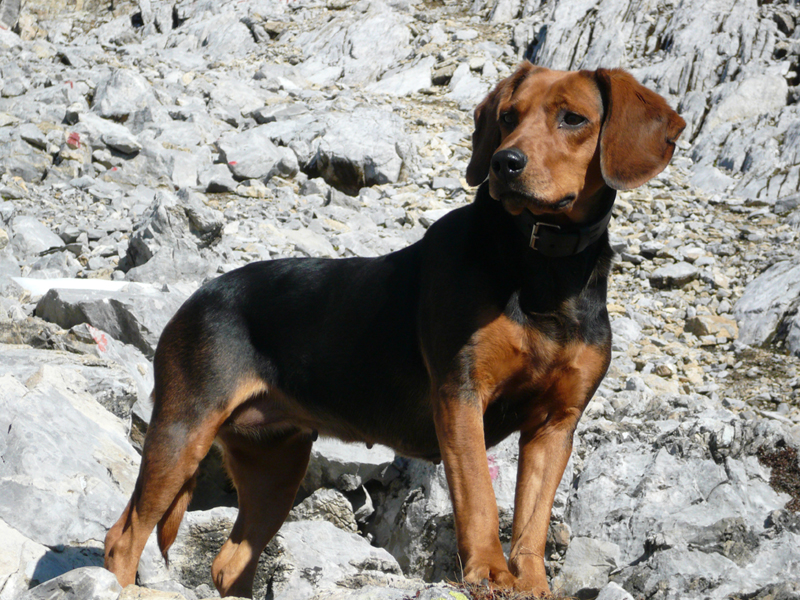
| Height | 42–50 cm |
| Weight | 18–22 kg |
| Lifespan | 12–14 years |
| FCI group | 6 · scenthounds |
| Origin | Austria (Tyrol) |
Exact ratings
Common health issues
Nutrition
The Tyrolean Hound (German: Tiroler Bracke) embodies the hunting spirit of the Alpine forests. This ancient Austrian breed, tempered by the harsh mountain environment, is a tireless and devoted helper for hunters and an energetic companion for active families. The dog has an incredibly sharp sense of smell, amazing stamina, and an inborn passion for tracking game, making it one of the best in its class. Its clear, melodic bay carries far into the mountains, signaling that it has found a trail. But behind its serious hunting demeanor lies a friendly and faithful friend. To discover all the nuances of this unique dog’s personality, care, and history, read more on Tvaryny.
This medium-sized hound, with its strong, athletic body, is perfectly suited for working on challenging, rugged terrain. Its dense, double coat provides reliable protection from the elements, allowing it to work in any conditions. Despite its outstanding working qualities, the Tyrolean Hound remains a relatively rare breed outside of its homeland, making it even more unique and desirable for true connoisseurs of hunting dogs. Other European hounds, like the German Hound, also have a noble history rooted in careful breeding for hunting.
Tyrolean Hound: A Quick Look at the Breed
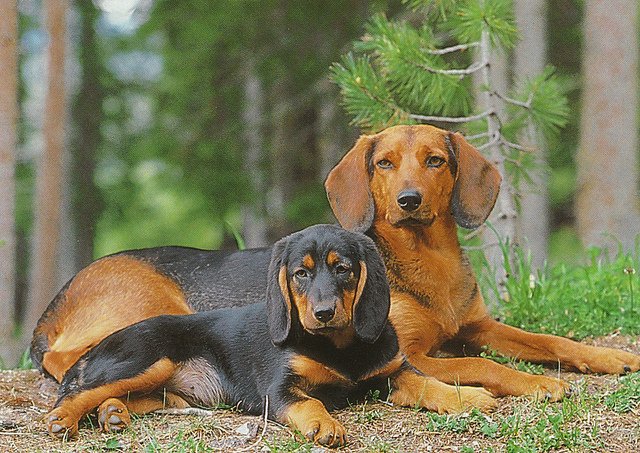
| Breed Name | Tiroler Bracke, Tyrolean Hound |
| Country of Origin | Austria (Tyrol) |
| Date of Origin | Middle Ages, standardized in the late 19th century |
| FCI Classification | Group 6 (Scent Hounds and Related Breeds), Section 1.2 (Medium-sized Hounds). Working trials are mandatory. |
| Height at Withers | Males: 17.3-19.7 inches, Females: 16.5-18.9 inches |
| Weight | Approximately 40-49 pounds (not strictly regulated by the standard) |
| Lifespan | 12-14 years |
| Use | Hunting hare, fox, blood tracking wounded hoofed game |
| Character | Energetic, persistent, independent, friendly, loyal |
| Temperament | Balanced, stable, non-aggressive |
History and Origins of the Tyrolean Hound
The history of the Tyrolean Hound is deeply rooted in the past and closely intertwined with the history of the Alpine region of Tyrol. It is believed that the ancestors of these dogs were Celtic hounds, which arrived in these lands along with the Celtic tribes. These dogs, known for their endurance and excellent sense of smell, were crossed with local breeds, gradually forming a unique type of hound perfectly adapted to mountain hunting.
The first reliable mentions of dogs similar to the modern Tyrolean Hounds date back to around 1500. Holy Roman Emperor Maximilian I, a passionate hunter, mentioned “purebred” hounds from Tyrol in his writings, which he used during his hunts in the Alpine forests. This shows that even then, the breed was highly valued for its working qualities.
For centuries, the breed developed in relative isolation in the mountain valleys of Tyrol. Selection was based exclusively on working qualities: dogs with the best sense of smell, stamina, a clear voice, and the ability to work independently, pursuing game on a trail, were highly prized. Physical appearance was of secondary importance, which led to the development of a functional, harmonious physique without any extreme features.
Systematic breeding and standardization of the breed began only in the second half of the 19th century. In the 1860s, Tyrolean hunters started keeping studbooks to preserve the purity of the bloodline and the outstanding working characteristics of their dogs. The first official breed standard was developed and published in 1896, and the breed received official international recognition in 1908. It’s interesting to note that the Tyrolean Hound became one of the first Austrian breeds to gain such status, which emphasizes its importance to the country’s hunting culture. The Austrian Black and Tan Hound is another magnificent hunter that requires a specific approach from its owner.
Breed Standard and Appearance
The Tyrolean Hound is a medium-sized dog with a lean and robust build and a functional, harmonious body structure. It gives the impression of an enduring and agile athlete, ready for long work in the mountains.
- Head: The skull is wide, lean, and slightly domed. The stop is smooth but clearly defined. The muzzle is strong and not pointed. The lips are dry and tight-fitting. The nose is always black.
- Eyes: Large, not deeply set, and rounded. The color is dark brown. The gaze is intelligent and calm.
- Ears: Broad, set high, of medium length (reaching approximately to the tip of the nose), with rounded tips. They hang flat along the cheeks.
- Body: Rectangular shape. The back is straight and strong. The chest is deep but not too wide, providing enough space for the lungs and heart. The belly is moderately tucked up.
- Tail: Set high, long, and shaped like a saber. It hangs down in a relaxed state and is raised above the topline when the dog is moving or excited. It is covered with dense, brush-like hair, especially on the underside.
- Limbs: Straight, muscular, with strong bones. The paws are compact, with firm pads and strong claws.
Coat and Color
One of the key features of the breed is its double coat, which reliably protects the dog. There are two coat types:
- Smooth-coated: Short, dense, and close-fitting hair with a well-developed undercoat.
- Rough-coated: A rougher, harsher coat to the touch, also with a dense undercoat.
The standard allows for two main color types:
- Red (deer red): Can range from a light red to a rich reddish-brown.
- Black and tan (saddle-back): A black “saddle” on the back with clearly defined red or tan markings on the muzzle, chest, limbs, and under the tail.
Small white markings on the chest (“star”) and paws are permissible.
Character and Temperament
The Tyrolean Hound is a dog with a dual character. While hunting, it’s a tireless, spirited, and independent tracker, capable of following a trail for hours. At home, it transforms into a calm, friendly, and devoted family member. Its temperament is stable and balanced; it is not prone to unprovoked aggression or nervousness.
Relationship with the family: Tyrolean Hounds form strong bonds with their owner and family. They get along well with children, especially if they grow up with them, showing patience and caution. However, as with any dog, interactions with small children should be supervised.
Relationship with other animals: Tyrolean Hounds usually get along well with other dogs, as they are used to working in a pack. However, their strong hunting instinct makes them potentially dangerous to cats, rodents, birds, and other small pets. Cohabitation is only possible with very early and proper socialization, but even then, the risk remains. The Småland Hound is another independent and passionate hunter with similar training challenges for owners.
Independence and intelligence: Like most hounds, the Tyrolean Hound was bred for independent work, often at a significant distance from the hunter. This has developed its high intelligence and ability to make its own decisions. On one hand, this makes it clever, but on the other, it can be quite stubborn and independent. It always has its own opinion, which can make the training process difficult for inexperienced owners.
Care and Maintenance

The Tyrolean Hound is a low-maintenance breed but has specific requirements for its living conditions due to its high energy levels.
Grooming
Grooming the Tyrolean’s coat is simple. Its dense, short coat only needs to be brushed once or twice a week with a special rubber brush or grooming mitt to remove dead hair and maintain healthy-looking skin. During seasonal shedding (in spring and autumn), the procedure should be performed more frequently. Bathe the dog only when absolutely necessary to avoid disturbing the natural protective layer of its skin.
Special attention should be paid to the ears. Their droopy shape prevents proper ventilation, which can lead to the buildup of dirt and the development of infections. Regularly check and clean the ears with a special lotion. Also, remember to trim the claws (if they don’t wear down naturally) and take care of the teeth.
Living Conditions and Exercise
The Tyrolean Hound is absolutely not an apartment dog. It is a working hound that needs space and daily intense physical exercise to be happy and healthy. The ideal place for it is a country house with a large, securely fenced-in yard. A fence is mandatory, as, having caught an interesting scent, the dog will not hesitate to go and investigate it, ignoring commands.
This dog needs a minimum of 1.5 to 2 hours of active walks a day. These cannot be calm strolls on a leash in the park. The Tyrolean needs to run, play, and have the opportunity to explore the territory. Great activities for it include:
- Long hikes in the forest or mountains;
- Running next to a bicycle (for an adult dog);
- Participating in hound sports (e.g., lure coursing);
- Scent work (nosework).
Insufficient physical and mental stimulation will inevitably lead to the development of destructive behavior: howling, barking, damaging items, and attempts to escape.
Training and Socialization
Training a Tyrolean Hound is not a task for novices. Their independent character and innate stubbornness require the owner to have patience, consistency, and firmness. They are intelligent and quickly grasp commands, but they will only obey them if they see the point and respect their owner as a leader.
The foundation of successful training is positive reinforcement: praise, treats, and games. Harshness and physical punishment are absolutely unacceptable—they will only make the dog retreat into itself or begin to resist. Training should be varied and interesting, as monotonous repetitions quickly bore this intelligent dog.
The most important aspect is early socialization. The puppy needs to be introduced to different people, places, sounds, and other animals (under control). This will help to raise a confident and well-balanced dog. Special attention should be paid to the “Come!” command, as the tendency to wander and follow a trail is the main problem in raising hounds. A similar situation is faced by owners of the Medium Vendée Griffon, which is also an excellent hunter.
Health and Typical Breed Diseases
Feeding Recommendations
Pros and Cons of the Tyrolean Hound
Before getting a serious dog like the Tyrolean Hound, it’s worth weighing all the pros and cons. A similar choice is faced by future owners of breeds such as the Medium Vendée Griffon or the Småland Hound, which are also excellent hunters but require a specific approach.
| Pros (+) | Cons (-) |
|---|---|
| Outstanding hunting qualities: unparalleled sense of smell, endurance, and spirit. | Extremely high need for physical exercise: not suitable for inactive people. |
| Robust health and low maintenance: no breed-wide list of hereditary diseases has been compiled — “not described” means “not studied”, not “not there”. | Not suitable for apartment living: needs space and its own territory. |
| Loyalty and friendliness toward the family: makes an excellent companion for active people. | Strong hunting instinct: prone to escaping, dangerous to small animals. |
| Attractive appearance and harmonious physique. | Stubbornness and independence: can be difficult to train for novices. |
| Simple coat care. | Requires early and prolonged socialization. |
| Stable temperament, no aggression toward people. | Loud voice: can cause problems with neighbors if the dog gets bored. |
Interesting Facts About the Tyrolean Hound
- Emperor Maximilian I so valued these dogs that their images can be found on ancient tapestries and in illustrations for his hunting treatises.
- The voice of the Tyrolean Hound is its “calling card.” It has a special, melodic tone that changes depending on whether the dog is just following a trail or has already spotted its quarry. Experienced hunters can tell what stage the hunt is at just by the dog’s voice.
- Unlike many other breeds, the Tyrolean Hound’s standard does not have strict weight requirements, focusing instead on proportionality and athletic build. Functionality is key.
- Although the breed is one of the oldest in Austria, it remains quite rare outside its homeland and neighboring countries (Germany, Italy). Most dogs today are still in the hands of hunters who are dedicated to preserving their working qualities.
- The Tyrolean Hound has a unique ability to adapt its working style to the terrain. In a dense forest, it works cautiously and methodically, while in open country, it is fast and spirited.
Frequently Asked Questions (FAQ)
Is the Tyrolean Hound suitable as a first dog?
No, it is generally not recommended. Their independence, stubbornness, and high exercise needs make them challenging for inexperienced owners. This dog requires a person who understands the psychology of hounds and can be an authoritative leader for it.
Can a Tyrolean Hound live in a city?
This is highly undesirable. Life in a small apartment cannot satisfy their need for space and movement. Even if you live in a house within the city limits, you will have to travel out of town daily to give the dog the opportunity to run freely without a leash in a safe place.
Does the Tyrolean Hound shed a lot?
Shedding is moderate but increases twice a year, in spring and fall. Regular brushing during this period will help keep the amount of hair in the house under control.
Can a Tyrolean Hound be kept purely as a companion dog, not a hunting dog?
Yes, this is possible, but only on one condition: you must provide it with alternative “work” and adequate exercise. This could be long hikes, nosework, lure coursing, or other types of canine sports that imitate hunting. Without this, the dog will be unhappy and may develop behavioral problems.
How loud is this breed?
The Tyrolean Hound is a hound, and it loves to use its voice. It won’t bark for no reason, but if it sees something interesting or is left alone and gets bored, you and your neighbors will certainly know about it. Its clear bark and howl can be heard from a great distance.
Video About the Breed
- Extremely keen nose, endurance
- Friendly, devoted family friend
- Ringing, melodious voice on the chase
- Very robust “natural” health
- Vocal — “gives tongue” on the trail
- Independent at work — not for a novice
- Strong hunting instinct (risky with cats)
- High exercise needs — not for an apartment
| Austrian Black and Tan Hound | Bavarian Mountain Hound | Alpine Dachsbracke | |
|---|---|---|---|
| Height | 48–56 cm | 44–52 cm | 34–42 cm |
| Energy | 4.5 | 4 | 3.5 |
| Apartment | 2 | 1.5 | 2.5 |
| Beginners | 2.5 | 1.5 | 2.5 |
What was the Tyrolean Hound bred for?
Is the Tyrolean Hound good for a family?
Is the breed suited to a novice?
FCI Standard No. 68 · Österreichischer Kynologenverband
For apartments · For kids · For beginners · Active · Smartest · Hypoallergenic · All rankings →