

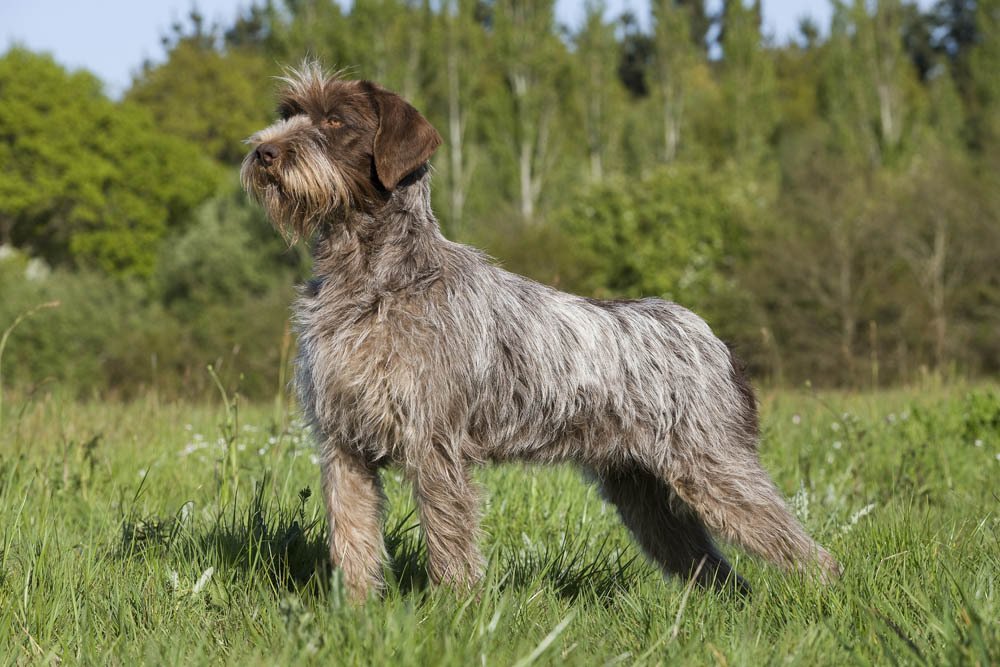
| Height | 50–60 cm |
| Weight | 23–28 kg |
| Lifespan | 12–14 years |
| FCI group | 7 · pointing dogs |
| Origin | France / Netherlands |
Exact ratings
Common health issues
Nutrition
The Korthals Griffon, also known as the Wirehaired Pointing Griffon, is a versatile and devoted gundog breed from continental Europe. This dog, renowned for its characteristic harsh coat and expressive “mustache” and “beard,” is not only an eager hunter but also a wonderful companion for an active family. They are oriented toward human companionship and thrive in marshy conditions. Loyal to their owner, the Korthals Griffon can learn many commands. Read more about this unique breed on Tvaryny.
It’s not the fastest hunter compared to some other gundogs, but it possesses an excellent nose and great stamina. Beyond its hunting duties, Wirehaired Pointing Griffons successfully participate in dog shows, agility trials, and obedience competitions. Their calm demeanor at home is heavily dependent on having an outlet for their colossal energy during walks, so this breed is best kept in the country in a private home with a securely fenced yard.
Korthals Griffon: A Brief Breed Overview
| Characteristic | Description |
| Origin | France / Netherlands (developed by Eduard Korthals) |
| FCI Recognition | 1954 (Standard No. 107) |
| FCI Group | Group 7 (Pointing Dogs) |
| Lifespan | 12-14 years |
| Height (at withers) | Males: 55-60 cm (22-24 in); Females: 50-55 cm (20-22 in) |
| Weight | 23-27 kg (51-60 lbs) (both sexes) |
| Temperament | Devoted, intelligent, energetic, friendly, excellent nose |
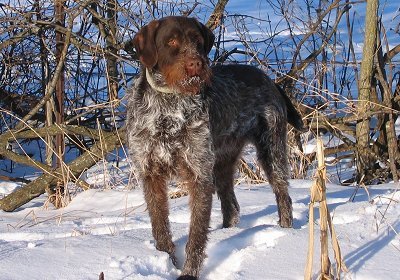
| Coat | Harsh, wire-like outer coat; dense, soft undercoat |
| Shedding | Minimal (but requires regular hand-stripping) |
| Energy Level | Very High |
| Exercise Needs | Minimum 1-2 hours of vigorous exercise daily |
| Purpose | Gundog (all-purpose), companion dog |
History and Origin of the Breed
The history of the Wirehaired Pointing Griffon is inextricably linked with the name of Eduard Korthals, a 19th-century Dutch breeder. Korthals, the son of a wealthy shipowner, had a passion for gundogs and set himself the goal of creating the ideal, all-purpose hunter. He aimed to develop a dog capable of working any terrain (including marshes and dense thickets), withstanding harsh weather, possessing a superb nose, and, crucially, working closely with the hunter.
He began working on the breed around 1874. Although Korthals was Dutch, he conducted much of his work in Germany and later in France, which still sparks debate over the breed’s “nationality.” France eventually adopted it as its own.
The Korthals Griffon’s gene pool was formed from the best gundogs of the time. It is believed the breeding involved:
- French and German Griffons
- Various spaniels (possibly French Spaniels)
- Pointers and Setters
- Barbet (French Water Dog)
- Possibly the Dutch Stabyhoun
Korthals kept exceptionally meticulous studbooks. Demanding selection of offspring allowed him to fix the desired traits. The first breed standard was published as early as 1887. The breed quickly gained popularity among European hunters thanks to its versatility – the Korthals Griffon could find game, point, and retrieve, both on land and from water.
What the Korthals Griffon Looks Like: Standard and Appearance
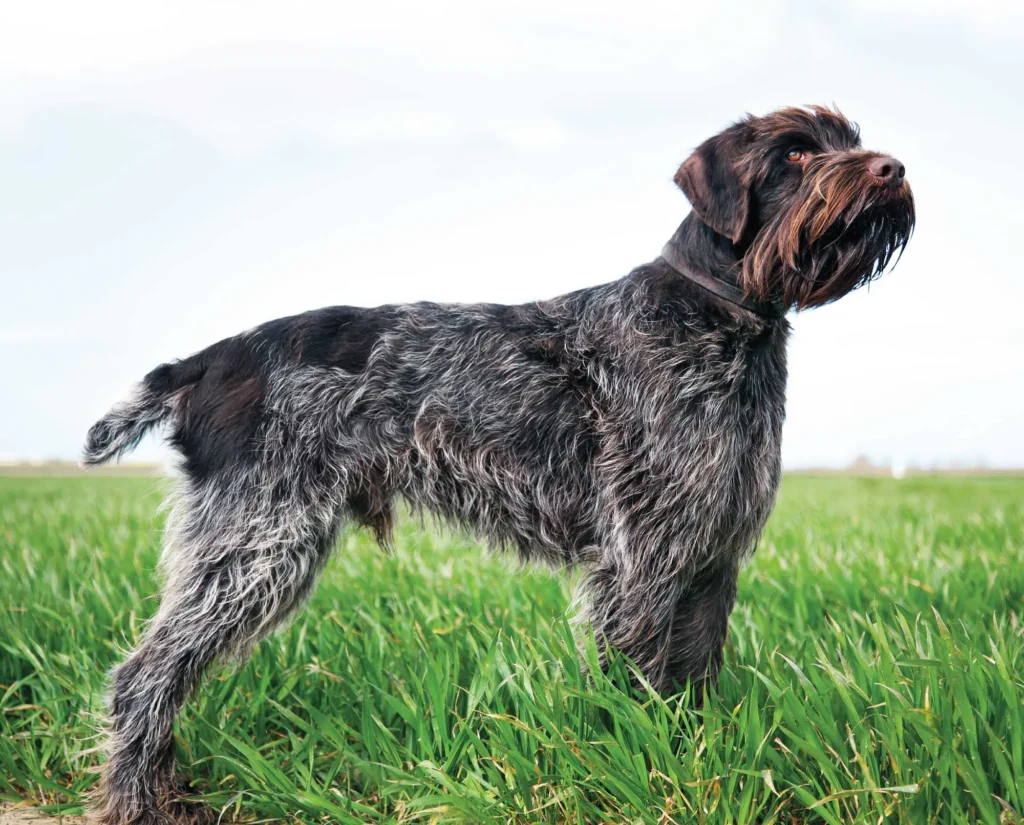
The Korthals Griffon is a medium-sized dog of robust but not heavy build, giving an impression of strength and stamina. Its appearance should be somewhat “scruffy” but not unkempt.
Head and Muzzle
This is the breed’s most characteristic feature. The head is large and long, with a distinct but not overly sharp stop. The skull is not too broad. What makes it’s unmistakable is the harsh hair on the muzzle, forming thick eyebrows, a mustache, and a beard. This “furnishing” not only gives it a wise look but also protects the muzzle when working in dense undergrowth.
Eyes and Ears
The eyes are large and rounded, usually yellow or brown, with an intelligent and friendly expression. The eyebrows protect the eyes from branches. The ears are medium-sized, set flat and level with the eyes, slightly rounded at the tips, and covered with shorter, but still harsh, hair.
Body and Tail
The body is slightly longer than it is tall, giving it a rectangular outline. The back is strong and level. The chest is deep, reaching the elbows, but not too broad, allowing the dog to move easily through cover. The tail is set relatively high, continuing the line of the back. Historically, it was docked to one-third or half its length. Today, docking is banned in many countries (and less common in the US for this breed than some others), and the dogs have a natural, long tail, which they carry horizontally or slightly raised.
Paws and Unique Feature
The paws are round, strong, with tightly-knit toes. A unique feature of the Korthals Griffon is its webbed feet. This adaptation makes them superb swimmers and helps them work efficiently in water and marshes, which was one of Eduard Korthals’ primary goals.
Coat and Color
The coat is the breed’s hallmark. It is double-layered:
- Outer coat: Harsh, wiry, straight or slightly wavy, but never curly or woolly. It feels like boar bristles to the touch. Length is typically 3-5 cm.
- Undercoat: A dense, soft, and fine layer that provides excellent insulation and is water-resistant.
This coat structure perfectly protects the dog from cold water, thorny bushes, and harsh weather. Standard color variations are:
- Steel-gray with brown patches (most common).
- Solid brown (often with gray ticking on the chest).
- White and brown.
- Less common – white and orange.
Black is a disqualifying fault in the standard.
Character: Temperament and Behavior
The Korthals Griffon is a dog of dual nature: a tireless and determined hunter in the field, and a gentle, devoted companion at home. They are known for their balanced temperament and obedient behavior.
Devotion to Family
This is a true “Velcro dog.” They are extremely people-oriented and crave being close to their family. This deep attachment to all family members can lead to separation anxiety if the dog is left alone for long periods. They are not suited for kennel life or for people who are out of the house all day.
Attitude Toward Children and Other Animals
With proper socializaton, Korthals Griffons are excellent with children. They are patient and good-natured, but as with any dog, interactions with small children should be supervised to teach both parties safe behavior.
They generally get along well with other dogs, especially if raised together. However, cats and other small animals (rodents, birds) are less fortunate. The Korthals Griffon has a very strong prey drive and is inclined to see small, furry creatures as prey. Early and consistent socialization can help, but there is never a guarantee.
Intelligence and Guarding Qualities
These are very intelligent dogs that are eager to please their owner. They learn quickly but can sometimes display an independent streak or stubbornness typical of pointing breeds. They need an owner who can be a consistent and patient leader.
The Wirehaired Pointing Griffon is wary of strangers and will always alert its owner to visitors with a bark. This makes it a good watchdog (alert dog), but not a guard dog. They rarely show aggression toward people; their job is to warn, not to attack.
Pros and Cons of the Breed
Like any breed, the Korthals Griffon has its advantages and disadvantages. It’s important to assess them soberly before committing to one.
| Pros (Advantages) | Cons (Disadvantages) |
|---|---|
| ✅ Versatile gundog: Works excellently on land and water, as a pointer and retriever. | ❌ Very high energy needs: Requires 1-2+ hours of vigorous exercise daily. Not for an apartment. |
| ✅ Devoted companion: Extremely attached to the family, gentle and loving. | ❌ Prone to separation anxiety: Hates being alone, needs constant human contact. |
| ✅ High intelligence: Learns quickly and is eager to please. | ❌ Strong prey drive: A risk to cats and other small animals. Requires a secure fence. |
| ✅ Minimal shedding: The coat barely sheds, which is good for allergy sufferers (though not hypoallergenic). | ❌ Grooming demands: Needs regular brushing and professional hand-stripping 2-4 times a year. |
| ✅ Good with children: Patient and non-aggressive (with socialization). | ❌ Stubborn streak: Like many intelligent gundogs, can be independent-minded. |
| ✅ All-weather dog: The harsh coat provides excellent protection from cold, water, and thorns. | ❌ Rare breed: It can be difficult to find a responsible breeder and you may have a long wait for a puppy. |
Care, Health, and Upkeep
The Korthals Griffon is a relatively healthy breed, but its unique coat and high activity level require specific care.
Coat Care
The harsh coat of the Korthals Griffon does not shed in the conventional sense, but it needs regular maintenance to stay healthy and functional.
- Brushing: The dog needs to be brushed with a stiff brush or comb 2-3 times a week to remove dirt, burrs, and dead hair, and to prevent matting.
- Hand-Stripping: This is the most crucial aspect of their grooming. The Griffon’s coat must be hand-stripped (plucked by hand) 2-4 times a year. This stimulates the growth of a new, harsh coat and maintains its correct texture and water-resistant properties.
- What NOT to do: Clipping the coat is strongly discouraged. This ruins the coat’s texture, making it soft, woolly, and curly. It loses its protective qualities and will begin to shed more.
- Bathing: Although the breed is suited for water work, it should not be bathed frequently with shampoo. Only bathe when absolutely necessary, using a special, mild shampoo designed for harsh coats.
Ears, Eyes, and Nails
The pendulous ears of the Wirehaired Pointing Griffon need special attention, especially if your pet has access to water. Their shape restricts air flow to the ear canal, which promotes moisture build-up and the growth of bacteria and yeast. Regularly inspect and clean the ears, and dry them thoroughly after every swim. Also, trim the nails regularly and clean the “beard” of food debris.
Physical Exercise and Activity
This is not a couch potato. The Korthals Griffon was bred for all-day work. It needs more than just a walk on a leash; it requires intense physical and mental stimulation.
- Daily Need: A minimum of 1-2 hours of active exercise. This could be running alongside a bicycle, a long hike, or games of fetch.
- Swimming: Thanks to their webbed feet and waterproof coat, Griffons are natural swimmers. This is an ideal form of exercise for them.
- Mental Stimulation: Their hunting intelligence requires a “job.” This can be actual hunting or a simulation: nosework, scent trailing, agility, or just advanced obedience.
Without sufficient stimulation, the Korthals Griffon will become destructive, noisy, and unmanageable.
Health: Common Conditions
Training and Socialization
The Korthals Griffon’s strong hunting instinct necessitates the need for very early socialization. The independence characteristic of pointing breeds requires special attention to obedience training, especially the recall command (“Come!”).
These good-natured and affectionate family pets are eager to please their owners, making them diligent students. However, they are considered “soft” dogs. This means they react poorly to harsh correction methods, shouting, or physical punishment. This can break their spirit or cause resistance. The best results come from positive reinforcement training, using treats, praise, and play.
Key aspects of training:
- Early Socialization: Introduce the puppy to different people, sounds, places, and (cautiously) other animals to ensure it grows into a confident, calm adult.
- Recall Training: This is the most vital command for a dog with a strong nose and hunting instinct.
- Consistency: Griffons are smart and will quickly learn if you are not consistent with your rules.
- A Job to Do: A bored Griffon is a destructive Griffon. They need mental work.
Feeding: Key Recommendations
Korthals Griffon vs. Other Gundogs
The Korthals Griffon belongs to the large group of continental pointing dogs but has its own distinct differences. It is often confused with other wire-haired breeds.
- Korthals Griffon vs German Wirehaired Pointer: This is the most common comparison. Both are versatile, wire-coated gundogs. However, the GWP is generally larger, more powerful, and has a “sharper” temperament, often used for larger game and possessing stronger protective instincts. The Korthals is considered “softer” in temperament and more family-oriented.
- Korthals Griffon vs Spinone Italiano: The Spinone also has a harsh coat and “beard,” but it is larger, heavier, and has a more melancholic expression. The Spinone works at a slower, more methodical pace than the Korthals.
- Korthals Griffon vs Cesky Fousek: Another wire-coated relative. They are very similar in purpose, but the Fousek has a slightly different coat texture and often a more pronounced instinct for water work.
Interesting Facts About the Breed
- The “Father” of the Breed: Eduard Korthals dedicated 20 years of his life to creating this breed, keeping exceptionally detailed stud records.
- Disputed “Nationality”: Although Korthals was Dutch, he bred his dogs in Germany and France. The FCI classifies the breed as French (country of origin), but the Netherlands also claims it as part of its heritage.
- “Paddle Paws”: The presence of webbed feet makes them one of the best swimmers among all pointing breeds.
- “Supreme Hunting Dog”: For its versatility (working in fields, forests, and water), the breed earned this nickname in English-speaking countries.
- Protective Beard: The thick mustache and beard are not just for show; they are functional protection for the muzzle from thorny plants while hunting in dense cover.
Frequently Asked Questions (FAQ)
Does the Korthals Griffon shed a lot?
No, they shed very little. However, their coat doesn’t fall out on its own; it dies and stays in the coat. This is precisely why they need regular brushing and hand-stripping several times a year to remove this dead hair.
Is the Korthals Griffon suitable for apartment living?
Absolutely not. This is an extremely high-energy breed, developed for work in open spaces. They need a home with a large, securely fenced yard where they can run. Life in an apartment without the opportunity for daily, hours-long exercise will lead to destructive behavior and an unhappy dog.
Does the Korthals Griffon get along with cats?
Usually, no. They have a very strong prey drive. If a puppy is raised with a cat from a very young age, they might become friends. But bringing an adult Griffon into a home with a cat, rabbit, or guinea pig is very risky.
Is this dog difficult to train?
They are intelligent and eager to please, which makes training easier. However, they are “soft” (sensitive) and react poorly to harshness. They need a patient owner who uses positive reinforcement methods. Their hunting independence can sometimes manifest as stubbornness.
How much does a Korthals Griffon puppy cost?
This is a relatively rare breed. You should be wary of “cheap” offers, as this may indicate a lack of health testing and poor living conditions. A cheap puppy sold without papers almost always costs more in the end: the screening the parents never had shows up later at the vet.
Video About the Breed
- A versatile pointer with a superb nose
- Affectionate, people-oriented, good with children
- Hardy, loves water and marshes
- A soft nature, easy to train
- Colossal energy — not for an apartment
- Copes poorly with harsh training methods
- The wiry coat needs stripping
- Needs work or sport to be calm at home
| Czech Wirehaired Pointer | German Wirehaired Pointer | Italian Spinone | |
|---|---|---|---|
| Height | 58–66 cm | 57–68 cm | 58–70 cm |
| Energy | 4.5 | 4.5 | 3.5 |
| Apartment | 2 | 2 | 2.5 |
| Beginners | 3 | 2.5 | 3.5 |
Who created the Wirehaired Pointing Griffon?
Is the Korthals Griffon suitable for a family?
Does the Korthals Griffon love water?
FCI Standard No. 107 · Société Centrale Canine
For apartments · For kids · For beginners · Active · Smartest · Hypoallergenic · All rankings →