Group 5 · primitive type · Japan (Wakayama, Mie Prefectures)
Kishu Ken (Kishu Inu)
An embodiment of the Japanese aesthetic of “shibumi”: reserved, dignified, devoted and remarkably clean. The Kishu Ken is an ancient aboriginal boar hunter, one of Japan’s six native breeds; predominantly snow-white, it is quiet, “cat-like” and boundlessly loyal to one person.
Apartment · with caveatsKidsCats · not suitableOther dogs · with caveatsBeginners · not suitable
The Kishu Ken, also known as the Kishu Inu, is the living embodiment of the Japanese aesthetic of "shibumi" - a simple, unobtrusive beauty that doesn't need flashy adornments. These noble Japanese dogs, with their deep hunting roots, remain largely a national treasure in their homeland. Thanks to their loyalty and high working drive, they are gaining traction as companions today, though their primal element remains hunting big game in the mountains. This breed isn't the best fit for a novice owner, as it demands a deep understanding of primitive dog psychology. They are independent thinkers that usually bond hard with a single leader rather than a whole family, although they respect every member of the "pack." Learn more on Tvaryny.
Kishu Ken (Kishu Inu): A Brief Breed Overview
Kishu Ken (Kishu Inu): A Brief Breed Overview · 7
Characteristic
Data
Origin
Japan (Wakayama, Mie Prefectures)
First Mention / Standardization
Ancient times / 1934 (Designated Natural Monument)
FCI Classification
Group 5 (Spitz and primitive types), Section 5 (Asian Spitz)
Lifespan
11–15 years
Height at Withers
Males: ~20.5 in (52 cm); Females: ~18 in (46 cm)
Weight
30–60 lbs (14–27 kg) depending on gender and build
Main Colors
White (most common), Red, Sesame
Comparing the Kishu Ken to Other Breeds
To better understand the uniqueness of the Kishu, it helps to look at its "relatives." Many people confuse Japanese breeds with one another.
For example, the Shiba Inu is significantly smaller and has a more "kitsch," independent personality, often prone to drama. The Kishu is a workhorse - more serious and less prone to tantrums. On the other end of the spectrum is the Shikoku (sometimes called the Japanese Wolfdog), which is much more driven and wild in temperament compared to the balanced Kishu. All three are Japanese national treasures, but the Kishu Inu occupies the golden mean - larger than a Shiba, but calmer than a Shikoku.
It is also interesting to compare the Kishu with other aboriginal breeds globally. While the Kishu is a specialized hunter, the Karst Shepherd demonstrates a completely different work type - herding and guarding, requiring interaction with a flock rather than a single leader. Interestingly, the Carolina Dog (American Dingo) is very close to the Kishu Ken in terms of primitive instincts and level of independence, demonstrating a similar survival model.
Interesting Facts About the Kishu Ken
Ninja Dog: Kishu Kens can move through the forest absolutely silently without breaking twigs. This is a legacy of centuries of ambush hunting.
Export Rarity: For a long time, exporting Kishu Inus from Japan was virtually impossible as they are considered a national treasure. Even now, the population outside Japan is extremely small.
Movie Star: In Japan, the Kishu Ken is often depicted in manga and anime as a symbol of loyalty and fighting spirit (for example, in the series "Ginga Nagareboshi Gin").
Nose Variety: Puppies often have pink noses that darken with age. However, in winter, the nose may lighten again due to lack of sun (so-called "winter nose").
History: The Wolf Legend and Reality
The Kishu Ken is one of Japan's most ancient breeds, named after the historical Kishu province (now the Wakayama and Mie prefectures). This is a mountainous region with dense forests where a unique dog phenotype evolved over centuries - one capable of surviving harsh conditions and hunting dangerous game.
There is a beautiful Japanese legend regarding the Kishu Ken's origin. It tells of a hunter who found a wounded wolf; instead of killing it, he nursed it back to health and set it free. Some time later, the wolf returned and gifted the savior a wolf pup. According to folklore, this descendant of the wild predator became the forefather of all Kishu Inu dogs. This story highlights not just their physical resemblance to wolves, but also the breed's high inteligence and independence.
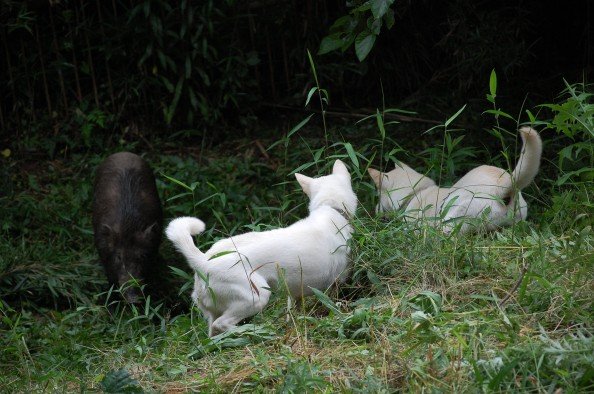
Historically, the Kishu had a variety of coat colors, including brindle variations, red, and spotted coats (known as "spots on white"). However, by the mid-20th century, standardization narrowed the diversity mostly to solid white. This was largely a practical preference by hunters: a white dog is much easier to spot in the forest twilight or darkness, preventing accidental shooting of the dog instead of a wild boar.
The spotted and brindle lines have largely faded into the past. Later, during World War II, the breed nearly vanished entirely. Famine, epidemics, and the government order to use dog pelts for military clothing pushed the Kishu Inu to the brink of extinction. The Japanese government intervened just in time, designating them a "National Natural Monument" in 1934. Thanks to this status, the population was saved. Historically used for hunting boar and bear, today they sometimes help herd or guard property. Buying a puppy outside Japan is still a challenge - annual registration numbers within Japan are steadily dropping, making this breed a rare gem in the canine world.
Appearance: Anatomy of an Athlete
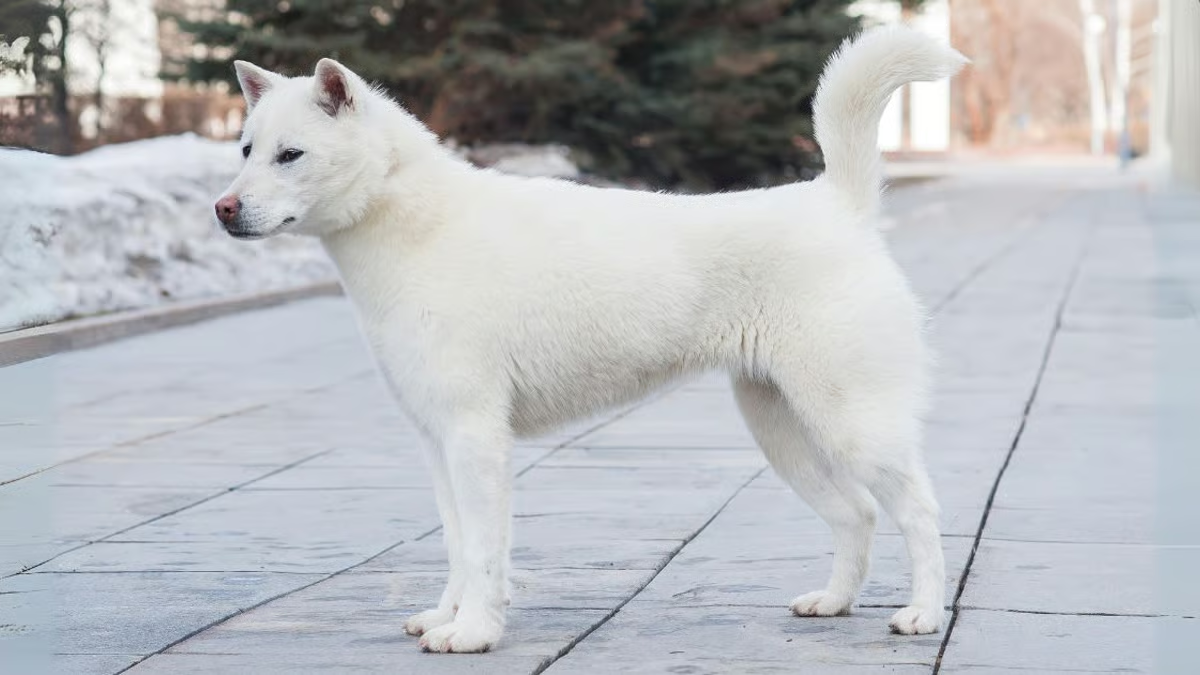
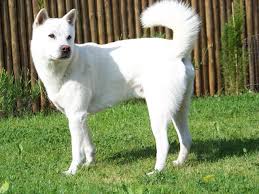
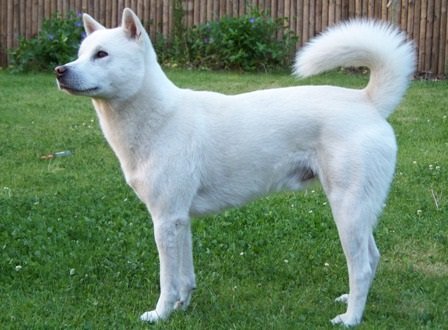
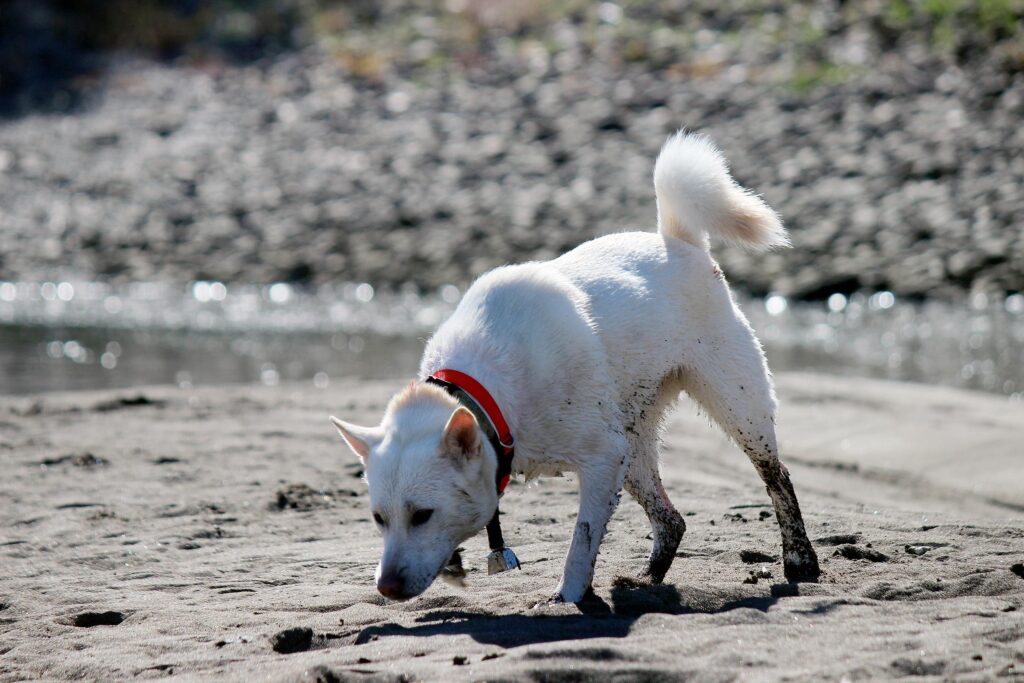
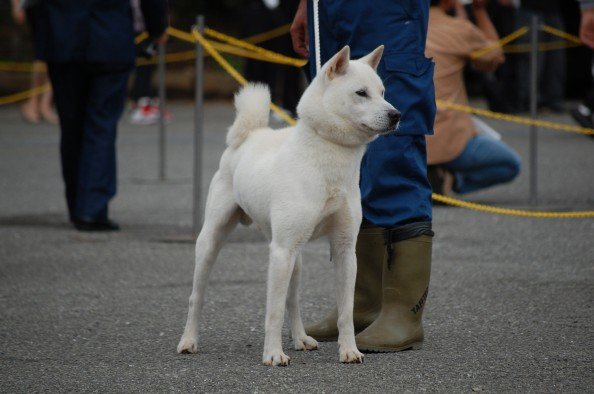
The Kishu Ken is a medium-sized dog of the classic spitz type. Their appearance radiates strength without heaviness and elegance without fragility. It is a dog with a sturdy constitution, well-developed muscles, and a broad, wedge-shaped head.
Head and Muzzle
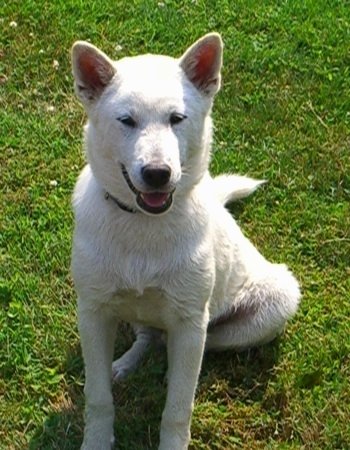
The skull is broad with a flat forehead. The stop (transition from forehead to muzzle) is noticeable but not abrupt; it’s fairly smooth. The muzzle is wedge-shaped, strong, and tapers toward the nose but isn't snippy. The Kishu has triangular ears that prick upwards and incline slightly forward, giving the dog an alert expression. The eyes have a specific shape - they are almond-shaped, slightly slanted, and dark brown. The gaze of a Kishu Ken is direct, confident, and somewhat assessing. The nose is predominantly black, but flesh-colored tones (so-called "snow nose") are acceptable in white dogs.
Body and Limbs
The neck is thick and muscular, with no loose skin. The back is straight and short, with a broad loin. The chest is deep with moderately sprung ribs. The belly is well tucked up, signaling an athletic nature. The limbs are straight with heavy bone. The feet are "cat-like," tight, with thick pads, allowing the dog to move easily over rocky slopes. The tail is set high, thick, and carried curled in a sickle or ring over the back.
Coat
These dogs are well protected by a double coat, which forms longer hair on the tail and cheeks. The outer coat is straight and harsh - it repels dirt and water. Beneath it lies a soft and very dense undercoat that provides thermal regulation. Coat color is the calling card of the modern Kishu. White is the most common, but the standard also recognizes red and sesame. It is important to note that the white color in the Kishu Ken is not albinism, but the result of deliberate breeding.
Character: Temperament of the "Silent Hunter"
Calmness and balance are characteristic of this revered Japanese breed, traits often mistaken for indifference. In reality, the Kishu is an observer. They do not bark without a reason. On the hunt, the Kishu Inu works silently, stalking prey, and only uses its voice when the animal is cornered. This trait of "silence" carries over to home life - they are very quiet housemates.
Relationship with the owner: The Kishu Ken tends to choose one master and stick by them for life. They respect strength of spirit and calm confidence. Rehoming such a dog is traumatic; they are not easily passed from hand to hand.
Attitude toward strangers: The Kishu is wary of outsiders. Do not expect them to rush to hug guests; they will likely take an observation post at a distance. While not aggressive toward people without a direct threat, they will not tolerate familiarity from strangers.
Children and other animals: This is an obedient pet that will coexist peacefully with children in the family if the kids respect the dog's personal space. Regarding other animals - it's complicated. A Kishu will be friends with dogs it grew up with. However, small animals (cats, rodents, birds) will almost always be viewed as prey.
You can often catch this dog in a contemplative state; sometimes it looks like they are meditating. However, they are always ready for action - the reaction time of a Kishu Inu is lightning fast. Their friendly character combines with a boldness displayed during working tasks. This four-legged friend will never be annoying, but will gratefully accept your attention.
Training and Socialization: A Battle of Wits
The Kishu Ken is a complex student: the path from puppy to obedient helper is long and winding. Only an experienced trainer or a patient owner who can handle the dog's stubbornness can successfully navigate it. Kishus are very smart, and that is exactly the problem. They won't sit 50 times in a row just because you said so - they need to see the point.
During training sessions, representatives of the breed strive to take the leader's position, testing boundaries. You shouldn't try to knock the dog off this pedestal with shouting or physical force - this will only lead to a loss of trust and a withdrawn animal. You must persistently and consistently prove your authority through resource control and calm demands. Drills don't work; partnership does.
This dog needs high-quality early socialization. The puppy needs to be introduced to different people, city sounds, and vehicles. Hiking, mountain walks, and active play like coursing (chasing a mechanical lure) will help the Kishu Inu feel good even in city conditions. Remember, letting a Kishu Ken off-leash in an open area is a risk. The hunting instinct can shut off the dog's hearing the moment it spots prey.
Pros and Cons of the Breed
Pros (+)
Cons (-)
High intelligence and independent decision-making
Tendency toward dominance and stubbornness
Cleanliness, no odor, simple hygiene (except shedding)
Heavy shedding twice a year (fur everywhere)
Loyalty to one owner, reliable protector
Aggression toward small animals (high prey drive)
Robust health and endurance
Difficult to train for beginners
Quiet dog, rarely barks at home
Distrustful of strangers, requires socialization
Care and Maintenance: What an Owner Needs to Know
The Kishu is a clean dog. They often groom themselves like cats and have practically no "doggy" odor. This makes them convenient for apartment living, provided they get enough outdoor exercise.
Coat Care
These pets, capable of adapting to the most difficult conditions, "blow" their coat twice a year. Shedding is a serious period in the dog's life when daily brushing is mandatory. The undercoat comes out in clumps, and if not removed, it can cause itching and a greenhouse effect for the skin. Between seasonal sheds, brushing once a week with a standard brush or slicker is sufficient.
Frequent bathing is not recommended for the Kishu Inu - 2–3 times a year or if heavily soiled is enough. Their coat has self-cleaning properties: mud dries and simply falls off.
Hygiene Procedures
Delaying nail care risks ruining the dog's posture. Kishu claws are quite strong and don't always wear down naturally, especially when walking on grass, so they should be trimmed regularly. Ear hygiene requires preventive checks and timely responses to any scratches or nicks obtained during active play in the brush.
Nutrition
Nutrition: The Key to Longevity
Health and risks
Health: Genetics and Risks
Frequently Asked Questions (FAQ) · 3
Is the Kishu suitable for an apartment? Yes, if you are ready to dedicate at least 2–3 hours a day to walking. Indoors, they behave calmly and inconspicuously, not taking up much space.
Is it hard to buy a Kishu Inu puppy in the US? Yes, it is quite difficult. While there are a few breeders, you may have to wait for a litter or even arrange an import from Japan or Europe, which is a long and expensive process.
Do they bark? Kishu Inus bark extremely rarely. They might voice a warning about a stranger on the property or during play, but they don't bark at every rustle.
Video About the Breed
FAQ
How does the Kishu differ from other Japanese breeds?
It is predominantly snow-white (historically for visibility on the hunt), quieter and more reserved; it stands out for a deep “cat-like” devotion to one person.
Does the Kishu get along with cats?
Usually poorly — it is a boar hunter with a very strong chase instinct; living with small animals is very problematic.
Is the Kishu suitable for a beginner?
No — an independent, self-reliant primitive dog; it needs experience, consistency and early socialization.