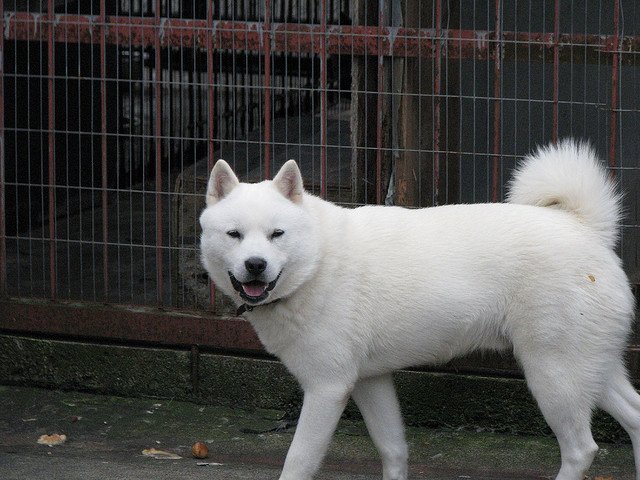
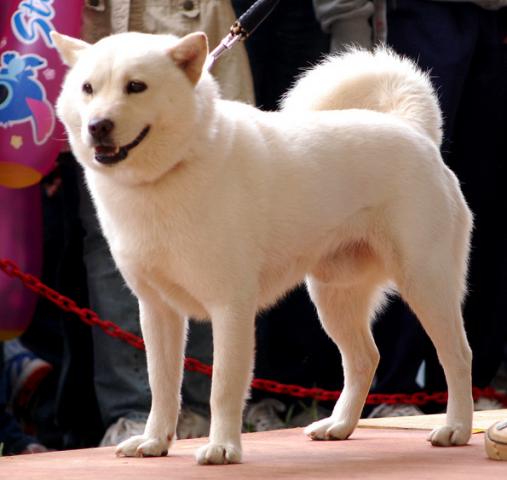
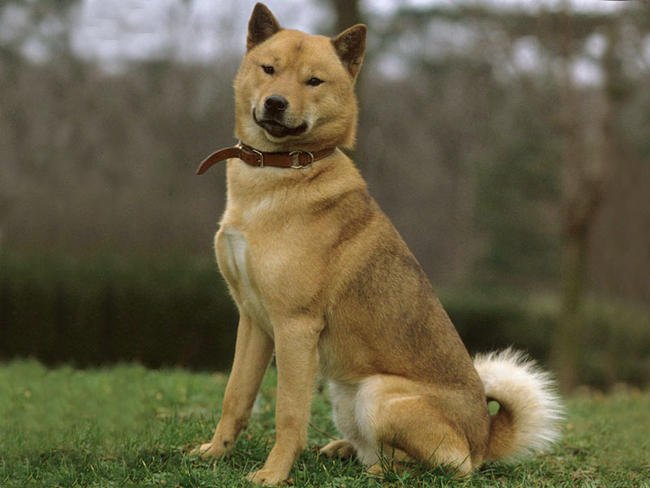
The Hokkaido (Ainu Ken) is a medium-sized Japanese native spitz and a natural monument of Japan since December 21, 1937. FCI Standard No. 261 describes a dog of exceptional endurance: faithful, docile, very alert and bold, with soundness of judgment. The breed stays rare even at home — the Japan Kennel Club registered 24 Hokkaido in 2025. The key breed test is the DNA test for collie eye anomaly (the NHEJ1 gene).
Apartment · not suitableKidsCats · with caveatsOther dogs · with caveatsBeginners · with caveats
The Hokkaido, also known as the Hokkaido Ken and the Ainu Ken, is one of six Japanese breeds that the state has placed on its register of natural monuments. It is a medium-sized native spitz with a thick double coat, erect ears and a curled tail, developed for hunting in the mountains and snows of northern Japan. Even at home the breed is rare: the Japan Kennel Club registered 24 Hokkaido in 2025, against 3,598 Shiba Inu that same year. Below we have gathered what holds up against the paperwork — FCI Standard No. 261, the register of Japan's Agency for Cultural Affairs, the standard of the Japanese association NIPPO, and peer-reviewed veterinary publications. More about breeds on Tvaryny.
Hokkaido (Ainu): quick overview and key characteristics
Hokkaido (Ainu): quick overview and key characteristics · 12
Parameter
Characteristic
Country of origin
Japan
FCI standard
No. 261 “HOKKAIDO,” current version published 10/30/2016, English version dated 02/09/2017
FCI classification
Group 5 (spitz and primitive types), Section 5 (Asian spitz and related breeds), no working trial
Use per the standard
Hunting dog, companion dog
Height at withers, males
48.5–51.5 cm (FCI No. 261)
Height at withers, females
45.5–48.5 cm (FCI No. 261)
Height per the Japanese NIPPO standard
males 52 cm (range 46–55), females 49 cm (range 43–52)
Weight
FCI Standard No. 261 sets no weight
Coat
Double: outer hair harsh and straight, undercoat soft and dense
Colors per the standard
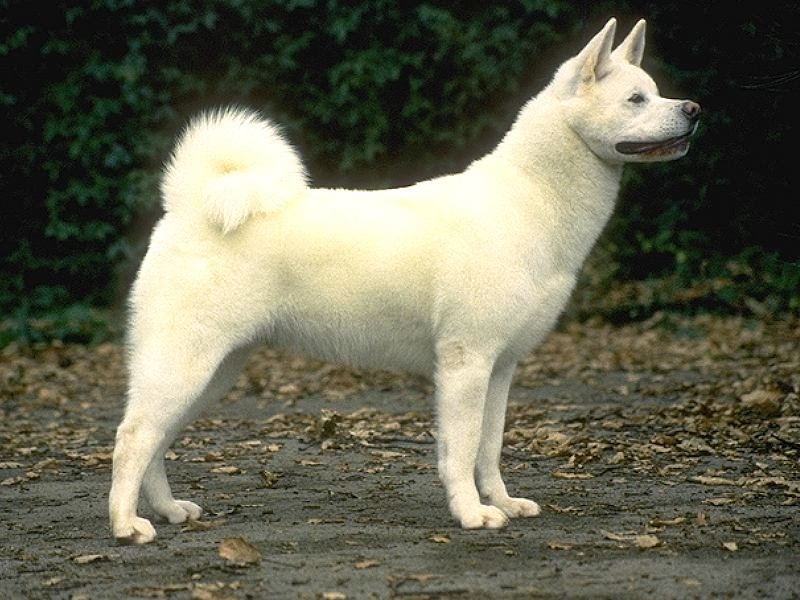
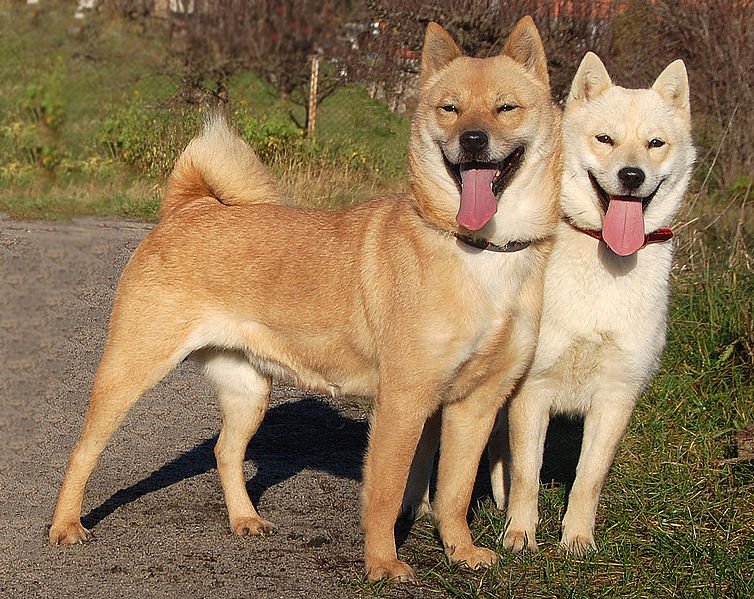
Sesame, brindle, red, black, black and tan, white
Status in Japan
National natural monument since December 21, 1937
JKC registrations in 2025
24 dogs (across all 141 breeds — 302,530)
Strengths and drawbacks of the breed
Strengths and drawbacks of the breed · 6
Pros (+)
Cons (−)
Deeply attached to the family; the standard describes a faithful and docile temperament
Inclined to work “for itself” and to test where the limits are
Endurance is the standard's key word for this breed
Heavy seasonal shedding of the dense undercoat
Attentive and responsive to changes at home
Friction with dogs of the same sex is possible
Easy coat care outside the shedding season
Needs a long workout every day
Takes cold well thanks to the double coat
Handles heat worse than frost
A rare breed with a documentary history that holds up
A puppy is hard to find, and the lines have to be verified without fail
Where the Hokkaido sits among the six Japanese breeds
The six breeds grouped together as the “Nihon Ken” get mixed up with one another constantly online. Here is a short guide resting strictly on the FCI standards in force — Akita No. 255, Shiba No. 257, Hokkaido No. 261, Kai No. 317, Kishu No. 318, Shikoku No. 319.
Where the Hokkaido sits among the six Japanese breeds · 6
Breed
Height under FCI (male / female)
Colors under the standard
Tongue
Hokkaido (No. 261)
48.5–51.5 / 45.5–48.5 cm — a range
Sesame, brindle, red, black, black and tan, white
Blue-black — not a fault
Akita (No. 255)
67 / 61 cm ±3
Red, sesame, brindle, white; “urajiro” required except in white
Blue or black-spotted — a fault
Shiba (No. 257)
39.5 / 36.5 cm ±1.5
Red, black and tan, sesame, black sesame, red sesame; “urajiro” required
Not mentioned
Kai (No. 317)
50 / 45 cm +3
Black brindle, red brindle, brindle
Not mentioned
Kishu (No. 318)
52 / 49 cm +3
White, red, sesame
Not mentioned
Shikoku (No. 319)
52 / 49 cm +3
Sesame, red, black and tan
Not mentioned
One further difference shows up only when the documents are read side by side: the stated use. For the Hokkaido, the Kai, the Kishu and the Shikoku the standard says “hunting dog, companion dog”; for the Shiba, “hunting dog for birds and small game, companion dog”; and for the Akita, in the version of the standard now in force, simply “companion dog.”
Facts worth knowing about the Hokkaido
The best-known Hokkaido came out of advertising. A white dog named Kai-kun played the “father” in a long series of commercials for the Japanese carrier SoftBank. According to the company's own newsroom, he was the first “father dog” of the Shirato family and appeared in roughly 300 television ads. The Jiji Press agency reported that Kai-kun died of old age on June 28, 2018, at the age of 16, and that he was indeed a Hokkaido Ken.
24 dogs in a year. Japan Kennel Club registration figures for 2025: Hokkaido 24, Shikoku 51, Kai 60, Akita 263, Shiba 3,598. Across all 141 breeds the club registered 302,530 dogs.
A status with no address. In the state register of monuments the location field for the Hokkaido reads “no territory specified”: the protected status belongs to the breed, not to a locality or to particular animals.
Four names in the Ainu language. The language archive of the National Ainu Museum records for the dog the words seta, sita (the everyday variant in the northeast of Hokkaido), plus the descriptive reyep, “the one that crawls,” and apacampe, “the one by the door.”
The only one with a range. The Hokkaido is the only one of the six Japanese breeds whose FCI standard sets height by limits rather than by a single ideal figure with a tolerance.
Last on the 1937 list. Of the dog breeds entered in Japan's register of natural monuments between 1931 and 1937, the Hokkaido was designated last — on December 21, 1937.
The breed's origins: what the documents actually state
Start with the document that describes the breed officially, because a handsome legend about Japan's native breeds is easy to write and a verifiable page is not. The historical summary of FCI Standard No. 261 states that the breed descends from medium-sized Japanese dogs brought to Hokkaido by settlers from Honshu in the Kamakura era, in the 1140s, when exchange between Hokkaido and the Tohoku region was opening up. That wording deserves attention, because it contradicts the story repeated most widely online — the one about “direct descendants of Jomon-period dogs.” The standard dates the breed not to the Neolithic but to a medieval migration from the main island.
Research is more careful here than popular writing. The paper on the mitogenomes of ancient Japanese dogs (Xiaokaiti and coauthors, Anthropological Science, 2024) starts from an archaeological fact: dogs have been present in Japan for at least 9,300 years, since the Jomon period. What the authors go on to show is that the mitochondrial lineages of dogs from the late 8th century are already different from the Jomon lineages, and more varied — later waves of settlers brought dogs of their own, and the older haplogroups were largely displaced. A direct line from “Jomon dog” to modern breed does not follow from that evidence.
There is, however, an older and very concrete observation that sets the Hokkaido apart from the southern Japanese breeds. Hashimoto, Yamakawa and Tanabe published a study of red-cell glycolipids in 1,591 dogs of 36 breeds in the Journal of Biochemistry in 1984. They found a polymorphism in the terminal sugar of hematoside: some dogs carry N-acetylneuraminic acid, others N-glycolylneuraminic acid. The second variant occurs in only a few eastern breeds, and the Hokkaido in that sample did not carry it — unlike the native breeds of southern Japan, northern China and Korea. From this the authors concluded that the routes of settlement differed: the dogs of southern Japan came from northern China by way of the Korean peninsula, while the dogs of the northern archipelago have another origin.
The name “Ainu Ken” points back to the Ainu, the indigenous people of Hokkaido, Sakhalin and the Kuril Islands. The historical section of the FCI standard states plainly that the Ainu kept these dogs for hunting bear and other game, and that the breed's second name comes from there. In the Ainu language the dog has several names, and the language archive of the National Ainu Museum (国立アイヌ民族博物館) records them precisely: seta is the main word, current on Hokkaido, on Sakhalin and in the Kurils; in the northeast of the island — the Kitami, Kushiro and Tokachi districts — everyday speech uses sita, while seta stays in the formal register. Descriptive names exist too: reyep, “the one that crawls” (a dog looking for affection creeps up to a person), and apacampe, “the one by the door.” None of this is exotica; it is the ordinary synonymy of a living language, documented by a national research institution.
The turning point came in 1937. The database of national cultural properties kept by Japan's Agency for Cultural Affairs holds a record under the name 北海道犬 (ほっかいどうけん, “Hokkaido Ken”): category, natural monument; date of designation, December 21, 1937. The “location” field reads 地域を定めない, “no territory specified” — the status went to the breed as such, not to a place or to particular animals. The description in the record, written in an older bureaucratic Japanese, lists exactly the traits the standards would later adopt: one of the medium-sized Japanese dogs long kept on Hokkaido; small ears, a pointed muzzle, a body somewhat longer than the height at the withers, an open hock angle.
The FCI standard adds a detail about the name: when the breed was declared a natural monument, it took the name of the region. “Hokkaido Ken” thus became the official designation, and “Ainu Ken” remained the second, historical name. Both are still in use today, and the FCI itself carries “Ainu” as a gloss on the breed name.
That same register lets us place the Hokkaido in a sequence: through the 1930s the Japanese state designated dog breeds as natural monuments one after another, and the Hokkaido is the last of them.
Breed in the register · 7
Breed in the register
Date of designation as a natural monument
秋田犬 — Akita
07/31/1931
甲斐犬 — Kai
01/22/1934
紀州犬 — Kishu
05/01/1934
越の犬 — Koshi no Inu
12/28/1934
柴犬 — Shiba
12/16/1936
土佐犬 — Tosa Ken (now the Shikoku Ken)
06/15/1937
北海道犬 — Hokkaido
12/21/1937
Alongside the state register, a membership body looks after the breed. The Japanese dog preservation society NIPPO (公益社団法人日本犬保存会) adopted its “Standard of the Japanese Dog” as early as 1934 — a single document covering all six breeds, sorted by size into small, medium and large. It puts the essence of the Japanese dog into three concepts: kan'i (悍威), contained inner strength and dignity; ryosei (良性), a good, balanced nature; soboku (素朴), natural plainness without ornament. These three words matter for a practical reason rather than an exotic one: they explain why Japanese standards say so little about “character” in the Western sense, and why timidity counts in them as a serious fault.
One clarification belongs right here, since this is perhaps the most frequent confusion of all. The “six Nihon Ken” are not all of Japan's native dogs but the six breeds the state entered in the register of monuments and NIPPO oversees. The scientific literature — Gojobori and coauthors in Nature Communications (2024), for one — puts the number of Japanese native breeds at eleven. So the phrase “one of the six original Japanese breeds” is accurate only in terms of protected status, and not in the sense of all Japanese dogs taken together.
One last historical detail, this one current: NIPPO notes that the old local lines of the Hokkaido are gradually being erased and that the breed is converging on a single unified type. For a rare breed that news cuts two ways — typicality goes up, while the diversity of lines from which unrelated breeding stock can be drawn narrows.
Appearance of the Hokkaido: FCI Standard No. 261, point by point
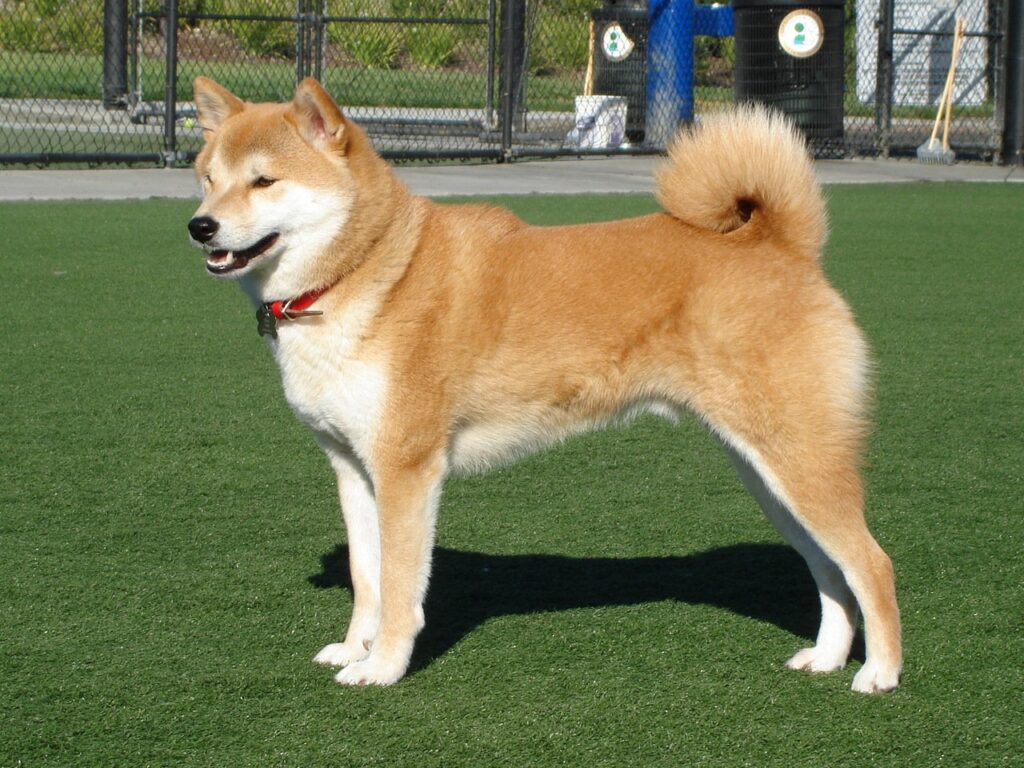
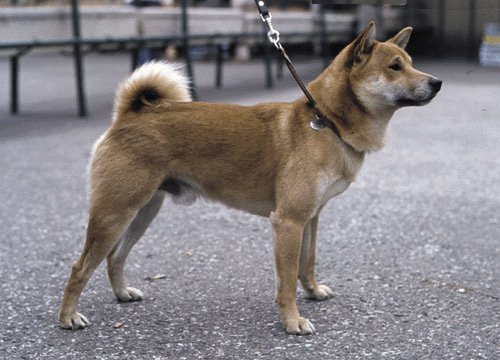
The standard puts general appearance this way: a dog of medium size with strongly marked sexual dimorphism, well balanced, sturdily built and well boned; the musculature firm and clean-cut. The proportions are spelled out in unusual detail for a Japanese breed — there are three of them here: height at withers to length of body, 10 : 11 (the body may be slightly longer in females); length of skull to length of foreface, 3 : 2; length of skull equal to the width of the cheeks. For comparison, the standards for the Shiba, Kai, Kishu, Shikoku and Akita stop at the first of these.
Skull and forehead: broad and slightly flat. The stop is shallow but defined.
Nose: black. A slight lack of pigment is permitted in white dogs.
Muzzle: wedge-shaped, with a straight bridge of nose. Cheeks well developed.
Lips and tongue: lips tight, with black edges. A separate sentence of the standard notes that a blue-black tongue is not a fault.
Teeth: strong, with a scissor bite.
Eyes: nearly triangular, not too small, dark brown; the outer corners slightly raised. This is the detail popular breed write-ups get wrong most often: the standard calls for eyes that are “not too small,” not for small eyes.
Ears: small, triangular, tilted slightly forward and firmly erect. Ears that do not stand are a disqualifying fault.
Neck: powerful and muscular, without dewlap.
Body: withers high, back straight and strong, loin moderately broad and muscular, croup with a correct slope. Forechest well developed, chest deep and moderately broad, ribs well sprung, belly slightly tucked up.
Tail: set high, thick, carried over the back in a vigorous curl or bent like a sickle; hanging down, the tip nearly reaches the hocks.
Limbs: shoulders moderately sloping, forearms straight and lean, pasterns slightly sloping, rear angulation moderate, hocks strong. Toes tight and well arched, pads thick and springy, nails hard, black or dark in color.
Gait: active, quick, light and springy.
The blue-black tongue: where the Hokkaido parts ways with the Akita
Pigment spots on the tongue turn up in nearly every text about the Hokkaido, usually with a hint at kinship with the Chow Chow. Check the hint against the documents and something more interesting appears. The Hokkaido standard (FCI No. 261) permits a blue-black tongue outright: it “is not a fault.” The Akita standard (FCI No. 255) lists “blue or black-spotted tongue” among its faults. The standards for the Shiba (No. 257), Kai (No. 317), Kishu (No. 318) and Shikoku (No. 319) do not mention the tongue at all. Of the six Japanese breeds, then, the Hokkaido is the only one whose standard specifically allows a pigmented tongue, and it does so where the closest relative in the group treats the same thing as a fault. The standards say nothing about the cause of the pigmentation, so we draw no pedigree from it — but the discrepancy itself can be checked against two PDFs on the FCI website.
Coat and color
The coat is double: the outer hair harsh and straight, the undercoat soft and dense, the hair on the tail fairly long and standing off. The standard recognizes six colors — the widest palette of any Japanese breed in the FCI nomenclature.
Sesame: the standard defines it as an even mixture of black, red and white hairs over the entire body.
Brindle: a striped pattern.
Red.
Black. Solid black is a recognized entry in its own right, and most popular breed descriptions drop it, keeping only “black and tan.”
Black and tan.
White. NIPPO observes that the share of white dogs has been rising in recent years.
Two details are easy to miss. First, the Hokkaido standard does not require “urajiro” — the light areas on the sides of the muzzle, the cheeks, throat, chest, belly and inner sides of the limbs — whereas the Shiba must have it in every color and the Akita in every color but white. Second, the list of faults in the Hokkaido standard includes “pinto color,” meaning large white patches on a colored ground: white is recognized as a solid coat, not as piebald marking.
Height: why the numbers differ from source to source
Precision pays off here, because height is where the confusion starts most often. FCI No. 261 gives height as a range: males 48.5–51.5 cm, females 45.5–48.5 cm. That is an exception among the Japanese breeds; every other FCI standard gives one ideal figure plus a tolerance — Shiba 39.5 / 36.5 cm with a tolerance of 1.5 cm, Kai 50 / 45 cm with +3 cm, Kishu and Shikoku 52 / 49 cm each with +3 cm, Akita 67 / 61 cm with ±3 cm. The Hokkaido is the only one of the six for which the FCI wrote limits.
Japan's NIPPO measures the breed on a different basis: male 52 cm (working range 46–55 cm), female 49 cm (43–52 cm). The Japanese association therefore puts the Hokkaido in the same size class as the Kishu and the Shikoku, while the FCI describes it as somewhat lower and between limits. Both sets of numbers are right; they simply come from two different documents. When a breed description shows “46–56 cm” as a single span covering both sexes, that is no longer a standard — it is two ranges merged into one. Neither FCI No. 261 nor the natural-monument record sets a weight.
Faults and disqualifications: what a judge looks for in the ring
The standard opens this section with the formula common to the whole FCI: any departure from what has been described is to be counted a fault, and the seriousness of the fault is weighed in exact proportion to its degree and to its effect on the health and welfare of the dog. A short list follows, which for the Hokkaido reads as below.
Faults: absence of sexual dimorphism (a male of female type and the reverse); slightly overshot or undershot mouth; timidity; pinto color.
Disqualifying faults: aggressiveness or excessive shyness; any obvious physical or behavioral abnormality; markedly overshot or undershot mouth; ears that do not stand; a hanging or bobbed tail.
Note that behavior sits here next to anatomy: under the standard a dog can be flawless in build and still be excused from judging over temperament. For a breed that popular writing presents as “stern and mistrustful,” that is a meaningful correction — reserve toward strangers and excessive shyness are different things, and the second is officially unacceptable.
A comparison with the close relatives: the imposing Akita Inu stands 15–19 cm taller at the withers under the standards, and the Shiba Inu stands roughly 9–12 cm lower. Together with the Kai, the Kishu and the Shikoku, the Hokkaido belongs to the medium-sized Japanese dogs, and mixing them up is easy: NIPPO notes specifically that the forechest of the Hokkaido is especially well developed, which makes it look like a dog with a lower center of gravity and gives it a stockier outline than the other medium Japanese dogs.
Temperament: what the standards put in writing, and what they leave unsaid
The “Behavior / temperament” section of FCI Standard No. 261 reads as follows: a dog of exceptional endurance, showing dignity and natural artlessness; the temperament is faithful, docile, very alert and bold; the dog also shows soundness of judgment and great stamina. “Docile” is neither a typo nor a softening — the word appears in the Kishu and Akita standards as well, and the Shikoku is described as “docile toward its master.”
In its own description of the Hokkaido, NIPPO goes further and warns explicitly against romanticizing the breed: in character the Hokkaido differs little from the other Japanese dogs, and despite its role on large game this is not a breed whose ferocity should be played up. That runs head-on into the mass image of the “fearless bear fighter” that travels from one text to the next. A hunting breed, yes; a breed whose aggressiveness is worth advertising, no.
The standard has one more dimension, rarely mentioned and thoroughly practical. Timidity is on the list of faults, and a dog that is “aggressive or overly shy” is disqualified along with “any dog showing obvious physical or behavioral abnormalities.” For a buyer this reads simply: in a breed where shyness is officially a fault, a puppy that shies away from people at 8–10 weeks and will not make contact is not a “typically reserved Japanese dog” but a reason to put more questions to the breeder.
What this means for living with the dog:
Selective attachment. The Hokkaido usually forms an especially close bond with one person, though the rest of the household also counts as “its own.” Plan the training so that more than the “main” owner works through the basic commands, or the dog will obey selectively.
Hunting motivation. The breed was built for work on game, so the quick movement of a small animal is a strong trigger. Count on secure fencing, a long line in unfamiliar places, and separate work on the recall.
Alertness without fuss. The standard calls the breed “very alert.” In practice that means a dog that reacts to changes rather than one that barks as background noise.
Friction with dogs of the same sex. This is a common trait of the hunting spitz breeds, and it belongs in your planning of walks and introductions.
If you want something equally out of the ordinary but with a different attitude toward small animals, take a look at the Mexican Hairless Dog (Xoloitzcuintli) — also a primitive breed, but with a completely different temperament and completely different grooming needs.
Training: a negotiation, not a contest
The standard credits the breed with “soundness of judgment,” and that is the most accurate description of what you will be dealing with on the training field. The problem is usually not that the dog fails to understand the command, but that it sizes up the situation on its own and decides whether the command is worth carrying out right now. Monotonous repetition therefore works worse than short, clear episodes that pay off for the dog.
Firmness without roughness. Physical pressure, in a breed where timidity is officially a fault, is the shortest route to a dog that shuts down or starts defending itself. What works is consistency and predictable rules.
Early socialization. By four months the puppy should meet the city calmly: traffic, crowds, loud noises, other dogs, the vet's office. Alertness is a trait of the standard; distrust of everything new is the result of a socialization window that was missed.
The recall as a project of its own. For a hunting breed this is not “one command among many” but a skill worked on for years and never tested for the first time where woods and game are close by.
Work for the head. Search games, scent work and routes that explore new places tire this kind of breed better than mechanically piling up the miles.
If other Japanese breeds with a comparable working background interest you, look at the Kai Ken (Tiger Dog) — another member of the six “Nihon Ken,” whose FCI standard recognizes brindle coats only.
Everyday care and housing
The Hokkaido does well in an apartment and in the yard of a private house alike — provided the yard is fenced, the dog is not kept on a chain and is not left alone around the clock. The breed was built to work beside people, and what breaks such dogs is social isolation, not cold. If you live in an apartment and are not ready to give the breed two or three hours of active movement every day, it is more honest to look at the Japanese Spitz: white and Japanese as well, but far less demanding in terms of exercise.
Grooming
The coat type described in the standard — harsh, straight outer hair plus a soft, dense undercoat — determines all of the care. Clipping such a coat is contraindicated: the outer hair does a protective job, including protection against overheating.
Outside the shedding season: comb through with a metal comb once or twice a week.
During the shed: daily, with a slicker brush or a wide-toothed comb; the undercoat comes out in sheets, and the more thoroughly you clear it, the fewer the mats and the less the skin irritation.
Bathing: rarely and as needed; frequent washing strips the greasy film that keeps water and dirt on the outside.
Nails, ears, teeth: regular checks and nail trimming; erect ears air out well, but they are worth inspecting for ticks after a trip to the woods.
Nutrition
Nutrition
Health and risks
Health and genetics: collie eye anomaly, and how to handle it
Frequently Asked Questions (FAQ) · 7
Are the Hokkaido, the Ainu Ken and the Hokkaido Ken the same breed?
Yes. In the FCI nomenclature the breed is called Hokkaido (Standard No. 261). “Hokkaido Ken” is the same name in Japanese; “Ainu Ken” is the historical name, tied to the fact that the Ainu bred these dogs for hunting. The breed took its official Japanese name from the region when it was entered in the register of natural monuments in 1937.
How does the Hokkaido differ from the Akita and the Shiba?
By size above all: under the standards the Akita is 67 cm in males, the Shiba 39.5 cm, the Hokkaido 48.5–51.5 cm. Beyond that: the Hokkaido admits six colors, among them solid black and brindle, which the Shiba does not have; “urajiro” is not required of it; and the blue-black tongue, a fault in the Akita standard, is expressly called no fault in the Hokkaido standard.
What is the main health test for this breed?
The DNA test for collie eye anomaly (a deletion in the NHEJ1 gene). The 2012 study in Veterinary Ophthalmology found that of 17 Hokkaido examined from three kennels, 12 were carriers and 5 affected, and concluded that the breed is highly susceptible. Ask the breeder for the test results for both parents.
Do Hokkaido bark much?
The standard describes the breed as very alert, and in practice this is a dog that speaks up for a reason rather than in the background. Even so, quietness is not a guaranteed breed characteristic: much depends on whether the dog gets enough exercise and whether it is left alone for long stretches.
Is the breed a good fit for a first-time owner?
The FCI standard calls the temperament faithful and docile, and NIPPO notes separately that ferocity is not something to emphasize in this breed, so the image of an “unmanageable beast” is overstated. But this is a hunting breed with a strong instinct and a high need for movement, so a first-time owner will need a trainer and an honest look at their own schedule.
How does the Hokkaido handle heat?
Worse than frost. The standard ties the build of the breed directly to its ability to withstand severe cold and heavy snowfall; the dense undercoat that saves it in winter gets in the way of heat loss in summer. In summer, walk the dog in the morning and the evening, provide shade and water, and do not clip it “to cool it down.”
How long do Hokkaido live?
We do not quote a figure we would be willing to sign our name to with a reference to a longevity study of this breed in particular. As a rough marker: the best-known representative of the breed, the advertising dog Kai-kun, lived 16 years according to Jiji Press.
Sources
FCI Standard No. 261 “HOKKAIDO,” current version of October 30, 2016 (English version of February 9, 2017); for comparison, FCI Standards No. 255, 257, 317, 318, 319.
Database of national cultural properties of Japan's Agency for Cultural Affairs, record “北海道犬,” natural monument, designated December 21, 1937.
NIPPO — 公益社団法人日本犬保存会: “Standard of the Japanese Dog” (1934) and the breed description 北海道犬.
Mizukami K. et al. Collie eye anomaly in Hokkaido dogs: case study. Veterinary Ophthalmology, 2012, 15(2), 128–132.
Hashimoto Y., Yamakawa T., Tanabe Y. Further studies on the red cell glycolipids of various breeds of dogs. Journal of Biochemistry, 1984, 96, 1777–1782.
Xiaokaiti X. et al. The history of ancient Japanese dogs revealed by mitogenomes. Anthropological Science, 2024.
Language archive of the National Ainu Museum (国立アイヌ民族博物館), dictionary entries on the names for the dog.
Japan Kennel Club (JKC), registration statistics for 2025.
The breed on video
FAQ
Are the Hokkaido, the Hokkaido Ken and the Ainu Ken the same breed?
Yes. In the FCI nomenclature the breed is called Hokkaido (Standard No. 261). “Ainu Ken” is the historical name, tied to the fact that the Ainu bred these dogs for hunting; the breed took its official Japanese name from the region when it was entered in the register of natural monuments in 1937.
What is the main health test for the Hokkaido?
The DNA test for collie eye anomaly — a deletion in the NHEJ1 gene. In the 2012 study (Veterinary Ophthalmology, 15(2), 128–132), of 17 Hokkaido examined from three kennels 12 turned out to be carriers and 5 affected; the authors concluded that the breed is highly susceptible. Ask for the test results for both parents of the puppy.
How tall is the Hokkaido?
Under FCI Standard No. 261: males 48.5–51.5 cm, females 45.5–48.5 cm. The Japanese NIPPO standard gives different numbers: male 52 cm (46–55), female 49 cm (43–52). These are two separate documents, so both pairs are correct; merging them into one range covering both sexes is a mistake.
Is the Hokkaido a good fit for a first-time owner?
The FCI standard calls the temperament faithful and docile, and NIPPO notes separately that ferocity is not something to emphasize in this breed — the image of an “unmanageable beast” is overstated. But this is a hunting breed with a strong instinct and a high need for movement: a first-time owner will need a trainer, secure fencing and separate work on the recall.
How does the Hokkaido differ from the Akita and the Shiba?
By size above all: under the standards the Akita is 67 cm in males, the Shiba 39.5 cm, the Hokkaido 48.5–51.5 cm. Beyond that: the Hokkaido admits six colors, among them solid black and brindle; “urajiro” is not required of it; and the blue-black tongue, a fault in the Akita standard, is expressly called no fault in the Hokkaido standard.
How does the Hokkaido handle heat?
Worse than frost. The standard ties the build of the breed directly to its ability to withstand severe cold and heavy snowfall; the dense undercoat that saves it in winter gets in the way of heat loss in summer. In summer, walk early in the morning and late in the evening, provide shade and water, and do not clip the dog “to cool it down.”