not FCI-recognized (Indian sighthound) · India (Rampur region, Uttar Pradesh state)
Rampur Greyhound
A swift Indian sighthound with a royal past: fast, hardy, reserved and devoted to one master. The Rampur Hound is a large smooth-coated sighthound from northern India, bred by maharajas to hunt jackals and boar; an athlete that combines lightning speed with an independent, aristocratic character.
Apartment · with caveatsKids · with caveatsCats · not suitableOther dogs · with caveatsBeginners · with caveats
The Rampur Greyhound is an aristocratic breed that is slowly disappearing. In the modern world, where there is no longer a pressing need to hunt large felines, these majestic athletes are losing their original purpose. It is an athletic and refined dog that possesses remarkable speed, phenomenally sharp eyesight, and boundless courage. Brave, hardy, and successful in its work, it is capable of covering huge distances under the scorching Indian sun. Learn more on Tvaryny.
Rampur Greyhound: A Brief Breed Overview and Key Characteristics
Rampur Greyhound: A Brief Breed Overview and Key Characteristics · 7
Characteristic
Description
Origin
India (Rampur region, Uttar Pradesh state)
First Mentioned
Approx. 1700s (end of the Mughal era)
Purpose
Hunting boar, jackal, and historically leopards and tigers
Lifespan
13–15 years (quite long-lived for their size)
Height at withers
Males: 26–30 in (65–75 cm); Females: 24–28 in (60–70 cm)
Weight
48–66 lbs (22–30 kg) (muscle mass without excess fat)
Coat Type
Short, smooth, close-fitting (mouse-gray)
Interesting Facts About the Breed
Royal Status: In the breed's heyday in Rampur, these dogs wore collars adorned with precious stones and had their own servants.
Unique Paw: Rampur paws have a structure that allows the toes to bend like human fingers, which helps them grip the ground better during sharp turns.
Non-recognition: The breed is still not recognized by the world's largest kennel organizations (FCI, AKC), but is recognized by the Kennel Club of India (KCI) and the Canadian club.
Relatives: Genetic studies show that the Rampur shares roots with the ancient Aboriginal Afghan Hound, which explains their endurance.
Eye Color: A unique "gooseberry" eye color is considered a sign of breed purity, although dark shades are also permitted.
History of the Breed: From Royal Palaces to Obscurity
An aristocratic breed of leopard hunters couldn't have just appeared in the backyards of commoners. Over two hundred years ago in the Rampur area, located between Delhi and Bareilly, the ruler himself - Nawab Ahmed Ali Khan Bahadur - focused on breeding them. His goal was to create the perfect hunting dog that would combine incredible speed for chasing prey in open fields with the physical strength to fight a dangerous beast.
The blood of the world's best sighthounds is intertwined in the Rampur's genetic code. According to the main theory, these dogs were bred by crossing the powerful and fierce Aboriginal Afghan Hound with the classic English Greyhound, which was brought to India by British colonists. From the Greyhound, the breed received explosive speed, and from Afghan ancestors, it gained endurance in harsh climatic conditions and toughness toward the beast. There is also a theory about the admixture of Saluki or Sloughi blood, which explains certain features of the head structure.
This brave, refined, and fast dog quickly became a sign of wealth and high status. It took part in the hunts of the nobility, pursuing not only fleet-footed antelopes but also large predators. Historical chronicles describe cases where a pack of Rampurs could stop and hold a leopard until the hunter arrived. Paradoxically, the Rampur Greyhound never showed aggression toward people and treated children with amazing gentleness, allowing them to play with it after an exhausting hunt.
However, times change. Since hunting lions and other big game began to lose relevance, and was subsequently banned by law in India, the number of Rampur Greyhounds began to decline rapidly. Having lost their functional purpose, they became too expensive for ordinary farmers to keep. It is likely that today we are witnessing the final days of the purebred Rampur Greyhound population in their historical range.
Outside of India, a small number of the breed lives in the USA (specifically in New Jersey), where they were brought by enthusiasts. Unfortunately, the revival of interest in Rampur Greyhounds has not yet contributed to a noticeable increase in the breed's numbers, and it remains in the category of rare exotics.
What the Rampur Greyhound Looks Like: Detailed Description of Appearance
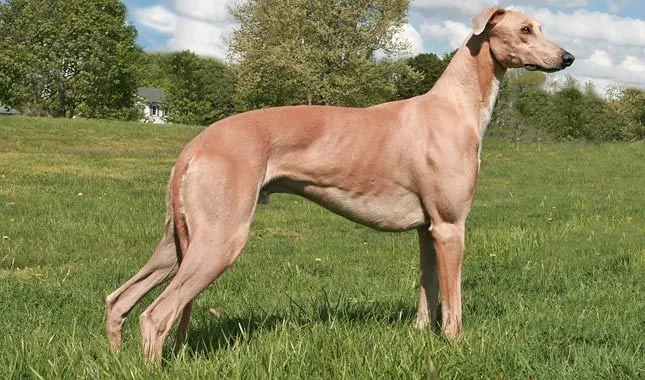
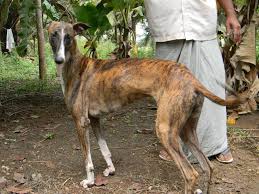
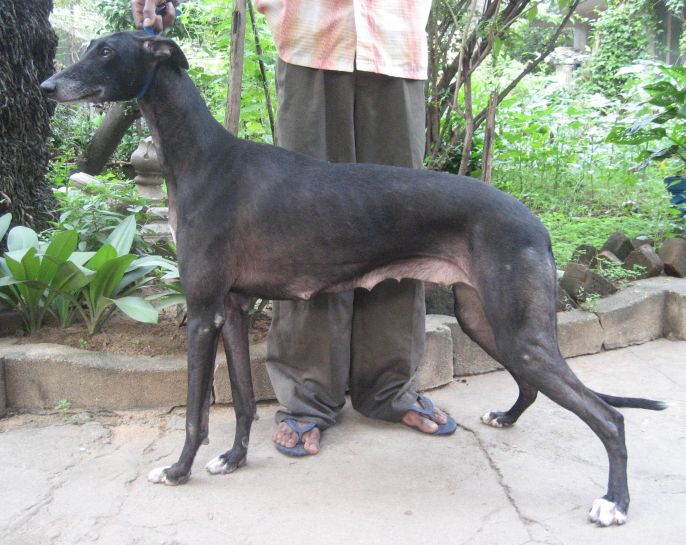
This is a slender, muscular dog that visually may seem somewhat coarser than the English Greyhound, but it is significantly larger than the Sloughi, although very similiar to it in general outline. The Rampur Greyhound can be recognized by a specific gaze: its eyes range from amber to dark brown (sometimes described as "yellow"), and they are often framed by a black rim, giving the look expressiveness and a certain magic.
Head and Muzzle: It has a characteristic head shape, which is wider than that of classic Western sighthounds. The skull is flat, the muzzle is long and strong, tapering to the nose, but it is not pointed ("snipey"). The ears are triangular and set high; in repose, they are folded back (rose-shaped), and when excited, they may be semi-erect. A distinct feature is the so-called "Roman nose" (a slight hump), which is often found in the best examples.
Body: The dog has a distinctly athletic build, evidenced by its strong back, slightly arched in the loin, and long, wiry limbs. Rampur Greyhounds are characterized by a very deep chest, which provides large lung volume for long runs, and an extremely thin waist with a sharply tucked-up abdomen. This creates the classic silhouette of a sighthound ready to sprint.
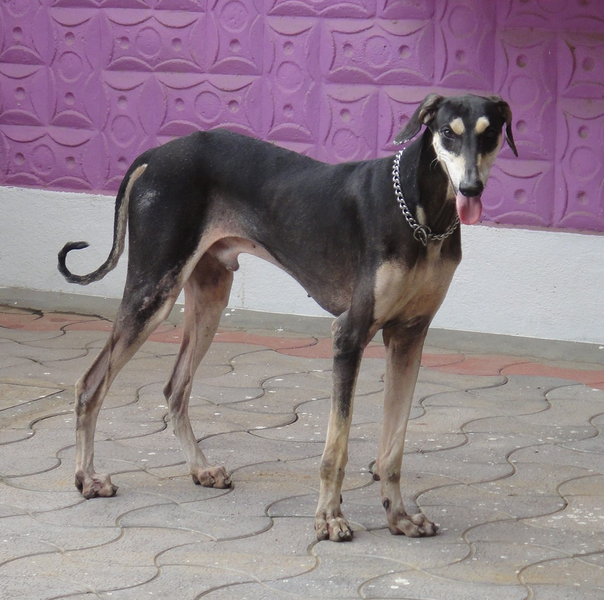
Limbs and Tail: The Rampur's paws are of the "hare" type, elongated, with tightly gathered toes and thick pads, which allow them to run on the hard, rocky soil of India without injury. This distinguishes them, for example, from the Poitevin Hound, which has a slightly different paw structure adapted to European forests. Their thin, long tail tapers to the end and reaches below the hocks, often curling into a hook at the tip.
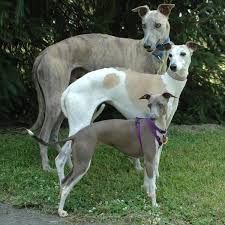
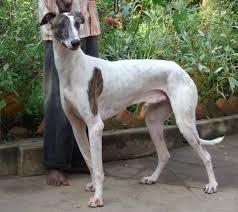
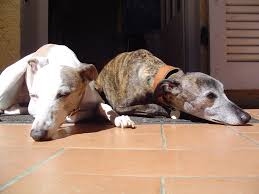
Usually, representatives of the breed have a black coat, sometimes gray (blue) or white. Rampurs with brindle or spotted markings on smooth fur are also found. The short coat of these dogs does not create grooming problems; to the touch, it resembles velvet or mole fur. In general, the Rampur Greyhound is a true beauty with a special, recognizable appearance that radiates strength and nobility.
Character: Temperament, Behavior, and Hunter Psychology
The Rampur Greyhound is not just a couch pet, but a fully-fledged, thinking family member with a complex inner world. It is capable of giving its owner boundless loyalty and devotion while providing pleasant and gentle companionship to all household members. This dog treats children with incredible tenderness, often acting as a patient "nanny," which is rare for such serious hunting breeds.
It has a great need for tactile contact and interaction with humans and is not prone to unprovoked aggressive outbursts. In everyday life, the Rampur is often "invisible" - it loves to sleep curled up and does not annoy anyone with barking. By the way, they bark extremely rarely, only in case of a real threat or strong excitement. However, one should not confuse their calmness with weakness. Rampurs are successfully trained for protection work and apprehending intruders, and this four-legged powerhouse achieves significant success thanks to its lightning-fast reactions.
During a hunt, representatives of the breed transform instantly. They develop remarkable speed (up to 40 mph/60 km/h and more) and are brave, passionate, and enduring. Despite their physical superiority even over dangerous predators, Rampur Greyhounds are obedient pets at home that catch every glance of the owner. This aristocratic dog in the yard promises good treatment to the master and everyone the master considers a friend. But with strangers, the Rampur can be suspicious and coldly aloof, not allowing familiarity. Of course, such an ideal picture is possible only with proper upbringing and early socialization.
Training and Socialization: How to Find Common Ground
The first and most important stage in training a Rampur Greyhound is teaching obedience and contact with the owner. By nature, this breed is prone to submissive behavior at home; however, outdoors, instincts can take over. Timely establishment of authority is a mandatory aspect of puppy upbringing. Here the owner should show firmness and consistency but avoid excessive severity or physical punishment. The Rampur is a proud dog; it should not fear the trainer, it should respect and trust them.
Representatives of the breed are endowed with sufficient intelligence to perform various tricks and commands, although sometimes they may think for a long time about the expediency of the action. The dog will master everything if training fills its every day and is based on positive reinforcement (treats, toys). Usually, basic training of Rampur Greyhounds does not drag on. The right approach allows you to get a well-mannered dog that knows various tricks and performs complex commands.
Early socialization is important. Introduce the puppy to different people, sounds, transportation, and other animals. This will help avoid excessive skittishness or aggression in the future. Remember their kinship with breeds such as the Caravan Hound (Mudhol Hound) - these are pack dogs, so they feel good in the company of other sighthounds but may conflict with dominant dogs of other breeds.
Pros and Cons of the Breed
Pros (+)
Cons (-)
Devotion: Extremely attached to family, often choose "one master."
Hunting Instinct: May chase cats, small dogs, and squirrels on a walk.
Minimal Grooming: Coat needs no trimming or frequent bathing.
Need for Movement: Require large fenced areas for free running.
Health: Genetically robust breed without excessive "commercial" breeding.
Rarity: Extremely difficult to find a purebred puppy outside India.
Guard Qualities: Can be good watchdogs due to mistrust of strangers.
Independence: Can be stubborn during training, require partnership, not drill.
Quiet: Almost never bark without reason.
Sensitivity to Cold: Freeze in cold climates due to lack of undercoat.
Coat Care and Maintenance
A large, fast, and active dog is categorically not suited for a cramped city apartment. The Rampur Greyhound needs a spacious yard, which should be fenced with the calculation that it is capable of jumping over a fence 6.5 feet (2 meters) high. Such a pet spends a lot of time in movement and play, so the question of space is perhaps the most important when choosing this hunting breed. If you cannot provide free running in a closed area, be prepared for daily multi-mile walks on a leash or coursing sessions (running after a mechanical lure).
In Rampur Greyhounds, the main lines of the skeleton and muscles are easily visible. Due to the lack of a fat layer, it is uncomfortable and even painful for such a dog to sleep on a hard, rigid surface. Therefore, a soft sleeping place (bed, sofa), protected from drafts, is prepared for it. They are heat-loving and can get cold in winter, so warm clothes for walks in freezing weather are not a luxury, but a necessity.
The smooth coat of the Rampur does not even need frequent brushing - it is enough to occasionally wipe the short cover with a damp towel or a special rubber mitt to remove dead hairs and give the coat a shine. Given their Asian history, representatives of the breed are accustomed to bathing in open bodies of water in hot India, so many of them love water and swim willingly in summer.
Nutrition
Nutrition: Key Recommendations
Health and risks
Health: Typical Diseases and Prevention
Frequently Asked Questions (FAQ) · 3
Is the Rampur Greyhound suitable for a family with children?
Yes, they are amazingly patient and gentle with children of their "pack." However, due to their large size and activity, the dog's games with little ones should take place under adult supervision so the dog doesn't accidentally knock the child over.
Is this dog difficult to train?
The Rampur is a thinking dog. It will not blindly follow commands like a shepherd dog. Training requires patience, respect, and motivation. They are intelligent but can be stubborn, so military-style drill does not work here.
Can they live with cats?
It is risky. The hunting instinct in Rampurs is very strong. If a puppy grew up with a cat, they may be friends in the house, but outside any small running animal is perceived as prey.
Video About the Breed
FAQ
How does the Rampur Hound differ from the English Greyhound?
It is a little taller and leaner, more tolerant of heat and drought and hardier in health, but also more independent and reserved with strangers.
Does it get along with cats?
Usually poorly — the breed has a very strong chase instinct; living with cats and small animals is problematic.
Is it suitable for an apartment?
Conditionally — it is calm at home but needs long daily runs in a safe area; without exercise it grows bored.