

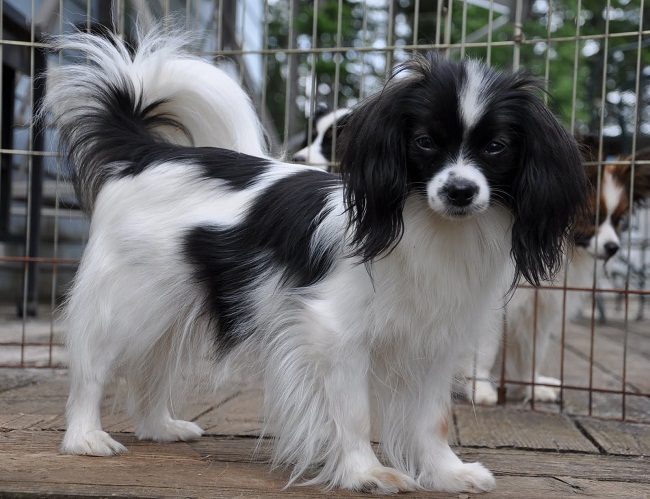
| Height | 20–28 cm |
| Weight | 1.8–4.5 kg |
| Lifespan | 13–15 years |
| FCI group | 9 · companion and toy dogs |
| Origin | France / Belgium |
Exact ratings
- Generally a healthy, long-lived breed
- Luxating patella
- Progressive retinal atrophy (PRA)
- Dental disease (small mouth)
- Fragile bones (injuries from falls)
Small portions of a quality small-breed food, with weight control. Regular combing of the long silky coat; look after the teeth; protect from falls from a height.
The Continental Toy Spaniel (Phalène) isn’t just a dog – it is living history embodied in an elegant, miniature frame. This ancient breed of decorative dog, with its beautiful coat and characteristic drooping ears resembling the folded wings of a moth, adorned the royal palaces of Europe for centuries. A combination of aristocratic looks, high intelligence, and a pleasant nature has made these dressed-up little ones famous pets, though they are currently less common in the modern world than their erect-eared relatives, the Papillons. The devoted Phalène is excellent for apartment living and is remarkably clean. It will spend all its energy cheering up the family it lives with and playing intellectual games. Read more about this on Tvaryny.
Continental Toy Spaniel (Phalène): A Brief Overview and Biometrics
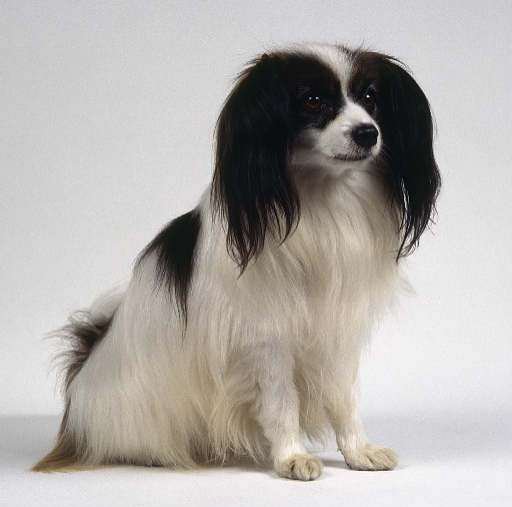
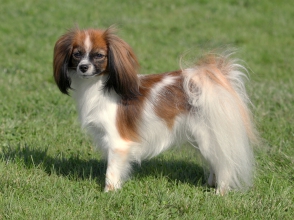
The Phalène is a variety of the Continental Toy Spaniel that differs from the Papillon exclusively by its ear set. While the Papillon’s ears stand vertically and resemble the open wings of a butterfly, the Phalène’s ears hang down, framing the head, which gives it a softer and more touching expression. It is a companion dog with a sturdy bone structure, despite its fragile appearance.
| Country of Origin | France, Belgium (officially recognized by the FCI) |
| Purpose | Companion, Toy dog |
| FCI Classification | Group 9 (Companion and Toy Dogs), Section 9 (Continental Toy Spaniel) |
| First Standard Mention | 1934 (separation of varieties, though the breed is much older) |
| Life Span | 12-15 years (long-lived individuals up to 17 years are common) |
| Height at Withers | 8-11 inches (20-28 cm) |
| Weight | 3.3 – 5.5 lbs (mini), 5.5 – 10 lbs (standard) |
| Coat Type | Long, silky, without undercoat |
History of the Breed: From Royal Chambers to the Present Day
The history of the dwarf spaniel spans about a thousand years and is beautifully illustrated by numerous works of art. European painting – primarily portraiture – often turns to the image of a tiny dog with a cute appearance sitting in its owner’s arms. It is the Phalène that is the initial, “original” form of the Continental Toy Spaniel. In the paintings of Titian, Rubens, Clouet, and other masters of the Renaissance, we see precisely these drop-eared spaniels. They were the favorites of Madame de Pompadour and Marie Antoinette.
Interestingly, the appearance of erect ears (Papillons) occurred significantly later, probably as a result of the infusion of Spitz or Terrier blood to reduce size. Until the 19th century, Phalènes dominated, but subsequently, fashion changed in favor of the “butterflies.” In the first third of the 20th century, cynologists engaged in breeding a stable breed type of the toy spaniel – the decorative mite quickly inhabited specialized kennels, yet remained a rare family dog. Today, the Phalène is experiencing a renaissance of sorts, as connoisseurs of classical beauty return to the breed’s origins.
Appearance and Anatomy: What the Ideal Phalène Looks Like
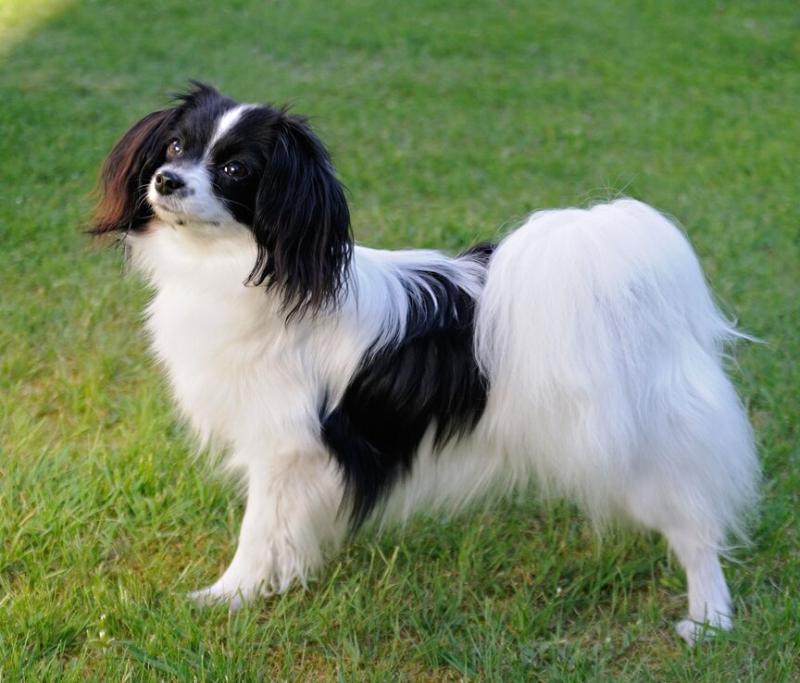
A small dog with a harmonious body structure, an elongated body, a rounded head, and drooping ears – it is their shape that is the main marker distinguishing the Phalène from the Continental Toy Spaniel Papillon. It is important to understand that anatomically, apart from the ear cartilage, these dogs are identical.
Head and Skull
The cranium should not be too round (like an apple) but must have a clearly defined stop (the transition from forehead to muzzle). The muzzle is shorter than the cranial part, pointed, but not as flat as in brachycephalic breeds; for example, if compared with the Pekingese breed, the Phalène has open airways and does not create problems.
Ears – The Pride of the Breed
The ears are set high, significantly above the eye line. They are pendulous but quite mobile at the same time. The ear leather should be strong but soft. A key feature is the long decorative hair on the ears, which creates a “fringing” effect. At rest, the ears lie against the head, but when the dog is alert, they may lift slightly at the base, yet the tips always remain dropped down.
Body and Coat
A deep chest ends low between the forelegs, ensuring sufficient volume for the lungs and heart. The dog’s belly is tucked up, and a long tail rises to the topline with a beautiful curve forward, forming a “fountain” of hair. It is adorned with long strands of hair – as are the ears and limbs; on the body, the thick coat is somewhat shorter but lies flat. Its coloring consists of colored patches on a white background, the area of which should predominate. A symmetrical white blaze between the Phalène’s eyes is especialy appreciated, adding expression to the muzzle.
The coat structure is silky, wavy, but not curly. It is reminiscent of another eastern aristocrat – the Japanese Chin, but is thicker and more resilient. An important point: the Phalène completely lacks an undercoat, which makes it less allergenic and simplifies cleaning in the house.
Temperament: An Intellectual in a Toy Body
This little one possesses a balanced temperament, which distinguishes it somewhat from the more choleric terriers. One can often hear the opinion that Phalènes are calmer than Papillons, more “grounded.” It may show a cool attitude towards strangers, with whom it tries to keep a distance without showing aggression, but also without making contact first. On the other hand, the owner’s family will find a wonderful companion for games and fun in the Continental Toy Spaniel.
- Intellect: Phalènes are in the top 10 smartest dog breeds in the world. They memorize hundreds of words and gestures.
- Empathy: The dog keenly feels the owner’s mood. If you are sad, the Phalène will simply lie next to you, touching you with its silky coat, like a small Cavalier King Charles Spaniel, with whom they share common roots.
- Activity: A tireless and lively dog will gladly take up an interesting activity. They show excellent results in agility and dog dancing (freestyle).
But if it feels a lack of attention from a human, it will become jealous or even fall into depression. The cute indoor pet can sometimes resort to stubbornness, which will require some patience and consistency in training from you.
Health: Specifics of the Drop-Eared Variety
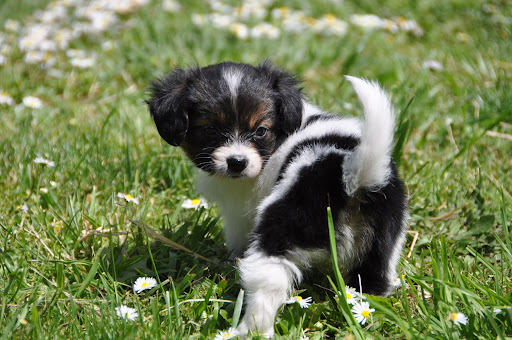
The breed is sturdy overall but not problem-free — the cautions are listed below. However, there are nuances that a future owner is obliged to know.
Ears – A Zone of Special Attention. The Phalène’s hanging ears create favorable conditions for the development of inflammatory processes (otitis) due to poorer ventilation of the ear canal compared to the Papillon. It is important to regularly inspect the auricle, remove excess hair from inside the canal (if it hinders air circulation), and perform all hygiene procedures in a timely manner.
A notable feature of the Continental Toy Spaniel’s organism, which relates them to other miniature breeds, is a sensitive reaction to high environmental temperatures. The little one can easily overheat, so it is necessary to prevent heatstroke and not walk it in the heat of the sun.
| Disease | Description and Symptoms | Prevention |
|---|---|---|
| Progressive Retinal Atrophy (PRA) | Genetic disease leading to blindness. | DNA testing of parents before breeding. |
| Patella Luxation | Lameness, the dog tucks up a leg when running. | Weight control, moderate loads, chondroprotectors. |
| Tartar | Unpleasant smell, gum inflammation, tooth loss. | Brushing teeth 2-3 times a week, ultrasonic cleaning at the vet. |
| Reverse Sneezing | Specific spasm of the larynx, similar to grunting. | Usually does not require treatment, passes on its own (stroke the throat). |
Coat Care and Hygiene
Caring for a Phalène is somewhat simpler than for other long-haired breeds, thanks to the absence of an undercoat – the fur does not mat so quickly. The Continental Toy Spaniel is an indoor dog who, like most dogs of decorative breeds, does not require exhausting physical loads. To satisfy its need for movement and fresh air, a very short walk is sufficient, yet it will happily support a long hike in the park.
Care Algorithm:
- Brushing: The thick coat of such a pet should be brushed every two days using a comb with long teeth and a soft brush. Pay special attention to the area behind the ears (where the hair is thinnest and most delicate), under the armpits, and on the “pants.”
- Bathing: You will have to bathe the homebody Phalène only when necessary or once every 10-14 days using professional moisturizing shampoos for long-haired dogs. It is important not to overdry the guard hair.
- Ears: Carefully monitor the cleanliness of the ears. After a walk in damp weather, the tips of the ears may get dirty – they should be washed with running water and dried.
- Nails: Trimming nails once every 2 weeks is mandatory, because due to the dog’s low weight, they are not worn down on the asphalt naturally.
Training and Socialization: Raising a Genius

Devoted to its owner, the Continental Toy Spaniel is a breed that is easily trained. Its representatives occupy an honorable place in the ranking of the smartest dogs, yielding only to Border Collies and Poodles. This means that a Phalène learns a new command in less than 5-10 repetitions. However, this intelligence has a downside: the dog quickly learns to manipulate the owner.
A well-bred Phalène will not create conflicts with cats and, what is very important for an indoor dog, will willingly use a litter box or puppy pad in bad weather. It requires close contact with a human, so the best choice for the owner will be a gentle approach to such a pet. Harsh methods, shouting, or physical punishment are absolutely unacceptable – this will lead to the dog becoming fearful and withdrawn. Use clicker training and plenty of treats.
Important: Do not allow the development of “Small Dog Syndrome,” when you allow the Phalène to growl at guests or other dogs just because it is small and looks “cute.” The Phalène is a big dog in a small body, and it needs clear boundaries of what is permitted.
Diet: Preventing Obesity
It is not difficult to overfeed a Phalène – if a somewhat rounded physique is allowed for a puppy, then for an adult dog, a thick layer of fat on the ribs indicates obesity, which is critical for its fine joints. After six months, food intake is reduced to two to three times a day, adhering to a strict feeding schedule.
Never feed it before a walk; digestion requires rest and a calm environment to avoid bloat (although this is rare in small breeds, better safe than sorry). Natural food is advisable to enrich with special additives (calcium, omega-3 for the coat), and the vitamin-mineral composition of super-premium dry food or holistic food is already balanced according to the main indicators. Avoid foods with a high grain content, as Phalènes can have sensitive digestion.
Pros and Cons of the Breed
When choosing a dog, it is important to weigh all the pros and cons, as you are taking responsibility for 15 years.
| Advantages (Pros) | Disadvantages (Cons) |
|---|---|
| High intelligence and learning ability | Tendency to bark (if not trained) |
| Lack of “doggy” smell and cleanliness | Demanding care for long hair |
| Compact size, ideal for travel | Does not tolerate loneliness (may howl) |
| Friendliness to other animals | Fragility of bones (dangerous with very small children) |
| Exclusivity (encountered less often than the Papillon) | High cost of puppies |
Interesting Facts about Phalènes
- Moth’s Name: “Phalène” translated from French means “moth” or “nocturnal butterfly.” The breed received this name because the dropped ears resemble the folded wings of a moth at rest, unlike the “Papillon” (day butterfly), which holds its wings open.
- Royal Blood: There is a legend that it was a Phalène that accompanied Queen Mary Stuart to the execution, hiding in the folds of her dress.
- Different in One Litter: A Phalène puppy can be born from two Papillons, and vice versa. This is connected to genetics, but in breeding, they try not to cross these two varieties with each other to avoid semi-erect ears, which is a fault.
Frequently Asked Questions About the Breed (FAQ)
Do Phalènes Shed?
Yes, but since they have no undercoat, shedding is not catastrophic. The hair falls as single hairs that are easy to collect from furniture; it does not drive into carpets like the needles of short-haired breeds.
Is a Phalène Suitable for a Family with a Child?
Yes, if the child understands that the dog is not a toy. Phalènes are playful, but due to their small size, a child can accidentally injure the dog. It is reccomended to get this breed for children aged 6-7 years and older.
Do They Bark?
Like all spaniels, they have a watchdog instinct and can announce guests with a ringing bark. However, they are not “yappers” by nature; this is corrected by upbringing.
Video About the Breed
- Very clever, easy to train
- Affectionate, sociable and clean
- Ideal for an apartment
- Generally robust health, long-lived
- Delicate — take care with small children
- The long coat needs combing
- Cannot bear long solitude
- Can be a vocal watchdog
| Papillon | Cavalier King Charles Spaniel | Japanese Chin | |
|---|---|---|---|
| Height | 20–28 cm | 30–33 cm | 20–28 cm |
| Energy | 3.5 | 3 | 2.5 |
| Apartment | 5 | 4.5 | 5 |
| Beginners | 4 | 4 | 4 |
How does the Phalène differ from the Papillon?
Is the Phalène suitable for an apartment?
Is the Phalène easy to train?
FCI Standard No. 77 · Fédération Cynologique Internationale
For apartments · For kids · For beginners · Active · Smartest · Hypoallergenic · All rankings →