

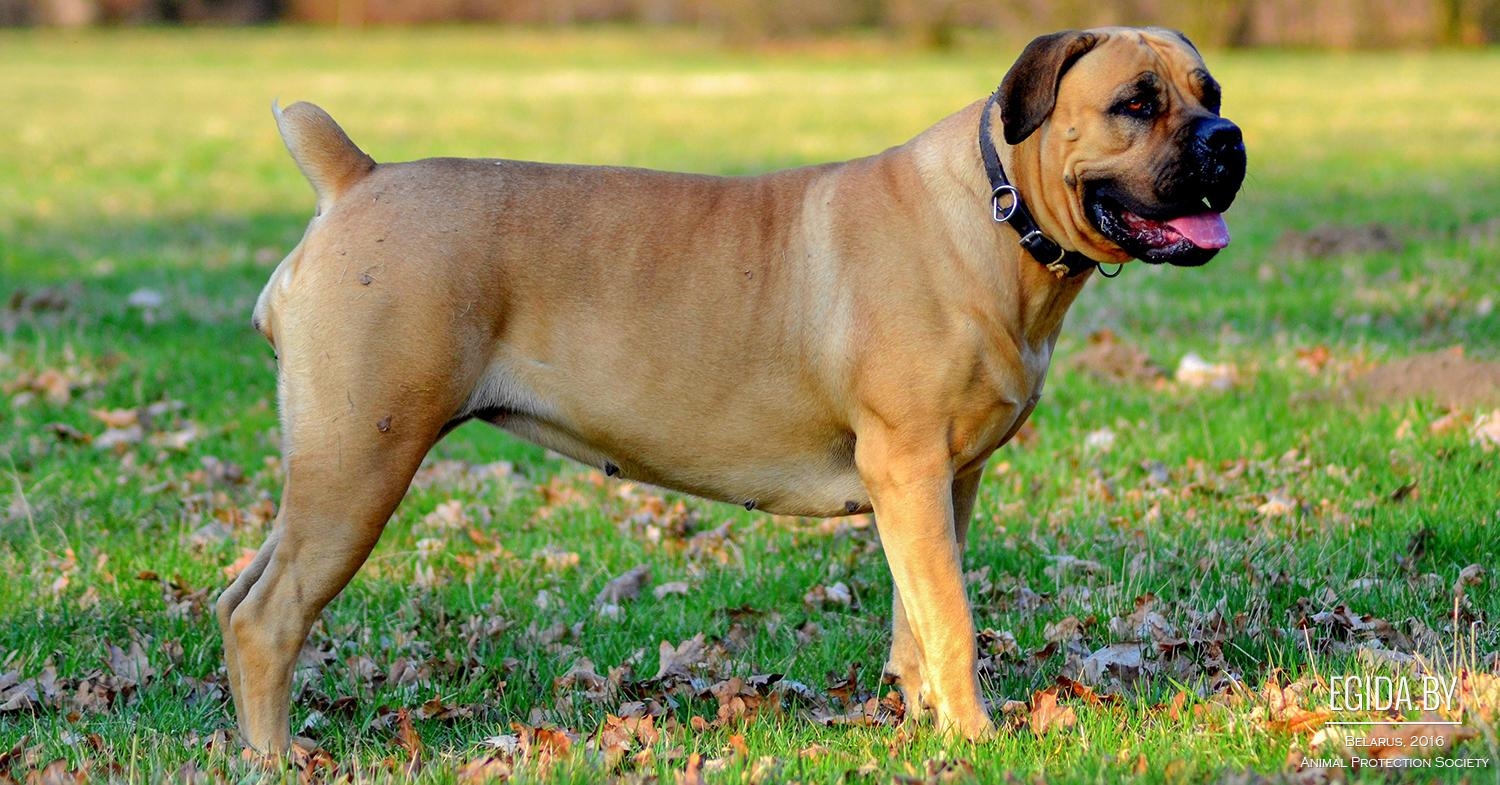
| Height | 56–69 cm |
| Weight | 50–90 kg |
| Lifespan | 9–11 years |
| FCI group | 2 · molossoids |
| Origin | South Africa |
Exact ratings
Common health issues
Nutrition
The Boerboel is a majestic and powerful dog breed hailing from South Africa, known for its impressive size, athletic build, and the character of a true guardian. Yet, behind that formidable appearance lies a loyal friend, an intelligent companion, and a gentle nanny for children. Their developed physical traits combine harmoniously with a balanced mind; Boerboels are a thinking breed capable of assessing situations and acting deliberately. These energetic, graceful, and brave animals make ideal partners for people with an active lifestyle and will win you over with their devotion at first sight. Read more on Tvaryny.
The Boerboel: General Breed Characteristics
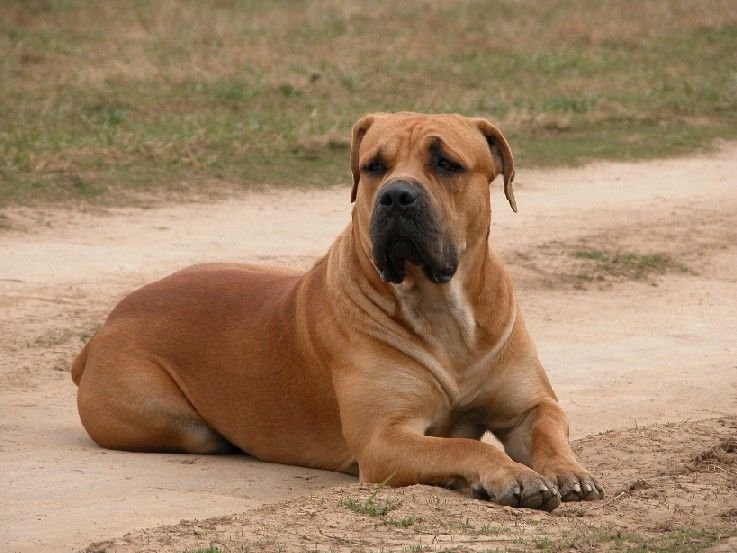
| Parameter | Characteristic |
| Origin | South Africa |
| Original Name | Boerboel (“farmer’s dog” in Afrikaans) |
| FCI Classification | Group 2 (Pinscher and Schnauzer, Molossoid, Swiss Mountain and Cattle Dogs), Section 2.1 (Molossoid, Mastiff type). Not fully recognized yet. |
| Lifespan | 10-12 years |
| Height at Withers | Males: 24–28 in (60–70 cm) Females: 22–26 in (55–65 cm) |
| Weight | Males: 130–200 lbs (60–90 kg) Females: 110–165 lbs (50–75 kg) |
| Temperament | Intelligent, obedient, confident, calm, brave, territorial, loyal |
| Activity Level | High |
| Drooling Potential | Moderate |
| Barking Tendency | Low (barks mainly when necessary) |
| Aggression Level | Low toward family, high toward threats (requires control and socialization) |
| Compatibility with Kids | Very High (with proper training) |
| Compatibility with Other Pets | Moderate (requires early socialization) |
History of the South African Boerboel
The history of the Boerboel is tightly interwoven with the history of South Africa’s colonization. Unlike legends linking them to Alexander the Great’s dogs, the actual facts are just as fascinating. The foundation for the breed was laid by sturdy, mastiff-like dogs brought to the Cape of Good Hope by European settlers in the 17th century. One of the first was Jan van Riebeeck, who arrived in 1652 with a “Bullenbijter” (Bullenbijter) – which translates to “bull biter”.
These dogs were crossed with other European breeds, such as the English Mastiff and the Bullmastiff, as well as native African dogs. In the harsh conditions of the African bush, only the strongest, most resilient, and smartest individuals survived. Farmers (Boers) needed a versatile dog: a reliable guardian to protect the family and livestock from predators (lions, leopards, hyenas), a hunting assistant, and a loyal companion. Thus, the “Boerboel” – the “farmer’s dog” – emerged.
For centuries, the breed developed in relative isolation. However, in the 20th century, due to urbanization and uncontrolled crossbreeding, purebred Boerboels faced the threat of extinction. In the 1980s, a group of enthusiasts led by Lucas van der Merwe created the South African Boerboel Breeders’ Association (SABT). They drove thousands of miles to find and register the best representatives of the breed, saving it from dissappearing. Today, the Boerboel is a national pride of South Africa, although at one time, exporting these dogs out of the country was strictly limited.
Standard and Appearance
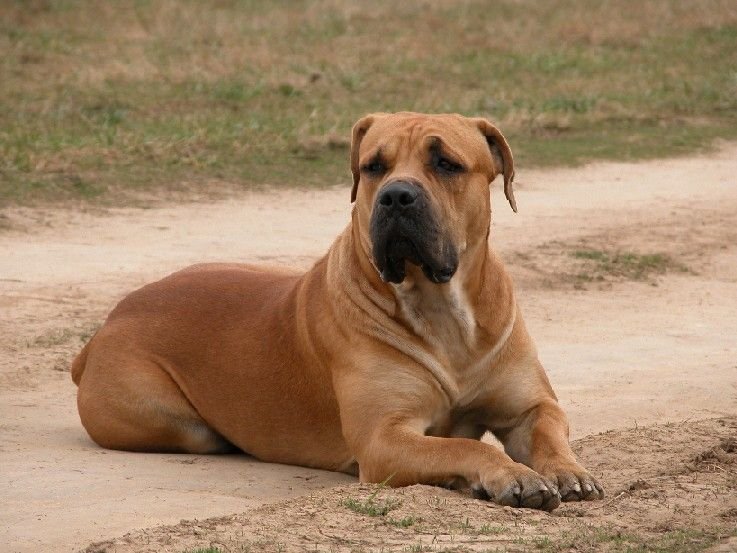
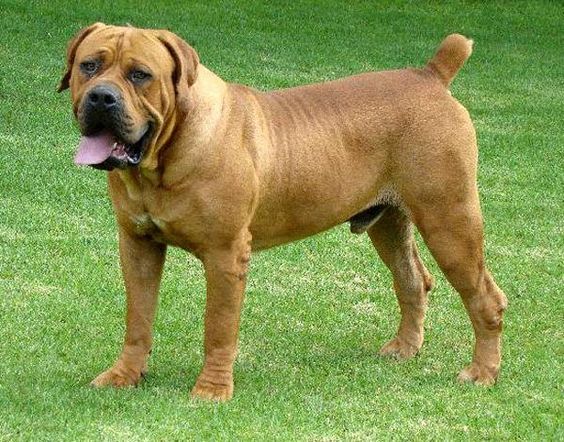
The Boerboel is the embodiment of strength, power, and harmony. Every feature of its appearance speaks to functionality and athleticism. This is a large, well-proportioned dog with well-developed muscles. Its movements are light, springy, and surprisingly silent for such a size, achieved thanks to the elasticity of its ligaments.
Key Physical Traits:
- Head: Large, broad, square, with powerful jaws. The skull is flat, and cheek muscles are well-developed. The muzzle is short but not flattened. A dark “mask” is often present.
- Eyes: Medium-sized, widely spaced, ranging in color from yellow to dark brown. The gaze is direct, confident, and intelligent.
- Ears: V-shaped, medium-sized, hanging, and set high. When calm, they lie close to the cheeks.
- Body: Rectangular, sturdy, with a broad and deep chest. The back is straight and strong.
- Limbs: Strong, straight, with heavy bone structure and well-developed muscles. Paws are large, rounded, with thick pads.
- Tail: Thick at the base, set high. Historically docked, but today this is banned in many countries, and a natural tail is the norm.
- Coat: Short, smooth, dense, and shiny. Provides good protection against the weather.
- Color: Permissible colors include various shades of fawn (from cream to red), brown, and brindle. A black mask is often present. Black coloring and spotting are undesirable.
Character and Temperament: Faithful Guardian and Gentle Family Member
The Boerboel’s character is a unique blend of traits that makes him an ideal family guardian. He possesses a stable psyche and a balanced temperament. This dog is not prone to unprovoked agression; he is calm and self-confident. However, his territorial and protective instincts are highly developed. The Boerboel always keeps a watchful eye on his territory and family. In the face of a real threat, he acts instantly, without hesitation or fear.
Despite their guarding qualities, within the family circle, the Boerboel transforms into a gentle and patient companion. These giants are particularly tender with children, often taking on the role of a caring nanny. Their high pain threshold and calm nature allow them to patiently endure childish antics. However, due to the dog’s large size, all play with children should be supervised by adults.
Boerboels are smart and independent – a legacy of their farming past where they had to make decisions on their own. This means they require an owner with a firm but fair character who can be a leader for them. Issues may arise with other pets, especially dogs of the same sex, so early and proper socialization is absolutely essential. They can coexist with cats and other animals if raised together. Similar socialization needs are found in service breeds like the East European Shepherd.
Pros and Cons of the Breed
| Pros | Cons |
|---|---|
| ✅ Exceptional guarding qualities. A born protector of family and territory. | ❌ Requires an experienced owner. Not suitable for beginners due to dominance and the need for a strong leader. |
| ✅ Loyalty to the family. Becomes deeply attached to their people, becoming a full-fledged family member. | ❌ High need for socialization. Without it, they can be aggressive toward strangers and other animals. |
| ✅ Love for children. Considered one of the best nanny dogs. | ❌ Tendency to dominate. Will constantly test the boundaries of what is allowed. |
| ✅ High intelligence. Learns quickly if you find the right approach. | ❌ Not suitable for apartment living. Needs space and private territory (a house with a securely fenced yard). |
| ✅ Stable psyche. Balanced, not prone to hysteria or senseless barking. | ❌ Drooling. Like many Molossers, Boerboels can drool, especially after drinking or while waiting for food. |
| ✅ Low maintenance care. The short coat does not require complex grooming. | ❌ High cost of ownership. A large dog requires a lot of quality food, and potential veterinary costs can be significant. |
Training and Education: The Key to a Harmonious Relationship
Training a Boerboel should begin from the very first day the puppy arrives home. Consistency, patience, and leadership are the key elements of successful upbringing. This breed has an excellent memory and sharp wit, but at the same time, can be stubborn. Training methods must combine firmness with gentleness. Roughness and physical punishment are unacceptable, as they can provoke aggression and undermine the dog’s trust.
Early socialization is the most critical aspect of raising a Boerboel. The puppy needs to be introduced to different people, sounds, places, and other animals. This will help him grow into a confident and well-adjusted dog who knows how to distinguish a real threat from everyday situations.
Boerboels are capable of withstanding immense psychological and physical stress, making them similar to serious working dogs like the Rottweiler. It is recommended to go through a general obedience course and, if desired, protection training under the guidance of an experienced handler familiar with the peculiarities of Molossers. The best approach to education is building a friendly partnership where the dog respects you as the undisputed pack leader.
Care and Maintenance

Grooming and Hygiene
Caring for a Boerboel is straightforward. Their short, dense coat requires brushing only 1-2 times a week with a rubber brush or grooming mitt to remove dead hair. Shedding is moderate. Bathe the dog only when necessary, usually no more than 2-3 times a year, to avoid drying out the skin. Use only professional dog shampoos.
Important hygiene procedures:
- Ears: Regularly inspect and clean the ears, as the breed is prone to otitis.
- Eyes: Wipe eyes with a damp cloth to remove natural discharge.
- Teeth: Clean teeth with special paste 2-3 times a week to prevent tartar buildup.
- Nails: Trim nails 1-2 times a month if they don’t wear down naturally.
Exercise and Activity
The Boerboel is an active and hardy dog that needs daily physical exercise to stay in shape and burn off energy. However, this exercise should be moderate. Long walks (1-1.5 hours a day), a light jog with the owner, swimming, or playing fetch in a fenced area are suitable. It is important not to overwork young dogs under 1.5-2 years old until their joints are fully formed to avoid injury.
Living Conditions
The ideal place for keeping a Boerboel is a private house with a large, securely fenced backyard. The fence height should be at least 6.5 feet (2 meters). This dog needs its own territory to guard. Apartment living is possible only with long and intense daily walks, but it is not the best option for such a large and territorial breed. Similar space requirements apply to the Buryat-Mongolian Wolfhound.
Nutrition: Feeding a Giant
Health and Common Breed Diseases
Interesting Facts About the South African Boerboel
- The name “Boerboel” literally translates from Afrikaans as “farmer’s dog” (“boer” – farmer, “boel” – big dog, mastiff).
- Boerboels were used not only for protection against wild animals but also for tracking wounded game while hunting.
- This breed is one of the few that originated in South Africa.
- In 2010, the Boerboel was admitted to the American Kennel Club (AKC) Foundation Stock Service, a step toward full recognition.
- Despite their strength, Boerboels are known for their amazing agility and speed over short distances.
Frequently Asked Questions
Is a Boerboel suitable for inexperienced owners?
Absolutely not. This breed requires a confident, experienced owner who understands the psychology of large, dominant dogs and can be an authoritative leader for them.
Can a Boerboel be kept in an apartment?
This is highly undesirable. A Boerboel needs space, its own territory, and the opportunity to spend a lot of time outdoors. Apartment conditions can negatively affect its psyche and behavior.
Do Boerboels shed a lot?
Shedding in Boerboels is moderate. Regular brushing helps keep it under control. They shed more heavily seasonally, in spring and fall.
How much does a Boerboel puppy cost?
The cost of a puppy from responsible breeders can be high, as it includes breeding expenses, quality care, veterinary services, documents, and health tests for the parents.
Are Boerboels aggressive?
With proper training and socialization, a Boerboel is not aggressive without cause. It is a calm and confident dog. Aggression can be the result of improper upbringing, fear, or a lack of socialization.
Video About the Breed
- A powerful, reliable guardian
- Clever and trainable
- Level-headed, devoted to the family
- More athletic than many molossers
- Strong, dominant — not for a novice
- Needs early socialization
- Wary of strangers
- Needs space and exercise
| Cane Corso | Rottweiler | Bullmastiff | |
|---|---|---|---|
| Height | 60–70 cm | 56–69 cm | 61–69 cm |
| Energy | 3.5 | 3.5 | 3 |
| Apartment | 2.5 | 2.5 | 2.5 |
| Beginners | 2 | 2.5 | 2.5 |
Is the Boerboel suited to a novice?
What was the Boerboel bred for?
Is the Boerboel good with children?
FCI Standard No. 335 · The Kennel Club
For apartments · For kids · For beginners · Active · Smartest · Hypoallergenic · All rankings →