

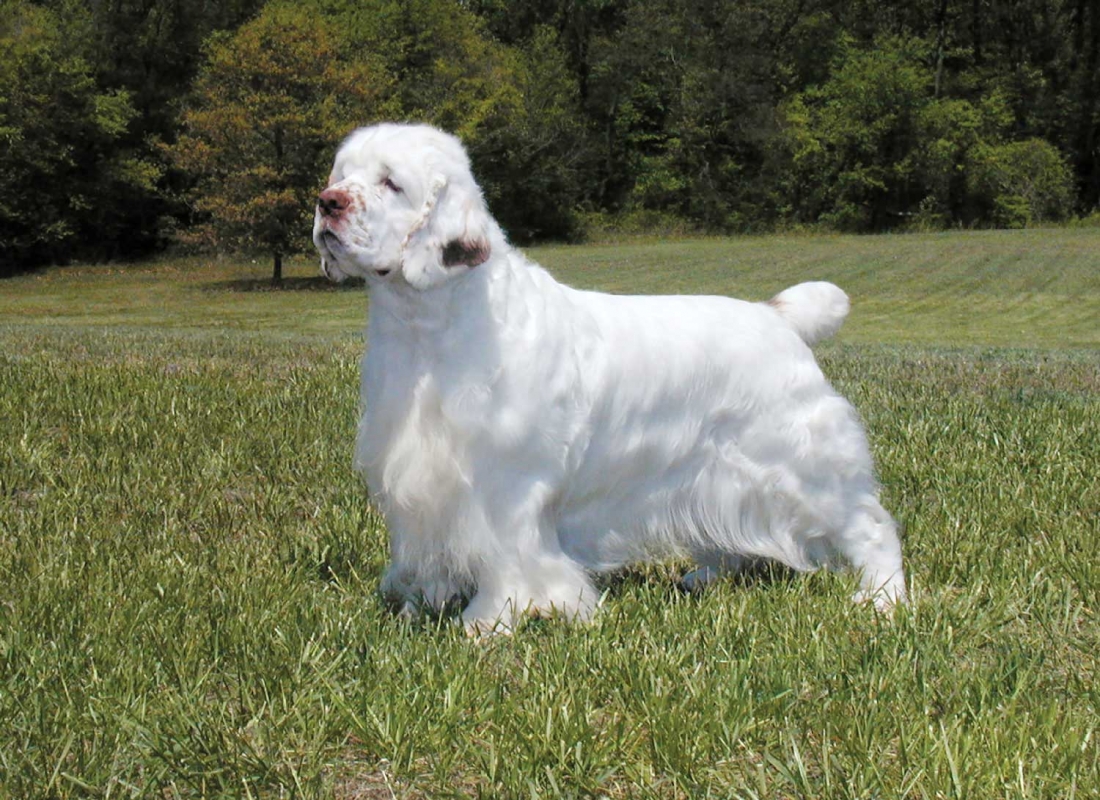
| Height | Males 46–51 cm · females 43–48 cm |
| Weight | Males 29.5–34 kg · females 25–29.5 kg |
| Lifespan | about 12 years |
| FCI group | 8 · Section 2 (spaniels) |
| Origin | Great Britain |
Exact ratings
Common health issues
Nutrition
The Clumber Spaniel is the heaviest and slowest of the English spaniels: a long, low, white dog with a massive head and a strikingly quiet way of going about things. He works in silence at his own unhurried pace, and at home turns into a calm, dignified companion deeply attached to his people. He is also one of the very few breeds whose rarity is not a figure of speech but an official status with a number behind it: Britain’s Kennel Club places the Clumber on its list of vulnerable native breeds. More about dogs on Tvaryny.
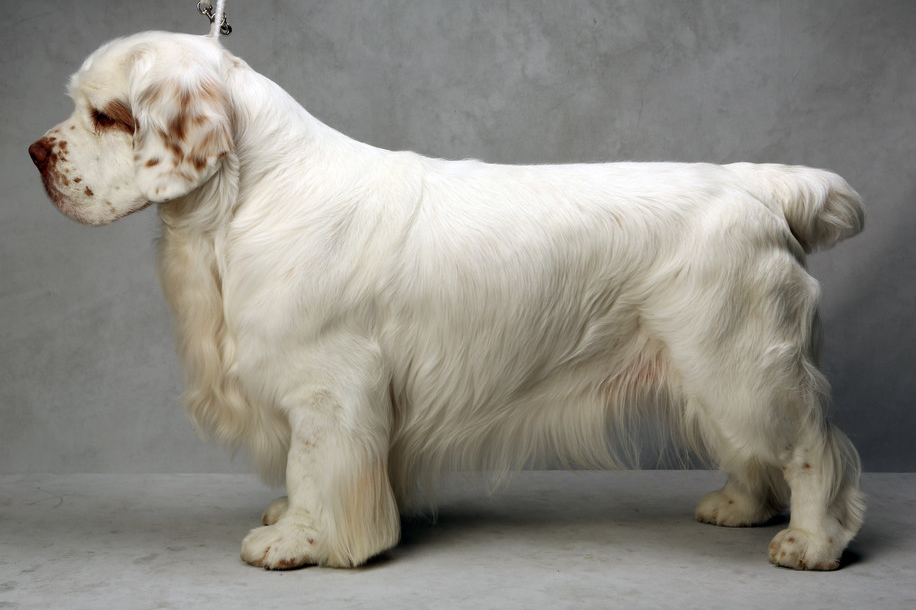
The FCI standard describes the Clumber as “stoical, great-hearted, highly intelligent,” and adds a phrase absent from the descriptions of the other spaniels: a silent worker with an excellent nose. It was quietness, not speed, that this breed was valued for. The same document warns plainly that the breed has grown heavier over time, and that fanciers should watch that the weight does not turn into weakness in the hindquarters.
History and Origin: What the Record Shows and What Is Only Story
One thing here is beyond dispute: the name comes from Clumber Park in Nottinghamshire, seat of the Dukes of Newcastle. Everything else is the territory of retelling, and this is exactly where breed pages usually part company with their sources.
The popular version runs like this: the French Duc de Noailles, saving his kennel from the French Revolution, shipped his best dogs to England. Dozens of publications repeat it — recently even the introduction to a peer-reviewed genetics paper. The trouble is that the earliest printed source says something else entirely.
In William Barker Daniel’s Supplement to the Rural Sports (London, 1813), on p. 684, the spaniels are said to have been given to an ancestor of the Duke while he was in France (when in France) — by the Duc de Noailles. The direction of travel is the opposite of the familiar story: no kennel was evacuated to England; an English aristocrat received the dogs while abroad. There is no revolution and no date in that sentence at all. Later nineteenth-century writers cite Daniel directly: Vero Shaw (1881) does so openly, and Rawdon Lee (1893) dates the episode “probably about the middle of the eighteenth century” — before the Revolution — adding that he could find no trace of Clumbers in France itself.
The sharpest skeptic here, tellingly, is not some outside critic but the British breed club. In its history essay the club calls the escape-from-the-Revolution account a “wonderful (but fanciful) story,” and follows it with a checkable claim: “There is no mention in either of the Dukes’ papers to any gift or sale being made.” On the club’s reading, what is firmly known amounts to this: in the 1760s dogs were brought to Clumber Park from the Continent, with France nowhere singled out.
Chronology supplies another argument. The visual evidence quoted most often is Francis Wheatley’s painting The Return from Shooting, dated 1788 — painted, that is, before the French Revolution began. The breed club points out that the three spaniels in it were described as “Springers or Cock-flushers” rather than as Clumbers, so the picture testifies to a long presence of heavy spaniels on these estates rather than to one particular breed.
The FCI standard itself words the origin with deliberate caution: Clumbers, it says, are said to have come first from France more than two hundred years ago, and were brought to Britain by the Duke of Newcastle, who bred them at Clumber Park. The registry, then, presents the story as tradition rather than as established fact — and that is the most honest formula on offer.
As for royal favor, the Clumber is linked with Prince Albert and Edward VII. The club and the registries repeat these claims in agreement with one another, yet every one of them arrives without a citation to an archival source. A little caution is in order: this is a durable tradition in how the breed gets described, not a documented episode.
The Breed Standard: Two Registries, Two Different Sets of Numbers
This is the most important passage on the page, because it is where the nonsensical “merged” ranges that fill directories come from. The reason is simple: the AKC and the FCI describe the Clumber differently — not only in the figures, but in which measurements they give at all.
The American Kennel Club standard, the one a reader in the United States meets first, specifies both. Ideal height at the shoulder is 18 to 20 inches for males and 17 to 19 inches for females; weight is 70 to 85 pounds for males and 55 to 70 pounds for females. Those are the figures a US owner hears at a show or from a breeder.
FCI Standard No. 109 (Group 8, Section 2 — flushing dogs; current edition dated October 13, 2010) goes the other way: it gives weight only, and no height whatsoever. Ideal weight there is 29.5–34 kg for males and 25–29.5 kg for females. Britain’s Kennel Club, whose standard underlies the FCI document, publishes the same weights with an imperial equivalent and likewise states no height at all.
| Measurement | AKC | FCI No. 109 / Kennel Club |
|---|---|---|
| Weight, males | 70–85 pounds (about 32–39 kg) | 29.5–34 kg |
| Weight, females | 55–70 pounds (about 25–32 kg) | 25–29.5 kg |
| Height at withers, males | 18–20 inches (about 46–51 cm) | not specified |
| Height at withers, females | 17–19 inches (about 43–48 cm) | not specified |
The practical takeaway is straightforward. Ranges like “25–39 kg” or “43–51 cm” belong to no standard at all: they appear when the bottom of the range is lifted from one registry’s line for females and the top from another registry’s line for males. Male and female Clumbers genuinely differ in both height and weight, and flattening the two into a single span is not correct.
The FCI standard also records a historical shift of its own: the breed has grown heavier since roughly the 1950s, and although the ceiling for males is set at 34 kg, some individuals go past it. The gap between the British and the American figures is therefore not an error on one registry’s part but a reflection of real drift in type.
On color the standard keeps a hierarchy that popular summaries flatten: a plain white body with lemon markings is preferred, and orange markings are permissible. Lemon is the favored variant, not an equal alternative. Slight head markings and a freckled muzzle are allowed. The Kennel Club lists lemon and white, orange and white, and their mirror forms as the standard combinations.
| General appearance | Well balanced, heavily boned, active, with a thoughtful expression; the general impression is one of strength. |
| Head | Large, square, of medium length, free of exaggeration. |
| Ears | Large, vine-leaf shaped, hanging forward. |
| Body | Long, heavy, close to the ground; hindquarters very powerful. |
| Coat | Abundant, close, silky and straight; good feathering on the legs and chest. |
| Movement | True fore and aft, with an easy drive. |
Set beside the lighter Field Spaniel, the Clumber looks conspicuously more massive and closer to the ground, and it is this pair — together with the Sussex — that directories confuse most often.
Character and Temperament: Calm You Should Not Mistake for Laziness
The standard is consistent about temperament: even-tempered, dependable, kind and dignified, “more aloof than other Spaniels,” with no tendency to aggression. It is a rare case of an official document recording exactly the trait owners describe — reserve toward strangers with no suspicion in it and no nerves either.
Indoors this really is a very quiet dog. The Clumber sleeps a great deal, often snores, does not tear around for no reason, and hardly ever barks without cause. That gets him written off as a couch dog, which is inaccurate: in the field a different mode switches on — focused, persistent, methodical. Unlike the more energetic Welsh Springer Spaniel, he works slowly, but he covers heavy brush with remarkable thoroughness.
With children Clumbers are usually patient and gentle; with other dogs and with cats they get along well, especially when raised together. Guarding is essentially absent from the breed — he is far too friendly for the job — although his size and deep voice can still work as a deterrent at the door.
One household trait deserves a line of its own: the habit of carrying something in the mouth. Clumbers pick up toys, sticks and slippers and “present” them to owners and to visitors. This is not a behavior problem but a breed manner, and it is far easier to live with than to fight.
Pros and Cons of the Clumber Spaniel
The short lists of strengths and drawbacks sit in the card above. What a list cannot show is how those items connect — and the connection is usually what decides whether the breed fits a household.
Almost every advantage here has a flip side that follows from the same anatomy. The stillness indoors that makes him easy to live with belongs to the same heavy, low-slung build that makes weight gain easy. The dense, weatherproof coat that lets him push through cover is the coat that puts hair on every surface in the house all year. The long, heavily boned frame that gives him his unmistakable outline keeps joints and back on the owner’s checklist for life. Read as two separate ledgers, the columns mislead: they describe one animal from two directions.
Two drawbacks deserve more weight than the rest, because neither can be trained away. The first is health: a national registry publishes a required minimum of pre-breeding tests for this breed, so buying a puppy responsibly comes down to asking for results rather than reassurance. The second is availability: with annual registrations in the low hundreds, a well-bred litter normally means a waiting list and a drive, not a phone call. Everything else — the shedding, the drool, the deliberate independence — is manageable for an owner who knew about it in advance and a daily irritation for one who did not.
Grooming and Daily Care: Ears, Eyes and Weight Under Watch
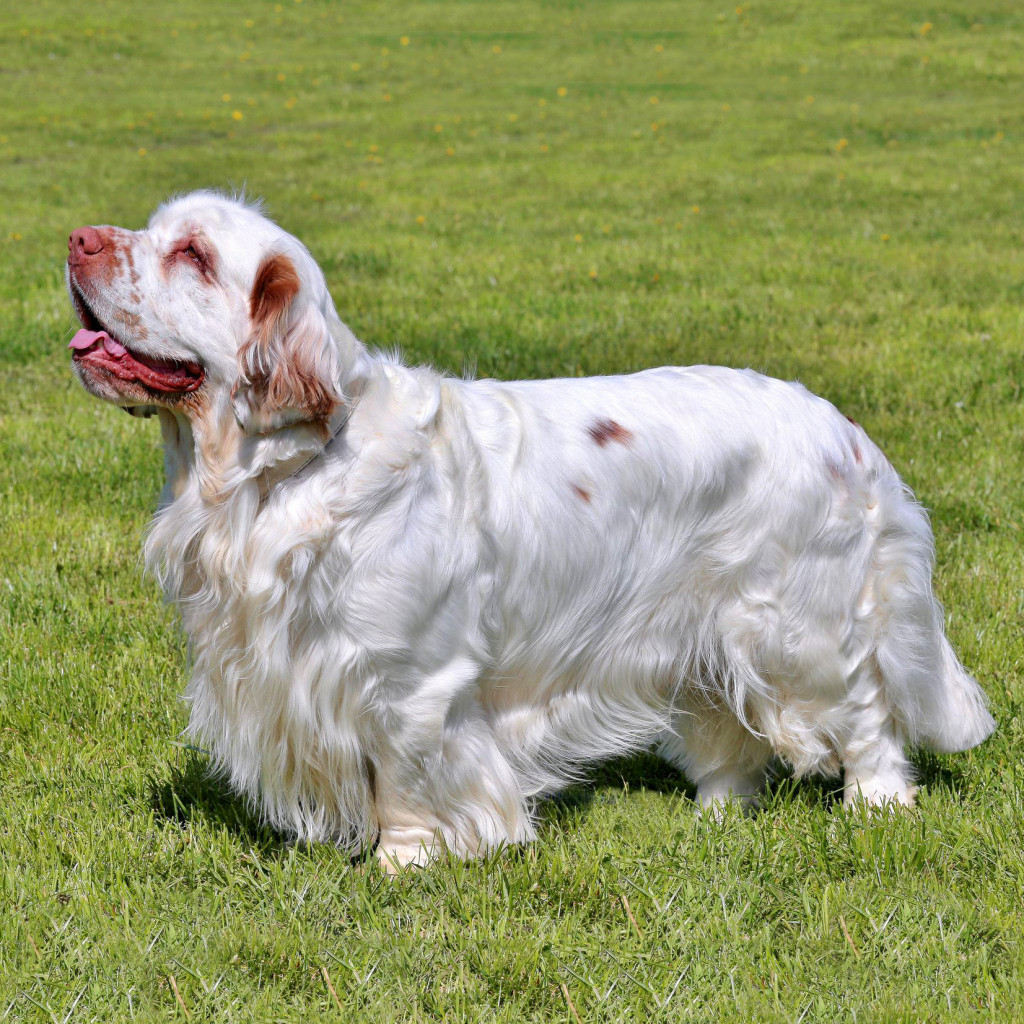
The care priorities for a Clumber do not have to be guessed at: Britain’s Kennel Club states outright what show judges are to watch for in this breed. The Clumber sits in Breed Watch Category 2 — “breeds with visible health concerns linked to exaggerated conformation that need closer attention and monitoring.”
The list of points of concern for the Clumber runs to four items, and each of them doubles as a line on the owner’s daily checklist:
- eyelids not in normal contact with the eyeball — turned inwards or outwards;
- obvious ear irritation;
- too fat;
- incorrect hind conformation and/or poor rear movement.
Ears. Large, heavy, close-hanging ears ventilate poorly, which makes an ideal setting for inflammation. Check them weekly for redness, odor and excess wax, clean them gently with a suitable ear solution, and make sure they dry out after a bath or a swim.
Eyes. Because of the way the eyelids are built, the eyes want a look every day. The standard notes, incidentally, that a visible third eyelid is not counted a fault — so what matters is redness, discharge and signs of irritation, not the mere visibility of the haw.
Coat. The Clumber sheds all year, and heavily in season. Brushing 2–3 times a week — daily during a shed — takes out the dead hair and prevents mats. Bathe as needed, usually once every 1–2 months. Hair between the pads and in the ear canal is trimmed away carefully.
Teeth and nails. Brush the teeth 2–3 times a week with a toothpaste made for dogs; trim the nails once a month, or as needed if they do not wear down on their own.
Training and Socializing a Clumber Spaniel
Clumbers are intelligent and remember well, but they are not dogs that obey a command for the sake of obeying. They weigh up what is in it for them first — which is why positive reinforcement is the only approach that works: praise, treats, play. Harsh handling breaks the relationship and produces nothing in return.
Keep sessions short and consistent. The breed is more independent in its decision-making than, say, the Smooth-Faced Pyrenean Shepherd, which is used to working in close cooperation with a handler. Early socialization is critical: from puppyhood, introduce your Clumber to different people, sounds, surfaces and animals.
On exercise, the Kennel Club’s guideline is roughly an hour of movement a day. But there is a breed-specific caveat here that most breeds do not carry: the Clumber has two documented inherited conditions that are triggered by exertion itself (in detail below). Intense, run-to-exhaustion training is therefore out of place, and any episode of sudden weakness, incoordination or collapse after exercise is a reason to call a veterinarian at once rather than to let the dog rest and forget about it.
Health: Official Testing Schemes, Genetics and Rarity
Feeding: Weight Control as Part of Joint Care
Interesting Facts About the Clumber Spaniel
Rarity with an official definition. The Kennel Club maintains a list of vulnerable native breeds of Britain and Ireland — breeds with fewer than 300 registrations a year; a separate “at watch” list covers breeds with between 300 and 450 registrations a year. The Clumber Spaniel sits on the first of those, the vulnerable list.
The numbers themselves. According to the official registration statistics, 160 Clumbers were registered in Britain in 2025. Across the decade the figure moved between 155 in 2024 and 285 in 2021 — that is, the breed holds steadily well below the threshold of 300 and shows no sign of leaving the category.
Not the rarest in its own company. The same vulnerable list includes the Clumber’s relatives: the Field Spaniel, with 48 registrations for 2025, is rarer still by a factor of three.
The silent hunter. The phrase “a silent worker with an excellent nose” is not an owner’s marketing epithet but a literal line from the FCI standard. The Clumber works quietly, which is exactly what made him valuable in dense undergrowth.
The heaviest of the spaniels. A comparison of the standards bears it out: no other spaniel carries an upper weight limit of 34 kg. The nearest relatives are noticeably lighter — Sussex Spaniels, similar in build, stay considerably more compact.
The breed as a scientific model. The description of PDP-1 deficiency in the Clumber mattered well beyond dog fancy: the authors noted explicitly that a canine model makes it possible to study the consequences of disrupted regulation of the pyruvate dehydrogenase complex, which the human mutation known at that time did not allow.
Frequently Asked Questions (FAQ)
The quick answers — apartment living, shedding, exercise, how hard the breed is to train, how long it lives — are collected in the card above. What follows is the part that does not fit into a short answer: how to use those answers when you are actually choosing a dog.
Most of the questions people ask about the Clumber turn out to be one question wearing different clothes: how much of what gets written about this breed is actually checkable. More of it than usual, as it happens. The rarity has a definition and a figure behind it. The life expectancy has a study and a confidence interval. The joints have two registries measuring by two different methods, and the difference between those methods is itself informative. Both exertion-linked conditions have DNA tests with published results. Very little about the Clumber has to be taken on trust — which is unusual for a breed page, and worth taking advantage of.
The one question the card cannot answer for you is the question about the breeder. Ask to see the actual hip and elbow scores rather than the assurance that the parents were “tested”; ask for the date of the eye examination; ask for the EIC and PDP-1 results and for each dog’s status in writing. A breeder working with a vulnerable native breed expects those questions and generally has the paperwork ready. Being told that the tests are unnecessary in this particular line is itself an answer, and a fairly complete one.
Video About the Breed
- Calm, quiet and dignified indoors
- Gentle with children and other animals
- Needs no excessive exercise
- Devoted and even-tempered
- Heavy year-round shedding
- A tendency to drool
- A serious list of breed health problems
- Stubborn in training
- A rare breed — hard to find a breeder
| English Cocker Spaniel | Sussex Spaniel | Field Spaniel | |
|---|---|---|---|
| Height | 38–43 cm | 33–41 cm | 43–46 cm |
| Energy | 4 | 3 | 4 |
| Apartment | 3 | 3 | 3 |
| Beginners | 3.5 | 3.5 | 3.5 |
Is the Clumber Spaniel suited to apartment living?
How long do Clumber Spaniels live?
Why is the Clumber called a rare breed?
Which tests should a breeder have done?
How much exercise does a Clumber need?
Is the Clumber easy to train?
FCI Standard No. 109 · The Royal Kennel Club (Breed Watch, testing schemes, registration statistics) · AKC · BVA/KC Hip Dysplasia Scheme 2024 · OFA · OMIA 001406 · Cameron et al., Mol Genet Metab 2007 · McMillan et al., Sci Rep 2024 · RVC and the Clumber Spaniel Club, IVDD owner survey
For apartments · For kids · For beginners · Active · Smartest · Hypoallergenic · All rankings →