

| Height | 62–76 cm |
| Weight | 30–60 kg |
| Lifespan | 10–14 years |
| FCI group | not FCI-recognized (Russian national breed) |
| Origin | USSR / Russia |
Exact ratings
Common health issues
Nutrition
If you’re dreaming of a dog that combines the roles of a reliable guard dog, a loving family friend, and a highly intelligent, strong, and active companion, then the East European Shepherd (EES) is the perfect choice. This breed is the ultimate embodiment of strength, intellect, and boundless loyalty. They won’t just be your home’s protector; they’ll become a true family member. Read more about this incredible breed on Tvaryny.
Thanks to their superb physique, obedience, and striking abilities, East European Shepherds often appear in movies and TV series. Their noble appearance and serious gaze make them ideal for roles as working and service dogs.
East European Shepherd: A Quick Breed Overview
| Origin | Russian Federation (former USSR) |
| Era of Origin | 1930s |
| UCI Classification | Group 1, Section 1 (Sheepdogs) |
| Life Expectancy | 12-14 years |
| Height at Withers | Males: 26-30 inches, Females: 24-28 inches |
| Weight | Males: 77-132 lbs, Females: 66-110 lbs |
| Temperament | Composed, Confident, Loyal, Courageous |
| Role | Service Dog, Guard Dog, Companion |
The Breed’s Origin Story
The history of the EES is intrinsically linked to the history of the Soviet Union. The breed development began in the 1930s at the “Red Star” central military kennels. The primary goal was to create a dog that surpassed existing breeds, particularly the Shorthaired German Shepherd Dog, in working ability and endurance. They needed a dog capable of operating in the USSR’s severe climate conditions- from Arctic cold to the hot deserts of Central Asia.
The foundation stock came from German Shepherds, which were then purposefully crossbred with other local breeds (the exact list remains a subject of discussion, but it is believed to include Laikas and some regional working dogs). Selection followed strict criteria, focusing on larger, more massive, and resilient individuals with solid temperaments. The EES was intended to be a universal soldier: guarding borders, serving in convoy duty, participating in search operations, and assisting the military. During World War II, these dogs proved to be true heroes, working as medics, messengers, demolition dogs, and saboteurs.
The first standart, which established the unique breed type of the EES, was approved in 1964. This standard clearly separated the East European Shepherd from its German ancestor, emphasizing its larger size, straight backline, and different gait. Today, the breed is recognized by the International Union of Kennel Clubs (UCI) and many national kennel organizations in former Soviet countries. However, the Fédération Cynologique Internationale (FCI) still does not recognize the EES as a separate breed, viewing it as a variation of the German Shepherd, though this hasn’t prevented the breed from having millions of dedicated fans worldwide.
What the East European Shepherd Looks Like: Breed Standard
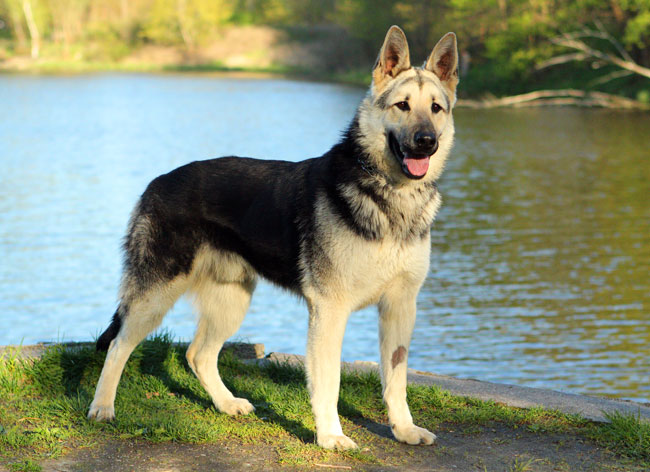
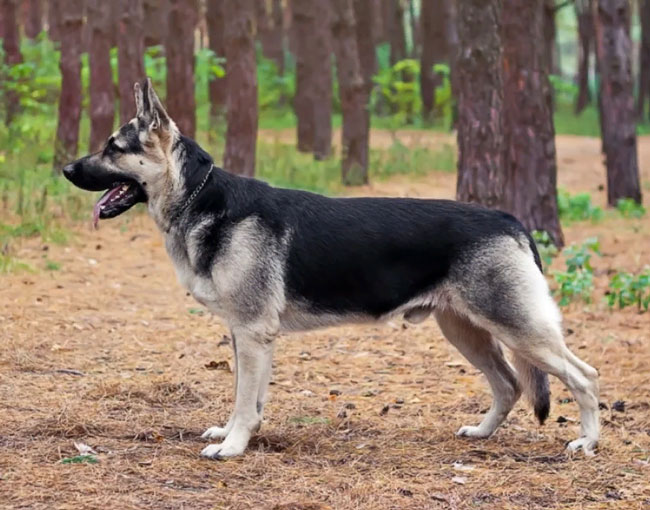
The East European Shepherd is a large, well-proportioned dog that exudes strength and confidence. Its appearance embodies functionality and nobility. The build is slightly elongated, featuring a strong bone structure and well-defined, lean musculature.
- Head: Wedge-shaped, proportional to the body, and quite massive. The forehead is flat, with a moderate stop (transition from forehead to muzzle). The muzzle length is roughly equal to the skull.
- Eyes: Oval, medium in size, and obliquely set. Color ranges from dark brown to almost black. The expression is intelligent, attentive, and self-assured.
- Ears: Medium-sized, erect, set high, and shaped like an isosceles triangle. In puppies, the ears may not stand fully erect until 4-5 months of age.
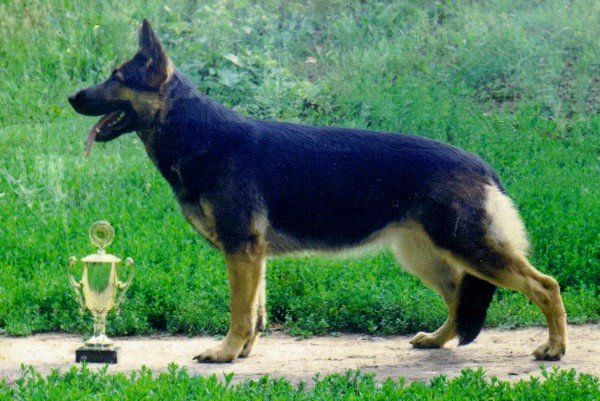
- Body: The back is straight, broad, and strong. The withers are well-developed, standing 1-2 cm higher than the rump. The loin is short and muscular. The croup is rounded, long, and slightly sloped.
- Tail: Sabre-shaped, carried down when resting, reaching the hock joints. It is raised to the level of the backline when excited.
- Coat: Dense, coarse, straight, with a well-developed undercoat. This thick “coat” reliably protects the dog from all kinds of harsh weather.
Coat colors vary, but the classics are: black, saddle-back (with a black “cape” covering the back and sides over a lighter background), black and tan, and sable (zoned gray). The background color can range from light gray to rich fawn. A dark mask on the muzzle is an important breed trait.
Temperament and Behavior: What to Expect from an EES
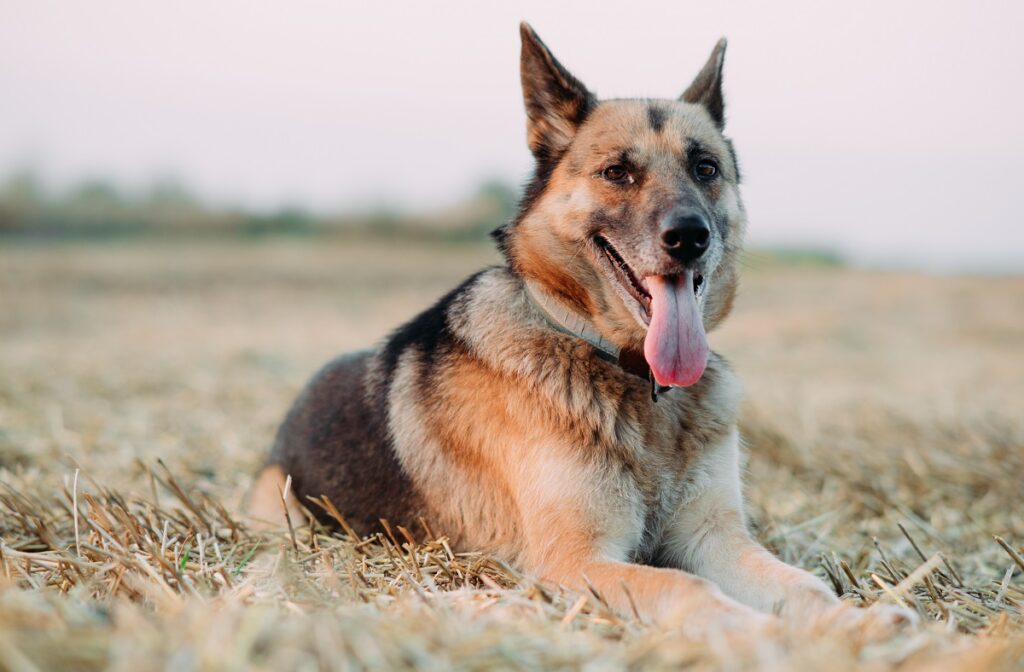
Temperament is one of this breed’s greatest strengths. The EES boasts a high intellect and an extremely balanced psyche. They are people-oriented and fiercely loyal to their handler and family. This Shepherd forms an unbreakable bond with its owner and is willing to follow them anywhere. It’s important to understand that the EES is often considered a “one-person dog,” although it will love and protect all family members.
The EES’s demeanor is consistently calm and confident. They are not prone to aggression or barking without cause. Their reaction to a threat is instant but controlled. They are a natural-born protector who clearly distinguishes between “friend” and “foe” and is always ready to defend their family and territory. With family members, they are affectionate and patient. The EES gets along wonderfully with children, especially when raised alongside them, acting as a gentle “nanny” and playmate. With proper socialization, they are usually calm around other pets in the house, though they may display dominance toward unfamiliar dogs.
Pros and Cons of the Breed
Before committing to such a serious dog, it’s essential to weigh all the pros and cons. We’ve prepared a table to help you make the right decision.
| Pros | Cons |
|---|---|
| High Intelligence and Trainability: Easily grasps commands and is capable of complex work. | Requires an Experienced Handler: Not the best choice for a novice; demands a firm yet fair hand. |
| Unwavering Loyalty: Will become the most reliable friend and protector for the whole family. | Needs Significant Physical Exercise: Requires long walks and mental stimulation. |
| Excellent Guarding Instincts: A natural-born protector who requires minimal specific training for territory defense. | Prone to Certain Health Issues: Hip/elbow dysplasia and gastric problems. |
| Balanced Temperament: Calm and self-assured, not prone to nervousness or cowardice. | Heavy Shedding: Needs regular brushing, especially during seasonal shedding periods. |
| Good with Children: Patient and caring “nanny” for kids within their own family. | Not Suited for Apartment Living: Thrives best in a private home with a dedicated yard. |
Health: Common Issues and Prevention
Caring for the East European Shepherd
Caring for an EES is not overly difficult, but it does require regularity. The main focus areas are coat maintenance, physical activity, and general hygiene.
Coat Care: The EES’s thick coat requires regular brushing, especially during seasonal shedding in the spring and fall. Use a deshedding tool like a Furminator or a slicker brush to remove dead undercoat. This not only improves the dog’s appearance but also prevents matting and skin irritations. Bathing should be done sparingly- 1 to 2 times a year, or as needed, using specialized dog shampoos.
Hygiene: Routinely inspect the ears for dirt or inflammation. Clean them with a cotton pad moistened with a canine ear-cleaning solution. Teeth also require attention- clened them with a dedicated dog toothbrush and paste, or provide dental chews. Claws usually wear down naturally with enough exercise on hard surfaces, but if they don’t, they must be trimmed with a nail clipper or grinder.
Training and Socialization Essentials
Training the EES is a mandatory and critical process. You should begin education and socialization from the first day the puppy arrives home. This is a serious working breed, and without proper raising, they can become unmanageable. The owner must immediately establish themselves as the leader- calm, confident, and consistent.
EES dogs are highly intelligent and quickly absorb new information. Positive reinforcement is the best training method for them. They are eager to please their owner, so praise and treats work far better than shouting or punishment. Early socialization is key: introduce your puppy to various people, animals, sounds, and environments. This will help them mature into a confident, well-adjusted adult.
The breed is ideal for various dog sports and service work: protection and guard duty, general obedience (like the AKC Canine Good Citizen equivalent), and search and rescue. These activities help channel the dog’s energy and intellect constructively. History is full of examples of this breed’s heroism, such as the Shepherd Elga, who saved many lives in Chechnya by finding mines. This highlights their outstanding working qualities, which are also highly valued in breeds such as the formidable Caucasian Shepherd Dog.
Nutrition: Key Recommendations
Fascinating Facts About the East European Shepherd
- Despite their external similarities, the EES and the German Shepherd have significant differences not only in conformation (the EES has a straight back, versus the sloping back of the GSD) but also in temperament. The EES is generally calmer and less excitable.
- These dogs are natural “actors.” You can spot them in many well-known films.
- The EES possesses a unique ability to adapt to virtually any environment, making it one of the most versatile working breeds in the world.
- The breed has a very expressive face. An experienced owner can always gauge their dog’s mood from its gaze and ear placement.
Frequently Asked Questions (FAQ)
Is the East European Shepherd suitable for apartment living?
It is strongly discouraged. The EES is a large, active dog that needs space. The best setup for them is a private house with a large, fenced yard where they can move freely.
How much exercise does an EES need?
A lot. A minimum of 2 hours of active exercise per day. This doesn’t just mean leash walking; it requires running, play sessions, and training drills. Without sufficient exercise, the dog may become bored and destructive.
Can the EES be left alone for long periods?
They handle solitude poorly. Their intense attachment to their owner can lead to destructive behavior if they are left alone all day. This breed is not recommended for very busy individuals.
Do they bark much?
No, the EES is not prone to unnecessary barking. They only voice when genuinely necessary, for example, to alert to the approach of strangers. Many other breeds, such as the Lagotto Romagnolo, are significantly more “talkative.”
Is it difficult to find a purebred EES puppy?
Yes, it can be challenging. Since the breed is not recognized by the FCI, many mixed-breeds or “look-alike” dogs are often presented as EES. It is critical to work with reputable, established breeders who specialize in this specific breed and can provide all necessary paperwork and health clearances for the parents.
Video About the Breed
- A clever, easily trained service breed
- Strong, fearless, level-headed
- A reliable guard and an affectionate family friend
- Obedient, with strong working ability
- Needs work and serious exercise
- Reserved with strangers, territorial
- Not for an apartment without exercise
- Dense coat sheds heavily
| German Shepherd | Black Terrier (Russian) | Kangal (Anatolian Shepherd) | |
|---|---|---|---|
| Height | 55–65 cm | 64–76 cm | 71–81 cm |
| Energy | 4.5 | 4 | 3 |
| Apartment | 2.5 | 2 | 1 |
| Beginners | 3 | 2 | 1.5 |
How does the VEO differ from the German Shepherd?
Is the VEO good for a family?
Is the VEO easy to train?
Russian national breed (VEO) · RKF
For apartments · For kids · For beginners · Active · Smartest · Hypoallergenic · All rankings →