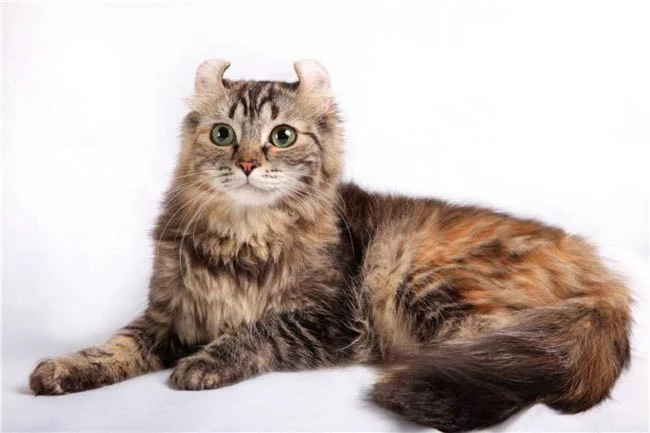
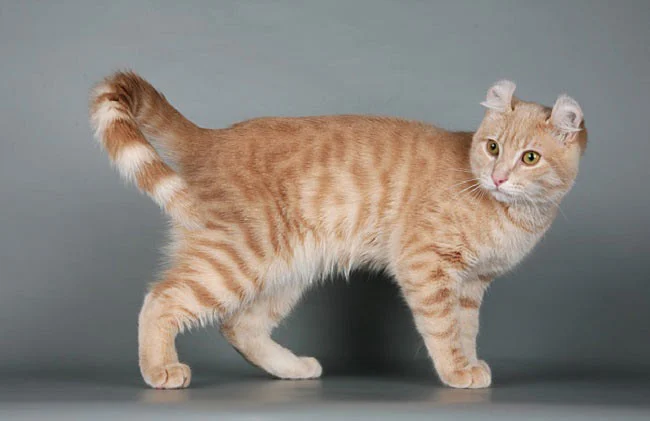
A big-eared eternal kitten with curved “elf” ears — sociable and devoted: playful, affectionate, clever and people-oriented. The American Curl is recognizable by its unique ears that gently curl backward; it is the “Peter Pan” of cats — it keeps its kitten-like playfulness into old age, adores company and people, “touches” with a paw and suits active families beautifully.
Weight
2.2–4.5 kg
Lifespan
12–16 years
Coat
Shorthair and semi-longhair varieties, minimal undercoat
The curl gene is not flagged as disease-related in OMIA
Cons
The curled ears need careful care
Dislikes being left alone for long
CFA stud book closed (litters from 2015)
The degree of curl is only settled by 4 months
Size
ToySmallMediumLargeGiant
Compatibility
KidsDogsOther catsBeginnersTime alone · with caveats
Original breed name: American Curl
One detail identifies the American Curl: the ear flaps sweep backward in an even arc, as if someone had folded them back and they simply stayed there. Everything else about this cat is deliberately ordinary — medium in size, slender, sturdy, in every color imaginable. That is no accident but the direct consequence of its history: the breed began in 1981 with one stray cat from California and was built over decades on the introduction of non-pedigree domestic cats. What follows is what is genuinely documented: how the curl is inherited, what the CFA, TICA and Canadian CCA standards say, what science knows about the gene itself, and why these ears need not "special" care but simply attentive, competent care. Other cat breeds are covered on Tvaryny.
American Curl: a short overview of the breed
American Curl: a short overview of the breed · 17
Characteristic
Description
Origin
Lakewood, California, USA
Year of appearance
June 1981 — the cat Shulamith, founder of the breed, is found
CFA recognition
Registration 1986, provisional status 1991, championship class 1993
FIFe recognition
2003 (American Curl Longhair and Shorthair)
Lifespan
12–16 years (estimate from the vet-reviewed guide PetMD)
Weight per the TICA standard
Females 2.2–3.6 kg; males 3.1–4.5 kg
Height
23–30 cm (PetMD estimate)
Coat
Shorthair and semi-longhair varieties, minimal undercoat
Color
All colors and patterns without exception
Ears
Arc of curl at least 90° and no more than 180°; firm cartilage from the base over at least one third of the ear's height; rounded, flexible tips (TICA standard)
Formation of the ear
Kittens are born straight-eared; the curl appears in the first days of life and the final degree settles at about 4 months
Eyes
Walnut-shaped, set at a slight angle; obligatorily blue in colorpoints
Temperament
Alert, even-tempered, active, strongly attached to its people
Voice
Quiet
Coat care
Comb two to three times a month (CFA recommendation)
What needs attention
Regular inspection and careful cleaning of the ears
Compatibility with children and animals
High
Choosing a kitten and questioning the breeder
Interesting facts about the American Curl
Every American Curl in the world descends from one cat — Shulamith, found in 1981. Her sister Panda disappeared two weeks after they appeared and left no descendants.
The Curl is the first breed admitted to the CFA championship class as one breed with two coat lengths at once. The Canadian CCA, meanwhile, judges them as two different breeds.
The ears weigh more in the scoring than any other feature: 20 points out of 100 with TICA and 30 out of 100 with the CCA.
TICA sets a requirement that resembles a geometry problem: in an alert Curl, the lines continuing the curve of the ears must converge at the center of the base of the skull.
The paper to which the curated OMIA database still refers for this trait runs to two pages: Journal of Heredity, volume 80, pages 474–475, 1989.
The TICA standard is written with a preference for the smaller cat, while males are expressly allowed developed "cheeks".
A straight-eared Curl is not a mistake of nature but a breeding tool: about half the kittens from a mating with a straight-eared cat receive the curl, and the rest add to the breed's genetic diversity.
Another American breed that owes its existence to a spontaneous mutation is the American Wirehair, in which the change affected not the shape of the ear but the texture of the coat.
If unusual feline silhouettes appeal to you, there are two other trails: the Pixiebob and the Kurilian Bobtail Longhair, known for their short tails and wildcat look.
History of the breed: from stray cat to championship class
The story starts with an ordinary scene. In June 1981, in Lakewood, California, two long-haired stray kittens with oddly back-turned ears appeared outside the home of Joe and Grace Ruga. One, a female called Panda, disappeared after two weeks. The second stayed and was named Shulamith — a black long-haired cat from whom, in the CFA's own wording, every American Curl without exception descends. The breed has, quite literally, a single founding point.
In December 1981 Shulamith produced her first litter: two of the four kittens inherited the curled ears. That alone was enough to suggest dominant inheritance — the trait passed from a single carrier parent and was not "lost" in the generation. The first public showing took place on 23 October 1983 at a CFA show in Palm Springs, California. In January 1984 the first Curl × Curl mating was made, and the kittens were born in March of the same year.
Then comes the least typical stretch of the story for a young breed: before building up any stock, the breeders went to geneticists. The mutation was studied by Solveig Pflueger and the British felinologist Roy Robinson. Robinson's result appeared in the December 1989 Journal of Heredity — a two-page note that still stands as the sole reference for this trait in the curated database of inherited traits, OMIA. By the figures the CFA and TICA cite from it, Robinson analysed 81 litters — 383 kittens — and found no defects in any cross combination examined.
Recognition came quickly. The CFA accepted Curls for registration in 1986, granted provisional status in 1991 and admitted them to the championship class in 1993. The breed also entered the association's history on a line of its own: it is the first breed admitted to the CFA championship class as a single breed with two coat lengths — shorthairs and longhairs were not split apart. FIFe recognized the American Curl Longhair and Shorthair in 2003. The Canadian CCA, by contrast, judges them as two distinct breeds — a useful reminder that "recognized" does not mean "organized the same way everywhere".
One clarification that heads off a common confusion: cats are not registered by the FCI. The Fédération Cynologique Internationale deals with dogs, and FCI standards for feline breeds simply do not exist. For the Curl the authorities are CFA, TICA, FIFe, WCF and national bodies such as the Canadian CCA. If someone shows you an "FCI standard for the American Curl", the source is mistaken.
Ears by the standard: degrees, cartilage and disqualifications
A standard is not poetry; it is a list of measurable requirements, and the Curl's is unusually detailed exactly where the ears are concerned. With TICA the ears are worth 20 points out of 100; with the Canadian CCA, 30 out of 100, against 60 points for the head as a whole. No other detail carries such weight.
The arc. TICA puts it this way: an arc of curl of at least 90 degrees, not exceeding 180. Below 90 is insufficient; above 180 is already excessive.
The cartilage. Firm cartilage must run from the base over at least one third of the ear's height. The standard adds that it should feel smooth and be barely thicker than in an uncurled ear. A thick or calcified ear is grounds for withholding awards (the CCA's wording).
The tips. Rounded and flexible. A rigid tip is a disqualification with TICA.
Set and direction. Ears wide at the base and open, curving back in a smooth arc along a circular line, set equally on top of and to the sides of the head. TICA adds a remark of its own: in an alert Curl with its ears turned forward, the lines continuing the curve of the ears must converge at the center of the base of the skull.
What is penalized. An abrupt change of direction instead of a smooth curve, dents and ripples in the curled part, a low set, and the "crimp" — a horizontal or vertical creased fold. On the vertical crimp TICA states plainly that the outer edge of the ear near the cheekbone appears folded forward, "as if closing the entrance to the ear canal", creating an extra rigid line of cartilage that interferes with the curve.
What is disqualified. Straight or markedly asymmetrical ears; absence of firm cartilage at the base; extreme curl in an adult, where the ear tip touches the back of the head or the ear itself; inflexible tips. And as a separate clause — ears whose lower part is abnormally flattened, shows compressed ridges of cartilage and lacks a normal, visible ear cavity.
That last clause deserves a second reading. It means the feline organizations do not merely describe a pretty arc — they explicitly bar from the ring any ear in which cartilage deformity has closed off the normal ear cavity. A "normal, visible ear cavity" is therefore written into the standard as the norm, its absence as a fault. The converse follows: in a correctly built Curl the ear cavity is normal. The widespread claim that "Curls have a narrowed ear canal" contradicts the standards, and we do not repeat it.
The standard yields a second, purely practical conclusion. Firm cartilage at the base and a flexible tip make a structure with a limit to what it will take. TICA warns directly: the cartilage should be neither rigid nor floppy, and the ears must be handled so as not to break it. A Curl's ear must not be unfolded to "look deeper", nor pulled during cleaning, and children must not grab the cat by the ears.
And third: kittens are born straight-eared. The curl appears in the first days of life, and the final degree, per TICA and the CFA, settles at about four months (16 weeks). The CFA uses a three-step grading: first degree — pet quality, second — breeder quality, third, the full "crescent" — show quality. A simple rule follows: a kitten's show potential cannot be assessed before four months — not by the breeder, the buyer, or a photograph. Any promise of "show class" at eight weeks is a promise on trust.
Appearance: the rest of the cat
Set the ears aside and what is left is a deliberately moderate cat. The TICA standard sets a semi-foreign type: slender, elegant, balanced, of medium bone — neither fine nor heavy. It is written with the smaller cat in mind, while males are allowed some latitude for cheeks. Excessive size is penalized.
Head. A modified wedge without flat planes, about one and a half times longer than wide. Profile: straight nose, a slight rise from the lower line of the eyes to the brow, a gentle curve from forehead to the top of the skull flowing into the neck without a break. A deep stop at the bridge is penalized.
Eyes. TICA calls the shape "walnut"; the CCA is more precise: oval on top, round below. Moderately large, set at a slight angle between ear base and nose tip, one eye's width apart. Color clear and brilliant, unrelated to coat color; the one exception is colorpoints, whose eyes must be blue.
Body. Rectangular, its length about one and a half times the height at the withers. Chest and flanks of medium depth, neck medium. A tubular or, conversely, cobby body is a fault.
Limbs. Of medium length, in proportion to the body, set straight when viewed from front and rear. Paws medium and rounded.
Tail. Flexible, wide at the base, tapering, equal to body length. The CCA offers a handy check: laid along the body it reaches the shoulder. In longhairs it is full, a plume. Any tail fault is a disqualification.
Coat. The shorthair is soft, silky, flat-lying, resilient, without plush density; the semi-longhair fine, silky, also flat-lying. In both the undercoat is minimal, written into the standard as a requirement: heavy undercoat, a thick ruff, cottony or plush texture are penalized.
Color. All categories, all divisions, all colors — that is how TICA words it; the CCA says "any color or combination of colors and patterns". The reason lies in the origin: the breed was developed from non-pedigree domestic cats, and there was no point in restricting the palette.
Character and compatibility
Accounts of the Curl's temperament rarely disagree from one source to the next, which is itself worth noting. The TICA standard characterizes the breed as intelligent, alert and active, of even, gentle temperament and strongly bonded to its people. The CCA words it almost identically: "alert, with a gentle, even disposition". TICA's breed profile adds the traits that usually settle the choice: inquisitive, exuberant and affectionate, extremely people-oriented, with a quiet voice.
Hence the nickname — "the Peter Pan of cats". It refers not to size or immaturity but to a kitten's way of playing persisting into adulthood: interest in anything that moves, the habit of touching whatever is interesting with a paw, following a person from room to room. Many owners describe a "dog-like" sociability — greeting at the door, settling beside you rather than in a corner of its own.
That even temperament is written into show rules. With TICA, the temperament of an exhibited Curl must be "unchallenging": the cat may be frightened, try to leave or complain loudly, but it has no right to threaten, and any clear challenge to the judge is a disqualification. That is not a description of a house cat, but it is a fair guide: aggression is not selected for.
The practical consequence of that people-orientation is also the breed's chief drawback: a cat built around contact copes poorly with a long empty day. If nobody is regularly at home for ten to twelve hours, the Curl needs either a second pet or an honest reconsideration in favour of a more self-sufficient breed. With children and other animals Curls get on well — provided the children have been taught not to grab the cat by the ears.
Play, training and socialization
The Curl is the case where "training a cat" stops sounding like a joke. The standard describes the breed as intelligent, alert and active, and play motivation that persists into adulthood gives a convenient lever: a cat that wants to play will readily work for play and for food.
Only positive reinforcement works. Cats do not link punishment to the act — they link it to the person, and the result is not training but mistrust. The scheme is simple: desired behaviour earns an immediate treat or game; undesired behaviour is not reinforced and the opportunity is removed. That is how you build a response to the name, a paw on request, walking into the carrier, and calm acceptance of nail clippers and ear inspection. One detail repays itself: if the carrier stands open in the room as an ordinary sleeping place rather than appearing once a year before a trip to the vet, half the stress of visits disappears.
Environment decides as much as training. Verticality is needed — shelves, cat trees, a windowsill with a view; scratching surfaces of various kinds; toys rotated rather than all left out. Two short wand-hunting sessions a day, each ending in an actual "catch", meet the predatory need better than a basket of toys. Puzzle feeders make the cat work for its food and slow down the too-fast eaters.
Advantages and disadvantages of the breed
Strengths. An appearance impossible to confuse with anything else, on a build entirely moderate in every other respect. An even, gentle temperament, anchored in the standard and in show rules. Play motivation that persists into adulthood, and genuine orientation towards people. Minimal undercoat and, as a result, simple coat care and modest shedding. All colors without restriction. And a curl gene that the curated database of inherited traits does not link to a disease.
Limits and constraints. The ears demand care and regular attention, and the cartilage can be damaged by rough handling. Ear infections are named by the veterinary guide as the breed's most characteristic problem. Prolonged solitude is poorly tolerated — not a breed for a home where nobody is in all day. Show potential cannot be read before four months. Since the causal DNA variant is unidentified, there is no test "for the curl". And the registries run the breed differently: in one the inflow of non-pedigree cats stays open, in another the stud book is closed — worth establishing before the purchase, not after.
Ear care: how it is done properly
This is the one routine where the Curl genuinely differs from any other cat, and the one where carelessness causes injury.
Look first, touch second. A healthy ear is pink inside, odorless, with very little secretion. If it looks clean, it is not cleaned: cleaning "just in case" irritates the skin and provokes exactly what you are trying to avoid.
The direction of the movement. The CFA describes the technique precisely: work up and away from the entrance to the ear canal with a cotton swab moistened with ear lotion, without pulling on the delicate cartilage. The key word is "away": nothing is pushed inward. Everything beyond the visible part of the flap belongs to the vet, not the owner.
Do not unfold the cartilage. TICA warns specifically that the ears must be handled so as not to break the cartilage. Do not straighten the ear to look deeper, do not hold the cat by the ear, and do not let children or groomers do so. Flag this breed feature to the veterinary practice at the first visit.
Products for cats only, and as directed. Ear lotions for other species, and alcohol-based or homemade solutions, can irritate and damage ear tissue. Choosing the product is a question for the vet, especially if the ear is already inflamed.
Tell the normal from the alarming. TICA writes that dark ear wax is normal for the breed and that the ears should be cleaned periodically. Keep one qualification in mind: a dry, dark deposit resembling coffee grounds, with an odor, is the classic picture of ear mites, not a "breed feature", and the two cannot be told apart by eye. Reasons to see a vet: the cat scratches its ear often or shakes its head, the ear is reddened, there is an odor, discharge is copious, the deposit returns quickly after cleaning.
Accustom from kittenhood. Inspecting an ear takes a few seconds and should be associated with a treat, not a struggle. A kitten used to the procedure by four months does not turn it into a problem as an adult.
Coat, hygiene and living conditions
Everything unrelated to the ears is low-maintenance, and the standard says why: minimal undercoat. It is the undercoat that supplies the bulk of shed hair and the tendency to mat, and here it is sparse by requirement, in both varieties. TICA notes that a silky, flat-lying coat with little undercoat also means little shedding.
The CFA gives a specific frequency: comb or brush two to three times a month. The semi-longhair may deserve a little more during the seasonal shed; the shorthair does well on the basic routine. A comb beats a slicker: the aim is not to tear out a scarce undercoat but to distribute skin oils and remove dead hair.
The rest is standard: trim claws as they grow, put scratching posts where the cat actually spends its time, brush the teeth, wipe the eyes as needed. Curls take to the litter box easily. Many accept a harness and enjoy going out, but habituation must be gradual and start at home.
A word on allergy, because "sheds little" and "hypoallergenic" are not synonyms. The main feline allergen Fel d 1 is produced by the salivary and sebaceous glands and reaches the coat during grooming; less shed hair slightly reduces how far it spreads around the home, but does not remove it. Hypoallergenic cats do not exist, and the Curl is no exception.
Nutrition
Nutrition
Health and risks
The curl gene: what exactly is inherited
Plenty gets written about the Curl's ears, and most of it repeats. Sort the layers apart — what is established, and what is still unknown.
What is established. In that 1989 paper Robinson described the trait as monogenic autosomal dominant and named the mutant gene curl, symbol Cu. "Monogenic" means one locus governs ear shape, not the sum of many. "Autosomal" means it does not sit on the sex chromosomes, so males and females inherit it alike. "Dominant" means one copy is enough: mate a curled-eared Curl to a straight-eared cat and, statistically, about half the kittens will have the curl. That is precisely the figure TICA gives when describing the introduction of straight-eared cats.
What is still unknown. The international database of inherited animal traits, OMIA, maintained by the University of Sydney, holds the record Curl in the cat (OMIA:000244-9685) with three entries: single-gene trait — yes, mode of inheritance — autosomal dominant, key variant known — no. In other words, the DNA sequence whose alteration turns the ear back has still not been published after nearly forty years. The practical consequence is direct: there is no DNA test "for the curl", and a kitten's phenotype can be predicted only from pedigree and observation. If you are offered such a test, ask which variant exactly it detects.
One more OMIA entry, and it matters most: the same record carries the field "disease-related" with the value "no". That is a cautious curatorial wording and should be read literally — it applies to one locus, not to the whole breed. The database does not link the curl gene itself to a disease. That is not the same as the claim "this breed has no problems", and the second should not be substituted for the first.
Why the comparison with the folded ear keeps coming up. Because there the situation is the opposite and has been worked out down to the molecule. In the Scottish Fold the ear fold is caused by the substitution c.1024G>T (p.V342F) in the TRPV4 gene; inheritance is autosomal incompletely dominant, and in OMIA the trait is explicitly flagged as disease-related — osteochondrodysplasia, affecting the distal limbs, the tail and the joints. Homozygotes are severely affected, heterozygotes more mildly, but radiographic changes are found in them too. In other words: in the Scottish, ear and skeleton belong to the same gene; in the Curl, science does not tie those two threads together. These are two mutations, two genes, two stories.
And here is the most recent and most useful finding. In 2026 the journal Animal Genetics published work by a Japanese team (Ukawa and colleagues) that looked for the TRPV4 variant c.1024G>T beyond Scottish Folds alone: 8610 cats of fourteen breeds were tested. Among the 115 cats registered as American Curls, two (1.7 %) proved to be heterozygous carriers of the folded-ear variant; there were no homozygotes. Carriers were also found in Norwegian Forest Cats, Munchkins and Minuets. The authors attribute this to historical crosses with Scottish Folds and draw a conclusion worth remembering for any buyer: the curl phenotypically masks the fold, so a carrier cannot be spotted by eye. A separate paper from the same group showed that in some TRPV4 heterozygotes the ear folded in kittenhood straightens by adulthood — the so-called "hidden folds".
One reservation, which the authors declare under competing interests: the study was carried out by employees of a commercial laboratory that sells the test for this variant. That does not invalidate the data, but it explains why the paper concludes by urging screening in other breeds. For an owner the practical sense is unambiguous all the same: the carrier proportion is small but not zero, and the TRPV4 test — unlike the non-existent test "for the curl" — exists and works. Asking a breeder about it is reasonable, especially if the pedigree contains matings outside the breed.
Health: what is documented
Frequently asked questions about the American Curl (FAQ) · 11
Why does the American Curl have curled ears? Because of a spontaneous mutation that arose in the non-pedigree cat population of the United States, first noticed in 1981. The trait is monogenic and autosomal dominant: one locus is responsible, the gene carries the symbol Cu, and one copy is enough for the ear to turn back.
Are all kittens born with the curl? No — all are born straight-eared. The curl appears in the first days of life and the final degree settles at about four months. Straight-eared kittens in a litter are normal and provided for in the breed.
Does the shape of the ears hurt the Curl? The shape is set by cartilage: firm at the base, flexible towards the tip, and the standard requires it to be smooth and barely thicker than usual. The problem comes not from the shape but from handling: the cartilage can be broken by pulling or unfolding the ear. That is why the cat is never picked up by the ears, and the ears are not straightened for examination.
Is it true that the Curl's ear canal is narrowed? The standards say the opposite: TICA disqualifies an ear whose lower part is abnormally flattened, whose cartilage is compressed into ridges and which lacks a normal, visible ear cavity. A normal ear cavity is a requirement of the standard. Wax accumulating inside the flap, on the other hand, is indeed linked by the veterinary guide to the unusual ear shape — hence the advice to inspect and clean regularly.
How often should the ears be cleaned? By condition, not by calendar: inspect regularly, clean when accumulation is visible. The CFA describes the technique — with a cotton swab and ear lotion, work up and away from the entrance to the canal, without pulling on the cartilage. Nothing is pushed inward.
Is dark ear wax normal? TICA describes dark ear wax as normal for the breed and advises periodic cleaning. But ordinary secretion cannot be told from traces of ear mites by eye. A dry deposit resembling coffee grounds, an odor, scratching or head-shaking — that is a matter for the vet.
Are the Curl and the Scottish Fold related? No — two mutations in two different genes. In the Fold the crease is caused by the substitution c.1024G>T in the TRPV4 gene and is associated with osteochondrodysplasia, a disorder of bones and joints. The Curl's gene is not flagged as disease-related in OMIA, and its causal variant is still unpublished.
Is there a DNA test for the curl? No. In OMIA the trait "Curl" carries the note "key variant known — no": the specific DNA change has not been identified. The test for the TRPV4 variant, by contrast, exists and makes sense: in the Japanese study of 2026, 2 out of 115 Curls tested proved to be carriers, and the curl masks exactly that carrier status.
Do Curls shed much? Moderately. The standard requires minimal undercoat in both varieties, and it is the undercoat that supplies the bulk of shed hair. The CFA recommends combing two to three times a month.
Are they hypoallergenic? No. The main allergen Fel d 1 is produced by the salivary and sebaceous glands and reaches the coat during grooming, so reduced shedding limits how far the allergen spreads around the home without eliminating it.
Are they suited to an apartment, and can they be left alone? To an apartment, yes — given vertical routes, scratching posts and daily play. Long absences are best avoided: the breed is built around the relationship with people and copes poorly with an empty day. A second pet solves part of the problem.
Conclusion
The American Curl is a rare case of a breed whose most visible trait is also its best-documented one. Of the ears we know how they are inherited, in what degrees they are measured, what is penalized and what disqualified, how to care for them and what must never be done to them. The limit of that knowledge is known too: the causal DNA variant is unpublished, and the paper to which OMIA still refers appeared in 1989. Anything beyond that limit is worth asking a source for. If breeds born of a spontaneous mutation interest you, the American Wirehair is the other American case.
Everything else about this cat — an even character, a moderate build, a simple coat, a full palette of colors — makes it easy to live with. The Curl suits a family that is at home, ready to give it attention every day and to treat its ears not as an ornament but as part of its care. If that is you, few questions about the breed will remain.
FAQ
Why does the American Curl have curled ears?
Because of a spontaneous mutation that arose in the non-pedigree cat population of the United States and was first noticed in 1981. The trait is monogenic and autosomal dominant: one locus is responsible, the gene carries the symbol Cu, and one copy is enough for the ear to turn back.
Are all kittens born with the curl?
No, all kittens are born straight-eared. The curl appears in the first days of life and the final degree settles at about four months. Straight-eared kittens in a litter are normal and provided for in the breed.
Do the Curl's ears need special care?
They need attention, not complicated procedures. Inspect regularly, clean by condition. The CFA describes the technique: with a cotton swab and ear lotion, work up and away from the entrance to the canal, without pulling on the delicate cartilage. Nothing is pushed inward.
Is it true that the Curl's ear canal is narrowed?
The standards say the opposite: TICA disqualifies an ear whose lower part is abnormally flattened, whose cartilage is compressed into ridges and which lacks a normal, visible ear cavity. Wax accumulating inside the flap, however, is indeed linked by the veterinary guide to the unusual ear shape.
Does the shape of the ears hurt the Curl?
The shape is set by cartilage: firm at the base, flexible toward the tip, and the standard requires it to be smooth and barely thicker than usual. The problem comes from handling, not from the shape — the cartilage can be broken by pulling or unfolding the ear. That is why the cat is never picked up by the ears.
Are the Curl and the Scottish Fold related?
No, these are two mutations in two different genes. In the Fold the crease is caused by the substitution c.1024G>T in the TRPV4 gene and is associated with osteochondrodysplasia, a disorder of bones and joints. The Curl's gene is not flagged as disease-related in the OMIA database.
Is there a DNA test for the curl?
No. In OMIA the trait “Curl” carries the note “key variant known — no”: the specific DNA change has not been identified. The test for the TRPV4 variant does exist: in the Japanese study of 2026, 2 out of 115 Curls tested proved to be carriers, and the curl masks that carrier status.
What is the American Curl's character?
The TICA standard describes the breed as intelligent, alert and active, of even, gentle temperament, strongly bonded to its people and quiet-voiced. Play motivation persists into adulthood — hence the nickname “the Peter Pan of cats”. Prolonged solitude is poorly tolerated.
Do Curls shed much and are they hypoallergenic?
Shedding is moderate: the standard requires minimal undercoat in both varieties and the CFA recommends combing two to three times a month. They are not hypoallergenic — the allergen Fel d 1 is produced by the salivary and sebaceous glands and reaches the coat during grooming.