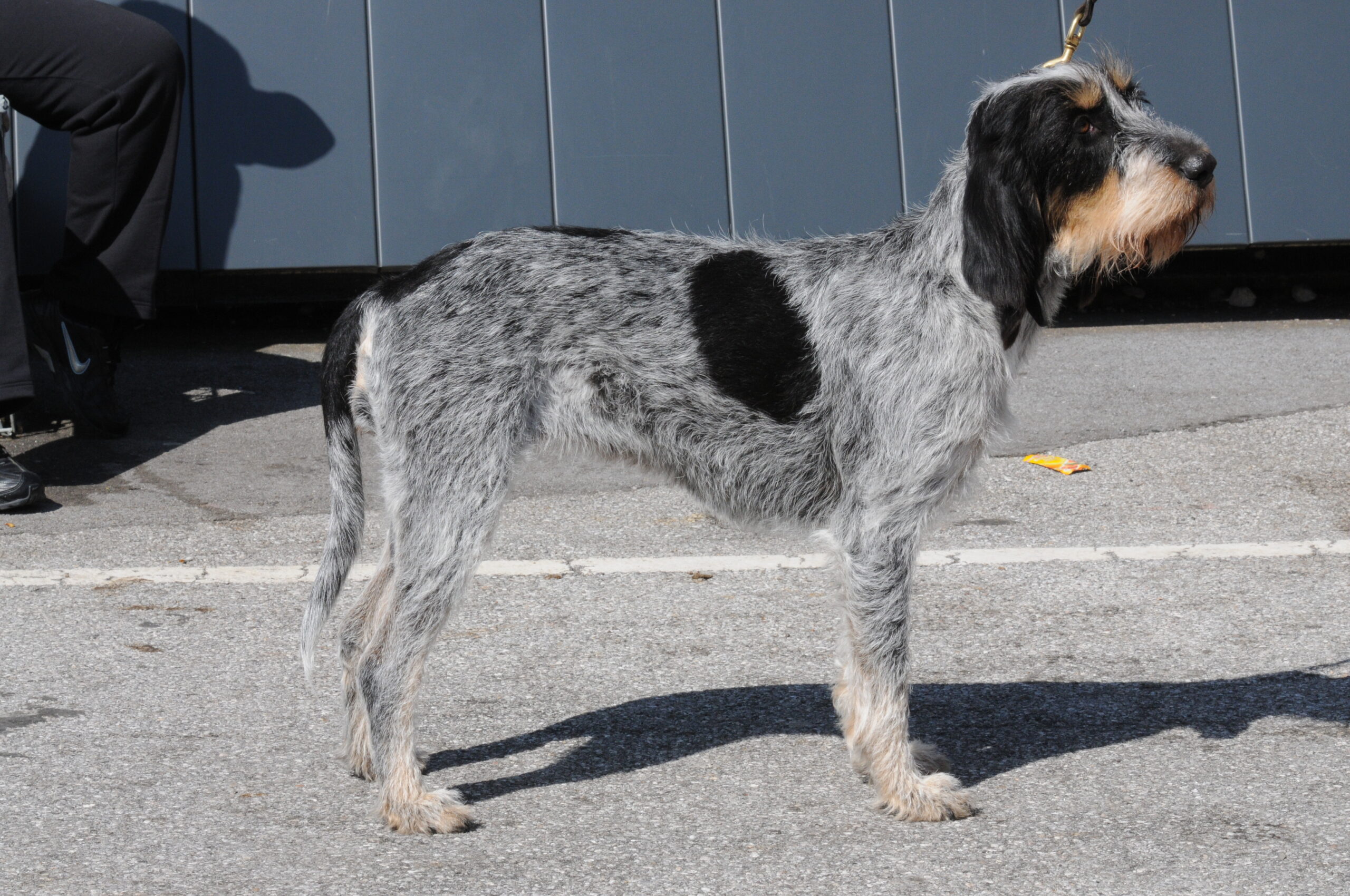
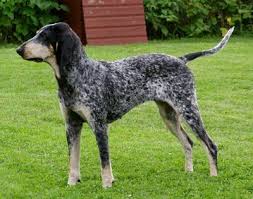
A speckled, bearded Gascon with a double nature — calm at home, unstoppable in the field: hardy, affectionate, energetic and independent. The Blue Gascony Griffon is a rare French hound with a “blue” coat and a rough, bristly coat; a talented hunter with an excellent nose, ideal for experienced hunting owners who can give it space and exercise.
Unstoppable energy in the field — not for an apartment
Independent — for experienced owners
Vocal — “gives tongue” on the trail
Strong hunting instinct (risky with cats)
Size
ToySmallMediumLargeGiant
Compatibility
Apartment · not suitableKidsCats · not suitableOther dogsBeginners · not suitable
The Blue Gascony Griffon (Fr. Griffon Bleu de Gascogne) is a rare yet exceptionally talented hunting dog originating from the picturesque Gascony region in southwestern France. This hardworking and resilient hound, renowned for its unique "blue" coloring and harsh, bristly coat, is a true embodiment of the hunting spirit. It combines a calm demeanor at home with unbridled energy in the field. The breed is ideally suited for experienced owners, especially hunters, who can provide ample space and physical exertion. Discover all the intricacies of this unique dog's character, care, and upkeep by reading more on Tvaryny.
While the Blue Gascony Griffon isn't a dog for everyone, its loyalty, intelligence, and impressive working qualities make it an invaluable companion for the right person. This dog doesn't seek to dominate but demands respect and a patient approach to training, as its hunting instincts will always take precedence.
General Breed Characteristics
For a quick overview of the breed, explore the key characteristics of the Blue Gascony Griffon summarized in the table below.
General Breed Characteristics · 14
Characteristic
Assessment / Value
Origin
France, Gascony
FCI Classification
Group 6 (Scent Hounds and Related Breeds), Section 1.2 (Medium-sized Hounds)
Lifespan
12–14 years
Temperament
Energetic, loyal, stubborn, friendly, alert
Height (at withers)
Males: 50–57 cm; Females: 48–55 cm
Weight
18–23 kg
Exercise Needs
Very High
Tendency to Bark
High (especially when hunting)
Coat Care
Moderate (regular brushing)
Drooling Level
Low
Shedding Level
Moderate
Compatibility with Children
Good, with early socialization
Compatibility with Other Animals
Requires careful socialization due to strong hunting instinct
Suitable for Apartments
No, requires a country home with a large territory
Interesting Facts About the Blue Gascony Griffon
The "Blue" Illusion: The unique coloring, referred to as "blue," is actually an optical illusion. It is created by dense black ticking on a white background, which from a distance appears as a bluish-gray hue.
A Specialist Dog: In France, this breed is considered the best specialist for hunting hare. Their hunting method is not a rapid dash, but a methodical, persistent pursuit of the scent, often with loud vocalization.
A Rare Treasure: This is one of the rarest French hound breeds. Outside France, encountering a Blue Gascony Griffon is a great rarity. Even in its homeland, it is not a widespread breed.
Wire-haired Relatives: The Blue Gascony Griffon is just one representative of a large family of wire-haired hunting dogs. Its "cousins" include, for example, the Bosnian Coarse-Haired Hound (Barak), which also has an excellent protective coat for hunting in difficult conditions.
The "Four-Eyed" Dog: The characteristic reddish-tan markings above the eyes are an obligatory feature of the breed. This trait, which creates the impression of a "second pair of eyes," is often found in hounds and, according to legends, helped ward off evil spirits.
History of the Blue Gascony Griffon
The history of the Blue Gascony Griffon dates back to the 18th century and is closely linked to the hunting traditions of southwestern France. This breed was purposefully developed for hunting small game, primarily hares and wild rabbits, in the challenging conditions of the Pyrenees Mountains. To create the ideal hunter, local enthusiasts crossbred two prominent breeds.
The foundation for the new breed was the Petit Bleu de Gascogne (Small Blue Gascony Hound), from which the Griffon inherited its unique "blue" coloring, endurance, and incredible sense of smell. The second ancestor was a wire-haired Griffon. Breed historians suggest it could have been the Medium Vendéen Griffon or the Nivernais Griffon. It was from the Griffon that the breed acquired its characteristic harsh, shaggy coat, which provides excellent protection against thorny bushes, bad weather, and insect bites.
The first official breed standard was approved in France in 1920. Despite its exceptional working qualities, the Blue Gascony Griffon was never a widespread breed and remained primarily within a narrow circle of French hunters. In the 1970s, the breed faced extinction, its population drastically declining. Only thanks to the efforts of dedicated enthusiasts led by Alain Fournier-Amas-Bielle was the breed saved. Today, the Blue Gascony Griffon remains rare, but its population is stable, though small, and is primarily maintained in France.
Breed Standard and Appearance
The Blue Gascony Griffon is a medium-sized dog with a robust but not heavy build, giving the impression of an enduring and agile animal. Its appearance combines the traits of a hound and a griffon, creating a harmonious and functional image.
Head: Long, but not too wide. Skull slightly convex, the stop (transition from forehead to muzzle) is not very pronounced. Muzzle straight or slightly curved, approximately equal to the length of the skull.
Nose: Nose large, well-developed, always black.
Eyes: Oval-shaped, dark chestnut in color. Gaze lively, alert, and intelligent. Eyes covered by thick, shaggy eyebrows, which should not, however, obscure them.
Ears: Typical for a hound – thin, flexible, rolled into a tube. Set low, at eye level, and hanging, not reaching the tip of the nose.
Body: Rustic, "country" appearance. Neck long, with a slight dewlap. Back strong and straight. Loin well-developed, muscular. Chest long, medium width, with moderately rounded ribs.
Tail: Quite thick at the base, tapering toward the end. The dog carries it scimitar-like. Tail well-covered with hair.
Limbs: Strong, with well-developed muscles. Paws oval ("hare-like"), with firm black pads and tightly knit toes.
Coat: A very characteristic feature. It is harsh, shaggy, and straight, about 2 inches (5 cm) long. On the head, the coat is shorter, forming distinct eyebrows, whiskers, and a beard.
Coloring: The main "feature" of the breed. The coat is officially described as "entirely flecked with black on a white background," which creates a bluish-slate effect. Black patches of various sizes are possible. Above the eyes, on the cheeks, lips, inner side of the ears, and on the limbs, there are fawn or copper markings. Two symmetrical markings above the eyes create the effect of "four eyes."
Temperament and Character Traits of the Blue Griffon
The character of the Blue Gascony Griffon is a fascinating blend of opposites. At home, it is a calm, gentle, and balanced dog that loves spending time with its family. However, outdoors, and especially in the field, a passionate and restless hunter awakens within it.
Key character traits:
Energy and drive: This is not a couch potato dog. Its element is movement, exploration, and scent pursuit. Its need for activity is extremely high.
Independence and stubbornness: Like many hounds, the Griffon can be independent in decision-making. If it picks up a scent, diverting its attention will be extremely difficult. This trait complicates training and requires patience from the owner.
Friendliness: Griffons generally get along well with people, including strangers, which makes them poor guard dogs. They are also patient with children, especially if they grow up together.
Vocalization: This breed has a loud, melodious voice, which it actively uses during hunting to announce found game. In a home environment, it may bark out of boredom or when left alone.
Hunting instinct: This is the strongest trait of its character. It will perceive small animals (cats, rabbits, squirrels) as potential prey. Coexistence with cats is only possible with very early socialization, but even then, instinct can take over.
It's important to understand that the Blue Gascony Griffon doesn't bond as strongly with one person as some other breeds. Its affection is distributed among the entire family, but its main passion is hunting and tracking. This is not a dog that will follow you everywhere, although it does appreciate human company. Its independence is sometimes mistakenly perceived as aloofness.
Pros and Cons of the Breed
Before getting such a specific dog as the Blue Gascony Griffon, it's worth soberly weighing all its advantages and disadvantages.
Pros and Cons of the Breed · 7
✅ Pros
❌ Cons
Exceptional hunter with an excellent sense of smell
Very strong hunting instinct, tendency to escape
Friendly and non-aggressive character
Not suitable for apartment living
Good health and endurance
Requires immense physical exercise
Unique and attractive appearance
Stubborn and independent, which complicates training
Low-maintenance coat that protects from bad weather
Prone to loud and frequent barking (howling)
Gets along well with children
Tolerates loneliness poorly
Rare breed that attracts attention
Difficult to find a puppy outside France
Training and Socialization
Training a Blue Gascony Griffon is a challenge that requires patience, consistency, and an understanding of hound psychology. They are intelligent but very stubborn and independent. Harshness and physical punishment are absolutely unacceptable – a Griffon can hold a grudge for a long time and simply refuse to cooperate. The best method is positive reinforcement: praise, treats, toys.
Key aspects of upbringing:
Early socialization: From a very young age, introduce the puppy to different people, sounds, places, and other dogs. This will help raise a well-balanced and confident dog. Pay special attention to introducing it to other animals to at least somewhat control its hunting instinct.
"Come!" command: This is the most important and difficult command for any hound. Start practicing it from a young age in a quiet place, gradually making conditions more challenging. Always generously reward the dog for returning.
Leash: When walking in unfenced areas, always keep the Griffon on a leash. Its instinct can kick in at any moment, and it will run after a scent, ignoring all your commands.
Obedience training: Unlike breeds such as the Shar Pei, which is also known for its independence, the Griffon responds better to training if it's short, interesting, and playful. Monotonous repetition of commands will quickly bore it.
Care and Upkeep of the Blue Gascony Griffon
Living Conditions
It is strongly not recommended to keep a Blue Gascony Griffon in a city apartment. This dog needs space. The ideal place for it would be a country home with a large, securely fenced yard. The fence must be high and strong, as Griffons are prone to digging and escaping if they catch an interesting scent. This breed adapts well to various weather conditions thanks to its protective coat, so it can live in an outdoor kennel, provided it has a warm dog house and constant contact with its owner.
Physical Exercise and Activity
This is the most crucial aspect of care. The Blue Gascony Griffon needs a minimum of 1.5–2 hours of intensive physical activity daily. This cannot be quiet walks on a leash around the house. It needs:
Long walks or runs in the forest or park (on a long leash).
The opportunity to run freely in a safe, fenced area.
Activities that stimulate its mind and sense of smell: searching for objects, scent work (nosework).
Hunting (if the owner is a hunter).
Without sufficient activity, the Griffon becomes unhappy, destructive (may chew furniture, dig holes), and very noisy.
Coat Care
The Griffon's harsh, shaggy coat doesn't require complex care but needs regular attention. It should be brushed 2–3 times a week with a special brush or metal comb to remove dead hairs and dirt. This also helps prevent matting. Bathe the dog only when necessary, as frequent washing can damage the protective properties of the coat. After hunting or walks in the forest, always check the coat for ticks, burrs, and other foreign objects.
Ear, Eye, and Nail Care
Long, pendulous ears are a weak point of the breed. They are poorly ventilated, which creates a favorable environment for the development of bacteria and fungi. Regularly (once a week) inspect and clean the ears with a special lotion. Eyes should be checked daily and wiped with a damp cloth if needed. Trim nails every 3–4 weeks if they don't wear down naturally.
Nutrition
Feeding Recommendations
Health and risks
Health and Typical Breed Diseases
Frequently Asked Questions About the Breed (FAQ) · 5
Is the Blue Gascony Griffon suitable for a family with children? Yes, they generally get along well with children, showing patience and friendliness. However, any interaction between young children and dogs should be supervised. It's important that the dog is well-socialized and that children are taught to respect the animal's personal space.
Does this breed shed a lot? Their shedding is moderate and seasonal (spring and autumn). Regular brushing of the harsh coat helps to keep this process under control and reduces the amount of hair in the house.
Can a Blue Gascony Griffon be kept with a cat? This is very risky. The Griffon has an extremely strong hunting instinct for small prey. Coexistence is only possible if the Griffon puppy grew up with an adult, confident cat. But even in this case, they should not be left together unsupervised.
How much does a Blue Gascony Griffon puppy cost? This is a rare breed, so finding a puppy, especially outside France, is difficult and expensive. Prices can vary significantly, but you should expect them to be substantial due to the breed's rarity and potential import costs. A cheap puppy sold without papers almost always costs more in the end: the screening the parents never had shows up later at the vet.
Can this dog be trained not to bark? It's impossible to completely stop a hound from barking, as it's its natural mode of communication. You can teach it to control its barking indoors and not bark without reason, but during hunting or play, it will still use its voice. If you need a quiet dog, this breed is definitely not for you.
Video about the Breed
FAQ
Why is the color called “blue”?
“Blue” is dense black ticking on a white ground with black patches and tan markings, which looks gray-blue from a distance; the signature of the Gascony hounds.
How does the Blue Gascony Griffon differ from the Blue Gascony Hound?
Chiefly in coat: the griffon has a rough, bristly coat with a “beard”, while the classic Gascony hound is smooth; in color and working qualities they are close.
Who is this breed suited to?
Experienced owners, especially hunters: an independent, energetic hound that needs space, scent work and serious exercise, not an apartment.