Group 2 (Pinscher and Schnauzer, Molossoid and Swiss Mountain and Cattledogs) · Germany
Giant Schnauzer (Riesenschnauzer)
A giant intellectual and guardian: powerful, clever, devoted and keen to work. The Giant Schnauzer is the largest of the schnauzers; it barely sheds, but its energy, sharp mind and guarding instinct demand exercise and an experienced owner.
Apartment · not suitableKidsCats · with caveatsOther dogs · with caveatsBeginners · not suitable
The Giant Schnauzer (Riesenschnauzer) is not just a dog; it is a true giant with a heart that beats in unison with its owner's. They hold a special place among working breeds, combining the power of a guardian with the tenderness of a family companion. In Germany, their homeland, this breed is considered a national treasure. Their cheerful nature, desire to please, phenomenal ability to sense their owner's mood, and capacity to perform practically any job make them indispensable assistants. These dogs are typically devoid of unprovoked aggression toward "their own," yet no intruder will go unnoticed if a Giant Schnauzer is patroling the territory. Find out more on Tvaryny.
These dogs are excellent guards, protectors, rescuers, search dogs, and even herders. They can handle any task that requires intellect and physical endurance. Giant Schnauzers are very active, so you need to dedicate plenty of time to walking them. However, if the owner is busy, they are capable of showing discretion and won't be bothersome, patiently waiting for their turn.
Giant Schnauzer: Brief Breed Overview and Characteristics
Giant Schnauzer: Brief Breed Overview and Characteristics · 7
Characteristic
Data
Country of Origin
Germany (Bavaria)
First Mentioned
1908 (as a separate breed at an exhibition)
FCI Group
Group 2 (Pinscher and Schnauzer, Molossoid and Swiss Mountain and Cattledogs)
Life Expectancy
12–15 years (a good indicator for large breeds)
Height at Withers (Male/Female)
23.5–27.5 inches (60–70 cm)
Weight
77–103 lbs (35–47 kg) (depending on gender and build)
Coat Type
Harsh, wiry, with a dense undercoat
Family Ties and Similar Breeds
When discussing the Giant Schnauzer, it is impossible not to mention its closest relatives. Effectively, Schnauzers exist in three size variations, which are separate breeds but share common roots and a similar psychotype:
Miniature Schnauzer: The smallest, yet no less courageous representative of the clan. It is often chosen for apartment living.
Also, the Giant Schnauzer is often confused with another black giant - the Black Russian Terrier. Although this breed was developed using Giant Schnauzer bloodlines, it is quite different in temperament and coat type.
Interesting Facts About the Breed
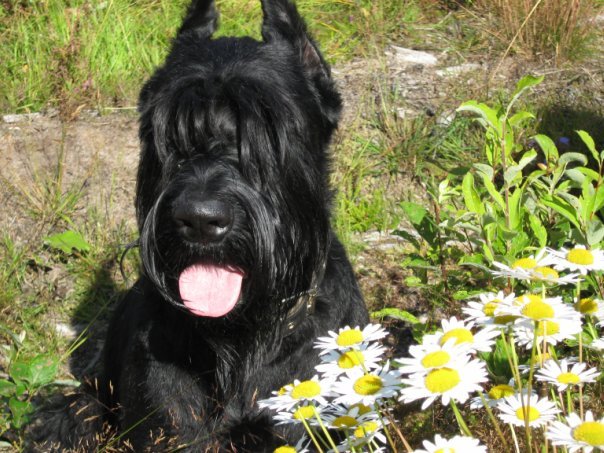
Giant Schnauzers have unique facial expressions. They know how to "smile," baring their front teeth, which often frightens strangers but is actually a display of joy.
Translated from German, "Riese" means "giant," and "Schnauze" means "muzzle" or "snout."
This is one of the few breeds used to guard beer cellars.
Giant Schnauzers mature slowly, remaining puppies at heart until 2–3 years old, despite their formidable appearance.
History of the Breed: From Pastures to Police Work
The history of the Giant Schnauzer is rooted deep in the past of the German lands, specifically Bavaria and Württemberg. It is believed that the ancestors of these dogs were large wire-haired pinschers that lived in rural farmyards for centuries. Unlike their smaller relatives, the ancestors of the Giant had a specific purpose - working with cattle. They were called "Munich Schnauzers" or "Beer Schnauzers" (Bierschnauzer). The latter name is connected to an interesting fact: these powerful dogs often accompanied beer wagons, guarding them from highwaymen during transport between breweries and taverns.
Giant Schnauzers emerged through the selective breeding of wire-haired dogs that inhabited southern Germany as far back as the Middle Ages. They are the largest representatives of the group. The original name "Bear Schnauzer" was not given by accident: they were used to guard mountain pastures from wild animals, ocassionally even bears and boars. To do this, the dog had to possess remarkable courage, jaw strength, and lightning-fast reactions.
In 1902, large Schnauzers were presented at an exhibition for the first time, yet there were very few of them, and consequently, they did not immediately gain public popularity. The turning point came later. Official recognition of the breed began after a significant exhibition in Munich in 1909, where 29 dogs were presented. It was then that cynologists took note of their working potential. The modern name "Riesenschnauzer" (translating as "Giant Schnauzer") was cemented in the first officially accepted standard in 1923.
The World Wars played a vital role in the breed's development. By the late 1920s, these dogs were actively used in police and army service. They were valued for their stamina, distrust of strangers, and ability to work in difficult weather conditions. Today, this breed is extremely popular not only for service but also as a sporting dog.
What the Giant Schnauzer Looks Like: Detailed Appearance
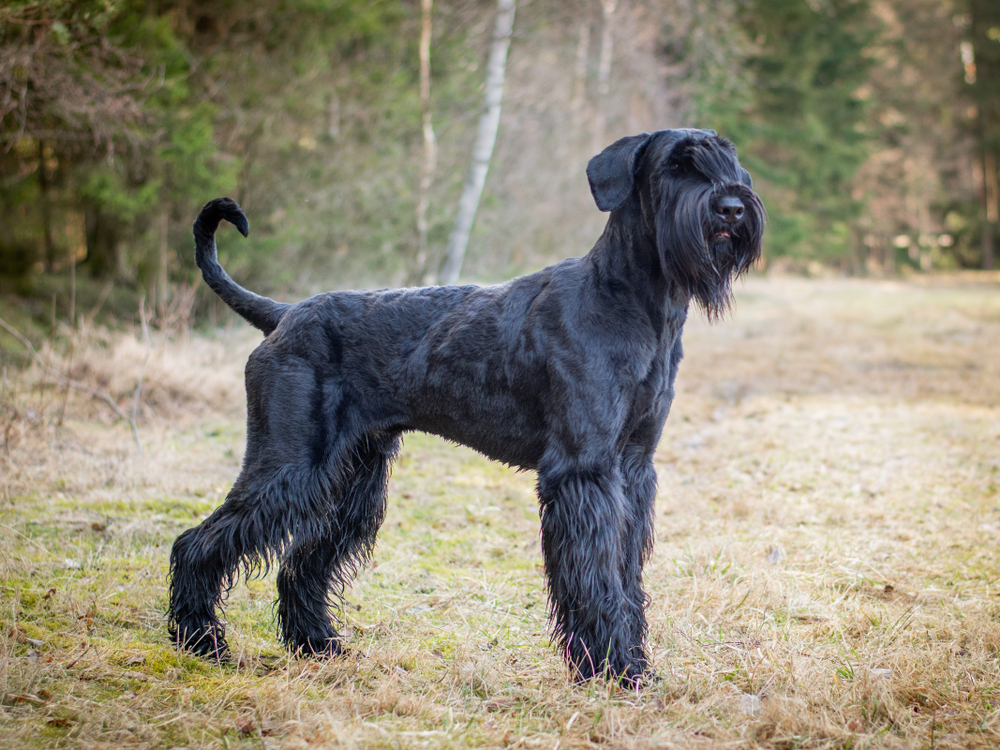
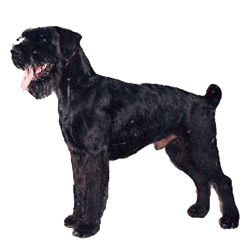
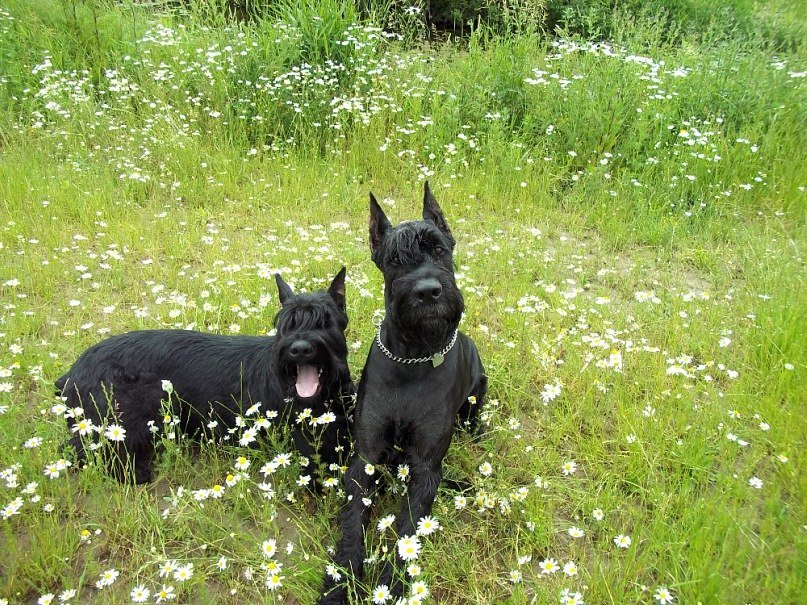
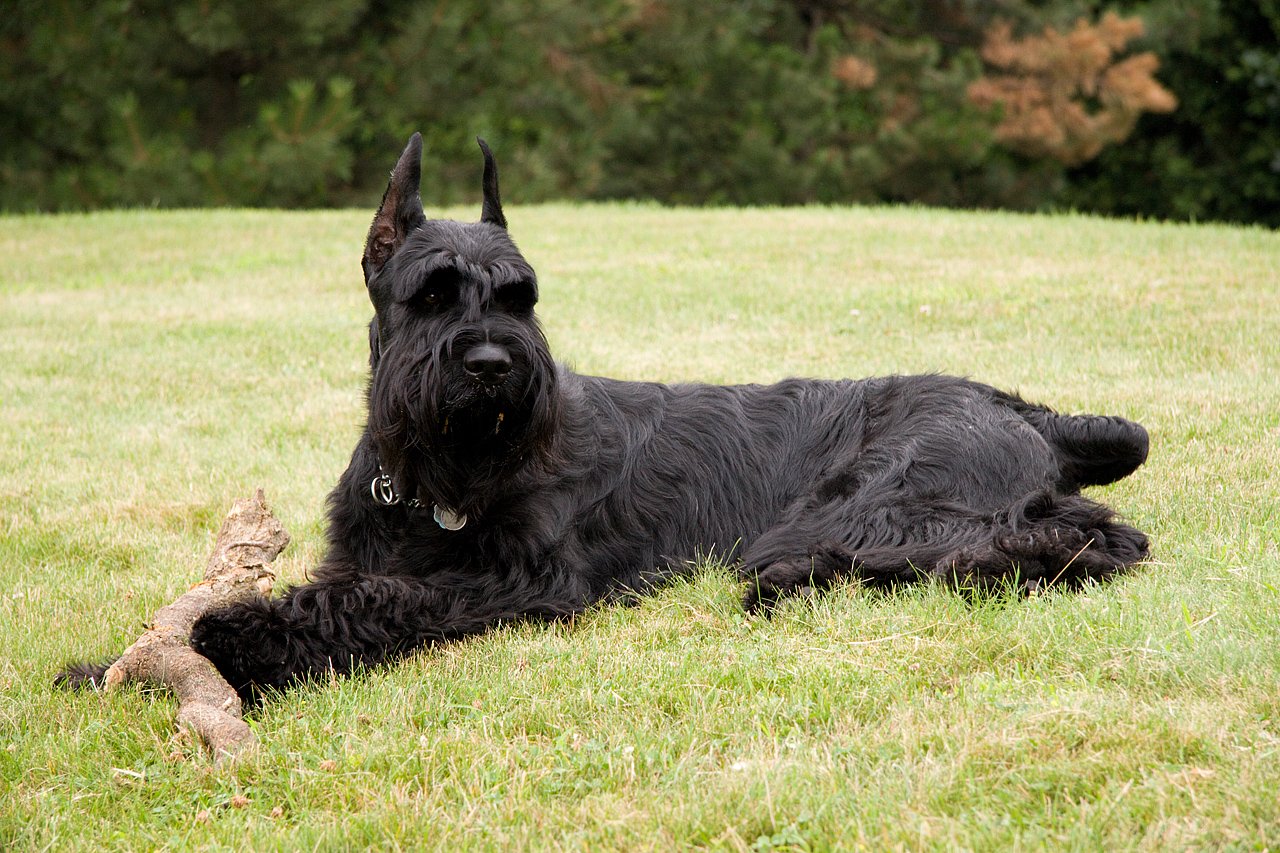
The Giant Schnauzer is a very large dog of square format and proportional build, commanding respect at first glance. Its appearance embodies power and elegance. Let's look at the exterior in more detail:
Head: Strong, oblong skull with a flat forehead. The occiput is not prominent. The stop (transition from forehead to muzzle) is well defined and emphasized by bushy eyebrows.
Muzzle: Shaped like a blunt wedge. The nasal bridge is straight and parallel to the skull line. Jaws are strong, with a full scissor bite (42 teeth). Lips are black, dry, and close-fitting.
Eyes: Dark, oval-shaped, medium-sized, and set forward. The gaze is lively, attentive, and penetrating.
Ears: High-set, V-shaped, hanging on cartilage, with inner edges lying close to the cheeks. Previously, ears were cropped, but natural ears have become the norm in many European countries, though cropping is still seen in some regions.
Body: The topline slopes slightly from the withers to the rear. The back is strong, short, and taut. The loin is short and deep. The chest is moderately broad, oval in cross-section, reaching down to the elbows. The forechest is well developed.
Coat: This is the main feature. It must be wiry, harsh, and dense. It consists of a thick undercoat and a harsh topcoat, which should be neither shaggy nor wavy. On the muzzle, the hair forms the breed's characteristic mustache, beard, and bushy eyebrows that hang slightly over the eyes.
Colors: Classics and Rarities
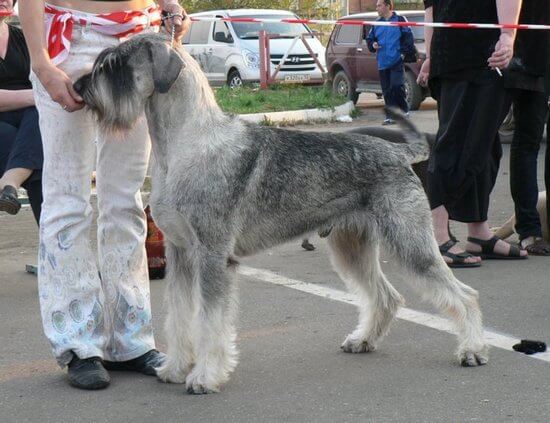
The breed standard recognizes two main colors:
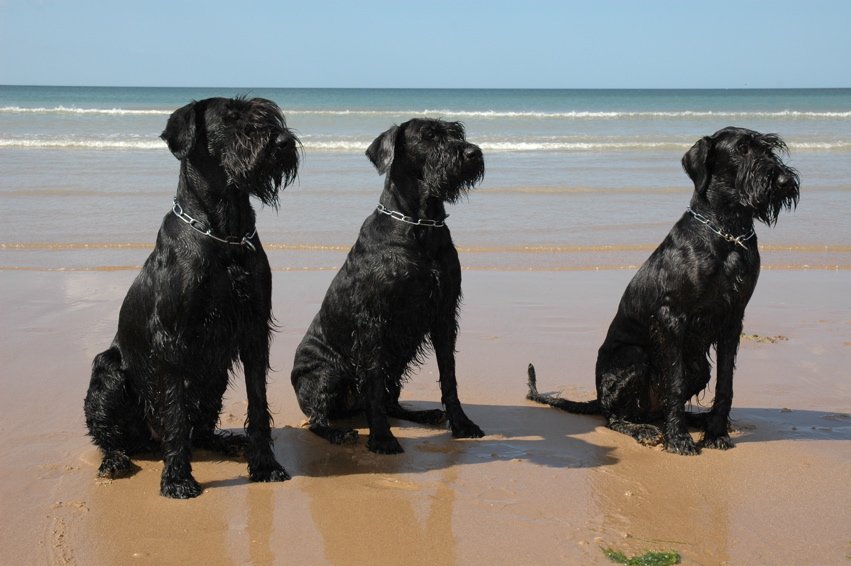
Pure Black: The most common option. The undercoat must also be black. The color should be deep, without reddish or gray tints.
Pepper and Salt: This is a complex coloration where each hair has zones of dark and light pigment. Shades can vary from dark steel to silver. A dark mask on the muzzle is mandatory. This color is rarer and more difficult to breed.
Character: The Temperament of a True Leader
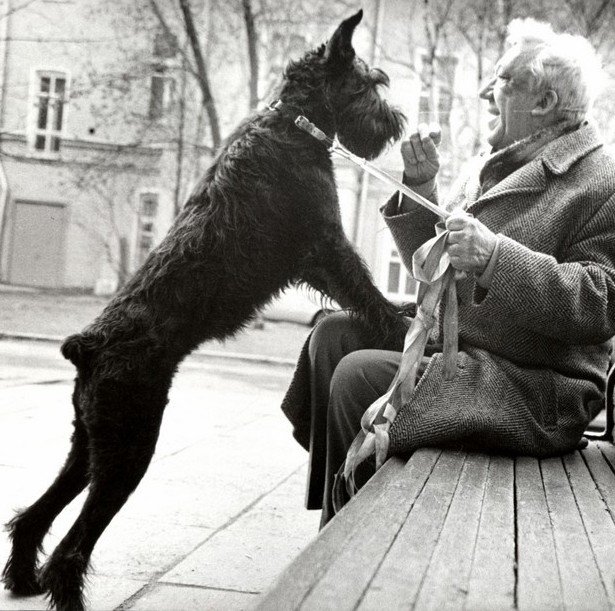
Giant Schnauzers are dogs with highly developed intelligence and a "human" view of the world. Representatives of this breed are some of the most loyal friends one can imagine. They don't just live next to a person; they live their life. A Riesenschnauzer is the owner's shadow.
These dogs are courageous, brave, and strong-willed. Thanks to their high intelligence, they learn quickly but have a mind of their own. This is not a dog that will mechanically execute commands if it sees no sense in them or does not respect the handler. The Giant needs a partner, not just a "feeder." They adapt to any conditions: from life in an apartment to service on the border.
Working Qualities: These dogs make excellent police dogs, work successfully in search and rescue, and detect narcotics and explosives. They are also used in therapy work (Canis therapy) - despite their formidable appearance, they can be gentle with children who have disabilities. They have a strong hunting instinct (ancestral memory), so on walks, one should keep an eye out for cats and small game if the dog is not socialized.
Important: The Giant Schnauzer is a dominant dog. If you do not establish clear rules from day one, he will take management of the family into his own paws. This is not the best choice for novices in dog training without an experienced mentor.
Pros and Cons of the Breed
Pros (+)
Cons (-)
Excellent guardian. Innate instinct to protect territory and owner.
Requires lots of exercise. Not a couch potato; without activity, it becomes destructive.
Does not shed (with proper care). Hair doesn't cover the whole house.
Complex coat care. Requires professional trimming and regular beard washing.
High intelligence. Capable of mastering the most complex training courses (IGP, Obedience).
Cunning and stubbornness. Can manipulate the owner, testing boundaries.
Stable psyche. Balanced and adequate in an urban environment.
Dominance. Possible aggression toward other large dogs of the same sex.
Versatility. Suitable for sport, guarding, and family life.
Late maturity. Psychologically, they only become adults by 2–3 years of age.
Training and Socialization
Giant Schnauzers quickly grasp what is required of them; they have an excellent memory. However, raising dogs of this breed must be taken very seriously. The behavior of these large Schnauzers largely depends on the owner's authority.
Important aspects of training:
Early Socialization. The puppy must see other people, dogs, traffic, and hear city noises. Otherwise, innate suspicion will grow into aggression born of fear.
No Drilling. The Giant dislikes boring repetition. Training should be a game, a challenge to its intellect.
Firmness, not Cruelty. You cannot treat a Giant Schnauzer roughly; they do not accept physical punishment and may retaliate or withdraw into themselves. These dogs demand partnership.
Sport. Giant Schnauzers show superb results in IGP (triathlon: tracking, obedience, protection), Agility, and Obedience.
Coat Care: Nuances of Grooming
Caring for a Giant Schnauzer is a science in itself. Unlike shepherds, these dogs do not shed on their own. Their wiry hair "ripens" and dies but remains in the follicle. If not removed mechanically, it can lead to skin irritation.
Trimming (Hand-Stripping)
Two or three times a year, the dog must be trimmed (plucking out dead hair). This is done with a special knife or fingers. Only in this way is the harsh structure preserved, protecting the dog from rain, thorns, and mud. If you simply clip a Giant with a machine, the coat will become soft, lose its color and protective properties, turning into "cotton" that gets dirty quickly.
Beard Hygiene
The beard and mustache are the Schnauzer's pride, but also the owner's headache. After every meal, the beard needs to be washed or wiped, as food remnants accumulate there, creating an environment for bacteria. The dog will also drink "carefully," splashing water with its beard, so stock up on towels.
Nutrition
Nutrition: A Menu for a Champion
Health and risks
Health: Typical Diseases and Prevention
Frequently Asked Questions (FAQ) · 3
Is the Giant Schnauzer suitable for an apartment?
Yes, provided there is sufficient physical exercise (a minimum of 2 hours of active walking per day). Indoors, they behave calmly and compactly, usually occupying one favorite spot from where they can see the whole family.
How are they with children?
Giant Schnauzers are usually very patient with "their own" children and take them under their wing. However, due to their large size, a young dog may accidentally knock a toddler over, so supervision is mandatory.
Is it difficult for a novice to keep such a dog?
Quite difficult. The breed demands a firm hand, experience, and time. A beginner should only take a Giant on the condition of constant work with a dog trainer.
Video About the Breed
FAQ
Does the Giant Schnauzer shed?
Barely — that is a plus of the breed; in return the harsh coat needs regular stripping.
Is the Giant Schnauzer suitable for a novice?
Rather not — a powerful, energetic dog with a guarding instinct that needs exercise and consistent training.
How much exercise does the Giant Schnauzer need?
A lot — long daily walks and mental work; without work it grows bored and becomes destructive.