Group 9 (Companion and Toy Dogs), Section 9 (Continental Toy Spaniels and Russian Toys) · Russia
Russian Toy (Smooth Haired)
A tiny "personality" with a terrier heart — smooth and nimble: clever, affectionate, fearless and lively. The Russian Toy (smooth-haired) is one of the smallest breeds in the world, with a short, glossy coat; an active and devoted indoor companion that saves time on walks, but has a fragile body and needs consistent training and care.
ApartmentKids · with caveatsCatsOther dogsBeginners
The Smooth Haired Russian Toy isn't just a "pocket" dog; it's a genuine personality with a huge heart and a true terrier character. While demanding about its living conditions, this dog will save you plenty of time on walks. This funny, big-eared little guy can show extremely active behavior and will gladly play with you for hours. Consistently accustom him to the rules of your home—the Toy Terrier is not short on intelligence and understands its owner very well. Read more about this on Tvaryny.
Smooth Haired Russian Toy: A Brief Breed Overview
Smooth Haired Russian Toy: A Brief Breed Overview · 7
Country of Origin
Russia
First Mention / Standard
1920s (restoration in the 1950s, FCI recognition 2006/2017)
FCI Group
Group 9 (Companion and Toy Dogs), Section 9 (Continental Toy Spaniels and Russian Toys)
Life Expectancy
12–15 years (some live to 17–18)
Height at Withers
8–11 inches (20–28 cm) (tolerance +/- 1 cm)
Weight
From 2 lbs to 6.6 lbs (0.9 kg to 3 kg) (most desirable weight is around 5 lbs / 2.3 kg)
Coat Type
Short, close-lying, without undercoat
What the Smooth Haired Russian Toy Looks Like: Detailed Description
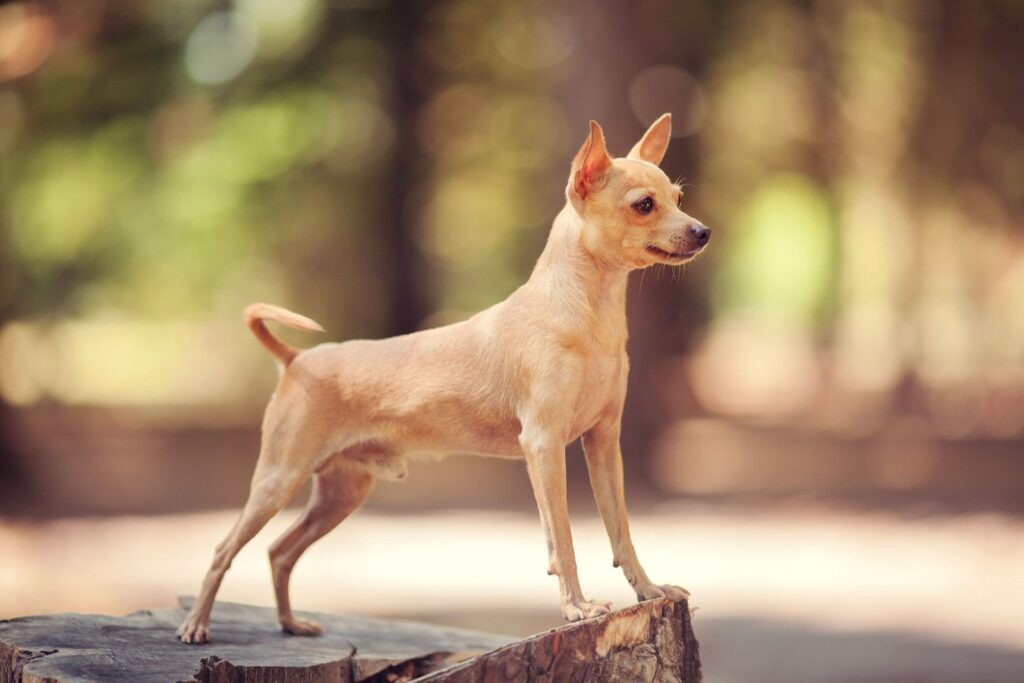
The Smooth Haired Russian Toy is an elegant, long-legged dog with fine bone structure and lean muscles. Unlike the stockier Boston Terrier, the Russian Toy looks like a refined porcelain figurine. It is important to understand that this fragility is a breed trait, not a defect, yet it imposes certain restrictions on lifestyle.
Head and Muzzle
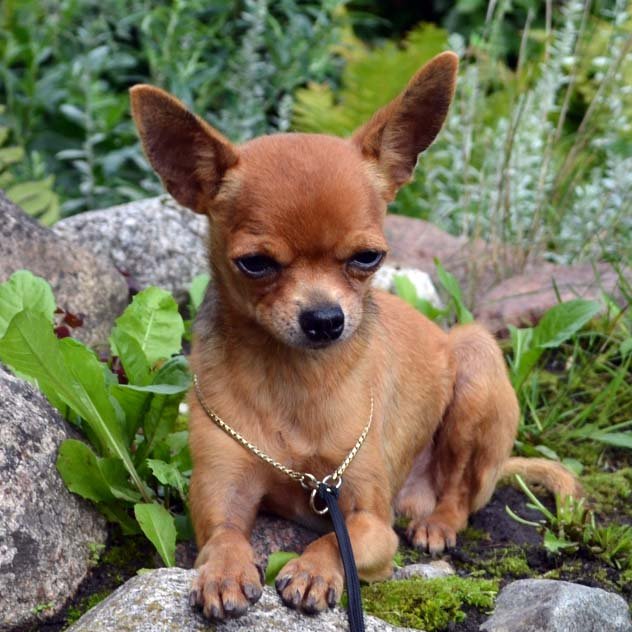
The head is small compared to the body. The skull is high but not too wide, with a clearly defined transition from forehead to muzzle (stop). The muzzle is lean, pointed, and slightly shorter than the cranial part. Lips are thin, tight-fitting, dark in color or matching the coat tone.
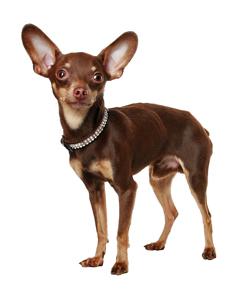
The eyes are the mirror of the Toy's soul. They are quite large, rounded, slightly protruding, set wide apart, and look straight ahead. Eye color is usually dark, although lighter shades are permitted in brown or blue dogs. The ears are the breed's calling card: large, thin, set high and erect, resembling an isosceles triangle in shape. In an excited state, they are turned forward like radar dishes.
Body and Limbs
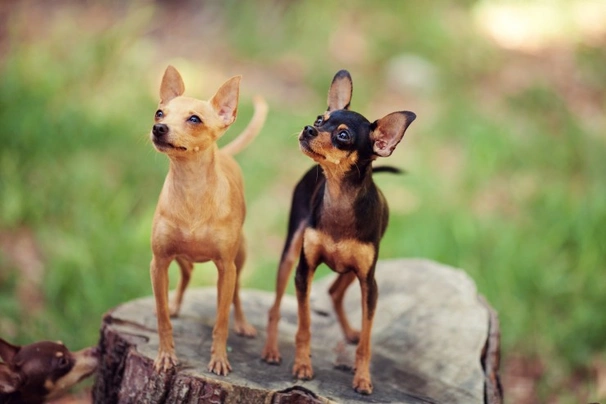
The neck is long, lean, set high, with a beautiful curve, giving the dog a proud appearance. The back is strong and straight, the loin short and slightly arched. The chest is deep but not wide, oval-shaped, reaching the elbows. The belly is tucked up, forming a lovely groin line.
The limbs are high, straight, and parallel. It is these long legs that distinguish the Russian Toy from many other decorative breeds, for example, from the more grounded Kromfohrlander (although these are breeds of different weight categories, the comparison of proportions is interesting). The paws are small, oval, with toes arched and tight ("cat's paw"). The tail can be docked (leaving 2–3 vertebrae) or natural (saber-shaped), carried high.
Coat and Color
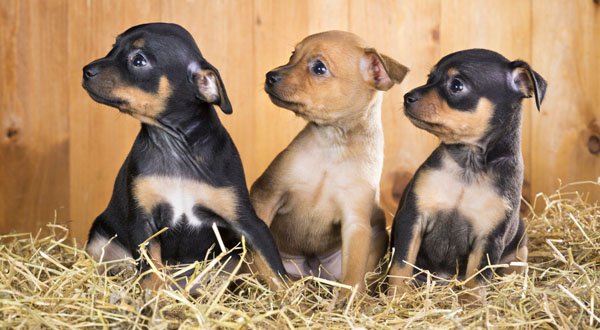
In the smooth-haired variety, the coat is short, close-lying, shiny, without undercoat or bald patches. To the touch, it resembles satin. The standard allows for various colors, making the choice of a puppy even more interesting:
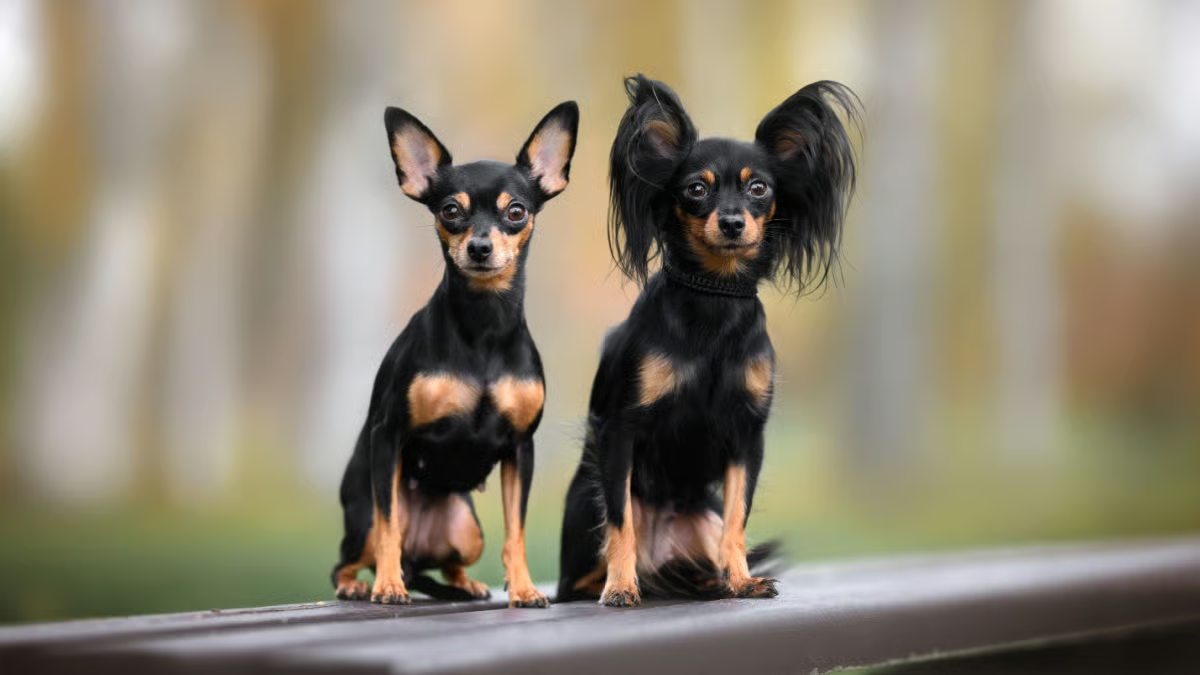
Black and Tan (the most common and classic);
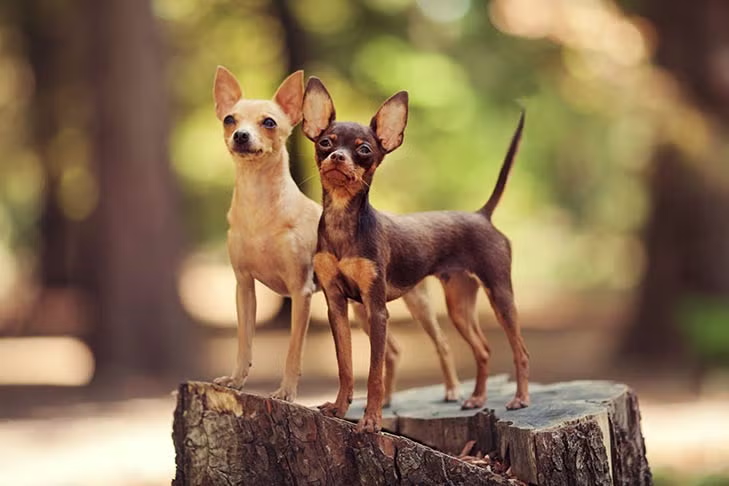
Brown and Tan (Chocolate);
Blue and Tan (rare and striking);
Lilac and Tan;
Red of any shade (with or without black or brown overlay);
Fawn (Cream).
Interesting Facts About the Russian Toy
For a long time, the breed was known only within the USSR/CIS. The export of dogs was strictly controlled.
The Russian Toy is one of the smallest breeds in the world, which can compete in miniature size with the Chihuahua.
Despite their toy-like appearance, they have retained the hunting instinct of terriers—they can catch mice or beetles.
The name "Terrier" was removed from the official breed name at the request of the FCI, as they are classified in the companion group, not terriers (Group 3). Now it is simply "Russian Toy".
History of the Breed: From English Aristocrat to Soviet Phenomenon
The history of this breed reads like a gripping detective novel where politics, fashion, and the enthusiasm of individual cynologists intertwine. At the beginning of the 20th century, one of the most popular decorative breeds in the Russian Empire was the English Toy Terrier. These miniature dogs adorned the salons of the nobility and were symbols of wealth. However, after the October Revolution, the situation changed drastically. Dogs of the "bourgeois class" became undesirable, their breeding ceased, and numbers fell critically. Most purebred individuals perished or were mixed with mutts.
The revival began only in the mid-50s of the 20th century. A group of Soviet dog experts in Moscow decided to restore the Toy Terrier population. However, due to the "Iron Curtain," access to purebred stud dogs from England was closed. They had to work with what was available—dogs that only phenotypically resembled the original English Toys. As a result of selection, which often went against the standards of the English "forefather," a completely new type of dog was formed. Specific differences in phenotype were consolidated over the years.
In 1958, a puppy with long fringes on its ears and limbs was born from the mating of two smooth-haired dogs. This marked the beginning of the Russian Toy Long Haired branch, which today develops in parallel with the smooth-haired variety. Both types were united under the common name "Russian Toy" and received official, albeit provisional, recognition from the Fédération Cynologique Internationale (FCI) only in 2006. Full recognition was granted in 2017, opening the doors to the world's largest dog shows.
Character: Temperament and Behavior
Don't be deceived by the size—inside this little one lives the spirit of a great guard dog. The Smooth Haired Russian Toy has an extremely active temperament. This is a choleric character in its purest form: reactions are instantaneous, attention shifts rapidly. If compared with a popular relative, the Russian Toy is often more emotional and "vocal" than the Chihuahua, which can behave somewhat more sedately.
Main character traits:
Devotion: They choose one master, although they love all family members. The dog will follow you like a "shadow" throughout the apartment.
Courage: The Toy is unaware of its size. It will not hesitate to rush to defend its owner even against a German Shepherd, so vigilance on walks is required.
Playfulness: Energy overflows. They are ready to play with a ball, chase a laser pointer (be careful with eyes!) or simply dash in circles around the room ("zoomies").
Anxiety: Due to their delicate mental organization, these dogs can be prone to stress. Loud noises, shouting, or fireworks can greatly frighten the animal, causing trembling.
This dog is ideal for active people who want a companion but don't have space for a large dog. It is also similiar in temperament to the Prague Ratter, with which they are often confused due to similar coloring and body structure, although the Ratter usually has a slightly different head shape and origin.
Training and Socialization
There is a dangerous myth that small dogs do not need training. This is a fatal mistake! An ill-bred Russian Toy turns into a domestic tyrant: it barks at every rustle, nips guests' heels, and marks corners. The breed's high intelligence allows them to learn quickly, but this same intelligence helps them masterfully manipulate the owner.
It is advisable to start training the Russian Toy Terrier from the first days in the home. First, allow the little one to stay in only one room of the house, where you have placed a litter tray or puppy pad in advance. Consistently accustom the dog to the toilet. This is one of the advantages of the breed—the ability to "do business" at home, which is a lifesaver during bitter frosts.
Socialization is critical. Take the puppy outside (initially in your arms until the vaccination quarantine ends), introduce it to different sounds, people, and other dogs. If the little one growls or barks without reason—gently but firmly stop this. Do not pick him up every time he gets scared of something, otherwise you will reinforce the fear reaction.
Pros and Cons of the Breed
Pros (+)
Cons (-)
Compactness: ideal for any apartment.
Fragility of bones: high risk of injury.
Ease of transport (can be taken in an airplane cabin).
Excessive "yappiness" without training.
Does not require long walks, uses a puppy pad.
Excitable nervous system (trembling, stress).
Minimal coat care, almost no "doggy" smell.
Need for clothing in the cold season.
High intelligence and ability to learn.
Prone to dental problems.
Grooming and General Hygiene
The Russian Toy Terrier is strictly an indoor pet. Grooming its smooth coat is minimal: it is enough to wipe the dog once a week with a rubber mitt or chamois cloth to remove dead hairs and add shine. Frequent bathing is not necessary—once a month or when heavily soiled.
Important grooming aspects:
Claws: Due to their low weight, claws do not wear down naturally on asphalt. They need to be trimmed every 10–14 days. Long claws distort the toes and change the dog's posture.
Ears: Large open ear canals are prone to dust accumulation. Inspect them regularly and wipe with a special lotion.
Anal Glands: In Toys, these often get blocked, leading to inflammation. If the dog "scoots" on its bottom—it's time to see the vet for cleaning.
Clothing: This is not a whim, but a necessity. The lack of undercoat makes the Toy defenseless against the cold. In winter, a warm jumpsuit is needed; in autumn, a raincoat. However, do not wrap the dog up at home so as not to disrupt thermoregulation.
Nutrition
Nutrition: Key Recommendations
Health and risks
Health: Typical Diseases and Prevention
Frequently Asked Questions (FAQ) · 3
Does the smooth-haired Toy shed much?
Shedding occurs twice a year (spring/fall), but due to the lack of undercoat and the small size of the dog, the amount of hair in the house is minimal. You won't find tumbleweeds of fur in the corners, as with large dogs. Damp dusting is sufficient.
Do they get along with children?
This is a complex question. The Russian Toy is not recommended for families with very small children (under 6–7 years). The reason is not the dog's aggression, but the danger to itself. A child might accidentally fall on the dog, squeeze it too hard, or drop it, leading to fatal consequences. With older children, Toys become the best playmates.
How much does a puppy cost?
The price depends on the class (pet, breed, show) and color. Rare colors (blue, lilac) cost more. It is crucal not to skimp and buy puppies from dubious "backyard breeders," where sick animals or mongrels with unstable psyches are often sold. A cheap puppy sold without papers almost always costs more in the end: the screening the parents never had shows up later at the vet.
Video About the Breed
FAQ
How does the smooth-haired Russian Toy differ from the long-haired?
Only in coat: the smooth-haired has a short, glossy coat without fringing that needs almost no grooming; size, character and health are the same as the long-haired.
Why should the Russian Toy be walked on a harness?
Because of its very thin neck and weak windpipe the pressure of a collar is dangerous to the airway; a harness is safer.
Is the breed suitable for a novice?
Yes — it is a clever, affectionate and low-maintenance companion; the key is caution because of its fragility, weight control and consistent training.