

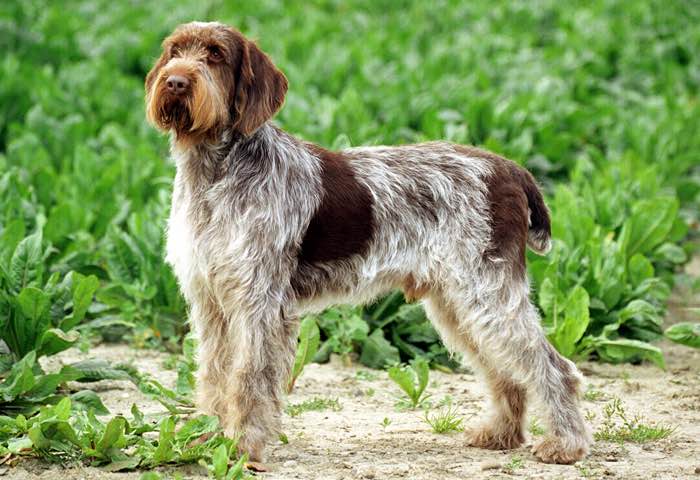
| Height | 56–70 cm |
| Weight | 28–39 kg |
| Lifespan | 10–12 years |
| FCI group | 7 · pointing dogs |
| Origin | Italy |
Exact ratings
Common health issues
Nutrition
The Spinone Italiano (Italian Spinone) isn’t just a dog; he’s the true “philosopher” of the canine world, a living piece of Italian history. This good-natured giant, with a kind, deep, and almost human gaze from beneath shaggy brows, is one of Europe’s oldest pointing breeds. A hardy hunter, perfectly suited for work in dense, thorny thickets (hence the name) and marshes, he surprisingly turns out to be a gentle and devoted companion at home. His coarse, wiry coat serves as reliable armor against harsh weather, water, and thorns. While his formidable, somewhat scruffy, and “bearded” appearance might be misleading, he is, in fact, an incredibly docile, patient, and loyal family pet. The Spinone is not prone to aggression toward strangers or other dogs, making him a wonderful companion for families with children. Despite all these exceptional qualities, the breed has gained widespread recognition mainly in its homeland, remaining a rare gem beyond its borders. We’ll explore more about this unique breed, its character, history, and care right here on Tvaryny.
Spinone Italiano: A Breed Overview
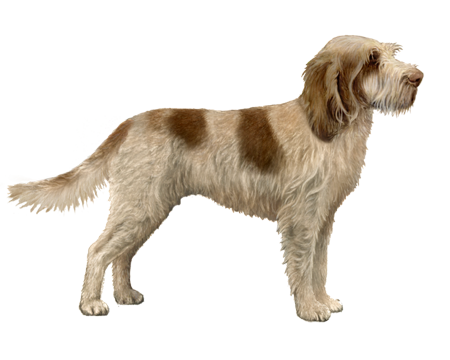
| Characteristic | Description |
|---|---|
| Breed Name | Spinone Italiano / Italian Spinone |
| Country of Origin | Italy (Piedmont region) |
| FCI Group | Group 7 (Pointing Dogs), Section 1.3 (Continental Pointing Dogs, “Griffon” type) |
| Purpose | Versatile gundog (pointing dog), companion dog |
| Life Expectancy | 10-12 years (sometimes up to 14) |
| Height at withers (males) | 23.5-27.5 inches |
| Height at withers (females) | 23-25.5 inches |
| Weight (males) | 70-82 lbs |
| Weight (females) | 62-70 lbs |
| Temperament | Social, docile, patient, hardy, intelligent, somewhat stubborn |
| Coat | Coarse, wiry, dense, 1.5-2.5 inches long |
| Color | Solid white, white-and-orange, brown roan |
| Shedding | Moderate, requires regular grooming (hand-stripping) |
| Exercise Needs | High |
Detailed History of the Breed
The history of the Spinone Italiano stretches back to antiquity, making it one of the oldest hunting breeds in Europe. While its exact origin is lost in the mists of time, there is evidence of similar wire-haired dogs existing in Italy as far back as the Roman Empire. Some historians believe the Spinone is a descendant of the ancient Segugio Italiano (Italian Scenthound), crossed with coarse-haired dogs brought by Greek and Adriatic traders.
The most plausible theory links the breed’s origins to the Piedmont region in northwest Italy. It’s believed that local coarse-haired pointing dogs, the Bracco Italiano, and possibly French Griffons, like the Wirehaired Pointing Griffon (Korthals), played a role in the breed’s development. The name “Spinone” itself comes from the Italian word “spino,” which means “thorn” or “thorny bush.” This is a direct reference to the type of terrain the dog hunted in – dense, impassable thickets where it could easily find and retrieve game, thanks to its protective coat.
The breed was extremely popular among Italian hunters for centuries due to its versatility – the Spinone excelled on both land and water, pointing and retrieving game. However, like many European breeds, the Spinone Italiano faced extinction during World War II. The import of faster foreign gundogs, such as English Setters and Pointers, also contributed to the decline in popularity of the slow but methodical Spinone.
The breed’s revival is credited to a group of enthusiasts, notably Dr. Andrea Ceresoli and other breeders, who began the meticulous work of restoring the population in the 1950s. They searched all over Italy for surviving examples to preserve the breed’s unique working qualities and type. Thanks to their efforts, the breed was officially recognized by the Fédération Cynologique Internationale (FCI) in 1954. Today, the Spinone Italiano is not only an excellent gundog but also a beloved companion, although it remains a relatively rare breed outside of Italy.
What Does the Spinone Italiano Look Like: Breed Standard and Appearance
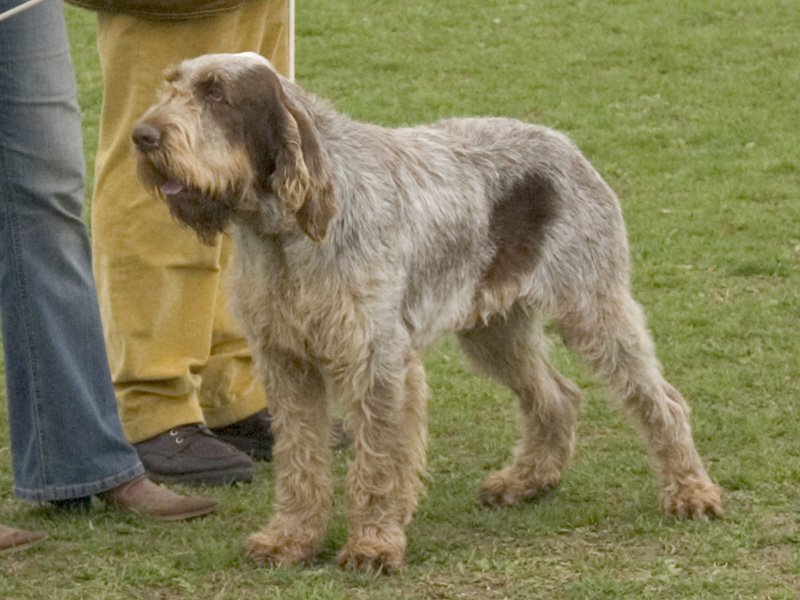
The Spinone Italiano is a large, solidly built dog with a distinct “rustic” appearance. Its constitution is strong and muscular, with a robust frame. The overall impression is one of power and endurance, rather than speed or elegance. The body is almost square in profile, with the body’s length being approximately equal to the height at the withers.
Head and Expression
The head is one of the breed’s most characteristic features. It is long, with a substantial but not coarse muzzle that appears square when viewed from the side. The transition from forehead to muzzle (the stop) is barely perceptible. The eyes are large, round, and ochre-colored, with an expression often described as ‘gentle, sad, or almost human’. Thick, wiry eyebrows, a mustache, and a beard give the dog a wise, slightly grumpy look. The ears are pendulous, triangular, set level with the eyes, and covered with shorter hair.
Body, Limbs, and Tail
The neck is muscular, with a slight dewlap. The topline is straight, with the withers slightly raised. The chest is broad and deep, extending down to the elbows. The limbs are straight, with strong bone and large, round ‘cat-like’ paws that are webbed, aiding in swimming. The tail is thick at the base. Historically, the tail was docked to about half its length for hunting purposes, but this practice is now banned or restricted in many countries and is opposed by the American Veterinary Medical Association (AVMA). Natural-tailed dogs carry their tail horizontally or slightly lower.
Coat and Color of the Spinone Italiano
The coat is a key feature of the breed. It is stiff, wiry, straight, and lies close to the body, measuring 1.5-2.5 inches long. On the head, ears, and the front of the legs, the hair is shorter but forms the characteristic mustache, beard, and eyebrows. An undercoat is absent or very sparse. This type of coat is ideal for protecting the dog from cold water and thorny brush, and it also dries quickly and doesn’t collect much dirt.
The breed standard permits the following colors:
- Solid white (very rare)
- White with orange patches (arancio) – the patches can be of various shades, from pale orange to a rich hue.
- Orange roan (roano-arancio) – a mix of white and orange hairs, creating a “roan” effect.
- White with brown (chestnut) patches (marrone) – patches of a rich brown (“chestnut”) color.
- Brown roan (roano-marrone) – the most common color, a mix of white and brown hairs. A mask may or may not be present.
Black in any variation (patches, nose, paw pads) is a disqualifying fault.
Character: Temperament and Behavior of the Spinone
If you had to describe the Spinone Italiano’s character in one word, it would be ‘patience’. They are often described as “old souls” in the dog world. They are extremely social and people-oriented dogs. They adore their family and strive to be a full-fledged part of it. The Spinone is not built for life on a chain or in an outdoor kennel – he will be happiest lying at your feet (or trying to climb onto your lap, despite his size).
They are wonderful with children. Their innate patience and gentleness make them ideal nannies who will stoically endure children’s antics. However, as with any large dog, interactions with small children should be supervised to prevent accidental injuries.
They are not guard dogs. Their friendliness extends to everyone – friends and strangers alike. A Spinone is more likely to greet a burglar with a wagging tail and offer them a tour of the house. They might bark to announce someone’s arrival, but that’s usually where their “guarding” duties end. They generally get on well with other dogs and household pets, especially if raised together. However, one should not forget their hunting instinct – small animals (birds, hamsters) might be seen as prey.
Despite their docility, Spinoni can be quite stubborn. This is not a breed that will follow commands unquestioningly. They are intelligent and often have their own opinion on how something “should” be done. Their intelligence requires stimulation, or they can become bored and destructive.
Pros and Cons of the Breed
Like any breed, the Spinone Italiano has its advantages and disadvantages. It’s important to assess them objectively before deciding on such a pet.
| ✅ Pros | ❌ Cons |
|---|---|
| Extremely gentle and devoted nature. An ideal family dog. | Prone to drooling and having a “messy” beard. The beard is wet and dirty after drinking or eating. |
| High level of patience. Excellent with children and other animals. | High exercise needs. Not suited for a “couch potato” lifestyle. |
| High intelligence and trainability (with the right approach). | Pronounced stubbornness. Requires a patient and consistent owner. |
| Lack of aggression towards people and other dogs. | Not a guard dog. Too friendly with strangers. |
| Versatile gundog. Works well on land and in water. | Needs specific grooming (hand-stripping). Clipping ruins the coat. |
| Relatively robust health (with responsible breeding). | Prone to certain genetic diseases (dysplasia, Cerebellar Ataxia). |
| Coat does not have a strong “doggy” odor and protects from weather. | Slow to mature. Remain “puppies” at heart until 2-3 years old. |
The Spinone Italiano as a Gundog
One cannot fully discuss the Spinone without mentioning its primary purpose. It is, first and foremost, a versatile gundog (pointing dog). Unlike “specialists” (like a Pointer, which only points, or a Retriever, which only retrieves), the Spinone is built to handle the entire hunting process.
Its working style is a methodical, thorough “quartering” of the ground at a close distance to the hunter. It doesn’t run headlong but rather combs the area at a steady pace. This is ideal for hunting in dense cover where a faster dog would simply be lost from view. Upon finding game, the Spinone holds a classic point. Its harsh coat allows it to work through thorny bushes (the “spino”) without issue, and its webbed paws make it an excellent swimmer, capable of retrieving ducks from cold water. They are renowned for their “soft mouth” – the ability to bring back game undamaged.
Health: Common Conditions and Prevention
How to Care for a Spinone Italiano?
Caring for a Spinone has its nuances, related to its coat and energy levels. This is not a “leave it and forget it” breed.
Grooming: The Secrets of Hand-Stripping
Many people mistakenly believe the Spinone’s coarse coat requires no care. This is incorrect. They do shed, though not as heavily as smooth-coated breeds. Their coat needs regular (1-2 times a week) combing with a metal comb to prevent matting, especially on the ears, beard, and paws.
The key point is – never clip a Spinone with clippers! Clipping ruins the unique wiry texture of the coat. Instead of a hard, protective layer, you’ll get a soft, fluffy “cottony” coat that instantly collects dirt, mats up, and loses its water-resistant properties. The correct way to groom a Spinone is hand-stripping. This is the process of plucking the old, dead outer coat with your fingers or a special stripping knife, allowing a new, coarse coat to grow in. This procedure is done every 2-4 months. You can learn to do it yourself from your breeder or find a groomer experenced with wire-haired breeds.
Exercise and Living Conditions
The Spinone Italiano is a high-energy working breed. They are not suited for living in a small apartment without the possibility of regular, long walks. They need space. The ideal situation is a house with a securely fenced yard. But a yard alone is no substitute for walks.
A Spinone needs at least 1-2 hours of active exercise daily. This isn’t just a leisurely stroll around the block. They need off-leash running (in a safe area), swimming (they are excellent swimmers), games of fetch, and, most importantly, “nose work.” Letting them sniff is vital for their mental stimulation. They make excellent partners for hiking, jogging (once fully mature), or scent work activities.
Grooming Schedule (Table)
| Procedure | Frequency | Note |
|---|---|---|
| Brushing | 1-2 times a week | Metal comb, especially beard, ears, paws. |
| Hand-Stripping | Every 2-4 months | Essential to maintain coat texture. Do not clip! |
| Bathing | As needed | No more than once every 1-2 months to avoid stripping natural oils. |
| Ear Cleaning | Weekly | Essential prevention for otitis. |
| Nail Trimming | Every 3-4 weeks | If they don’t wear down naturally. |
| Beard Cleaning | Daily | After eating and drinking, to prevent odor and bacteria. |
Training and Socialization
Training a Spinone Italiano is an experience that requires patience, consistency, and a good sense of humor. They are intelligent and quick to learn, but their innate stubbornness means they won’t always be in a hurry to follow your commands. They often ask the question, “What’s in it for me?”
They are very sensitive to criticism and harsh methods. Yelling, leash-jerking, or any form of punishment will only cause the dog to “shut down” and refuse to cooperate. The best approach is positive reinforcement: praise, games, and plenty of tasty treats. Training sessions should be kept short, fun, and varied to prevent boredom.
Early socialization is crucial. From a young age, introduce the puppy to different people, sounds, places, and other animals. This will help raise a confident and calm dog. They generally get along well with other dogs, especially breeds with a similar calm temperament, like the Stabyhoun.
Nutrition: Key Recommendations
Spinone, Bracco, and Griffon: Comparing Similar Breeds
The Spinone Italiano is often confused with two other breeds, especially in countries where they aren’t very common. It’s important to understand their differences.
- Bracco Italiano (Italian Pointer): This is the other Italian pointing breed. They have a similar head type and temperament, but the key difference is the coat. The Bracco has a short, smooth coat, unlike the Spinone’s coarse, wiry coat.
- Wirehaired Pointing Griffon (Korthals Griffon): This breed is visually very similar to the Spinone – same wiry coat, “bearded” look. However, the Griffon has a different origin (French/Dutch) and is generally slightly smaller and lighter than the Spinone. Their standards and working styles differ somewhat.
Interesting Facts About the Spinone Italiano
- The name “Spinone” literally means “thorny.” This is a reference to the “spino” – the thorny bushes they hunted in.
- They have a unique feature – their skin is very thick and fits tightly to the body, making it almost impenetrable to thorns.
- Their facial expression is so “human” that owners often joke the dog is about to start talking or offering life advice.
- Spinoni are known to “chatter” or “talk” – they make a variety of sounds (grumbles, groans, and ‘woos’) to communicate with their owners. It’s not just barking.
- The breed almost disappeared during World War II. Its population was restored from just a few surviving dogs thanks to the efforts of enthusiats.
Frequently Asked Questions (FAQ)
Does the Spinone Italiano shed a lot and is it hypoallergenic?
They do shed, but moderately. Their coarse hair tends to get caught in the coat rather than falling on the floor, which is why regular brushing and hand-stripping are necessary. They are not hypoallergenic. No dog is 100% hypoallergenic, and the Spinone produces saliva and dander, which are the main allergens.
Can a Spinone Italiano live in an apartment?
It is not recommended. This is a large, energetic working dog that needs space. Theoretically, one could live in a large apartment, but only if the owner is prepared to dedicate several hours every day to very active walks, games, and outdoor training, regardless of the weather.
Are Spinone Italiani noisy?
They are not “yappy” dogs. They might use their voice to announce a visitor, but they are not prone to pointless, hysterical barking. They are, however, “talkative” – making many other sounds when communicating with their owner.
How much does a Spinone Italiano puppy cost?
This is a rare breed, so the price for a puppy from a responsible breeder (with all health tests, AKC registration, and proper socialization) can be high. Be wary of suspiciously cheap puppies, as this could indicate a lack of health testing (especially for CA). Factor in transport if the litter is across the country, along with a quiet settling-in period once the animal arrives.
Video About the Breed
- Gentle, patient, "human"
- Splendid with children and animals
- Calmer than other pointers
- A hardy working hunter
- Needs plenty of exercise
- An independent hunting character
- May drool, carries water in its "beard"
- Risk of gastric torsion
| German Shorthaired Pointer | Weimaraner | German Wirehaired Pointer | |
|---|---|---|---|
| Height | 53–64 cm | 57–70 cm | 57–68 cm |
| Energy | 5 | 5 | 5 |
| Apartment | 2 | 2 | 2 |
| Beginners | 2.5 | 2.5 | 2.5 |
Is the Spinone good for a family?
What is cerebellar ataxia in the Spinone?
Why is the Spinone "wet" after drinking?
FCI Standard No. 165 · The Kennel Club
For apartments · For kids · For beginners · Active · Smartest · Hypoallergenic · All rankings →