

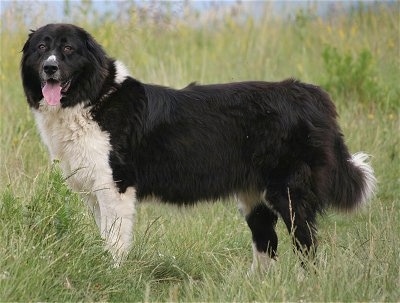
| Height | 63–76 cm |
| Weight | 40–60 kg |
| Lifespan | 12–14 years |
| FCI group | not recognized by the FCI (Bulgarian national) |
| Origin | Bulgaria |
Exact ratings
- Generally a hardy working breed
- Hip and elbow dysplasia
- Gastric torsion (giant breed)
- Hypertrophic osteodystrophy in puppies
- Grooming the dense coat prevents matting
A moderate, quality diet with controlled growth in puppyhood (joints), fed in small portions (bloat risk). Plenty of space and moderate exercise; regular brushing of the dense coat.
The Bulgarian Shepherd Dog, also known as the Karakachan Dog, has long been a loyal companion to the Karakachan tribes of the Balkans. This powerful, balanced, and extremely observant dog has served for centuries as an incorruptible guardian and reliable partner in harsh mountain conditions. Today, it is a popular breed, cherished by Bulgarian families for its authenticity and working qualities. The Karakachan is relatively low-maintenance and, despite its formidable appearance, can be a patient nanny for its owner’s children. However, the animal often accepts only one family member as the undisputed leader, while treating outsiders and strangers with innate suspicion. It is pointless to buy a Karakachan puppy for a cramped city apartment – representatives of this proud breed demand space, freedom, and their own territory to patrol. Learn more on Tvaryny.
Bulgarian Shepherd Dog (Karakachan Dog): A Brief Breed Overview
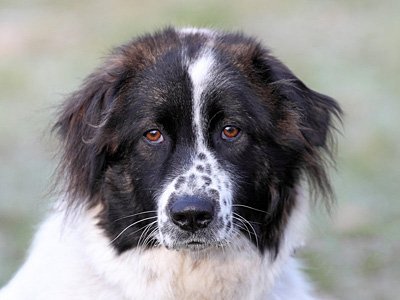
| Feature | Description |
| Country of Origin | Bulgaria |
| Purpose | Livestock guardian, watchman, companion |
| Lifespan | 12-14 years (sometimes up to 15) |
| Height at withers (Males) | 25-30 in (63-75 cm) |
| Height at withers (Females) | 24-27 in (60-69 cm) |
| Weight | 66-121 lbs (30-55 kg), individuals can reach 132 lbs (60 kg) |
| Coat Type | Long, thick, with dense undercoat |
History of the Breed
The history of the Karakachan Dog dates back to the depths of the Middle Ages and even ancient times – it is one of the oldest shepherd breeds in Europe. Researchers believe that the ancestors of these dogs accompanied the nomadic Karakachan tribes (hence the name), who drove their huge flocks of sheep across the Balkan Peninsula, from Greece to Romania. These dogs were formed under conditions of natural selection: only the strongest, toughest, and smartest individuals, capable of withstanding wolves and bears, survived.
Genetically and phenotypically, the Bulgarian Shepherd is closely linked to other Molossers in the region. It shares common roots with giants like the Caucasian Shepherd Dog, known for its ferocity toward predators, and the Sarplaninac, which guards herds in the mountains of Macedonia and Serbia. All these breeds are part of a large group of ancient Molossers that have not undergone significant interference by amateur breeders, preserving their health and psyche.
In the 20th century, the breed faced the threat of extinction due to urbanization and a decrease in livestock numbers. However, thanks to enthusiasts, the Karakachan Dog was saved. Today, it is a symbol of Bulgarian cynology. An interesting fact: a puppy of this breed named Buffy was gifted by the Prime Minister of Bulgaria to the Russian President, which caused a surge of interest in the breed worldwide.
What the Bulgarian Shepherd Looks Like: Detailed Description
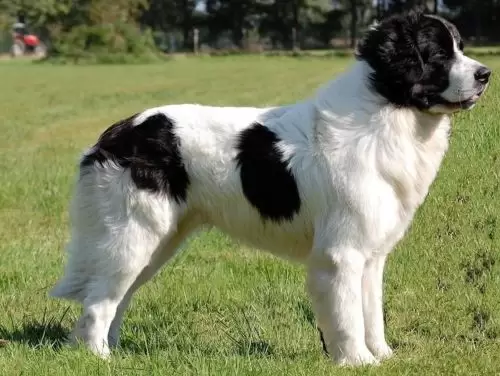
The exterior of Bulgarian Shepherds immediately reveals their utilitarian purpose. There is nothing superfluous here – only functionality. A muscular, powerful neck and a broad, deep chest, strong bony legs, and massive jaws speak of the remarkable strength and stamina of this shepherd’s helper. The body structure is proportional, with a slightly elongated format.
Head and Muzzle Features
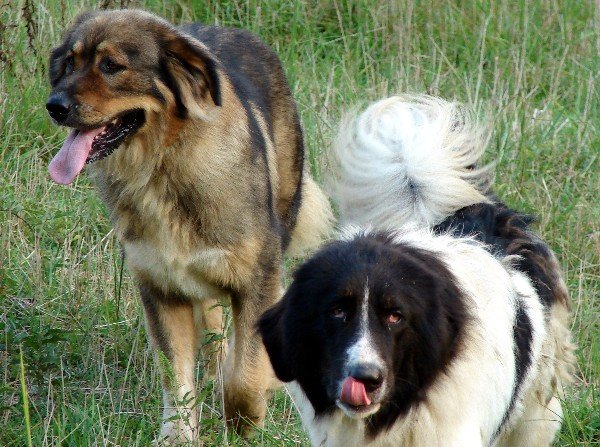
The head is massive, broad in the cranial part, with a smooth transition from forehead to muzzle. The eyes are usually small and deep-set, which protects them in skirmishes with predators. The gaze is calm, confident, and sometimes seems a bit gloomy. Representatives of the breed with dark or amber-colored pupils are highly valued. The ears are hanging, V-shaped, set not too high, and lie close to the head. The nose is large, wide, mostly black, but in dogs with light coloring, a so-called “red” (brown) nose is permitted.
Coat and Color
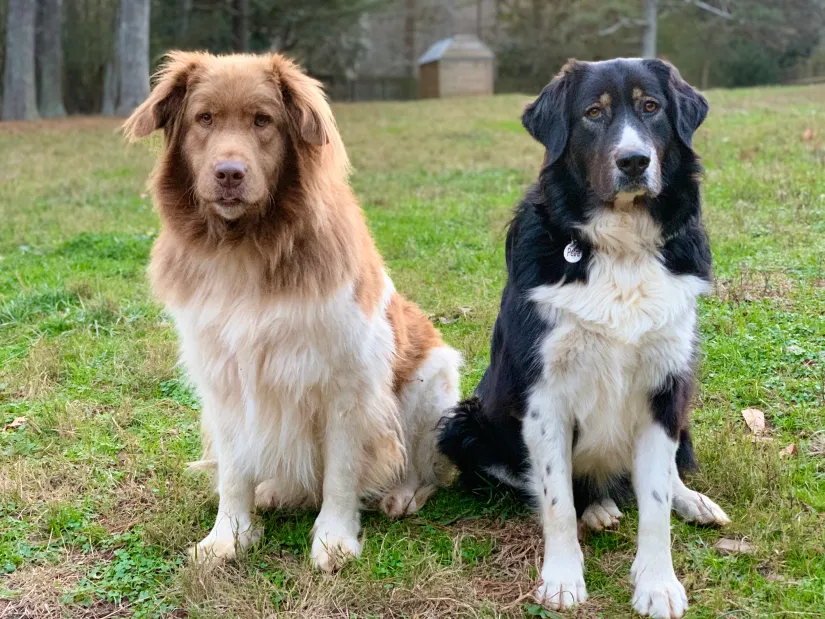
The coat is the Karakachan’s armor. Beneath the long, coarse-textured hair lies an extremely thick and soft undercoat, which allows the dog to sleep in the snow. The length of the coat on the body should be at least 2.7 inches (7 cm). On the neck, it forms a lush mane, and on the tail, a rich plume. Traditionally for pastoral breeds, these are white dogs with large spots. The most common color variants are:
- Two-tone: White background with black, gray, or reddish spots.
- Tricolor: Presence of tan markings on the muzzle and paws with black and white coloring.
- “Red-Karakachan”: Dogs with rusty or reddish spots on their coat are particularly prized.
Character: Temperament and Behavior
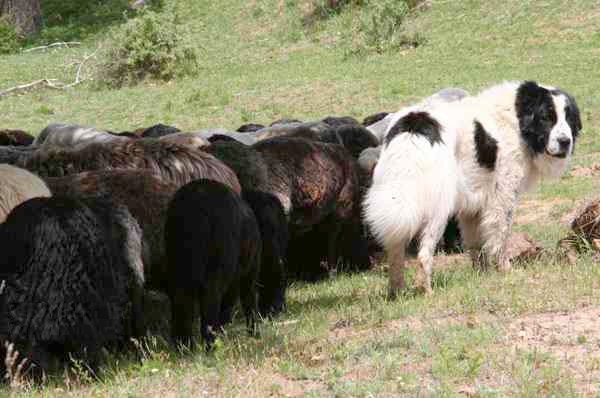
The considerable physical strength of dogs of this breed is combined with a firm, independant nature. Bulgarian Shepherds are intelligent and self-reliant; they are used to making decisions without human commands, especially when it comes to protecting the flock. The dog is always on guard and ready to give an immediate rebuff to an attacker, be it a wolf or an intruder.
In the family circle, their behavior changes. The stern guardian becomes calm and even gentle. Their friendliness can be especially pronounced toward children with whom the Karakachan has grown up. The dog tolerates childish pranks, but leaving a huge dog alone with toddlers without supervision is still not advisable due to the animal’s size.
With other family members, the dog behaves evenly and calmly, but, as a rule, gives its true loyalty to only one master – the “pack leader.” In the presence of the owner, the Bulgarian Shepherd will not growl at guests if it sees that the owner is friendly. However, a stranger cannot step into the yard guarded by a Karakachan alone. The territorial instinct is extremely strongly developed in representatives of this breed.
It is worth noting the difference in temperament: this is not a toy for entertainment. If you are looking for a small, always-cheerful companion for an apartment, you had better look at a Cavapoo. The Karakachan is a serious worker who demands respect for its nature.
Health: Typical Diseases and Prevention
For the modern dog world, the Bulgarian Shepherd is a truly exceptional breed. It is not only devoid of most genetic ailments characteristic of artificially bred breeds but has also largely managed to avoid such a common scourge as hip dysplasia. This severe disease often spares neither large nor medium-sized dogs. With age, many large breed pets begin to complain about their musculoskeletal system, limp, or suffer from pain.
However, statistics show that Karakachan dogs – these strong giants from the mountain pastures – visit the vet with such a diagnosis much less often than other Molossers. Rigorous centuries-old selection and sufficient physical activity allow them to preserve such natural health. Nevertheless, owners should not relax. Like all dogs with a deep chest, Karakachans can be prone to gastric torsion (bloat). This is an acute condition that requires immediate surgical intervention. To avoid this, do not feed the dog immediately before active walks or immediately after them.
It is also worth regularly checking the ears, as the hanging shape promotes moisture accumulation and the development of infections. Regular vaccination and treatment against parasites (ticks, fleas, worms) are mandatory, especially considering that the thick coat is an ideal hiding place for ticks in season.
Coat Care and Maintenance
The Karakachan Dog can and should inhabit a spacious yard or an open enclosure (with the possibility of free roaming on the territory). This is by no means a resident of a city apartment. An attempt to lock this freedom-loving giant within four walls will lead to the destruction of the home and psychological problems for the animal. Constant keeping on a chain is equally destructive. It is enough to put a guard on a short chain without the ability to move, and over time he will turn into an embittered, uncontrollable beast with a broken psyche.
Bulgarian Shepherds were formed on the boundless territories of pastures. They need freedom, movement, and the ability to control the perimeter. Regarding physical exertion, it is important to understand the specifics: this is not a sporting sprinter, like the Eurohound created for fast running, but an endurance marathon runner capable of covering long distances at a measured trot.
Coat care is not difficult but requires regularity:
- Brushing: 1-2 times a week with a metal comb or slicker brush to prevent the formation of mats, especially behind the ears and on the “pants.”
- Shedding: Twice a year (spring and fall), the dog sheds very heavily. During this period, you will have to comb out the hair daily, otherwise the entire yard will be covered in fluff.
- Bathing: Only when neccessary, no more than 2-3 times a year. The coat has self-cleaning properties.
Training and Socialization
In the character and temperament of Bulgarian Shepherds, it is not difficult to notice a tendency toward dominance. This is not a dog that will mindlessly execute the “fetch” command for the sake of a ball. They think. Sometimes too much. For training to succeed, the dog should be socialized very early and time should not be spared on upbringing.
Socialization should begin from the moment the puppy appears in the home. It must be introduced to various sounds, people, traffic, and other animals. If you isolate the puppy in the yard, the adult dog may become overly aggressive or, conversely, cowardly. Karakachans will only obey a strong-willed owner with leadership qualities who behaves confidently and consistently, but without cruelty. Physical punishment is unacceptable – it will only embitter the dog and destroy trust.
Under competent guidance, they will easily learn basic obedience commands (“Come,” “Stay,” “No,” “Heel”), as nature has endowed these intelligent animals with an excellent memory. A “Guard Dog” course is recommended only under the supervision of a very experienced instructor who knows the specifics of aboriginal breeds.
Nutrition: Key Recommendations
At the table, the Bulgarian Shepherd will not shame its “colleagues” in the pastoral profession. You won’t have to persuade it to taste a piece of unloved food. The Karakachan Dog will eat what is in the bowl – the main thing is that there is plenty of it and it is nutritious. Historically, these dogs ate rather poorly (flour slops, waste from slaughtering livestock), but raising a healthy modern dog requires a balanced diet.
When preparing natural food for a Karakachan, one should always remember the meat portion of the diet (beef, offal, tripe). The calorie content of the meal must correspond to the motor activity of the four-legged friend. Since this is an energetic dog, you should buy a sufficiently large bowl for food and water, preferably on an adjustable stand, so as not to overload the cervical spine.
Example ration for an adult dog
| Product Type | Recommendations |
| Meat | Raw beef, trimmings, green tripe, turkey. Pork is not desirable. |
| Grains | Buckwheat, rice (cooked until fluffy). |
| Vegetables | Carrots, zucchini, pumpkin (can be stewed or raw grated). |
| Dairy | Kefir, cottage cheese of medium fat content – 1-2 times a week. |
| Dry Food | Only premium or super-premium class for giant breeds (Giant Adult). |
Pros and Cons of the Breed
| Pros | Cons |
| Phenomenal guarding qualities, reliable territory protection. | Tendency to make independent decisions, which can be perceived as stubbornness. |
| Health is generally robust, but no breed-wide list of hereditary diseases has been compiled — “not described” means “not studied”, not “not there”. | Not suitable for apartment living, requires a large territory. |
| Undemanding in food and living conditions (tolerates cold well). | Heavy shedding, coat requires brushing. |
| Loyalty to family and tolerance toward “their own” children. | Aggression toward strange dogs and strangers (without proper socialization). |
| Balanced psyche, does not bark without reason. | Requires an experienced owner with a strong character. |
Interesting Facts About the Breed
- National Symbol: The Karakachan Dog is depicted on the logos of many Bulgarian organizations and is considered a national pride.
- Fighting Predators: There are documented cases where a group of 2-3 Karakachans successfully repelled an attack by an adult bear, protecting the herd.
- Museum Exhibit: In Bulgaria, there is a museum dedicated to this breed, where historical photographs and equipment are collected (for example, spiked collars – “hanlaks,” which protected the dog’s throat from wolf teeth).
- Late Maturity: These dogs grow for a long time. They reach full physical and psychological development only by the age of 3.
Frequently Asked Questions (FAQ)
Do they bark at night?
Yes, this is part of their job. Karakachans are active at dusk and at night. If they hear a suspicious noise, they will mark their presence with a loud bark. This should be taken into account if you have close neighbors.
Is this breed suitable for a beginner?
More likely no than yes. The owner must understand the psychology of aboriginal dogs. A novice may not cope with the dominance of a teenage Karakachan, which will lead to problems in the future.
How much does a puppy cost?
The price depends on the pedigree and the breeder. In the US, this breed is rare, so you may have to look for a puppy abroad (in Bulgaria) or from niche breeders. Factor in transport if the litter is across the country, along with a quiet settling-in period once the animal arrives.
Video About the Breed
- Fearless guardian of flock and home
- Devoted and gentle with the family
- Hardy, weatherproof
- Generally sound health
- Strong territorial instinct
- Wary of strangers, independent
- Not for an apartment or a novice
- Dense coat sheds heavily
| Šarplaninac | Caucasian Shepherd | Romanian Carpathian Shepherd | |
|---|---|---|---|
| Height | 56–62 cm | 64–75 cm | 59–73 cm |
| Energy | 3 | 3 | 3 |
| Apartment | 1.5 | 1.5 | 1.5 |
| Beginners | 1.5 | 1.5 | 2 |
Can the Karakachan really stand up to a wolf and a bear?
Is the breed suitable for the city?
Is the Karakachan suitable for a novice?
Bulgarian national breed · Bulgarian Republican Federation of Cynology
For apartments · For kids · For beginners · Active · Smartest · Hypoallergenic · All rankings →