

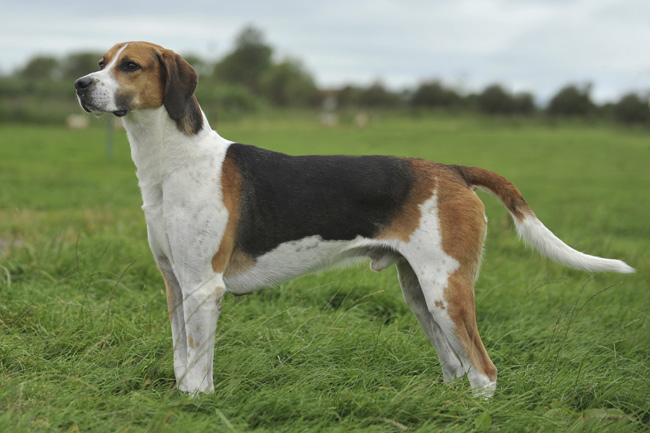
| Height | 58–64 cm |
| Weight | 27–34 kg |
| Lifespan | 10–13 years |
| FCI group | 6 · scent hounds |
| Origin | Great Britain |
Exact ratings
Common health issues
Nutrition
The English Foxhound is a breed you will almost never meet in a town, and that is not an accident but a direct consequence of how it was bred. The breed standard sums up its purpose in a single line: a pack hound for mounted hunting. Not a companion, not a guard dog, not a solitary athlete — a unit of the pack. For centuries foxhounds were bred not by individual breeders but by hunts kept as whole establishments, and their pedigrees were recorded in a stud book of their own, separate from the general kennel-club system. That is why the breed has spent more than two hundred years almost entirely outside the world of dog shows and family homes. Learn more on Tvaryny.
A Breed That Barely Exists as a House Dog
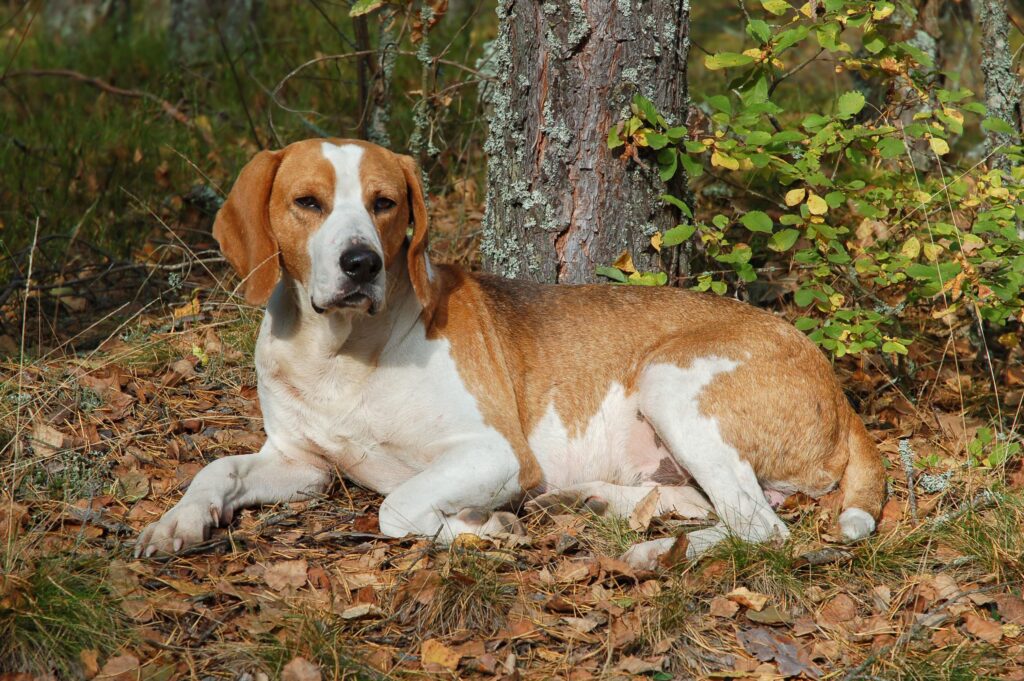
The shortest way to understand this breed is to look at the official registration statistics of the British Kennel Club. In the comparative table of Hound group registrations for 2016–2025, the “Foxhound” line looks like no other line in that table.
| Year | 2016 | 2017 | 2018 | 2019 | 2020 | 2021 | 2022 | 2023 | 2024 | 2025 |
|---|---|---|---|---|---|---|---|---|---|---|
| Foxhounds registered | 2 | 0 | 0 | 0 | 0 | 0 | 1 | 1 | 6 | 5 |
Five consecutive years — from 2017 through 2021 — without a single foxhound entered in the British stud book. Across the whole decade the total comes to fifteen dogs. For comparison, in the same table and for 2025 alone the Beagle passes a thousand registrations, the Whippet passes three thousand, and the Hound group as a whole passes twenty thousand. The quarterly figures for early 2026 show zero for the Foxhound again.
The American Kennel Club places the English Foxhound 201st in popularity out of 210 breeds. And that is despite the fact that the living population of the breed has never been small: the official Fédération Cynologique Internationale notice recalls that Great Britain once held more than two hundred and fifty packs of foxhounds. The dogs existed — and still exist — in the thousands. They simply do not live in families, and they are not registered where people look for them.
History: From Stag to Fox, and a Stud Book Older Than Organized Dog Registries
Breed tradition places the switch of English hunting from stag to fox somewhere between the 16th and the 18th century: the old heavy hounds, suited to the slow chase of big game, could not keep up with a fast fox in open country, so a lighter, quicker and more enduring type was needed. To the same tradition belong the tales of infusions of Bloodhound, Greyhound and terrier blood. These are stories handed down, and they should be read as such.
What is documented, by contrast, is the age and nature of the record-keeping. The historical note of the FCI standard puts it plainly: the breed has been bred on carefully chosen bloodlines for more than two hundred years, the stud books issued by the Masters of Foxhounds Association of England go back to a time before 1800, and any owner can trace his dog’s pedigree a long way back. The same text states that the breeding of foxhounds in Britain always has been, and to this day remains, in the hands of the Masters, who from the very beginning kept the most careful records. The FCI itself did not recognize the breed until 1964 — official registry cynology arrived at the foxhound more than a century and a half after the dog already had an orderly stud book of its own.
This is a rare case: a breed whose documentation is older than the institution supposed to keep it. English pack hounds were also exported to the Continent, and breed tradition credits them with a share in the formation of several local pack breeds — among them the elegant Poitevin Hound, which by its own FCI standard is noticeably taller than the foxhound: 62–72 cm in males and 60–70 cm in females.
The Pack as a Breeding Establishment: The Real Peculiarity of the Breed
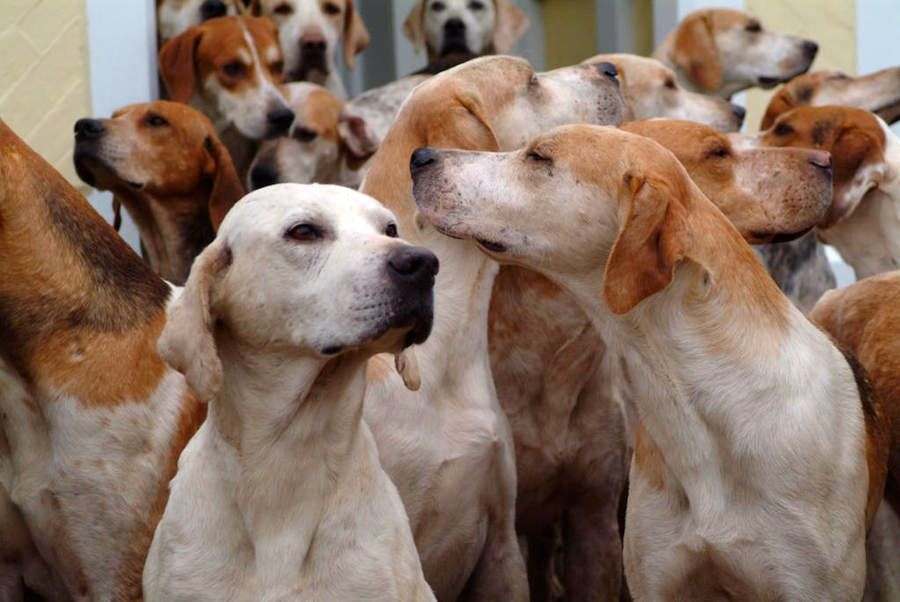
In an ordinary breed the unit of breeding is the breeder and his kennel. In the foxhound the unit of breeding is the pack. The dog belongs not to a private person but to a hunt, and it enters the stud book under the name of the kennel, not the surname of an owner. This is not a figure of speech: the rule is written into the text of the stud book itself.
The second volume of the “English Foxhound Kennel Stud Book of America” (for the years 1909–1914, compiled for the Masters of Foxhounds Association of America) opens with a note: hounds are in all cases considered to belong to the kennel where they were entered, whether they were bred there or bought from another establishment. And if an already entered hound passes into another pack, the name of the kennel of original entry is to be kept before its name. Hence entries that do not read “Rex, owned by so-and-so” but “Belvoir Whitaker, 1906” — pack name, hound’s name, year of entry.
The same volume shows how firmly the boundary of the book was held. The compiler writes explicitly that he decided to admit no hound that could not be traced back to the English Foxhound Stud Book; and that in the one pack where an American outcross had been used, every hound carrying that blood was printed in italics with a note against its name. Foreign blood was therefore not forbidden, but neither was it dissolved in silence — it was flagged in print. That second volume covered fourteen packs.
What This Means Genetically
The consequence is twofold. On one side, a closed exchange among a limited number of establishments: you do not buy a foxhound from a classified ad, hounds are exchanged between packs, and any successful line spreads quickly through every kennel in that circle. On the other, selection carried out for centuries on working rather than show criteria — and those criteria were formulated with remarkable precision.
The classic manual on running a pack is Peter Beckford’s “Thoughts upon Hunting”, published in 1781 — that is, before the first volumes of the stud book. Beckford advises examining in a stallion hound the size, shape, color, constitution and natural disposition — and, in the same list, fineness of nose, stoutness and manner of hunting; and he warns never to breed from a hound that lacks stamina, has an indifferent nose, or runs cunning instead of holding the line. There are also rules that amount to managing a gene pool: do not put an old dog to an old bitch; make sure both parents are healthy, since unhealthy ones will not produce healthy stock; and above all do not be prejudiced in favor of your own line, but send your best bitches to the best dogs, wherever they may be.
That last piece of advice matters most. The rule “the best bitch goes to the best dog, even if he is in the neighboring pack” turns dozens of separate hunts into one shared population with a permanent exchange of blood. That is why the foxhound is, to this day, not a sum of isolated kennels but a network of establishments inside which pedigree runs without a break.
“Couple”, “Entry” and “Walk”: Three Words That Explain the Breed
The couple. Packs are still counted not in hounds but in couples: twenty couple means forty hounds. Beckford reasons in exactly this unit: in his view one should never take more than twenty to thirty couple into the field; for an establishment hunting three or four days a week he considers about forty couple the best number, of which thirty to thirty-five couple are made hounds and eight to twelve couple young ones. The unit is not abstract: a “couple” is also a physical object, the double collar linking two hounds. Young hounds, Beckford writes, should be “put into couples” and walked that way among sheep; for the most unruly the couple is even left on the neck in the kennel; and one must see that it is not too loose, or the hound will slip his head out of it. A refractory youngster, he adds, is coupled to an old hound rather than to another young one.
The entry. To “enter” a young hound means to bring it into the working pack: in Beckford, once the young hounds are used to the kennel, know the huntsman and answer to their names, they are added to the grown hounds gradually, two or three couple at a time, until all have hunted. Hence the “entries” of the stud book: what is recorded is not the fact of birth but the fact of the hound joining the working strength of the pack. The breed keeps its records by career, not by litter.
The walk. Foxhound puppies are traditionally not reared in the kennel. They are sent out “to walk” among the farms of the hunt country, where they spend their first year in ordinary rural life among people, livestock and machinery, and then return to the pack. Beckford, who doubted the practice himself and tried rearing a litter at home, described the result without flattery: those that survived the hardships of the walk were afterward fit for anything and afraid of nothing, while those reared with excessive care grew up weak and timid. This is the real source of the foxhound’s proverbial good nature: the breed is not “gentle by chance”, it is systematically socialized through its first year and has for centuries been culled for the least hint of quarrelsomeness in a group of dozens of hounds.
FCI Standard No. 159: What It Actually Says
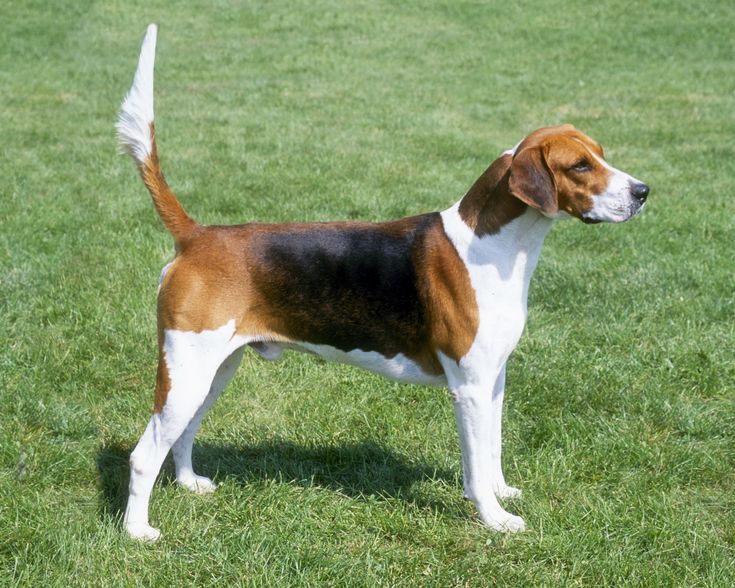
FCI Standard No. 159 “English Foxhound” is a short and demonstratively practical document. Country of origin: Great Britain; the current official version is dated March 26, 2009; classification: Group 6 (scent hounds and related breeds), Section 1.1 “large-sized hounds”, with working trial. The utilization is stated in one line: a pack hound for mounted hunting.
| Point | Wording of the standard |
|---|---|
| Height at withers | Approximately 23–25 in (58–64 cm). The standard gives one range, with no split by sex |
| Weight | The standard sets no weight. The AKC gives a rough guide of about 60–75 lb (27–34 kg) for the breed |
| General appearance | Balanced, powerful, cleanly outlined |
| Skull | Flat, of medium width; the stop is slight |
| Muzzle | Long and square, nostrils large, flews moderately developed |
| Eyes | Medium in size, hazel or brown, alert expression |
| Ears | Pendant, lying close to the cheeks, set on high |
| Neck | Long, slightly arched, strongly developed but not coarse |
| Body | Back broad and level with a slight arch over a strong loin; chest deep, ribs well sprung |
| Tail (stern) | Set on high, carried gaily, but never curled over the back |
| Feet | Round, close-knit and strong, with good pads; nails strong |
| Gait | Free, long-striding, tireless movement with the ability to gallop; strong drive from behind, without rolling |
| Coat | Short and dense, weatherproof |
| Color | Any recognized hound color and markings — the standard gives no list of “permitted” colors |
| Elimination | Aggression or excessive shyness; any obvious physical or behavioral abnormality |
Three rows of this table deserve a careful reading, because they are precisely the ones most often repeated backward. First, the foxhound’s ears are set on high, not low — the low set belongs to another breed, discussed below. Second, the stop in the English Foxhound is slight, not “well defined”. Third, the standard lists no colors at all: the formula “any recognized hound color” means that a tricolor, a bicolor or a “lemon” hound is equally correct, and that none of these is a requirement.
On temperament the standard is two short lines: strength and endurance, a natural aptitude for hunting, friendly and not aggressive. An aggressive or excessively shy dog is eliminated from the ring. For a breed kept by the dozen in one building this is not a declaration of good manners but a technical safety requirement.
The English and the American Foxhound Are Two Different Breeds
The confusion is persistent, while the breeding and the paperwork are entirely separate. The American Foxhound has its own FCI standard (No. 303, country of origin the USA), and the text of that standard takes the English hound as its reference point: the American chest is to be “narrower in proportion to its depth than that of the English hound”. Another relative is the Harrier, whose standard names the foxhound directly: the Harrier is described as “less powerful and more refined than the Foxhound”. The Harrier also belongs to a different section: not to the large hounds but to the medium-sized ones.
| Criterion by the standards | English Foxhound (FCI 159) | American Foxhound (FCI 303) | Harrier (FCI 295) |
|---|---|---|---|
| Section of Group 6 | 1.1, large-sized hounds | 1.1, large-sized hounds | 1.2, medium-sized hounds |
| Height | Approximately 23–25 in (58–64 cm), no split by sex | Males 22–25 in (56–63.5 cm); females 21–24 in (53–61 cm) | 48–55 cm, preferably 48–50 cm |
| Skull | Flat, of medium width | Broad and full | Flat, occipital bone slightly marked |
| Stop | Slight | Moderately defined | — |
| Ears | Set on high | Set on moderately low; a high set is listed among the faults | V-shaped, rather short, set on fairly high |
| Feet | Round, close-knit, strong | “Fox-like”, with well-arched toes | — |
| Judging scale | No scale of points | The standard carries a 100-point scale, 15 of them for feet | No scale of points |
The simplest practical marker is the ear. What is the norm in the English hound (a high set) is written into the list of faults of the American standard. The second marker is sex: the American standard separates the heights of males and females, while the English gives a single range for the whole breed.
Character: An Extrovert Raised by the Pack
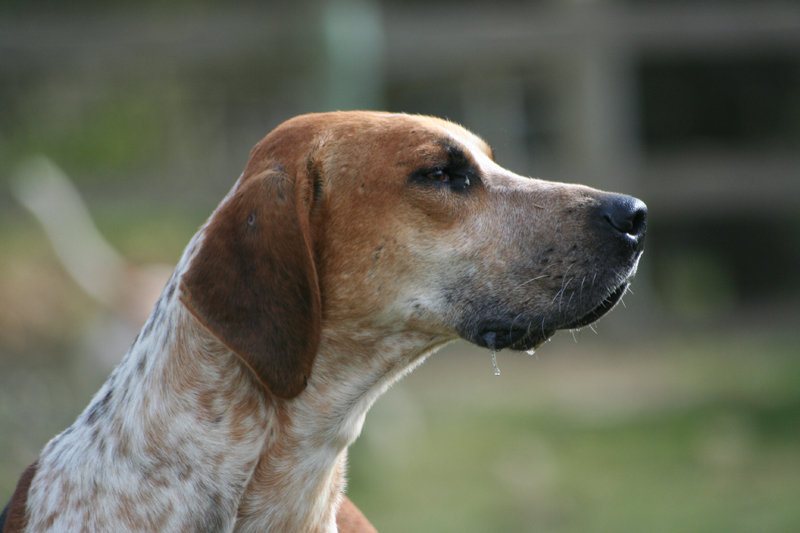
A dog that works alongside three or four dozen other dogs, horses and riders cannot afford to be quarrelsome. The standard fixes this by demanding a friendly animal and eliminating aggressive or excessively timid ones, while the year spent at walk on a farm builds the same trait in practice. The result is a breed that is almost impossible to provoke into a fight with another dog and that takes the noise of children in stride.
The flip side is obvious: the foxhound cannot be alone. It grew up in permanent company and copes badly with long hours in an empty apartment — the boredom comes out as destruction and as voice. The voice of a pack hound is loud and long by design: it was selected so that a rider could hear his hounds across fields and coverts.
Here the foxhound differs most sharply from breeds made for solitary work. The lively Rat Terrier is oriented toward individual hunting of vermin and toward its own territory; the giant Irish Wolfhound is considerably more phlegmatic indoors and does not need constant canine company. The foxhound is comfortable exactly insofar as somebody living is beside it — preferably another dog.
On the level of exercise there are not only kennel-club opinions but data. In a large online survey of British owners, covering 12,314 purebred dogs after cleaning, the breeds walked the most included the English Setter, the Foxhound, the Irish Setter and the Old English Sheepdog. A heightened need for movement is therefore not a value judgment but something visible in the real behavior of owners.
Education and Training
The foxhound is often called “hard to train”. It would be more accurate to say that its mind is tuned to a different task. A pack hound works ahead of the rider and decides for itself: to hold the line when it fades, not to abandon the chase for a stray scent, to match its pace to the rest of the pack. Working on eye contact with a human is not in that job description at all. So a dog that does not look into your eyes waiting for a command is not stupid — it is doing what it was made for.
The practical consequences are direct. Priority number one is the recall, and it must be worked on from the first days and for years, because it is the first thing to fail the moment the nose catches a fresh line. Outside a securely fenced area, walks are safe only on a leash: the AKC explicitly advises keeping the hound leashed anywhere the space is not safely enclosed. Harsh methods yield nothing but a shut-down dog: for centuries the packs culled hounds that closed up under pressure, so the breed answers coercion with passivity rather than obedience.
What does work: short, highly motivated sessions, a stable routine, work paired with another dog (the foxhound learns by copying — exactly as the young hound “entered” into the pack picked up the manner of the grown ones), and activities where the nose is allowed to be used legally: scent games, tracking, running disciplines together with the owner.
Care and Living Conditions
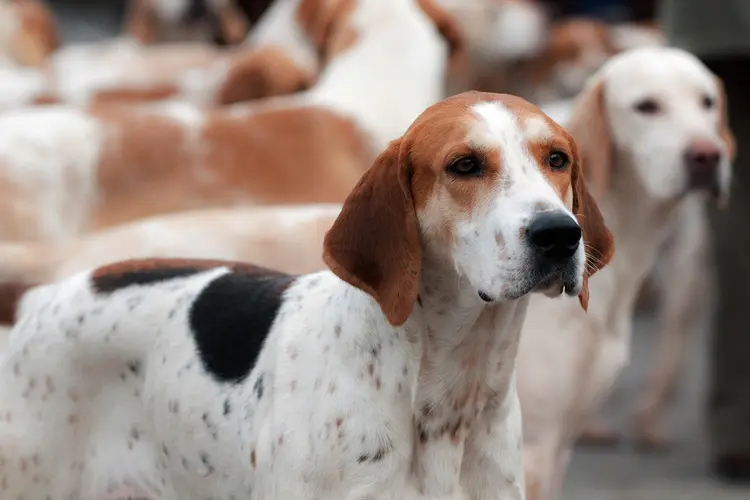
This is not an apartment breed, and the AKC says so directly: the English Foxhound is not recommended for city or apartment life, because the space would be too confined; it is a dog for an active family with land, able to be a companion on runs and hikes, but needing long, brisk daily walks. The optimum configuration is a country house, a reliable fence and a second dog at home.
- Coat. Short, hard and dense by the standard; care is minimal. A weekly pass with a soft-bristle brush or a hound glove is enough to lift dead hair and dirt.
- Ears. The weak spot. A pendant ear lying close to the head ventilates badly, and that is exactly why low-hanging, pendant ear types are prone to infection, as the AKC notes. Regular inspection and cleaning with soft gauze and a veterinary lotion are a mandatory routine, especially after work in fields and woods.
- Nails. If the dog does not wear them down itself on hard ground, they must be trimmed: an over-long nail interferes with walking and running and causes discomfort.
- Teeth. Regular brushing with a canine toothpaste is part of the basic care recommended for the breed.
- Fence and leash. Not decoration but safety equipment: on a line the hound follows the scent and physically stops hearing.
Health: What Is Documented for This Breed Specifically
Feeding a Working Dog
The Fox-Hunting Ban: What the Law Says and What Became of the Packs
Pros and Cons of the Breed
Pros
- Friendliness written into the standard. Aggression and excessive shyness are eliminating faults; the dog has been selected for centuries for the ability to work in a tight group.
- Gets along famously with other dogs. Life in a pack is its norm, not a trial.
- Minimal coat care. A short, dense coat, a weekly brush or hound glove, and that is all.
- Stamina under load. The standard demands tireless movement and the ability to gallop; this is a natural partner for long runs and hikes.
- A transparent pedigree. A breed with unbroken record-keeping older than most kennel-club institutions.
Cons
- A need for movement, not for a stroll. In the survey of British owners the foxhound is among the most-walked breeds; twenty minutes around the block does not exist as a format for it.
- Not for an apartment. The AKC explicitly does not recommend the breed for city and apartment life.
- Does not tolerate solitude. A dog raised in the company of dozens of dogs copes badly with an empty house.
- The voice. Loud and long by design — it was meant to be heard across a field.
- The hunting instinct switches off the hearing. On a line the dog stops responding to commands; outside a fence, the leash only.
- Finding a puppy is next to impossible. In the country of origin registrations of the breed are counted in single figures per year, and the stock lives inside hunting establishments.
Interesting Facts About the Breed
- The stud books of the breed issued by the Masters of Foxhounds Association of England go back to before 1800 — long before national kennel clubs appeared.
- Packs are counted in couples. As early as 1781 Beckford wrote of an establishment of “about forty couple” — that is, roughly eighty hounds.
- A “couple” is not only a unit of counting but an object: the double collar in which young hounds were taught to walk beside their elders.
- In the stud book a foxhound “belongs” to the kennel where it was entered, not to a person; on moving to another pack the name of the kennel of original entry is kept with its name.
- The American stud book of the early 20th century admitted only hounds traceable to the English book, and printed those with an American outcross in italics with a separate note.
- The standard of the American cousin measures the chest by girth and considers 28 in (71 cm) a good girth in a hound 23 in (58 cm) at the withers — while specifically stating that the chest should be narrower in proportion to its depth than that of the English hound.
- The Harrier standard defines that breed through the foxhound: “less powerful and more refined than the Foxhound”.
- The Fédération Cynologique Internationale recognized the English Foxhound only in 1964.
Frequently Asked Questions (FAQ)
Is the English Foxhound suitable for an apartment?
No. The AKC explicitly does not recommend city and apartment life: the space is too confined for the dog. This is a breed for a house with a securely fenced yard, long daily exercise and, preferably, a second dog at home.
How does the English Foxhound differ from the American?
They are two separate breeds with separate standards. The simplest marker is the ears: in the English hound they are set on high, whereas the American standard lists a high ear set among the faults. The American standard also separates the heights of males and females, while the English gives a single range of approximately 23–25 in (58–64 cm).
Why is a foxhound almost never seen in a home?
Because it is bred by packs rather than by private breeders, and its pedigree is kept in the hunts’ own stud book. In the comparative registration table of the British Kennel Club for 2016–2025 the breed shows zero five years running, and over the whole decade the total comes to fifteen dogs.
Is the foxhound good with children and other dogs?
Yes. The standard demands friendliness and eliminates aggressive and excessively shy dogs — otherwise a pack of dozens of hounds would not work. Because of its size and pace a large hound can knock over a small child by accident during play, so games are worth supervising.
Can a foxhound be let off leash?
Only in a safely fenced area. This is a hound that works by nose and, once on a line, stops responding to commands; the recall is trained for years and is still not relied on in open country.
Is the hunting for which the breed was created still legal?
It depends on the jurisdiction. In England and Wales the Hunting Act 2004 has applied since February 18, 2005 and prohibits hunting a wild mammal with a dog outside the list of exemptions. In Scotland a stricter Act has applied since October 3, 2023: the exceptions work only with no more than two dogs, and following a laid scent trail is a separate offence. Neither Act extends to Northern Ireland.
Video About the Breed
- Friendliness written into the standard
- Gets along famously with other dogs
- Hardy, athletic
- Minimal coat care
- A transparent pedigree going back to the 18th century
- Needs 2+ hours of exercise a day
- Made for a pack, not for solitude
- A loud voice, prone to baying
- A strong nose — follows a scent
- Finding a puppy is next to impossible
| Beagle | Harrier | American Foxhound | |
|---|---|---|---|
| Height | 33–40 cm | 48–55 cm | 53–63.5 cm |
| Energy | 4 | 4.5 | 5 |
| Apartment | 3 | 2.5 | 2 |
| Beginners | 3 | 3 | 2.5 |
Is the English Foxhound suitable for an apartment?
How does the English Foxhound differ from the American?
Why is a foxhound almost never seen in a home?
Is the foxhound good with children and other dogs?
Can a foxhound be let off leash?
Is the hunting for which the breed was created still legal?
FCI Standard No. 159 · The Kennel Club (standard and comparative registration tables 2016–2025) · AKC · FCI Standards No. 303, 295, 24 · Sheahan et al., Vet Pathol 1991 · Duprey et al., Emerg Infect Dis 2006 · Hunting Act 2004 · Hunting with Dogs (Scotland) Act 2023
For apartments · For kids · For beginners · Active · Smartest · Hypoallergenic · All rankings →