

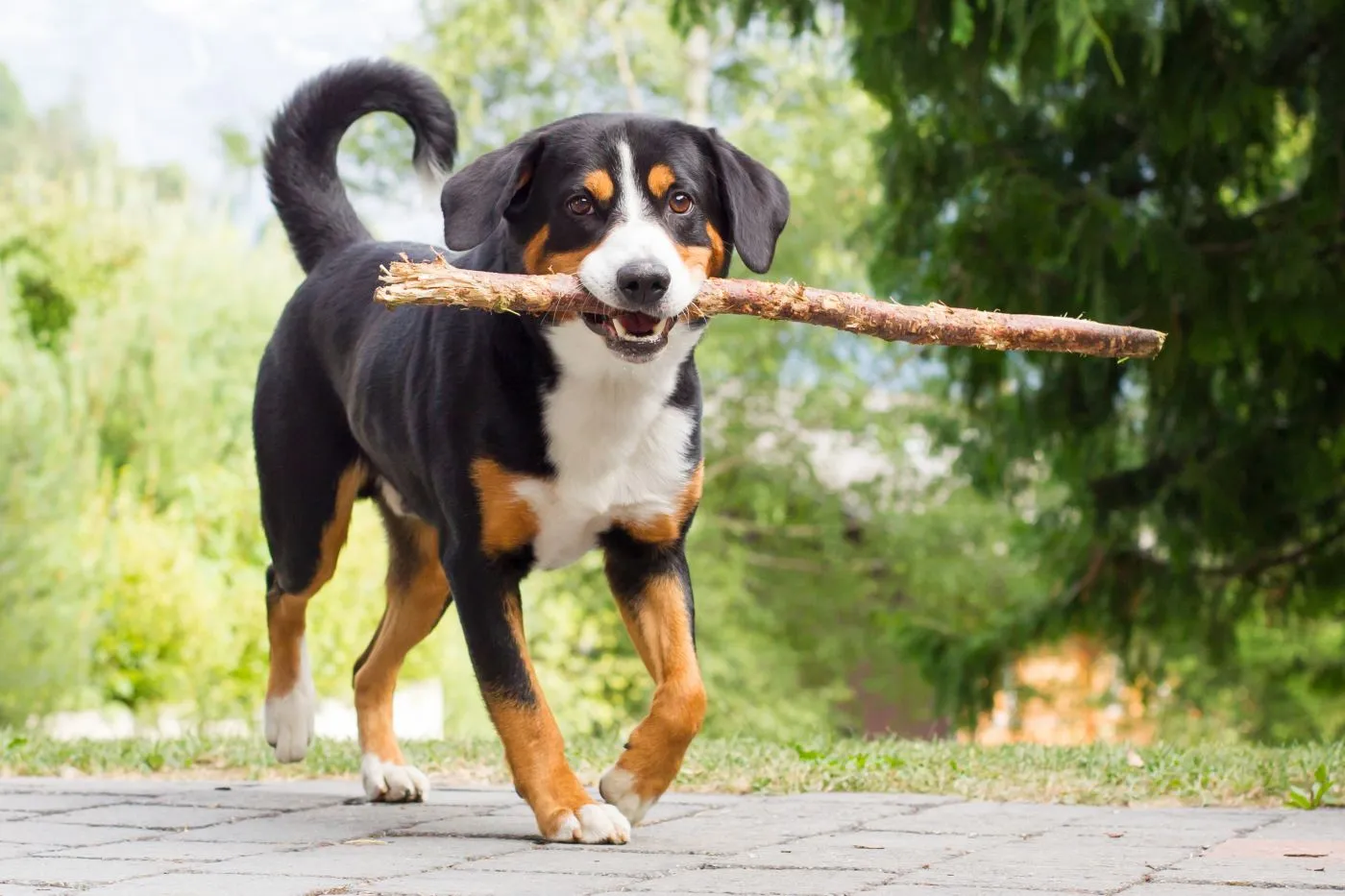
| Height | 48–58 cm |
| Weight | 22–32 kg |
| Lifespan | 12–14 years |
| FCI group | 2 · pinschers, schnauzers, molossoids, mountain dogs |
| Origin | Switzerland |
Exact ratings
- Generally a robust working breed
- Hip dysplasia
- Eyelid disorders (ectropion/entropion)
- Prone to boredom and destructiveness without work
- Joint problems if overworked while young
Balanced food for a very active breed, with controlled growth in puppyhood (joints). Intensive exercise and mental work are a must; a country house with space suits it best.
The Appenzeller Sennenhund isn’t just a dog; it’s a whirlwind of energy, unwavering loyalty, and classic Swiss dependability. These beautiful companion dogs are versatile working canines, historically tasked with a variety of jobs: from herding livestock and guarding pastures to pulling carts and protecting the farm. Cheerful, smart, and always ready for an adventure, the Appenzeller is the perfect family member for active individuals. We’ll dive deeper into this unique breed further on, right here on Tvaryny.
This dog thrives in a large country home with a spacious yard where it can run freely and burn off its boundless energy. Unlike its more popular cousin, the Bernese Mountain Dog, the Appenzeller doesn’t have a long coat, which is a big plus: grooming is much simpler and less time-consuming.
Appenzeller Sennenhund: Key Breed Information
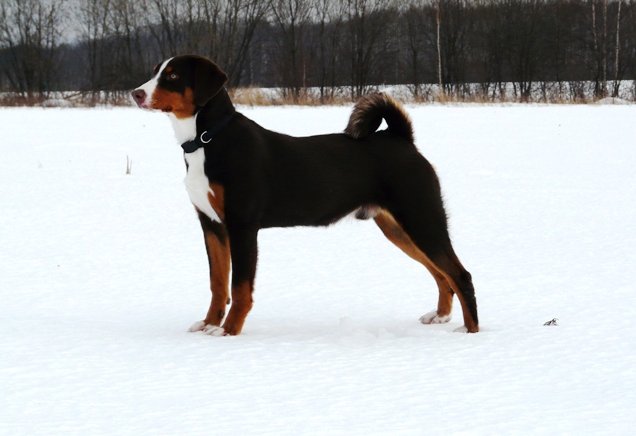
| Breed Name | Appenzeller Sennenhund |
| Country of Origin | Switzerland (Canton of Appenzell) |
| FCI Classification | Group 2 (Pinscher and Schnauzer, Molossoid and Swiss Mountain Dogs), Section 3 (Swiss Mountain and Cattle Dogs) |
| Lifespan | 12–15 years |
| Height (at the Withers) | Males: 20.5–22 inches, Females: 19.5–21 inches (deviation of +/- 0.8 inches is allowed) |
| Weight | 48–70 pounds |
| Temperament | Energetic, self-assured, fearless, clever, somewhat wary of strangers, devoted to family |
| Purpose | Herding dog, guard dog, companion dog, search and rescue, sporting dog |
| Color | Tricolor: predominantly black or Havana (brown) with symmetrical rust and white markings |
| Exercise Needs | Very high |
The History of the Appenzeller Sennenhund
The history of the Appenzeller Sennenhund is deeply rooted in the Alpine meadows of Switzerland, where these dogs have served as indispensable farmhands for centuries. It’s believed that they, along with the other Swiss Sennenhund breeds, are descendants of Molossian dogs brought to the Alps by the Romans. For centuries, they developed in isolation, perfectly adapting to the harsh mountain conditions.
The first written record describing this type of dog dates back to 1853 in the book “The Animal World of the Alps.” They were described as “loud, short-haired, multi-colored, medium-sized herding dogs” used for guarding farms and herding cattle.
A key figure in the breed’s establishment was the great enthusiast, Professor Albert Heim. In the late 19th century, he became concerned that these unique Swiss dogs might disappear as other breeds gained popularity. In 1898, the Appenzeller was recognized as a distinct breed. Thanks to Heim’s efforts, the “Appenzeller Sennenhund Club” was founded in 1906 with the goal of preserving and promoting the breed in its original form. It was Heim who drafted the first official breed standard in 1914, which, with minor changes, remains in effect today. The Fédération Cynologique Internationale (FCI) officially recognized the breed much later.
What the Appenzeller Sennenhund Looks Like: Standard and Appearance
The Appenzeller is a well-proportioned, muscular, medium-sized dog with a nearly square build. Its appearance radiates agility, strength, and confidence. One of its most characteristic features is its tightly curled tail, which this breed carries playfully over its back. This tail is often called a “post horn.”
| Body Part | Description According to the FCI Standard |
|---|---|
| Head | Proportional to the body, wedge-shaped. Flat and wide skull with a slight furrow. Gentle stop. |
| Muzzle | Medium length, tapering to the nose. Straight nose bridge. Nose is black (in black dogs) or dark brown (in Havana dogs). |
| Eyes | Small, almond-shaped, with a lively and alert expression. Color ranges from dark brown to brown. |
| Ears | Set high, wide at the base. Hanging, triangular in shape with rounded tips. Lie flat against the cheeks when at rest. |
| Body | Compact, powerful. Back is straight and strong. Chest is broad, deep, and oval-shaped. |
| Tail | Set high, medium length, covered with dense fur. Characteristically curled into a tight ring (“post horn”) and carried on one side of the back. |
| Limbs | Strong, muscular, with sturdy bones. Straight and parallel when viewed from any side. |
| Coat | Double coat (Stockhaar). The outer coat is thick and shiny. The undercoat is dense and black, gray, or brown. |
| Coloring | Tricolor. The primary color is black or Havana (chocolate-brown). Symmetrical rust-colored and white markings. A white blaze on the muzzle, a patch on the neck and chest, white “socks” on the paws, and a white tail tip. |
Character and Temperament of the Appenzeller
The Appenzeller Sennenhund’s character is a unique combination of a working dog’s traits and a devoted companion’s heart. They are incredibly intelligent, brave, and energetic. This is not a couch potato dog; it needs a purpose in life and constant activity.
- Family Devotion: Appenzellers form an extremely strong bond with their families. They often choose one person as “their” human but love and protect all family members. They usually get along well with children they’ve grown up with, but their herding habit of nipping at heels needs to be managed from an early age.
- Guard Dog Qualities: This is a key characteristic of the breed. Appenzellers are very wary of strangers and will always alert you to guests with a loud, piercing bark. Their fearlessness makes them excellent, incorruptible guardians.
- Energy and Intelligence: This breed has an extraordinarily high energy level. They need not only physical but also mental stimulation. They learn quickly but get bored just as fast with monotonous tasks. Their sharp minds require constant engagement through games, training, or work. Some terriers, like the elegant yet energetic Manchester Terrier and the lively Brazilian Terrier, share similar energy and intelligence.
- Compatibility with Other Animals: Socialization must begin as early as possible. Due to their strong territorial and possessive instincts, they can be intolerant of other dogs, especially of the same sex. If an Appenzeller grows up with other household pets, it usually accepts them as part of its “pack.”
Pros and Cons of the Appenzeller Sennenhund
Before getting this type of dog, it’s important to realistically assess all its advantages and disadvantages.
| ✅ Pros | ❌ Cons |
|---|---|
| Exceptional Loyalty: Forms a deep bond with its owner and family. | Extremely High Activity Needs: Not suitable for inactive people or apartment life without adequate exercise. |
| High Intelligence: Learns quickly and can perform complex commands. | Prone to Barking: Can be very noisy, which neighbors may not appreciate. |
| Excellent Guard Dog: Natural wariness of strangers and a loud bark make it an ideal watchdog. | Strong Suspicion of Strangers: Requires intense, early socialization to avoid excessive suspicion or aggression. |
| Robust Health: no breed-wide list of hereditary diseases has been compiled — “not described” means “not studied”, not “not there”. | Stubbornness: An intelligent dog can be independent in its decision-making, requiring patient and consistent training. |
| Low Maintenance Grooming: The short coat doesn’t require complex grooming. | Herding Instinct: May try to “herd” family members, especially children, by nipping at their heels. |
| Versatility: Suitable for dog sports (agility, obedience), herding work, and as an active companion. | Does Not Tolerate Solitude Well: Due to its strong attachment to family, it can suffer from separation anxiety. |
Care and Maintenance of the Appenzeller
Caring for an Appenzeller Sennenhund is straightforward but requires attention to the key aspects of its life: physical activity and living conditions.
Grooming and Coat Care
The Appenzeller’s coat is short and dense, with a thick undercoat. It does not require clipping or stripping. You only need to brush the dog 1-2 times a week with a rubber brush or a comb with wide teeth to remove dead hair. During seasonal shedding (spring and fall), you should brush more frequently. Bathe the dog only as needed. Also, regularly check and clean its ears and eyes to prevent infections. If its nails don’t wear down naturally, they should be trimmed.
Physical Exercise and Activity
This is the most crucial aspect of Appenzeller ownership. These dogs need at least 1.5-2 hours of intense physical activity every day. A simple leash walk is just a warm-up for them. They need off-leash running (in a safe area), games of fetch and frisbee, and, ideally, participation in canine sports:
- Agility
- Flyball
- Obedience
- Herding
A bored Appenzeller that doesn’t get enough exercise will quickly find its own entertainment: digging holes, chewing furniture, or barking incessantly.
Training and Raising an Appenzeller Sennenhund
Training an Appenzeller is an exciting but also challenging process. Their sharp minds allow them to master commands instantly, but their independent nature requires the owner to have patience, consistency, and a firm authority. The foundation of successful training is early socialization and positive reinforcement.
Never use harshness or physical punishment. This can make the dog either timid or, conversely, provoke aggression. They respond best to praise, play-based methods, and treats. From puppyhood, introduce the Appenzeller to different people, animals, sounds, and situations. This will help you raise a well-balanced and confident dog that reacts appropriately to new circumstances.
Feeding the Appenzeller Sennenhund: Key Recommendations
The main rule for feeding an Appenzeller is to control portion sizes and food quality. These dogs have a great appetite and are prone to gaining excess weight, which puts additional strain on their joints and heart. Their diet must match their high activity level.
The diet can be based on either high-quality premium or super-premium dry food for active medium-sized dogs, or a natural diet. With a natural diet, the meals should consist of:
- Lean meat (about 50-60%): beef, turkey, chicken, offal.
- Grains: buckwheat, rice, oatmeal.
- Vegetables and fruits: carrots, pumpkin, zucchini, apples, greens.
- Fermented dairy products: kefir, low-fat cottage cheese.
You should absolutely not give your dog table scraps, sweets, smoked meats, fatty foods, or cooked tubular bones.
| Food Item | Approximate Daily Portion for a 55-pound adult dog | Notes |
|---|---|---|
| Meat and Offal | 14-18 ounces | The foundation of the diet, a source of protein |
| Grains (cooked) | 7-9 ounces | A source of carbohydrates and energy |
| Vegetables (raw or cooked) | 5-7 ounces | Fiber, vitamins |
| Fermented Dairy | 3.5-5 ounces | Give 2-3 times a week, not with a meat meal |
| Vegetable Oil | 1 tablespoon | For healthy coat and skin |
Health of the Appenzeller Sennenhund: Common Illnesses and Prevention
Appenzellers are a breed with robust health, toughened by centuries of life in the mountains. Health is generally robust, but no breed-wide list of hereditary diseases has been compiled — “not described” means “not studied”, not “not there”. For example, cancer is significantly less common in them than in Bernese Mountain Dogs. However, like other breeds, there are certain risks:
- Hip and Elbow Dysplasia: The most common hereditary problem. It’s important to choose a puppy from reputable parents with clear health screenings. During the puppy’s growth period, you should avoid excessive exercise, jumping from heights, and climbing stairs.
- Eye Diseases: Progressive retinal atrophy (PRA) and cataracts can occasionally occur. Regular checkups with a veterinary ophthalmologist are recommended.
- Bloat (Gastric Torsion): As with many dogs with deep chests, there is a risk of this dangerous condition. Feed your dog small meals 2-3 times a day and do not allow intense play immediately after eating.
Overall, the Appenzeller is a hardy dog. Its health is similar to that of the smallest of the group, the Entlebucher Mountain Dog, though the Appenzeller is slightly larger. Compared to its largest relative, the Greater Swiss Mountain Dog, the Appenzeller is more agile and light on its feet.
Fun Facts About the Breed
- The Unique Tail: The curled tail (“post horn”) is the breed’s calling card. In the past, it was used to easily identify one’s dog from a distance in the pasture.
- A “Yodel” Instead of a Bark: Appenzellers are known for their high-pitched, melodic, and very loud bark, which is sometimes compared to a Swiss yodel.
- A Rare Breed: Despite its wonderful qualities, the Appenzeller Sennenhund remains a relatively rare breed outside of Switzerland and neighboring countries.
- Three-in-One: Historically, this was a universal “three-in-one” dog: it herded cattle (often independently), guarded the home and property, and was also used to pull small carts (e.g., milk carts).
- The Herding Nip: When herding cattle, Appenzellers use a special technique—they don’t bark at the cows, but instead silently and quickly run up and nip at their heels, forcing them to move in the desired direction.
Frequently Asked Questions About the Appenzeller Sennenhund
Is the Appenzeller suitable for apartment living?
It is highly inadvisable. Theoretically, it’s possible, but only if the owner is prepared to dedicate 3-4 hours a day to intense outdoor walks and training. This dog needs space. The ideal conditions are a private home with a securely fenced-in yard.
Do Appenzellers get along with children?
Yes, if they grow up together. An Appenzeller will be patient and protective of “its” children. However, due to its herding instincts, it may try to “herd” children by nipping at their heels. This behavior must be corrected. Always supervise interactions between the dog and small children.
Do they shed a lot?
They have moderate shedding throughout the year and two intensive shedding periods in the spring and fall when they lose their undercoat. Regular brushing helps to keep this process under control.
Can you leave an Appenzeller alone for long periods?
No. This is a very people-oriented breed. They don’t handle loneliness well and can develop destructive behavior or separation anxiety if left alone for a full day.
Video About the Breed
- All-purpose working and droving dog
- Lively, clever, devoted
- Watchful, incorruptible guard
- Hardy, weatherproof
- Very high exercise and work needs
- Wary of strangers, vocal
- Absolutely not for an apartment or a novice
- Herding instinct (may “herd” and nip)
| Entlebucher Mountain Dog | Australian Shepherd | Bernese Mountain Dog | |
|---|---|---|---|
| Height | 42–52 cm | 46–58 cm | 58–70 cm |
| Energy | 4.5 | 5 | 3 |
| Apartment | 2 | 2 | 2 |
| Beginners | 3 | 2.5 | 3 |
How does the Appenzeller differ from the other Swiss mountain dogs?
Is the Appenzeller suited to an apartment?
Is the breed suited to a novice?
FCI Standard No. 46 · Schweizerische Kynologische Gesellschaft
For apartments · For kids · For beginners · Active · Smartest · Hypoallergenic · All rankings →