


| Height | 63–72 cm |
| Weight | 32–45 kg |
| Lifespan | 10–13 years |
| FCI group | 2 · pinschers |
| Origin | Germany |
Exact ratings
- Dilated cardiomyopathy (DCM) ~58%
- Von Willebrand disease (~70% carriers)
- Wobbler syndrome (neck)
- Joint dysplasia
- Gastric torsion (bloat)
Quality protein for muscle, weight control and feeding from a raised bowl in small portions (bloat risk). If DCM is diagnosed — a diet under a cardiologist’s supervision (taurine, L-carnitine as prescribed).
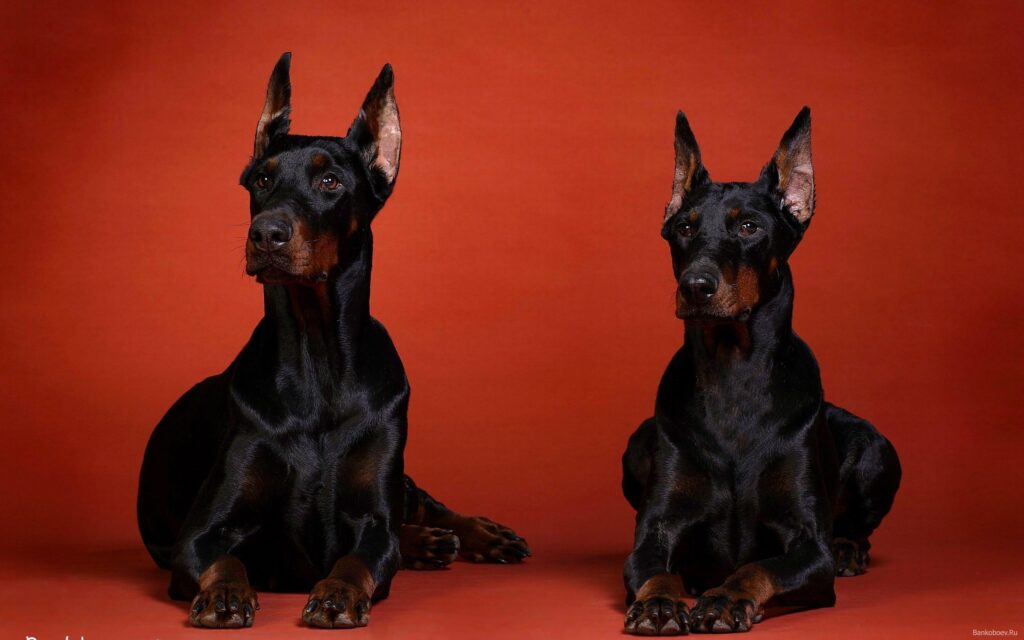
The Doberman Pinscher (Dobermann) isn’t just a dog; they’re a true legend in the world of dog breeds. Elegant, athletic, and with a piercing, intelligent gaze, they command a mix of admiration, respect, and sometimes fear. Dobermans are far more than the ‘vicious dogs’ often depicted on screen. They are incredibly loyal companions, eager students, and unmatched protectors. Due to their strong, innate protective instinct, they are often saddled with a reputation for being aggressive. However, these qualities are only ever directed toward an actual threat to their owner or guarded property. In reality, behind that severe exterior lies a sensitive, loving, and infinitely devoted soul. Read more about the breed on Tvaryny.
The Doberman: A Brief Overview of the Breed
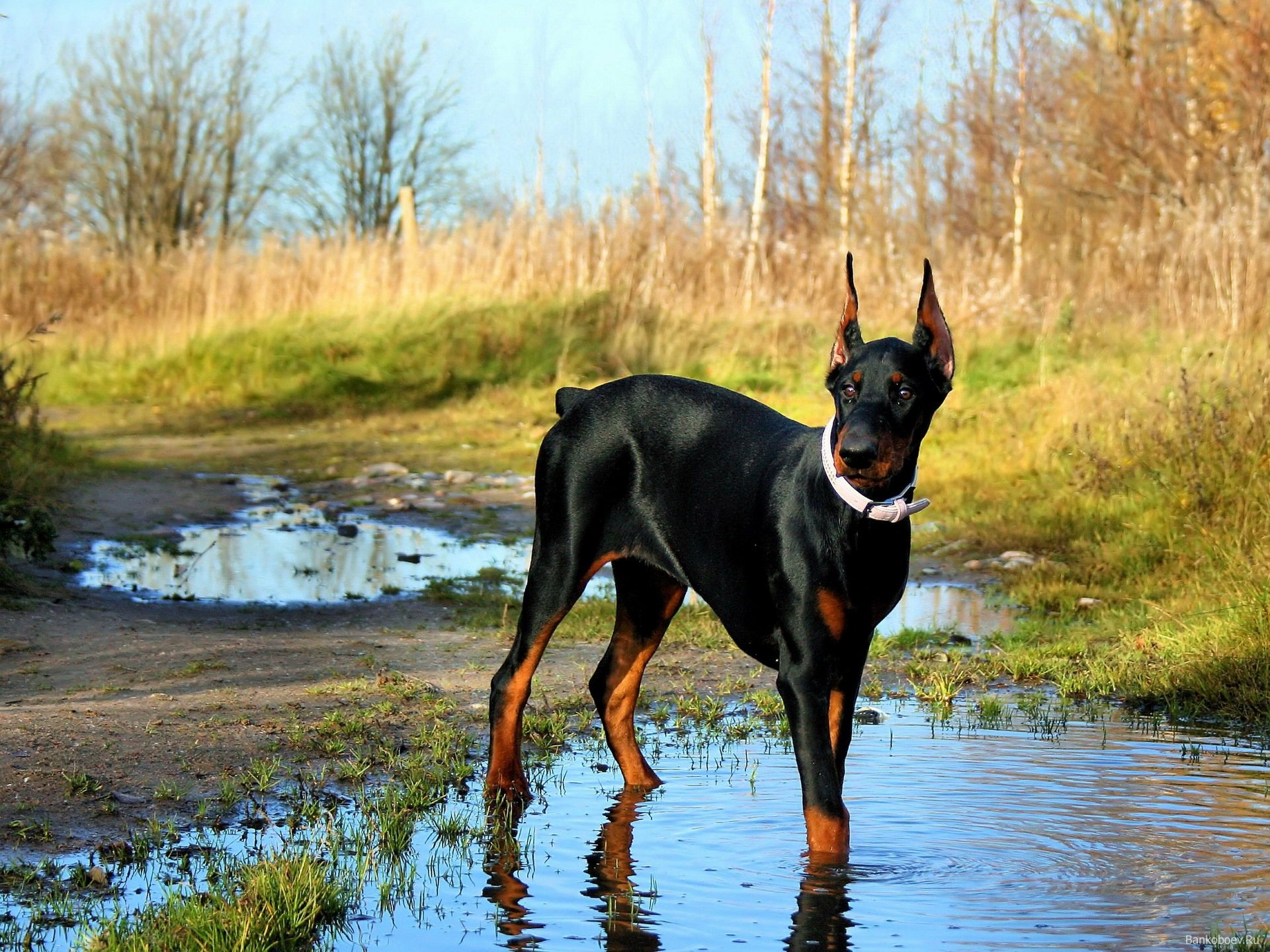
The official name for the breed is the Dobermann (Doberman Pinscher). While the name “Doberman Pinscher” is commonly used, especially in the US, the original German breed club dropped the “Pinscher” suffix to emphasize the breed’s unique status.
| Characteristic | Description |
| Origin | Germany (Apolda, Thuringia) |
| Time of Origin | Late 19th Century (circa 1890) |
| FCI Classification | Group 2 (Pinschers and Schnauzers, Molossian, Swiss Mountain and Cattle Dogs). Section 1 (Pinschers and Schnauzers). |
| Height at Withers | Males: 68-72 cm Females: 63-68 cm |
| Weight | Males: 40-45 kg Females: 32-35 kg |
| Lifespan | 10-13 years (often shorter due to health issues) |
| Use | Companion dog, service dog, guard dog, performance dog. |
The Breed’s Origin Story
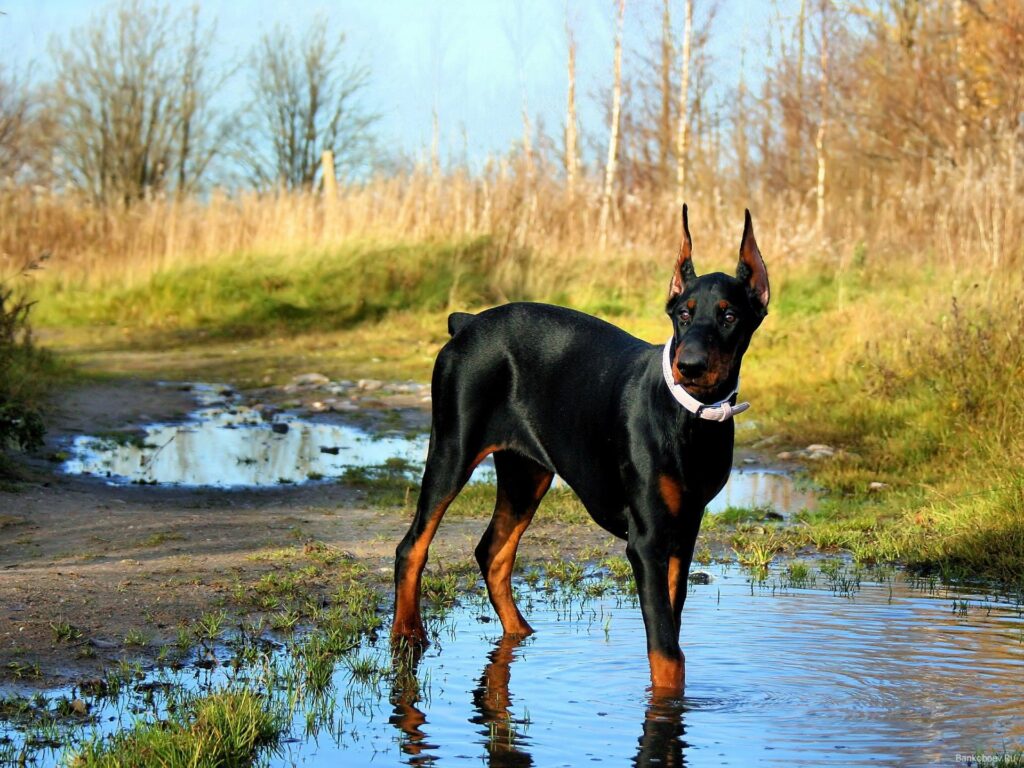
The history of the Doberman is inextricably linked to one man: Karl Friedrich Louis Dobermann (1834-1894). He lived in the German town of Apolda, where he worked as a tax collector and managed an animal shelter, often catching stray dogs. His work was dangerous, requiring a reliable, brave, and devoted guard dog.
Dobermann kept no precise breeding records, so the exact “recipe” for creating the breed remains a mystery. It is believed he used dogs from his shelter. The main ancestors of the modern Doberman likely included old German Pinschers (precursors to the contemporary German Pinscher), which were known for their fearlessness and guarding qualities. It is theorized that he mixed in the blood of “Butcher’s Dogs” (ancestors of the Rottweiler), the Beauceron, the Weimaraner (to enhance scenting ability), and the Manchester Terrier (for the short, smooth coat and clear tan markings).
Friedrich Louis Dobermann was determined to create not just a dog, but a “super-dog” – the perfect protector: smart, fast, and resolute. And he succeeded. The dogs he bred quickly earned a reputation as magnificent guards.
After Dobermann’s death in 1894, the work on the breed was continued by other enthusiasts, notably Otto Goeller, who is considered the breed’s “godfather.” It was Goeller who softened the somewhat aggressive temperament of the early Dobermans, making them more suitable for the role of companion and service dog. He founded the first breed club in 1899. Thanks to Goeller, Dobermans gained even more popularity, not only as working dogs but also as companions.
Soon after, these dogs began to spread worldwide. By 1902, Dobermans were already performing duties as police dogs in Russia. They were actively used during the First and Second World Wars, where they earned the nickname “Devil Dogs” among American Marines for their bravery. The breed was officially recognized by the Fédération Cynologique Internationale (FCI) in 1960.
What the Doberman Looks Like: Standard and Appearance
The Doberman is the embodiment of athleticism and elegance. They are a medium-to-large sized dog with a muscular but “lean” build. Nothing about them is superfluous – every line of the body speaks of strength and speed. The Doberman’s silhouette should be practically square (especially in males), with a proud posture.
Head and Muzzle
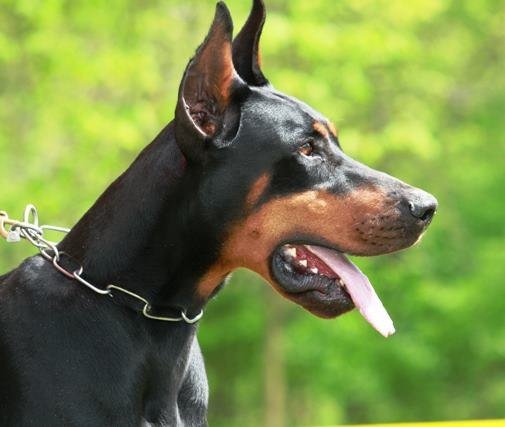
The Doberman’s head is strong and muscular, appearing as a blunt wedge when viewed from above. The transition from forehead to muzzle (the stop) is well-defined. The muzzle is quite broad. The lips are dry, clinging tightly to strong jaws with a perfect scissor bite. The nose is broad, with large nostrils; the color depends on the coat (black in black dogs, brown in brown ones). The eyes are medium-sized, oval-shaped, and dark (the darker, the better). The gaze is lively, intelligent, and confident.
Ears and Tail: Cropping and Docking
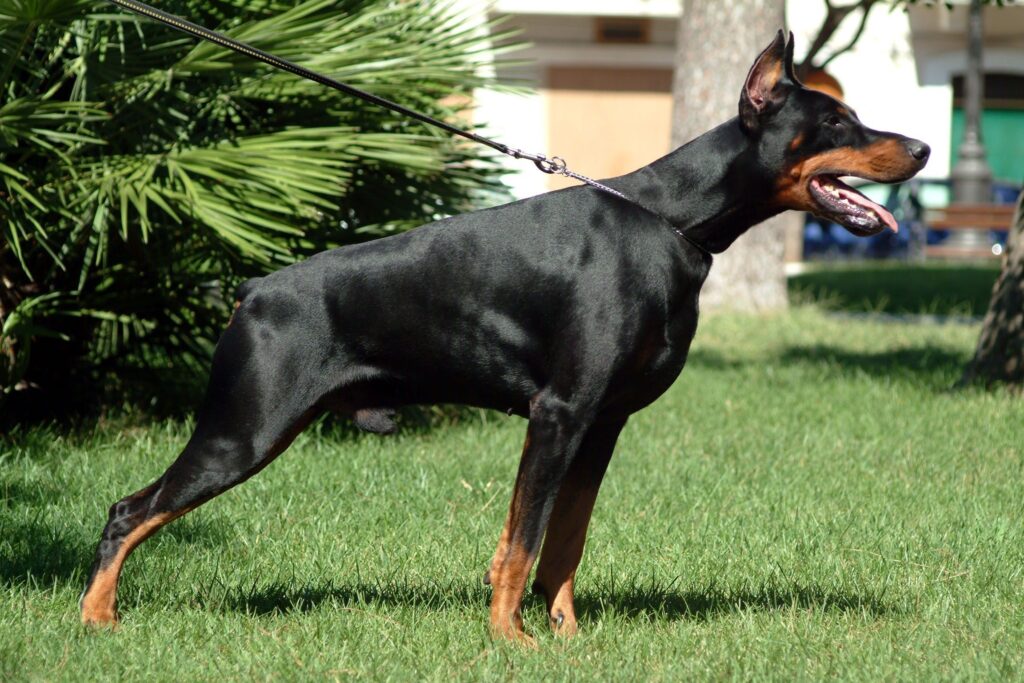
Historically, Dobermans had their ears and tails cropped (cut). The tail was docked very short (leaving 2-3 vertebrae), and the ears were given a sharp, erect shape. This was done for practical reasons – to ensure the dog had no vulnerable points when working (guarding, fighting). Today, docking and cropping are prohibited by law in many European countries and Australia, considered inhumane cosmetic procedures. While tail docking is still common for show dogs in the US, ear cropping is becoming increasingly controversial and often performed only for specific working dog bloodlines.
- Natural Ears: medium-sized, set high, hanging close to the cheeks.
- Natural Tail: long, sabre-shaped.
As a result, the appearance of the modern Doberman can vary greatly depending on the country and the breeder’s decision. The “natural” Doberman looks less menacing but loses none of its inherent elegance.
Body and Limbs
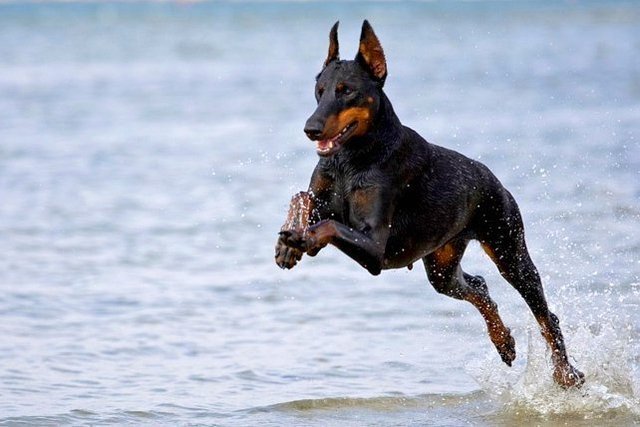
The neck is long, muscular, with a beautiful arch. The back is straight, short, quite broad, and sturdy. The chest is deep and wide enough, oval-shaped. The abdomen is elegantly tucked up, creating a beautiful underline. The limbs are straight, parallel, with well-developed musculature. The paws are compact, “cat-like,” with arched toes.
Doberman Coat and Color
The coat is one of the Doberman’s defining features. It is short, stiff, dense, and close-lying, with no undercoat. This makes grooming minimal but also leaves the dog vulnerable to cold.
The FCI standard recognizes only two main colors:
- Black with rust-red tan markings.
- Brown (or dark brown) with rust-red tan markings.
The tan markings must be clearly delineated and located in strictly designated areas: on the muzzle, cheeks, above the eyes, on the throat, on the chest (two spots), on the legs, and under the tail.
There are also “dilute” colors, such as blue (faded black) and Isabella (faded brown, “fawn”). These are not recognized by the FCI standard and are often associated with a genetic disorder – Color Dilution Alopecia (CDA), which leads to skin and coat issues. A “white” (actually cream) Doberman also exists – this is a partial albino, which also carries serious health problems and is not recognized by any reputable kennel organization.
Character: Temperament and Behavior
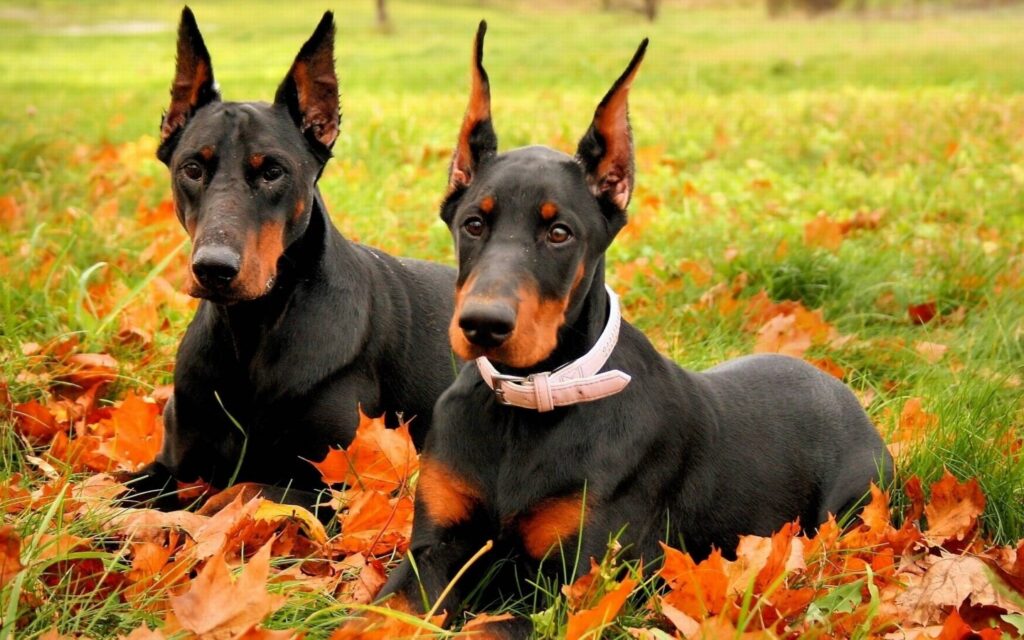
The Doberman’s character is a complex mixture of opposites. They are a decisive and self-assured dog, strong-willed, with a firm demeanor. Yet, they are also exceptionally devoted to people, focused on their owner, and eager to comply with all their demands. This is the classic “one-person dog” or one-family dog.
Intelligence and Sensitivity
Dobermans rank highly among the most intelligent dog breeds. They pick up commands instantly and are capable of complex situation analysis and independent decision-making (which can sometimes complicate training). However, their intelligence is matched by high sensitivity. A Doberman keenly senses its owner’s mood and does not tolerate shouting, roughness, or unfair punishment well. They are “Velcro dogs” who crave to be near the family 24/7 and suffer from loneliness and lack of attention.
Guard Instinct
The Doberman has a well-developed protective and guarding instinct. He is always on alert, monitoring his territory and “pack” members. He will never allow his owner or family to be harmed and is ready for a desperate defense of his owner’s property. At the same time, a properly raised Doberman is peaceable and friendly outside his territory. He won’t seek conflict first, but in the face of a real threat or aggression from other dogs or strangers, he will be able to stand up for himself and his own. Their fearlessness, strength, and courage will always help them secure victory.
Dobermans and Children
A Doberman raised alongside children usually treats them well and can become a brave, bold protector and playmate. However, they are large, powerful dogs. Even when playing, they can accidentally knock over a small child. Therefore, all interaction should take place under adult supervison. It is also important to teach children to respect the dog’s personal space.
Interacting with Other Animals
Socialization with other animals must be early and consistent. Dobermans can coexist with other dogs and cats, especially if raised together. However, males may exhibit aggression toward dogs of the same sex. Small animals (rodents, birds) may be perceived as prey due to their hunting instinct (which, though subdued, is present).
Care and Maintenance
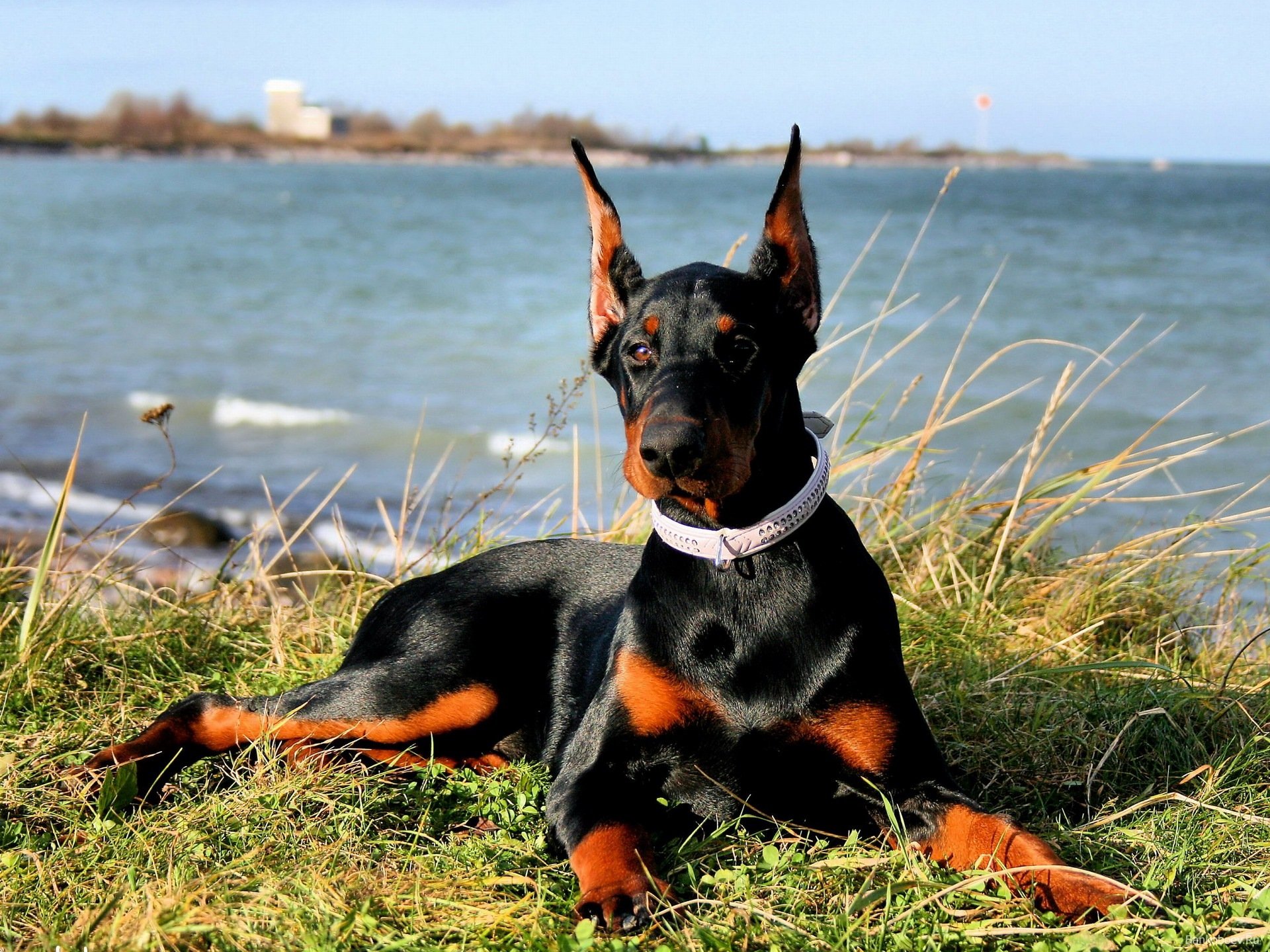
At first glance, Doberman care seems simple, but there are important nuances related to their short coat and high energy levels.
Grooming (Coat Care)
Grooming the Doberman’s coat is minimal. Their short hair does not require trimming. Brushing the dog once a week with a rubber mitt or a natural bristle brush is enough to remove dead hairs and give the coat a shine. Frequent washing is not recommended – it disrupts the skin’s natural oil balance. A full wash with shampoo is only necessary for heavy soiling (1-2 times a year). To keep the coat clean after a walk, simply wipe it down with a damp terry towel.
It is also important to regularly:
- Trim nails: approximately every 2-3 weeks, if they are not worn down on concrete or asphalt.
- Clean ears: inspect weekly and clean with a specialized lotion as needed.
- Brush teeth: 2-3 times a week with dog-specific toothpaste.
- Clean eyes: as needed with chamomile infusion or a clean cotton pad moistened with water.
Living Conditions and Weather Vulnerability
Due to the lack of an undercoat, Dobermans are absolutely unsuited to living outdoors in a kennel. They are strictly indoor dogs. They are very sensitive to cold – they absolutely need a warm coat or sweater for winter walks. In summer, conversely, there is a risk of overheating, especially for black-coated dogs. Always carry water with you and never leave the dog in a hot car.
Physical Exercise
This is a key aspect of Doberman ownership. They are very active and energetic dogs who need not only physical but also mental stimulation. A routine walk “on the leash” twice a day is catastrophically insufficient for them. A Doberman requires:
- At least 2 hours of active exercise per day.
- The opportunity to run freely off-leash (in a secure area).
- Mental stimulation: learning commands, tricks, search games.
If a Doberman does not receive enough exercise, their pent-up energy will find an outlet in destructive behavior (chewed furniture, barking, aggression).
Training and Socialization
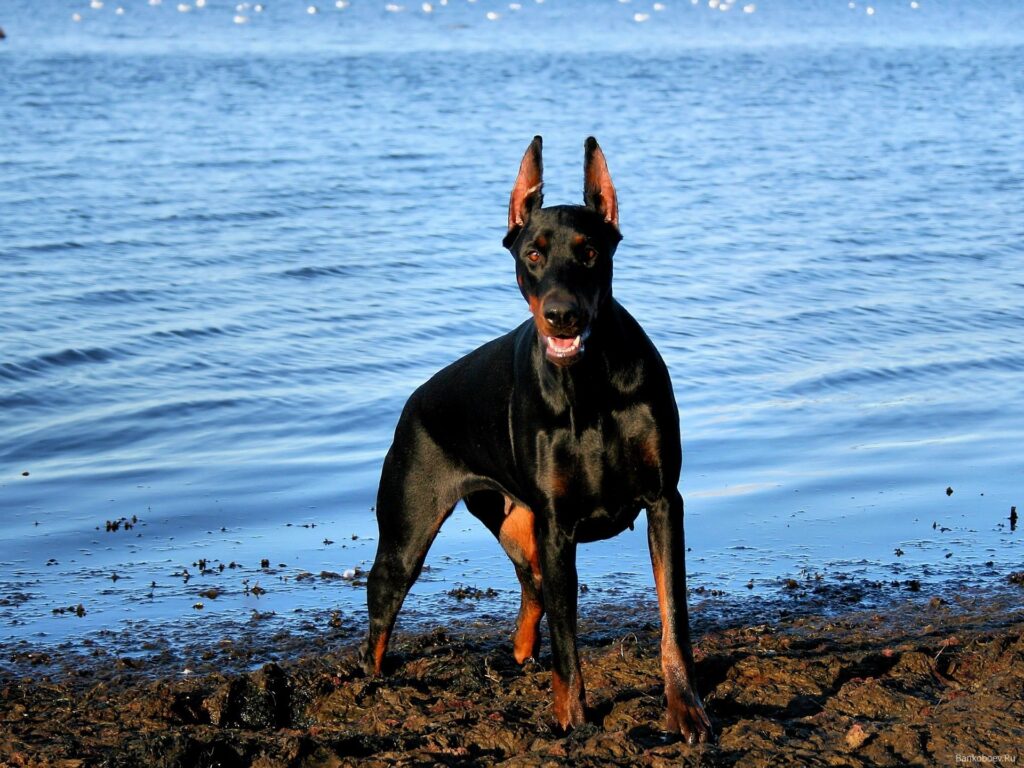
Doberman training is a must, not an option. Due to their intelligence, strength, and protective instincts, an unruly Doberman can be dangerous. This breed is categorically not recommended for first-time owners or people with a weak disposition.
Early Socialization
Early socialization (from 3 to 16 weeks) is critically important for the Doberman. They must be neither timid nor aggressive. The puppy needs to be introduced to different people, sounds, places, and transportation. Take the puppy out more often for walks in crowded areas and allow interaction with other well-behaved dogs. You must ensure that the adult dog will react appropriately to any situation.
Training Methods
To begin training, a trusting relationship must exist between you and the dog. You must assume the dominant position, but not through force or cruelty, rather through confidence, consistency, and authority. The Doberman must regard you as the leader.
They respond brilliantly to positive reinforcement methods (treats, praise, play). Roughness or physical punishment can shatter a Doberman’s sensitive psyche or, conversely, provoke aggressive retaliation. Training must be consistent, fair, and engaging. These dogs quickly become bored with monotonous repetition.
Sports and Work
Dobermans are exceptionally gifted dogs. They excel as professionals in any field. Sports such as Agility, Obedience, Coursing, and working disciplines (e.g., IPO/Schutzhund – protection work, where they can legally fulfill their instincts under control) are ideally suited to them. The tendency for tracking is in their blood – they make excellent assistants for police and rescue workers, unlike many traditional hunting breeds such as the Bohemian Wirehaired Pointing Griffon or Spinone Italiano.
Health: Common Ailments and Prevention
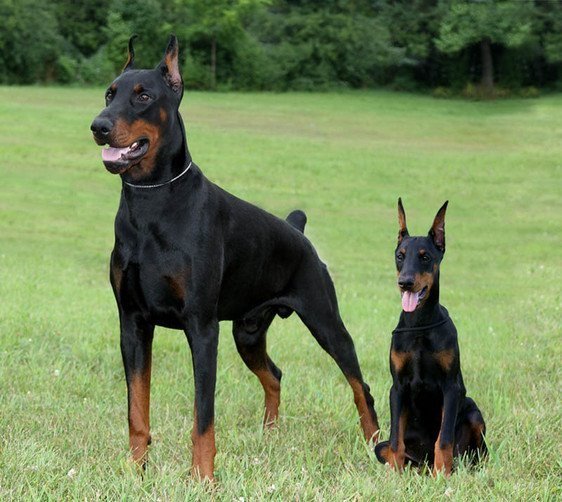
Dobermans are strong and resilient dogs, but sadly, the breed carries a number of serious genetic diseases that significantly shorten their lifespan. The list of ailments is concerning, and this is arguably the breed’s biggest drawback.
This absolutely does not mean your pet will definitely get sick. But to ensure the puppy is least susceptible to genetic diseases, you should carefully study its pedigree and choose a breeder who tests their dogs for these conditions. Care and attention will help avoid a lot of health problems for your four-legged friend.
| Ailment | Description | Prevention / Diagnosis |
|---|---|---|
| Dilated Cardiomyopathy (DCM) | The most dangerous disease, the “silent killer” of Dobermans. The heart muscle weakens, and the heart chambers enlarge, leading to heart failure and sudden death. | Annual (!) cardiologist check-up, starting from 1-2 years: heart ultrasound (EchoCG) and Holter monitoring (24-hour ECG recording). Genetic testing. |
| Wobbler Syndrome (CVI) | Spinal cord disease in the neck region. Vertebral instability compresses the spinal cord, causing pain, loss of coordination (“drunken” gait), limb weakness, and eventually paralysis. | Diagnosis: MRI. Treatment is often surgical. Avoid jumping from heights, caution during puppyhood. |
| Von Willebrand’s Disease (vWD) | Hereditary blood disorder, similar to hemophilia. Impaired blood clotting leads to severe bleeding from injuries or surgeries. | Mandatory genetic test before purchasing a puppy or before any planned surgery (e.g., spaying/neutering). |
| Hypothyroidism | Insufficient thyroid gland function. Leads to weight gain, skin and coat problems, lethargy, and cold intolerance. | Regular blood tests for thyroid hormones (especially in maturity). Treated with hormone therapy. |
| Hip Dysplasia (HD) | Abnormal development of the hip joint, leading to pain, lameness, and arthritis. | X-rays (after 1.5-2 years). Weight control, avoidance of excessive strain on puppies. |
| Gastric Dilatation-Volvulus (GDV) / Bloat | An acute condition where the stomach twists, blocking the release of gas. Leads to death within hours without emergency surgery. | Feed 2-3 times a day in smaller portions. Do not allow active games immediately after eating (1-2 hours). |
Nutrition: Key Recommendations
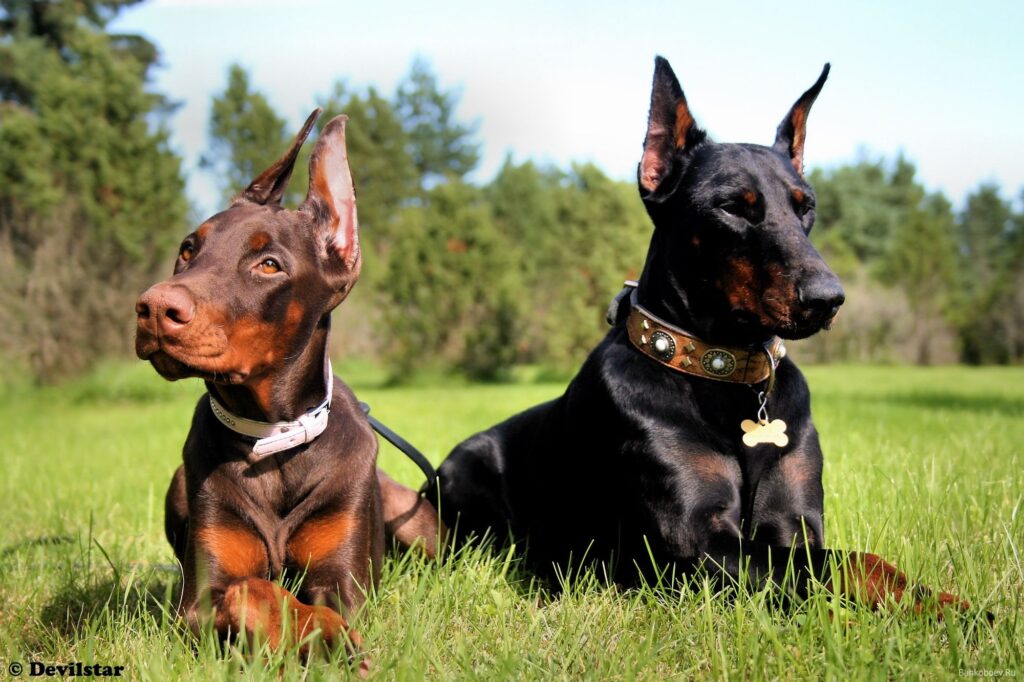
Dobermans are active dogs that require high-quality, protein-rich nutrition. The choice is between a raw/natural diet or prepared dry kibble.
Natural Feeding (Raw/BARF)
The main product in a Doberman’s diet should be meat (beef, turkey, chicken – if no allergies). Offal (heart, liver – in moderation), cartilage, and beef tripe are beneficial. Meat should be given to the dog in small chunks. Ground meat is practically not absorbed. Never feed your pet fatty foods (pork).
In addition to meat products, you should give a Doberman:
- Dairy products: cottage cheese, kefir, natural yogurt.
- Eggs: 2-3 times a week (cooked or raw yolks).
- Sea fish: once a week (cooked, boneless).
- Vegetables and fruits: carrots, pumpkin, zucchini, apples. The dog should eat these from an early age. Vegetables are best grated and added raw, lightly seasoned with oil (for vitamin absorption).
- Grains: rice, buckwheat. Porridge should not make up more than 20-30% of the ration.
Dry Kibble
If you choose dry kibble, it should be a premium, super-premium, or holistic-class food for active large breeds. It is already balanced and contains all the necessary vitamins. Never mix dry kibble and natural food in the same meal – this leads to digestive problems.
Preventing Bloat (GDV)
Dobermans are prone to bloat. To minimize the risk:
- Feed the dog 2-3 times a day, not just once.
- The bowl can be placed on a raised stand at the dog’s chest level.
- It is categorically forbidden to play active games, run, or jump for 1.5-2 hours after eating.
Pros and Cons of the Breed
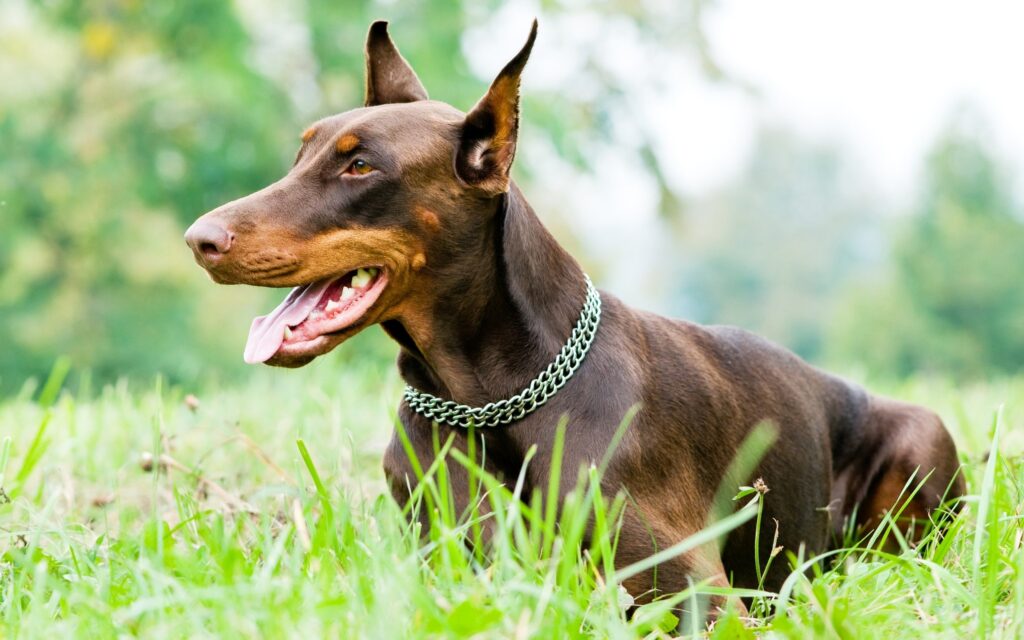
The decision to get a Doberman should be extremely well-considered. This is not a dog you can adopt “for looks” and neglect its needs.
| ✅ Pros | ❌ Cons |
|---|---|
| High intelligence, learns quickly. | Requires an experienced owner, not for novices. |
| Boundless devotion to the family, a “Velcro dog.” | Serious health problems (especially DCM), high vet bills. |
| Excellent guard and protector. | High need for physical and mental exercise. |
| Minimal coat care, no “doggy” odor. | Tendency toward dominance and stubbornness if sensing owner weakness. |
| Elegant, athletic appearance. | Does not cope well with loneliness, prone to separation anxiety. |
| Energetic partner for sports and active recreation. | Does not tolerate cold well, requires a coat in winter. |
| Potential aggression towards other dogs (especially of the same sex). |
Interesting Facts About the Breed
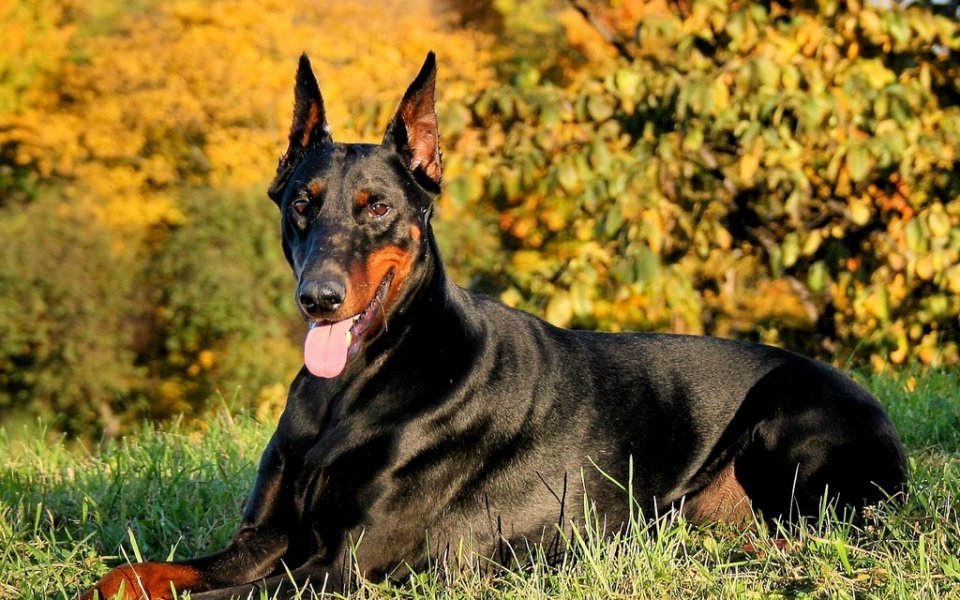
- Hero Dog: During World War II, a Doberman named Kurt saved the lives of 250 American Marines on Guam. He warned them of a Japanese ambush but was killed by a grenade himself. He became the first dog buried at the National War Dog Cemetery.
- Movie “Star”… with a Minus Sign: Hollywood created the Doberman’s image as a “killer dog,” a henchman for villains (e.g., in “Resident Evil” or “John Wick”). This has severely damaged the breed’s reputation.
- Not Just Guards: Although Dobermans were bred for protection, they are versatile “soldiers,” unlike many hunting breeds (such as the Bohemian Wirehaired Pointing Griffon or Spinone Italiano). Their keen sense of smell allows them to work successfully as search and rescue dogs.
- The Smartest Guard: In Stanley Coren’s famous test of canine intelligence, the Doberman ranks 5th, surpassed only by the Border Collie, Poodle, German Shepherd, and Golden Retriever. This makes them the most intelligent of all classic guard breeds.
- Name with a Mistake: The founder of the breed, Karl Friedrich Louis Dobermann, had a surname with two “n”s at the end. However, when the breed was registered, one letter was “lost,” and the breed became known as Doberman.
Frequently Asked Questions (FAQs) about the Breed
Is it true that Dobermans are malicious and aggressive?
No. This is a myth amplified by cinema. A Doberman, by standard, should be neither timid nor aggressive. He is a self-confident protector. His “aggression” is a controlled protective instinct. He will not attack without cause, but he will defend his owner without hesitation in the event of a real threat. Dobermans become aggressive due to improper training, lack of socialization, or poor genetics.
Do Dobermans get along with children?
Yes, Dobermans raised in a family with children are usually very patient, gentle, and protective of them. They can be excellent nannies. However, they are large, powerful dogs. Any games must take place under adult supervision, and children need to be taught how to interact with the dog.
Can a Doberman be kept in an apartment?
Yes, on one condition: you must provide the dog with a sufficient level of physical and mental exercise. In an apartment, a Doberman is calm and sleeps a lot if he has been “exercised.” But if he is bored, he will tear the place apart. They hate the cold and cannot live outside.
Is ear cropping and tail docking mandatory?
No. It is banned in most countries worldwide. It is purely a cosmetic procedure that carries no health benefit for the dog and is painful. A “natural” Doberman with hanging ears and a long tail is the same Doberman, with the same character and intelligence.
How long do Dobermans live?
The average lifespan is 10-13 years, but sadly, due to the high prevalence of DCM (cardiomyopathy), many dogs die suddenly at 6-9 years old. Regular heart examinations are a vital necessarry for this breed.
Video About the Breed
- Boundlessly devoted guardian
- Very intelligent and trainable
- Elegant, athletic
- Attuned to the owner’s mood
- High tendency to DCM (heart)
- Needs an experienced owner
- Lots of exercise and socialization
- Feels the cold — short coat
| German Shepherd | Rottweiler | Boxer | |
|---|---|---|---|
| Height | 55–65 cm | 56–69 cm | 53–63 cm |
| Energy | 4.5 | 3.5 | 4.5 |
| Apartment | 2.5 | 2.5 | 3 |
| Beginners | 3 | 2.5 | 3.5 |
Is it true that Dobermans often have heart problems?
Is a Doberman suitable for a beginner?
Is the Doberman aggressive?
FCI Standard No. 143 · DCM study (Wess et al.)
For apartments · For kids · For beginners · Active · Smartest · Hypoallergenic · All rankings →