

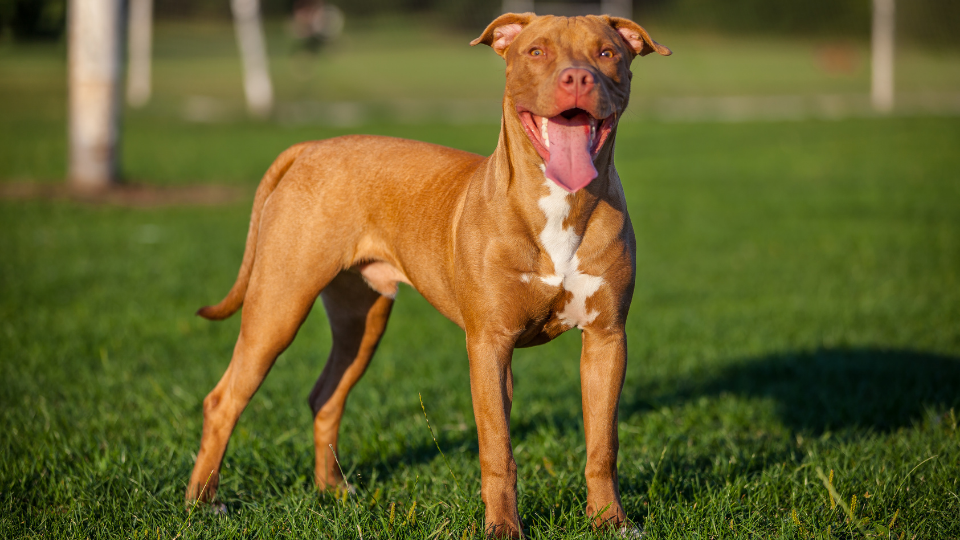
| Height | male 46–53 cm, female 43–51 cm |
| Weight | male 16–27 kg, female 14–23 kg |
| Lifespan | 12–14 years |
| FCI group | not recognised by the FCI |
| Origin | USA |
Exact ratings
Common health issues
Nutrition
The American Pit Bull Terrier is a breed argued over not only by dog people but by parliaments. In some countries it is entered in stud books and shown in the ring; in others its importation is forbidden by law, and the dog is classified by its appearance rather than by its pedigree. This page neither defends the breed nor accuses it: it gathers what is written in the registry standards, in the legislation of six countries in force and in the peer-reviewed literature — including the places where those sources do not agree with one another. The conclusion is the reader’s to draw. Find out more on Tvaryny.
Breed, Type and Registries: Who Keeps the Records
The first thing to grasp is that the word “pit bull” means different things depending on who is using it. To a kennel registry it is a specific breed with a written standard and a stud book. To the legislator, in most countries, it is a type — a dog that looks a certain way, regardless of its ancestry. Because of that divergence, half the arguments about the breed are not about dogs at all, but about definitions.
Two American registries keep the breed as a breed:
- United Kennel Club (UKC) — by the text of its own standard, this was the first registry to recognise the American Pit Bull Terrier. UKC founder C. Z. Bennett assigned registration number 1 to his own pit bull terrier, Bennett’s Ring, in 1898. The breed sits in the terrier group; the standard in force is the revision of 1 May 2017.
- American Dog Breeders Association (ADBA) — by the association’s own published history, it was founded in September 1909 as a multi-breed body; its president was Guy McCord and its co-founder Con Feeley, both close associates of John P. Colby. In 1951 it passed to Frank Ferris, and in 1973 it was bought by the Ralph Greenwood family. The ADBA’s own conformation standard (Heritage) was developed from 1976 at the request of owners who wanted to copy neither the UKC nor the AKC. Since 2006 the registry has also been open to other purebred dogs.
And now the two registries that do not keep the pit bull terrier — the point most often confused.
The American Kennel Club (AKC) recognises a related breed, the American Staffordshire Terrier. The AmStaff’s official AKC standard was approved on 10 June 1936, and that same document, with the same amendments, is still in force today. These are separate registration systems: a dog may hold UKC papers as a pit bull terrier while its close relative holds AKC papers as an AmStaff, and formally they are different breeds, despite the shared origin.
The FCI — the international federation whose nomenclature most European kennel organisations work to — lists four breeds in group 3 “Terriers”, section “Bull type terriers”: the Bull Terrier (no. 11), the Staffordshire Bull Terrier (no. 76), the American Staffordshire Terrier (no. 286) and the Miniature Bull Terrier (no. 359). The American Pit Bull Terrier is not on that list. The FCI standard for the AmStaff is dated 3 September 1996, country of origin: the USA.
The practical consequence for an owner is simple and unwelcome: in FCI countries your dog cannot hold an international pedigree as a pit bull terrier — it is either registered as an AmStaff or it remains without recognised papers. And in law, as we shall see below, that absence of papers frequently works against the dog rather than for it.
History: the Bull-and-Terrier, the Catch Dog and Number One
The historical section of the UKC standard is worth reading as a primary source rather than as a retelling. It describes the origin like this: at some point in the nineteenth century, dog enthusiasts in England, Ireland and Scotland began experimenting with crosses between bulldogs and terriers, looking for a dog that would combine the terrier’s gameness with the bulldog’s strength and athleticism. These bull-and-terriers reached the United States with immigrants.
The standard then names the work for which the breed was actually kept in America, and it is not fighting: farmers and ranchers used their pit bull terriers as catch dogs on semi-wild cattle and hogs, for hunting, for driving livestock and as family companions. A catch dog finds and holds a large animal until a person arrives; hence the standard’s requirement that the pit bull retain the functional ability to “hold, wrestle (push and pull) and breathe easily while doing so”.
The European background to that story has its own turning point: when the baiting of large animals was outlawed in 1835, dog fighting — easier to hide from the constabulary — gained in popularity, and it was for the pit that a smaller, more agile dog was selected. The breed came out of that milieu, and no serious registry denies it: the ADBA states plainly that it “does not condone any illegal activity, but will never deny the history of our breed”.
Today the UKC lists the disciplines in which the breed competes: obedience, rally obedience, tracking, agility, lure coursing, dock jumping, weight pulling and conformation.
Appearance, and What the Standard Actually Says
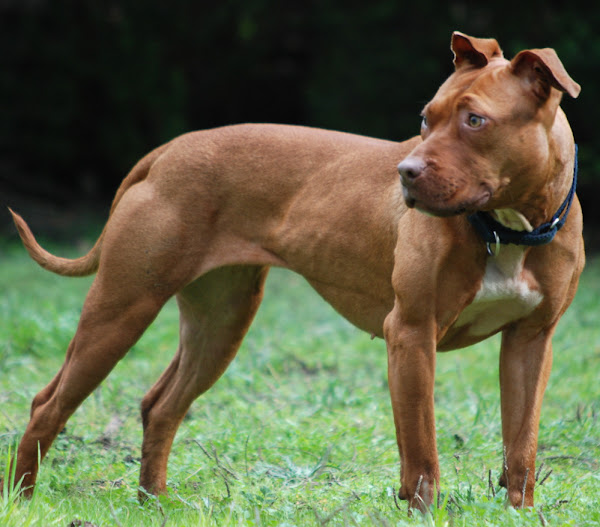
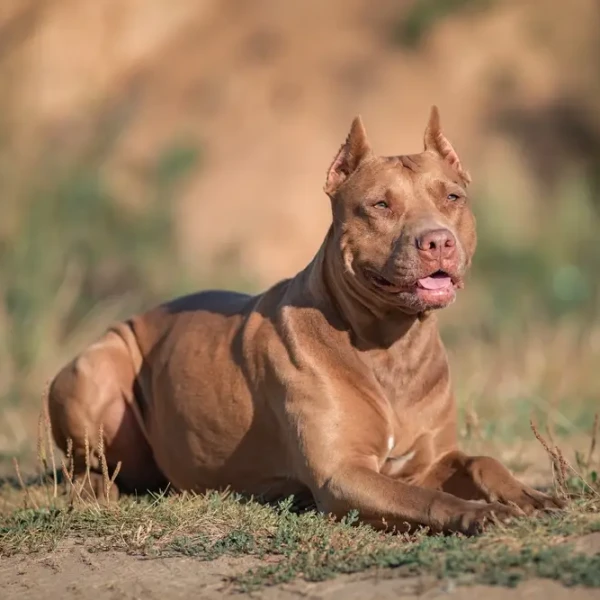
The UKC standard describes the pit bull terrier as a medium-sized, solidly built, short-coated dog with clearly defined musculature. The body is only slightly longer than tall; the front leg from elbow to ground is roughly half the height at the withers. The head is of medium length, with a broad, flat skull and a wide, deep muzzle, the muzzle shorter than the skull in a ratio of about 2:3. The bite is a scissor bite. Ears are set high, small to medium, natural or cropped — with no preference. The tail is relatively short, set low and tapering to the tip.
The most important thing in this standard is not the description but what it is written against. The text warns that “quality should never be sacrificed for size”, and that the UKC “is not willing to recognise the appropriateness of the use of exaggerated specimens of this breed in a breeding programme”. Among the eliminating faults: a muzzle so short and blunt that it interferes with normal breathing; a chest so wide that it interferes with movement; an excessively massive body type that impedes working ability. The fashionable “heavy” pit bull with a hypertrophied head is thus not the pinnacle of the breed but precisely what the standard calls a fault.
Height and weight — separately for males and females. The standard stresses that overall balance and a correct weight-to-height ratio matter more than the figures themselves, and gives heights “only as a general guideline and approximation”:
| Parameter | UKC standard — American Pit Bull Terrier | AKC standard — American Staffordshire Terrier |
|---|---|---|
| Height, male | 18–21 inches at the withers (≈46–53 cm), as an approximate guideline | about 18–19 inches (≈46–48 cm) |
| Height, female | 17–20 inches at the withers (≈43–51 cm), as an approximate guideline | about 17–18 inches (≈43–46 cm) |
| Weight | desirable for an adult male 35–60 pounds (≈16–27 kg), for a female 30–50 pounds (≈14–23 kg) | no figures given: “height and weight should be in proportion” |
| Ears | natural or cropped, with no preference | cropped or uncropped, uncropped preferred |
| Tail | natural; a bobbed tail is an eliminating fault | “not docked” |
| Colours | any colour and any pattern except merle | all permitted, but solid white, more than 80 % white, black-and-tan and liver are “not to be encouraged” |
| Disqualifications | cryptorchidism, viciousness or extreme shyness, albinism, merle, unilateral or bilateral deafness, long coat, dwarfism, a screw tail | no separate list of disqualifications; a list of faults |
Two details in that table are worth reading carefully. First, merle is disqualifying, as is albinism: a “rare merle pit bull” is not a rarity but a dog the standard does not recognise. Second, the disqualification list includes deafness, unilateral or bilateral. A registry does not enter into its disqualifications something that does not occur in the breed; the presence of that clause means the problem is real enough to be written down separately. Blue eyes the standard treats as a serious fault.
Enthusiasts habitually speak of a “bulldog” and a “terrier” type — a heavier and a lighter dog. The standard makes no such division and penalises the extremes on both sides. On cropping, the UKC as an international registry notes that the practice is banned in a number of countries, and that no dog may therefore be penalised at UKC events for a full tail or natural ears.
Temperament, “Gameness” and What the Tests Measure
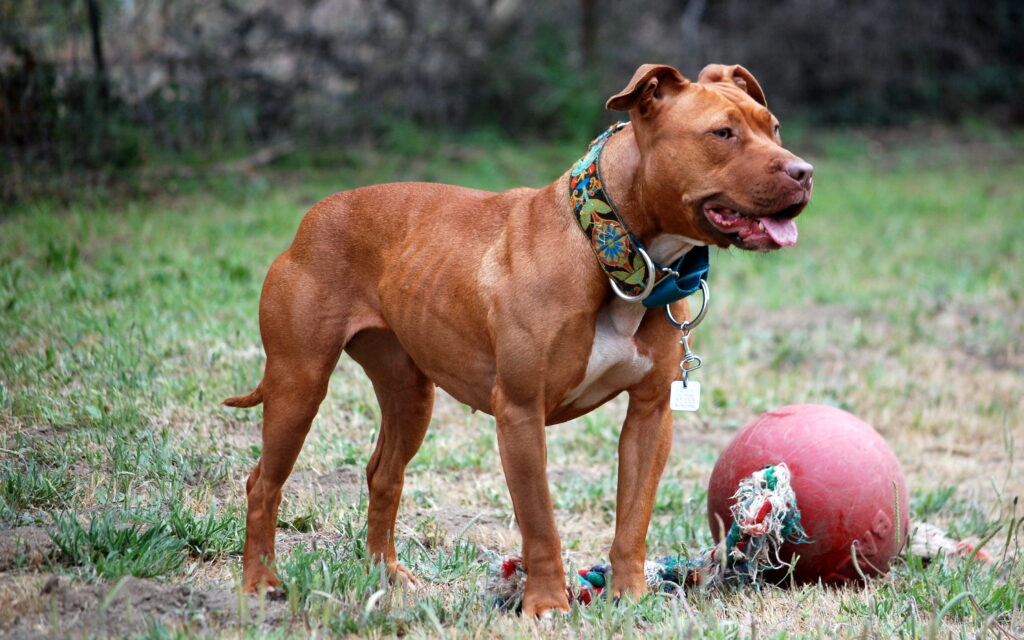
The “Characteristics” section of the UKC standard is the shortest route to understanding what the registry itself expects of the breed. Let us give its content almost verbatim, because paraphrase shifts the emphasis every time:
- the essential characteristics are strength, confidence and a zest for life; the breed is eager to please and brimming with enthusiasm;
- pit bull terriers “make excellent family companions and have always been noted for their love of children”;
- “because most APBTs exhibit some level of dog aggression and because of its powerful physique, the APBT requires an owner who will carefully socialise and obedience train the dog”;
- “the breed’s natural agility makes it one of the most capable canine climbers so good fencing is a must for this breed”;
- “the APBT is not the best choice for a guard dog since they are extremely friendly, even with strangers”;
- “aggressive behaviour toward humans is uncharacteristic of the breed and highly undesirable”; viciousness or extreme shyness is a disqualification.
So the registry itself separates two things that everyday conversation constantly runs together: aggression towards people, which the standard considers uncharacteristic and disqualifies, and aggression towards other dogs, which the same standard calls a trait of most representatives of the breed. This is neither a softening nor an accusation — it is the plain text of the document by which the breed is judged in the ring.
The word “gameness” likewise comes from the standards rather than from folklore: the UKC uses it in describing the aim of the original crosses, the ADBA in describing what it considers the essence of the breed (“never quit, always give 110 %”). The practical side of the trait is neutral: a dog that does not abandon what it has started works well in weight pulling and in sport — and equally does not abandon what it has started in a conflict with another dog.
The ATTS temperament test. The most frequently quoted figure about pit bull character is the pass rate in the American Temperament Test Society test. By ATTS statistics as of January 2023, the American Pit Bull Terrier: 960 dogs tested, 841 passed, that is 87.6 %; the Golden Retriever: 836 tested, 718 passed, that is 85.9 %. Before drawing a conclusion from those numbers, it is worth reading what the ATTS actually measures:
- the test lasts eight to twelve minutes and simulates a walk in a park; the dog is on a loose six-foot lead and the handler is not permitted to speak to the dog, give commands or correct it;
- ten subtests: a neutral stranger, a friendly stranger, a hidden noise (a bucket of stones), three shots from a starter pistol, an umbrella opened suddenly, plastic and wire footing underfoot, a strangely dressed passer-by and scenes of escalating threat;
- a failure is recorded for unprovoked aggression, panic without recovery or strong avoidance; dogs are admitted from 18 months;
- there is no subtest in which the dog meets another dog. In other words, the very trait the UKC standard calls a breed characteristic is not assessed by this test at all.
Add to that the fact that dogs are brought to the test by their owners voluntarily — not a random sample of the breed population, but a sample of those whose owners considered them ready. The 87.6 % figure is honest exactly within the limits in which it was obtained: it is about reactions to people and stimuli in specific conditions, not about the probability of a conflict in a dog park.
A separate peer-reviewed measurement comes from Germany. Ott et al. (2009) tested Bull Terriers of a single line by the protocol of the Lower Saxony dangerous-animals ordinance: of 38 dogs, 37 (97.37 %) responded appropriately in all situations of the test and one did not. The authors found no statistically significant difference between them, 415 dogs of the breeds covered by the legislation, and 70 Golden Retrievers.
Identification: Why the “Pit Bull” in the Report and the Pit Bull in the DNA Are Different Things
This is the least known and at the same time the most important part of the subject. Almost all pit bull legislation and almost all bite statistics rest on someone having looked at a dog and named a breed. Peer-reviewed studies have measured how reliable that operation is; the result is the same every time.
- Olson et al., The Veterinary Journal, 2015. Four shelters, 16 staff members, 120 dogs. Visually, staff assigned 62 dogs (52 %) to the pit bull type; DNA testing, only 25 (21 %). Inter-observer agreement: 76–83 % (kappa 0.44–0.52, that is, moderate); the sensitivity of visual identification ranged from 33 % to 75 %, specificity from 52 % to 100 %. The authors’ conclusion, literally: visual identification of pit bull-type dogs is unreliable.
- Voith et al., Journal of Applied Animal Welfare Science, 2009. Twenty dogs from 17 different facilities. For 87.5 % of the dogs to which a facility had assigned specific breeds, DNA analysis did not detect all the breeds named.
- Hoffman et al., same journal, 2014. Shelter staff in the USA and Britain were shown photographs of 20 dogs. British participants frequently called Staffordshire Bull Terriers the same dogs the American participants considered pit bulls. Separately: 41 % of respondents working under breed bans admitted they would knowingly record a restricted-breed dog under a different name.
- Gunter et al., PLOS ONE, 2018. 919 dogs from two large shelters, genetically tested. 4.9 % proved purebred. Staff guessed at least one breed from the true set in 67.7 % of cases, but as soon as more than one had to be named, accuracy fell to 10.4 %.
Now lay that over the texts of the laws. The official British guidance frames the criterion without hedging: whether your dog is a banned type “depends on what it looks like, rather than its breed or name”. The Spanish Real Decreto 287/2002 describes a potentially dangerous dog in annex II purely morphologically — strong musculature, a powerful athletic appearance, a short coat, a chest girth of 60–80 cm, a height at the withers of 50–70 cm, a weight above 20 kg, a bulky cuboid head — and applies this to a dog with “all or most” of these features. The German federal law extends the import ban to the four named breeds “and their crosses with one another or with other dogs“.
So the legal concept coincides with the very visual judgement whose unreliability those studies measured. For an owner this means something concrete: the risk is tied not only to the dog’s actual ancestry but to how an outsider will assess it — an inspector, a landlord, an insurer, a shelter worker. And it works both ways: a mongrel without a single pit bull in its pedigree may attract every restriction, while a dog of pit bull ancestry may attract none.
The Law: Where and How the Breed Is Restricted
What Peer-Reviewed Research Shows About Bites and Bans
Upbringing and Training
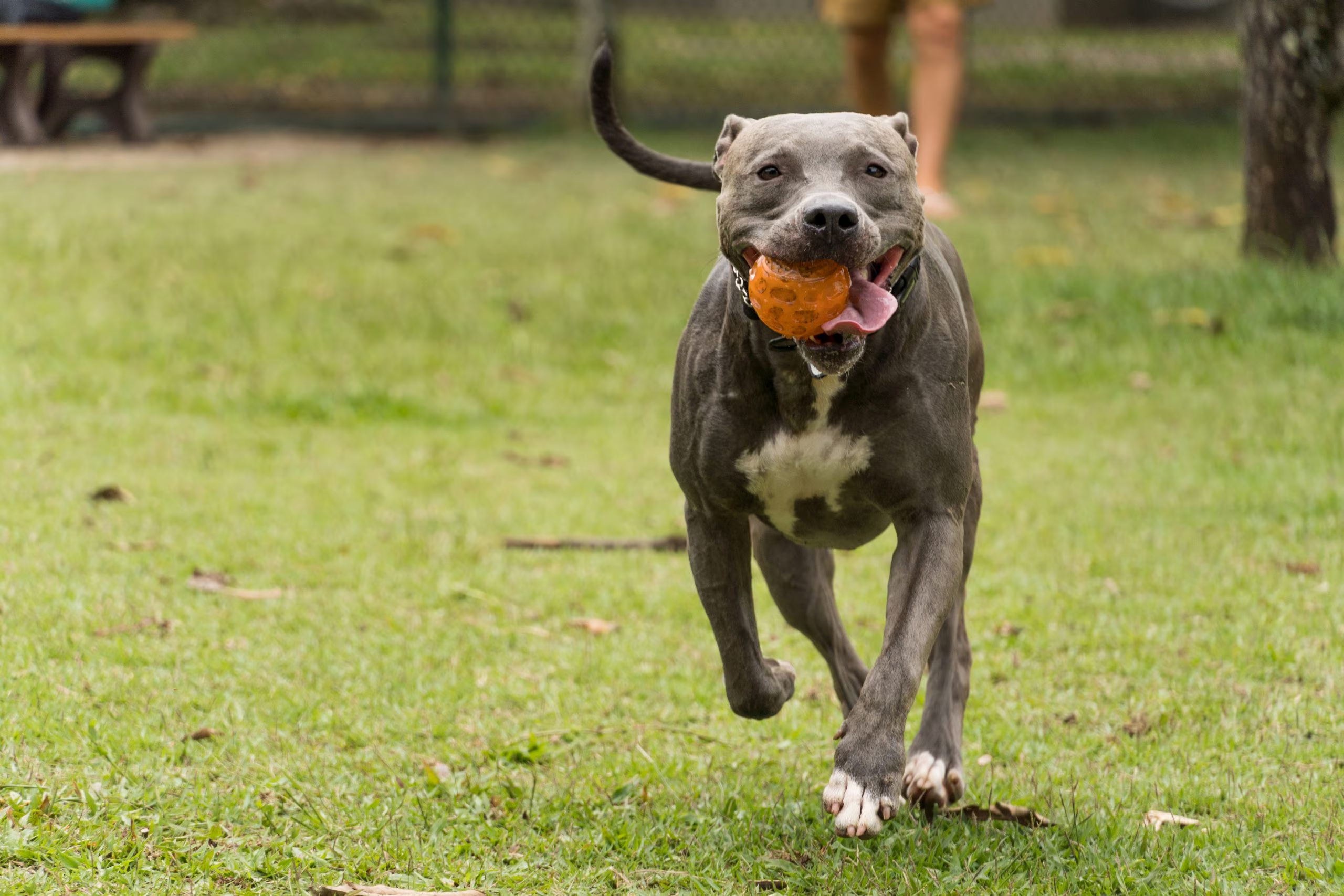
The UKC standard frames the requirement on the owner as an obligation rather than a wish: the breed needs a person who will carefully socialise and obedience train the dog. Two concrete things from the same text set the practical minimum.
- Fencing. The standard calls the breed one of the most capable canine climbers and says plainly that good fencing is a must. This is not about escape for its own sake — it is about the fact that a dog which has left the yard finds itself alone with unfamiliar animals and people.
- Obedience under arousal. Since the standard considers a certain level of dog aggression a breed trait, the key skill is not a “sit” in quiet conditions but a reliable recall and breaking off contact at the point where the dog is already aroused.
The breed works well on positive reinforcement combined with clear and unchanging boundaries. Excessive pressure produces either withdrawal or a defensive reaction — and both degrade controllability at exactly the moment it is needed.
Breed-specific tools. The “spring pole” — a rope on a spring suspended from a sturdy branch or beam — gives a legal and controlled outlet to the need to hold on to prey; the “flirt pole” (a long rod with a lure) works well for the “take it” and “leave it” commands and for quickly taking the edge off surplus energy. Both make sense only with a rule about starting and finishing on the person’s command: the tool should teach the dog to switch on and switch off, not simply wind it up.
A separate word about off-lead dog parks. Given what the standard says about dog aggression, a shared walk with unfamiliar dogs is, for an adult pit bull terrier, not a neutral default but a decision taken afresh each time, in knowledge of the particular dog.
Physical Exercise: More Than Just a Walk
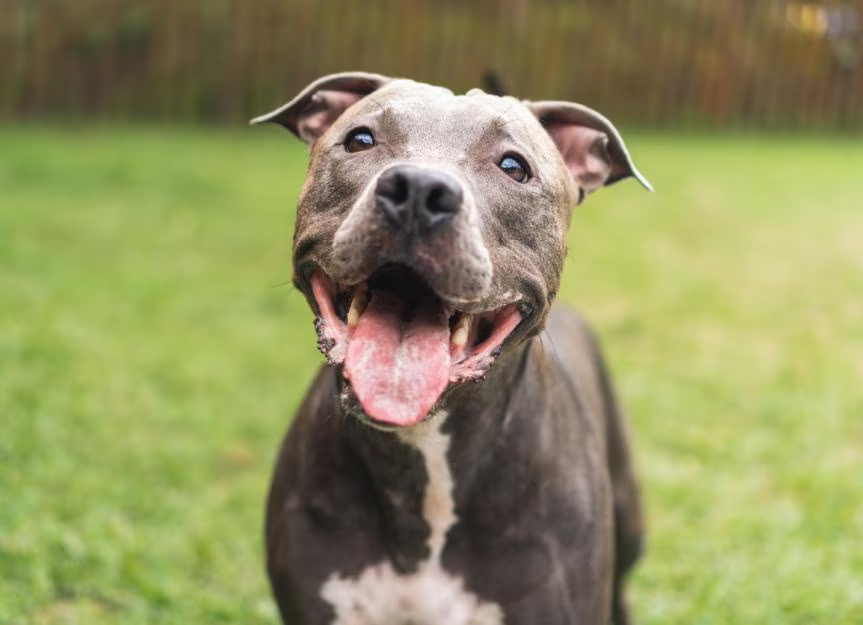
Half an hour of quiet walking in the morning will not be enough for this breed. The standard describes a dog built for work that combines strength with endurance, and without a load this construction finds an application for itself — usually in the form of destroyed possessions and growing excitability.
A comparison with other working types helps to see the difference. The English Foxhound is built for prolonged pursuit on a scent trail — its endurance is above all running endurance. The pit bull terrier combines running endurance with strength endurance, so what it needs is not kilometres in themselves but muscular work: running uphill, swimming, towing, controlled holding games. Giant breeds work differently: the Irish Wolfhound, for all its size and strength, works in short bursts and is considerably calmer in everyday life.
Two limitations that are often forgotten. First: the breed has no undercoat, so it tolerates cold badly, while a short coat and dark pigment are no protection from heat — heatstroke is a perfectly real risk during intensive work in summer. Second: a young dog must not be given impact loads — jumps from a height, long runs on hard surfaces — until joint formation is complete.
Feeding
Health: What Is Documented
Interesting Facts About the Breed
- Registration number 1. UKC founder C. Z. Bennett gave the very first registration in the club’s history to his own pit bull terrier, Bennett’s Ring, in 1898 — so the whole registry began with this breed.
- A dog that climbs walls. This is not an urban legend but a line of the standard: the UKC calls the breed one of the most capable canine climbers and for that reason requires good fencing.
- A poor guard — by the official document. The same standard says plainly that the pit bull terrier is not the best choice for the role of guard dog, because it is too friendly even with strangers.
- Merle is never “rare”. The UKC standard accepts any colour and any pattern except merle, and merle and albinism are entered directly among the disqualifications.
- A shared history, separate documents. The AKC standard for the American Staffordshire Terrier was approved on 10 June 1936 and is still in force; the FCI keeps the AmStaff under number 286 in the terrier group, while the pit bull terrier is absent from its nomenclature altogether.
- Sergeant Stubby. The most famous four-legged participant in the First World War, who warned soldiers of gas attacks, is traditionally mentioned among famous pit bulls. It is worth remembering that he had no pedigree at all — and that story itself illustrates the theme of this whole page: a dog is assigned its breed by its appearance.
Video About the Breed
- Attachment to the family; the UKC standard notes friendliness even towards strangers
- High trainability and aptitude for sport — from weight pulling to agility
- Short coat, minimal grooming
- A detailed public standard with explicit temperament requirements
- Some level of aggression towards other dogs — by the standard, a trait of most representatives
- Legal restrictions depending on the country: import ban, permit, muzzle, neutering
- Requires meaningful daily work and good fencing
- No undercoat: tolerates cold badly, and in summer the risk of heatstroke rises
| American Staffordshire Terrier | Staffordshire Bull Terrier | Boxer | |
|---|---|---|---|
| Height | 43–48 cm | 36–41 cm | 53–63 cm |
| Energy | 4.5 | 4.5 | 4.5 |
| Apartment | 3 | 4 | 3 |
| Beginners | 2.5 | 3 | 3.5 |
Are pit bulls aggressive towards people?
Can a pit bull terrier be kept with other dogs?
Where is the breed banned or restricted?
What rules apply in the United Kingdom?
Why might my dog be judged a pit bull when it is a crossbreed?
Do the FCI and the AKC recognise the breed?
UKC standard 2017 · AKC · FCI · ADBA · ATTS 2023 · JAVMA 2013 · Vet Rec 2026
For apartments · For kids · For beginners · Active · Smartest · Hypoallergenic · All rankings →