

| Weight | 2.5–4.5 kg |
| Lifespan | 12–16 years |
| Coat | short, curly (rex), low-shedding |
| Recognition | CFA · TICA · WCF · FIFe |
| Origin | Great Britain |
Exact ratings
Common health issues
Nutrition
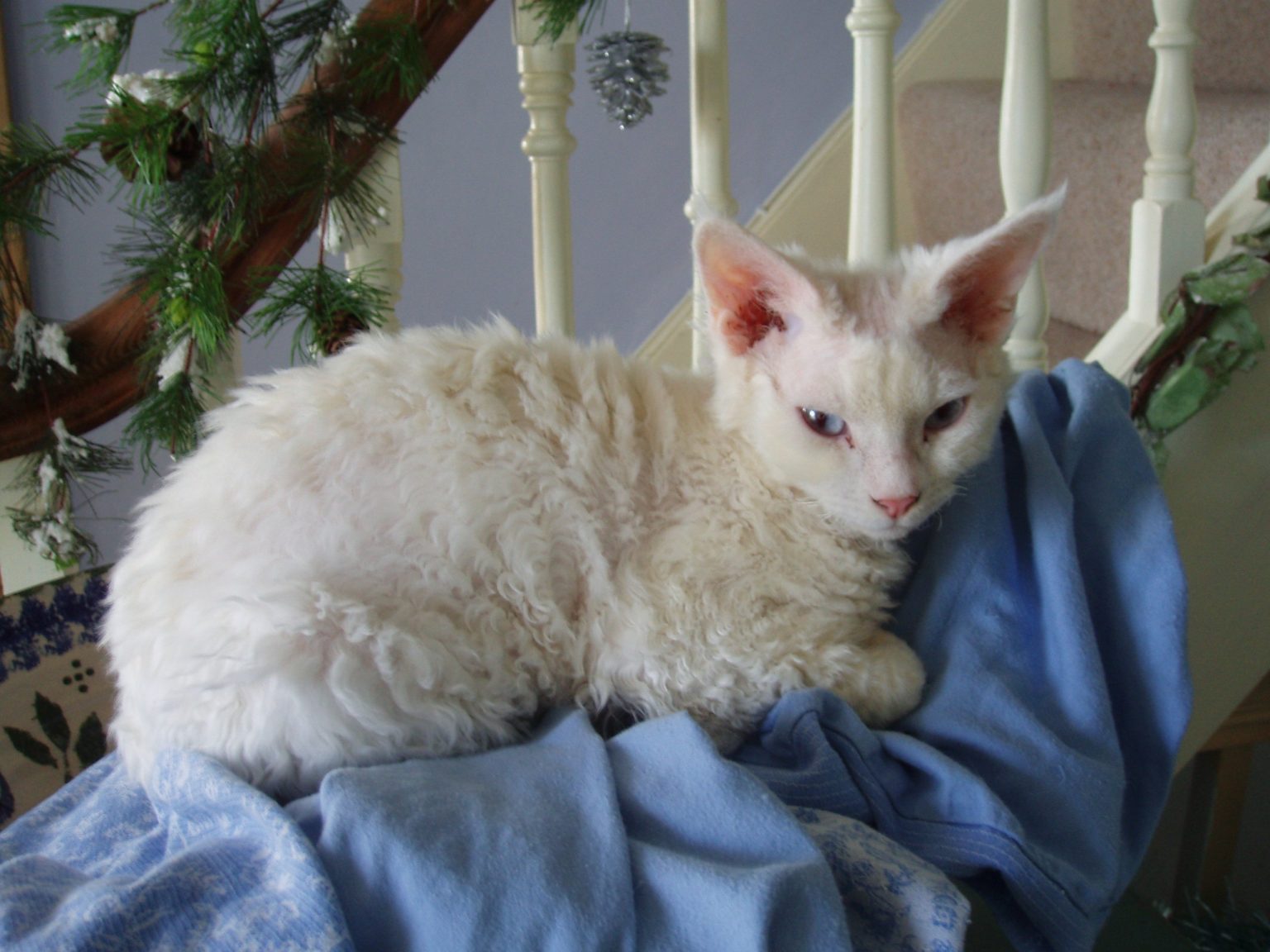
The Devon Rex is a cat you are unlikely to mistake for anything else: enormous low-set ears, wide-spaced eyes, a short curly coat and a face that has earned the breed the nicknames “elf”, “pixie” and “monkey in a cat suit”. This is a cat that lives not beside its human but literally on them — on the shoulders, under the comforter, up a sweater sleeve. Coat care is minimal, which is not the same as trouble-free: the Devon has its own set of skin quirks, its own compulsory blood test before mating, and its own hereditary disease with a ready-made DNA test. For more on cat breeds, visit Tvaryny.
And straight away, the thing the internet gets wrong about the Devon Rex more often than anything else. There are several curly-coated cat breeds, and almost every source says each one has “its own mutation”. The real picture is different and more interesting: the Devon Rex is not related to the Cornish Rex — the genes are different; whereas the Devon Rex and the Sphynx are two versions of one and the same gene. Nearly everything else follows from that single fact: why a Devon × Cornish cross produces straight-coated kittens, why one hereditary disease turns up in Devons and Sphynxes and nowhere else, and why the Devon’s coat is uneven rather than simply “curly”.
Devon Rex: a brief breed overview
| Characteristic | Description |
|---|---|
| Origin | Buckfastleigh, county of Devon, United Kingdom |
| Founder of the breed | The cat Kirlee, litter of 1959 |
| Curl gene | KRT71, allele re, recessive |
| Recognition | GCCF — 1967; CFA — registration 1979, championship status 1983; TICA — 1979 |
| Lifespan | 12–16 years |
| Height at the shoulder | 25–30 cm |
| Weight | Females 2.5–3.5 kg; males 3–4.5 kg |
| Temperament | Very affectionate, playful, intelligent, inquisitive, energetic; needs attention |
| Grooming | Minimal and pointedly gentle; regular ear cleaning and attention to the skin |
| Activity | High |
| Vocalization | Moderate (a quiet voice) |
| Compatibility with children | Very good |
| Compatibility with other animals | Good (with proper socialization) |
| Checks to require from the breeder | COLQ DNA test (Devon Rex myopathy / CMS) and blood type of both parents |
Three curly cats: why the Devon is no relative of the Cornish
In the middle of the twentieth century several curly-coated cats turned up in England within a few years of each other. The natural assumption was that this was one and the same mutation resurfacing here and there. There was only one way to test it at the time — mate the carriers and look at the kittens. If the mutation is a single one, every kitten is born curly. If the mutations are different, each covers the other’s fault and the kittens are born with straight coats.
The experiment that created the breed
Kirlee, the curly tom from Devonshire, was mated to females descended from Kallibunker, the founder of the Cornish Rex in neighboring Cornwall. Every kitten was born with a straight coat. That was the answer: Kirlee carried a different mutation. The geneticist Roy Robinson described it in 1969 in the journal Genetica as “a third rex mutation in the cat” — hence the old labels that still circulate in reference books: “gene I” (Cornish) and “gene II” (Devon).
Note the logic: straight-coated kittens were not the failure of the experiment, they were its result. It is precisely because the cross “went wrong” that the Devon Rex exists as a breed of its own rather than as a line inside the Cornish Rex.
What turned up once DNA could be read
Forty years later both mutations were identified by name, and the picture was not quite what the popular breed profiles describe.
- Devon Rex — the KRT71 gene. In 2010 the group led by Leslie Lyons (UC Davis) described in Mammalian Genome a complex rearrangement in this gene: an 81-base-pair deletion with insertions that disrupts splicing. The allele was named re; inheritance is recessive, so a curly Devon carries two copies.
- Cornish Rex — the LPAR6 gene. It was found in 2013, again by the Lyons team, in a paper published in PLOS ONE: a four-base-pair deletion in exon 5 that truncates the protein early. In the breed it is fully fixed.
- German Rex — the same LPAR6 as the Cornish. This is probably the single biggest correction to the usual talk of “three different rex genes”. The very same deletion was found in German Rexes; in that small breed it is not fixed but still segregating. So there are three curly breeds — but only two genes.
KRT71 and LPAR6 are entirely unrelated molecules. LPAR6 is a cell-surface receptor without which the hair shaft loses its structural integrity (in humans, faults in the same gene produce woolly hair). KRT71 is a type II keratin that builds the inner root sheath of the follicle: the Henle and Huxley layers and the cuticle of that sheath. In plain terms, it is the mold the hair is cast in. Damage the mold and the hair comes out distorted whatever it is made of.
Continue the census and KRT71 turns out to be the great “curly” gene of cats generally. Besides the Devon it also houses the Selkirk Rex mutation: the splice variant c.445-1G>C described in 2013 in Scientific Reports, with incomplete dominance — one copy is already enough to make the coat curl. The tally: four curly or hairless breeds account for two genes, with three variants of KRT71 (Sphynx, Devon, Selkirk) and a single LPAR6 (Cornish and German).
Devon and Sphynx: two steps of the same gene
This next point barely appears in breed profiles, although it explains a great deal. The same 2010 work showed that the Sphynx’s hairlessness is also a fault in KRT71, merely a different one: a point substitution affecting the same splicing mechanism. It was labeled hr. The result is an allelic series of three versions of one gene:
KRT71+ (normal coat) > KRT71hr (Sphynx) > KRT71re (Devon)
Read it like this: the normal coat dominates both faults, and the Sphynx’s hairlessness dominates the Devon’s curl. Every Devon Rex examined was homozygous for re, while many of the Sphynxes proved to be either homozygous for hr or compound heterozygous — carrying the “sphynx” and the “devon” allele at once.
This is not an abstraction but a working breeding rule — and the federations have settled it in opposite directions, which is telling. With the CFA, the Sphynx still lists the Devon Rex among its permitted outcrosses, with the proviso that Sphynxes born on or after 31 December 2033 may have only Sphynx parents. The British GCCF states the opposite, and bluntly, in its Devon Rex breeding policy: no cat with Sphynx ancestry should be introduced into the Devon Rex breed, because selection for hairlessness runs against the coat-quality requirements of the rex breeds; offspring of Sphynx × Devon matings go onto the reference register, do not count as variants and are not used in Devon breeding.
Traffic is therefore permitted in one direction only: the Devon may widen the Sphynx gene pool, not the other way round. Decades of such matings mean a shared gene pool — and therefore shared hereditary disease. In the health section below you will see that the Devon’s principal genetic problem is described in exactly these two breeds and in no others.
The curly breeds compared
| Characteristic | Devon Rex | Cornish Rex | German Rex |
|---|---|---|---|
| Gene | KRT71 (allele re) | LPAR6 | LPAR6 — the same as the Cornish |
| Inheritance | Recessive | Recessive | Recessive |
| Old label | “Gene II”, Rex Type 2 | “Gene I”, Rex Type 1 | Long thought to be separate |
| Body type | Hard, muscular, broad chest | Fine, “oriental”, arched back | Rounder, closer to the European type |
| Head | Short wedge, high cheekbones, marked “pinch” | Egg-shaped, “Roman” profile | Rounded |
| Ears | Very large, low-set, broad at the base | Large, high-set, close together | Medium, well apart |
| Hair types | All three types, but the guard hair is very sparse, short and itself rexed | No guard hair; the coat is undercoat | No guard hair |
| Texture | Soft, uneven, sparse in places | Dense, regular wave | Soft, plush |
| Cross with a Devon | — | Produces straight-coated kittens | Produces straight-coated kittens |
History of the breed: one cat behind all of it
The story of the Devon Rex begins not with a breeding plan but with a find. In the county of Devon, near the small town of Buckfastleigh, lived a curly-coated stray tom — by the account handed down within the breed, he kept close to a disused tin mine. In July 1959 a tortoiseshell-and-white queen produced a litter by him, and one kitten came out covered in curls, right down to rings on the tail. The queen belonged to Miss Beryl Cox, who kept the kitten and named him Kirlee.
The British press had already been writing about curly cats — the Cornish Rex of Cornwall, discovered ten years earlier. Miss Cox wrote to the breeders to say that she too had a curly cat. Then came the test mating, the straight-coated kittens, and the conclusion that this was a new mutation.
Recognition
- The GCCF (United Kingdom) recognized the Devon Rex in 1967.
- The CFA (United States) voted unanimously in February 1979 for separate breed status and accepted the Devon Rex for registration; the breed moved into the provisional class in 1981 and gained championship status in 1983. The common line “the CFA recognized the breed in 1979” is therefore only half true: 1979 was registration, and the show championship began four years later.
- TICA accepted the Devon Rex into the championship class in 1979 — the year the association was founded.
Why “the whole breed from one cat” is not just a pretty phrase
Every Devon Rex alive today descends from Kirlee. Worse: the queens brought to him in the early years were not only closely related to one another but were direct descendants of Kallibunker — since the mutation was at first assumed to be the same. Winning recognition for the breed required several generations of rex × rex matings, carried out inside a tiny group of animals.
The GCCF says so in as many words in its breeding policy: the inbreeding begun in order to secure recognition carried on afterwards, and from the very start the breed was dogged by serious health problems — patellar luxation, coagulopathy and a hereditary myopathy (spasticity), now known as CMS. That is not the wording of the breed’s critics but of its own breeding committee.
Hence breeding requirements stricter than in most breeds. In the GCCF system a Devon Rex or Devon Rex variant may stand on the active breeding register only under one of three conditions: the cat itself has tested normal for the CMS gene; or its parents have tested normal; or the results are normal for every line of the pedigree in the preceding generations. That is precisely the question a kitten buyer should be asking.
What a “Devon Rex variant” is
The term will certainly turn up in pedigrees, and it frightens buyers for no reason. Because the curl is recessive, two Devons can produce a kitten with an ordinary straight coat. That is neither a fault nor a “half-breed”: it is a variant of the breed — a Devon Rex by origin and by type, carrying one copy of the curl gene. Variants work fully in breeding: the GCCF states outright that getting the full benefit of the outcross requires variant × variant matings among others, and that straight-coated offspring from such matings count as variants only after a DNA test has confirmed the gene.
Outcrossing is allowed in the breed, but narrowly: the GCCF approves a list of partner breeds — Abyssinian, Asian Shorthair, British Shorthair, Burmese and Korat — with all other breeds listed as not approved. It is stated separately that the Devon Rex is incompatible with the Cornish Rex, the Selkirk Rex and the LaPerm, that such matings are highly undesirable, and that their offspring go onto the reference register and are used in no rex breeding programme. The aim is spelled out plainly: to keep the breed entirely separate from the other rex mutations.
What a Devon Rex looks like
The Devon Rex is a small to medium cat, but nothing about it is fragile: under the coat is a hard, muscular body with a broad chest, which breed descriptions call a “hard body”. The hind legs are noticeably longer than the front ones, hence the characteristic high rear and the ability to jump onto the top of a cabinet from a standstill.
- Head: a short modified wedge, high expressive cheekbones, a short muzzle and a strong chin. The marked “pinch” — the clear narrowing behind the whisker pads — is obligatory. The skull is flat. It is the pinch and the shorter, squarer muzzle that most quickly distinguish the Devon from the Cornish, whose nose is long and narrow.
- Ears: very large, extremely broad at the base, set low and turned outward rather than upward, tapering to rounded tips. Often tufted at the tips and well furnished inside.
- Eyes: large, oval, wide apart and set at a slant, the outer corners higher than the inner ones. Any color is allowed, usually in harmony with the coat. The expression is mischievous and curious.
- Body: of medium length, muscular, with a broad chest. For all its apparent delicacy, it is not fragile.
- Legs: long and slim, the hind ones longer than the front; feet small and oval.
- Tail: long, fine, tapering, covered in short curly hair.
- Color: the standard admits every genetically possible color and pattern — solids, tabbies, bicolors, colorpoints, tortoiseshells, smokes — with any eye color. Chocolate shades close to those of the Havana Brown are as possible as anything else.
The coat: why it is uneven — and why that is normal
It is worth pausing here, because new owners are often alarmed. An ordinary cat’s coat has three layers: the long straight guard hair forms the outer covering, a finer awn hair sits below it, and the wavy down hair makes up the undercoat. In the Devon Rex, unlike the Cornish Rex, all three hair types are present — but, as the CFA breed description puts it, the guard hair is very sparse, short and itself rexed.
There are three practical consequences. First: the covering comes out “open”, the wave loose and soft, and the density is not the same all over the body — the back, flanks, belly and tail often carry noticeably sparser patches. Second: density changes — with age, with the season, with a queen’s hormonal state; a kitten may thin out temporarily and grow back in. Third, and most important for care: fine curled hair breaks easily. A stiff brush and frequent combing do not improve a Devon’s coat, they snap it off.
Another hallmark of the breed is the whiskers and eyebrows: short, crinkled, often broken off. That is not a sign of illness or of poor care, but a direct consequence of the same mutation.
Devon Rex character and behavior
If the Devon’s looks intrigue you, the character is what settles it. These are extremely sociable, playful and intelligent cats for whom a human is not a source of food but the center of the world.
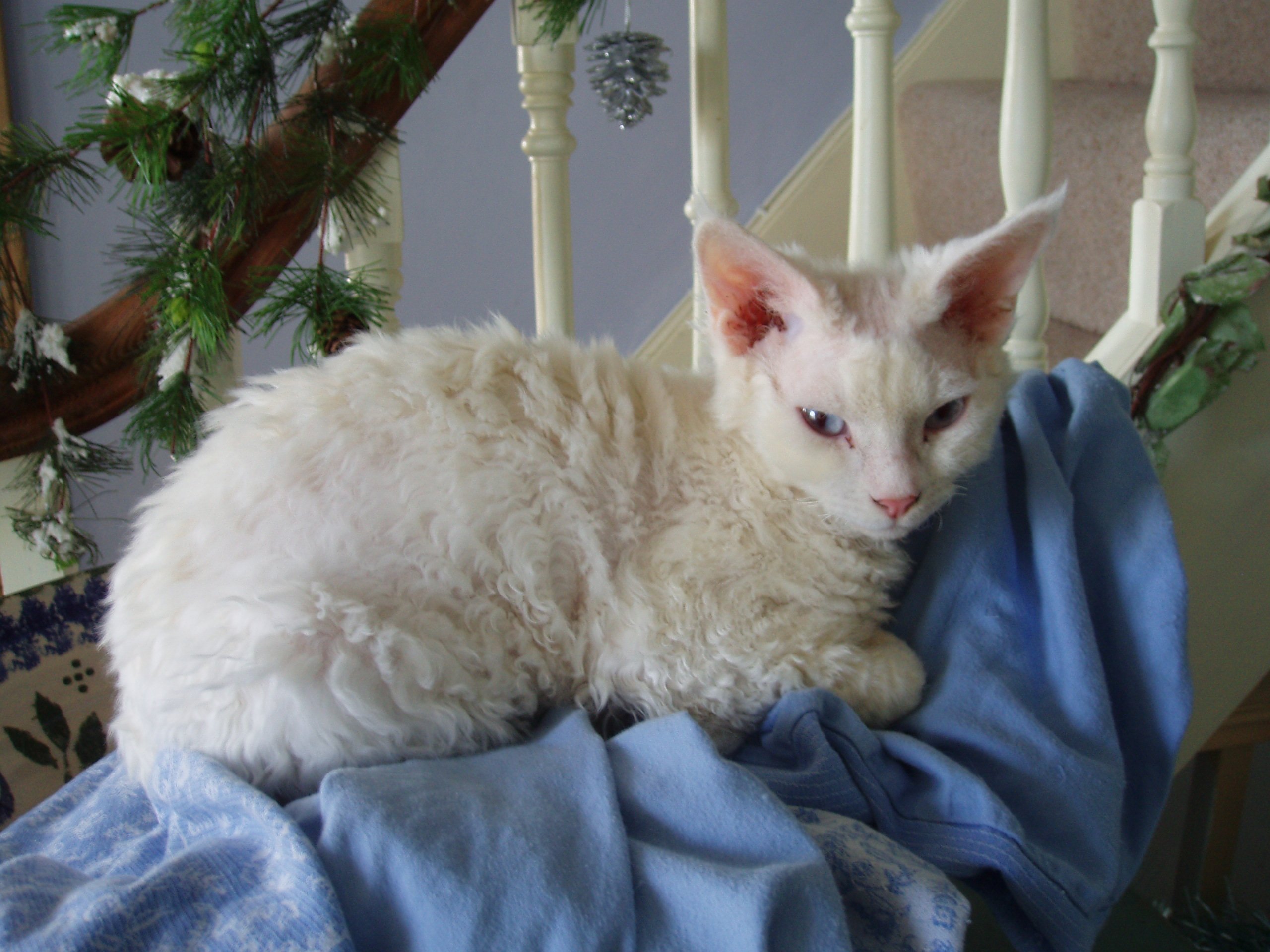
- “Monkey in a cat suit”: acrobats and explorers. High shelves, door frames and the owner’s shoulders are all working surfaces. The shoulder is not a sweet habit for a Devon, it is the favorite observation post.
- Oriented on people: they usually pick one “own” human but stay affectionate with the whole family. A Devon follows you from room to room and takes part in every household task, whether the help is wanted or not.
- Poor with solitude: this is probably the breed’s main drawback for busy people. A cat with nobody to interact with grows bored and anxious. A second animal in the house softens the problem but does not replace the human.
- High intelligence: they pick up tricks quickly, answer to their name, fetch a thrown object and walk calmly on a harness. They need as much mental work as physical.
- Friendliness: they get on well with children, with other cats and with dogs, especially if raised together. They can be selective about which other cats they befriend.
- Vocalization: the voice is quiet and unobtrusive, though Devons do like to “talk”.
- Love of warmth: a sparse coat holds heat badly, so the Devon deliberately hunts down sources of warmth — a lap, a comforter, a sunny windowsill, a warm radiator. A cat that burrows under the blanket in winter is not being affectionate, it is solving a physical problem.
Devon Rex health: what is actually known
Coat care and grooming
The guiding principle of Devon Rex care is stated back to front: the less you touch the coat, the better it looks.
- Coat: fine curled hair will not stand up to intensive combing. Once a week or less, run a hand, a very soft baby brush or a damp cloth over the cat to lift the dead hairs. Stiff brushes, slickers and furminators are not for a Devon.
- Bathing: as needed — when the skin and coat begin to feel greasy. A mild cat shampoo, then blot carefully with a towel and keep the cat warm until it is completely dry: a wet Devon chills fast.
- Ears: the most laborious part of the routine. Weekly cleaning with a proper ear lotion and a cotton pad (not a cotton bud pushed into the canal).
- Skin and paws: once a week, inspect the armpits, the groin and the folds around the claws — exactly the zones where a Devon accumulates greasy deposit first.
- Cold and sun: a warm sleeping place away from drafts, clothing in cold weather, and limited direct sun in summer, especially for pale cats.
- Claws and teeth: claw trimming every 2–3 weeks, regular tooth brushing.
Taken together: the coat asks for a minimum — and above all asks not to be fussed over. The bulk of the work falls on the ears (weekly), the skin (checking armpits, groin and claw folds), the teeth and protection from cold and sun. In total time, this is neither the easiest cat nor a heavy one.
Training and socialization
The Devon Rex is one of those cats with which training works the way it does with a companion dog: not because the cat “obeys”, but because it finds the work interesting.
- Trainability: tricks and cues are picked up quickly; they fetch a toy, answer to their name and take a harness without drama.
- Positive reinforcement only: praise, play, a treat. Devons are sensitive to their human’s mood and cope badly with pressure and punishment — under duress a cat does not learn, it shuts down.
- Vertical space: tall cat trees, shelves, routes near the ceiling. For a cat that climbs by nature, it is easier to grant a legal route than to argue it off the cabinet.
- Puzzles: interactive toys and puzzle feeders cover a need for mental work that runs above average in this breed.
- Early socialization: meeting a variety of people, sounds and animals under supervision produces a calm, confident adult.
Which answers the commonest question about keeping one. For an apartment, yes — provided there is vertical space, there are scratching posts and there is play. For someone out of the house all day, no: the Devon Rex copes badly with solitude, and company matters more to it than square footage.
Feeding the Devon Rex
Interesting facts about Devon Rexes
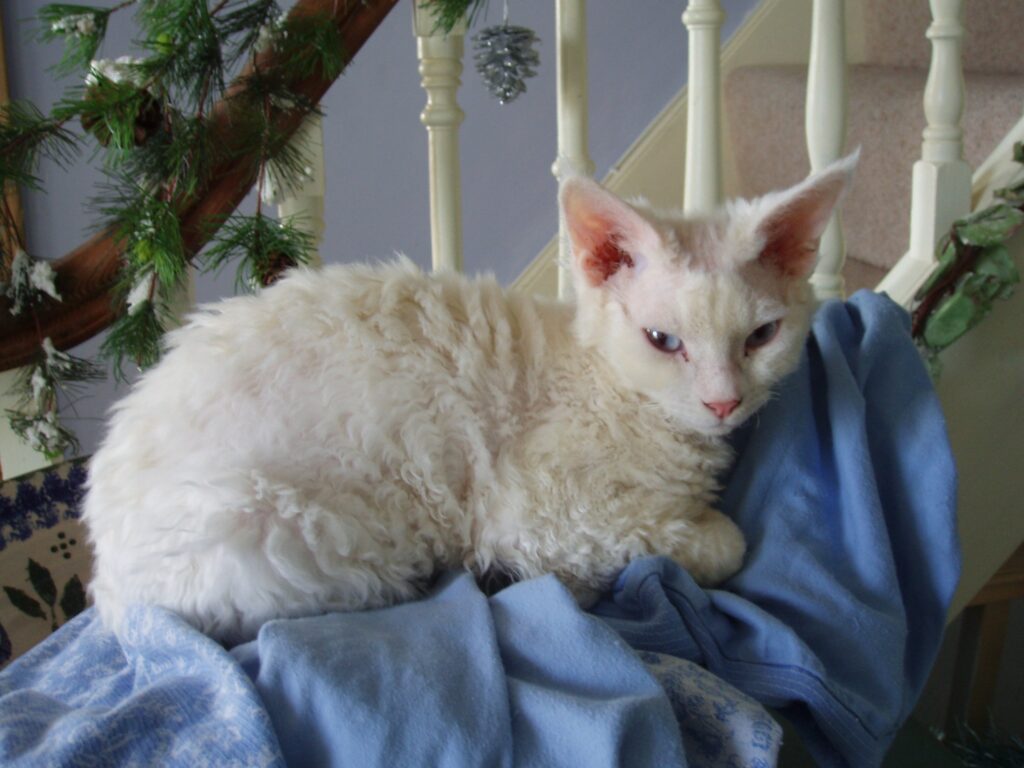
- The cat from the mine: Kirlee’s father was a curly-coated stray tom who kept close to a disused tin mine in Devon.
- The breed was born of a failed mating: the straight-coated kittens from the cross with Cornish Rexes proved the mutation was new — and only for that reason did the Devon become a breed of its own.
- Its closest genetic relative is the Sphynx, not the Cornish: the Sphynx’s hairlessness and the Devon’s curl are two versions of the same KRT71 gene.
- Nicknames: “elves”, “pixies”, “aliens” and “monkeys in cat suits”.
- Shoulder cats: the owner’s shoulder is a Devon’s standard observation post.
- Broken whiskers are normal for the breed: the short crinkled vibrissae snap because of the very mutation that produces the curl.
- Longhaired Devons exist: the longhair gene has been in the breed from the start — Kirlee was a proven carrier of it. British breeding policy permits breeding longhaired Devons and variants, but requires that their partners be non-carriers.
- A straight-coated Devon is still a Devon: kittens with ordinary coats from two Devon Rexes are registered as “variants” of the breed and are used fully in breeding.
- Every color at once: the standard admits any genetically possible color and pattern with any eye color.
- Extraordinarily affectionate and “dog-like”
- The curly coat hardly sheds
- Sharp, playful, easy to train
- Ideal for an apartment
- Cannot bear solitude at all
- Feels the cold — seeks warmth, needs warmth and clothing
- Hereditary myopathy (CMS): a DNA test on both parents is essential
- Needs plenty of attention and play
| Cornish Rex | Sphynx | LaPerm | |
|---|---|---|---|
| Weight | 2.5–4.5 kg | 3–5 kg | 3–5 kg |
| Energy | 5 | 4.5 | 3.5 |
| Apartment | 5 | 5 | 5 |
| Beginners | 3.5 | 3.5 | 4.5 |
Is the Devon Rex hypoallergenic?
Why does the Devon Rex constantly seek warmth?
What is the Devon Rex's character?
Is the Devon Rex related to the Cornish Rex?
Which tests should you ask a Devon Rex breeder for?
Why is the Devon Rex's coat uneven, with bare patches?
Why should a Devon Rex be blood typed?
CFA / TICA / GCCF / WCF / FIFe standards (Devon Rex); GCCF Devon Rex Breeding Policy; Robinson, Genetica (1969); Gandolfi et al., Mammalian Genome (2010) and PLOS ONE (2013); Abitbol et al., PLOS ONE (2015); Gandolfi et al., Animal Genetics (2015); Anderson et al., PLOS Genetics (2022); Åhman et al., Medical Mycology and Veterinary Dermatology (2007); Colombo et al., J Feline Med Surg (2012); Maddison et al., JAVMA (1990); Boeykens et al., Frontiers in Veterinary Science (2024)
For apartments · For kids · For beginners · Most affectionate · Quietest · Hypoallergenic · All rankings →