Group 5 · spitz and primitive types, section 5 · Thailand
Thai Bangkaew Dog
The only Thai breed in the FCI section of Asian spitz (standard No. 358; provisional recognition 2011, definitive 2022). A watchful, people-oriented companion with a double coat on a white ground. The standard calls the breed intelligent, devoted and easy to train, and places aggressiveness and excessive shyness among the disqualifying faults. Reserve with strangers is a breed trait, so early socialization is essential.
Height
46–55 cm · 41–50 cm
Weight
16–20 kg, 14–18 kg — not in the standard, see below
Reserved with strangers — early socialization needed
Uses its voice readily: hard in dense housing
Heavy seasonal shedding of the undercoat
Scarce outside Thailand, little breed data
Size
ToySmallMediumLargeGiant
Compatibility
Apartment · with caveatsKids · with caveatsCats · with caveatsOther dogs · with caveatsBeginners · not suitable
The Thai Bangkaew Dog is the only Thai breed the Fédération Cynologique Internationale (FCI) has placed in its section of Asian spitz. Its standard carries the number 358 and ranks among the youngest in the group: provisional recognition is dated April 14, 2011, and definitive recognition June 21, 2022. The breed is uncommon outside its homeland, which is exactly why so many retellings circulate about it — retellings that are easy to mistake for the document itself. This article is built on that split: first what the FCI standard actually says, then what the peer-reviewed veterinary literature has published about the bangkaew, and separately what people in Thailand tell about the breed. More on breeds and their care at Tvaryny.
Thai Bangkaew Dog at a glance
Thai Bangkaew Dog at a glance · 12
Characteristic
Data and figures
Country of origin
Thailand
FCI classification
Group 5 (spitz and primitive types), Section 5 (Asian spitz and related breeds), without working trial
Standard number
No. 358
Utilization under the standard
companion dog
FCI provisional recognition
April 14, 2011
FCI definitive recognition
June 21, 2022
Height at the withers (males)
minimum 46 cm, maximum 55 cm
Height at the withers (females)
minimum 41 cm, maximum 50 cm
Weight
16–20 kg (males), 14–18 kg (females) — not in the standard, see below
One caveat belongs right here, and it rarely shows up in popular write-ups. The "SIZE" section of standard No. 358 regulates height at the withers only, and it does so separately for males and for females. Weight does not appear in the document at all, and neither does life span. That is why two rows of the table above are flagged "not in the standard": those are numbers that travel through reference books, not a norm a judge measures against in the ring. If you run into a description that presents the bangkaew's weight as "per the FCI standard," the author of that description is mistaken.
The second caveat is about height. The standard gives different heights for males and females, and collapsing them into a single "41–55 cm" range will not do: the bottom figure belongs to females, the top one to males, and no individual dog actually fits that "combined" range. Read it correctly: males 46 to 55 cm, females 41 to 50 cm. Departures in either direction the standard counts as faults.
The legend of wild blood: what the document says, and what tradition says
The most popular claim about the bangkaew goes like this: wild jackal blood runs in its veins, and genetics has confirmed it. Let us pull that claim apart into two halves, because their standing is completely different.
The first half — descent from a wild canid — is written into the FCI standard. This is no internet retelling: the official FCI document itself traces the breed's pedigree to a cross between the abbot's bitch and a wild canid. But the document deliberately declines to name a species, and it states that this canid is extinct. Thai tradition puts forward two animals for the role of wild ancestor: the jackal (Canis aureus) and the red dog, or dhole (Cuon alpinus). Both species are alive today, so neither one matches the standard's phrase about an "extinct wild canid." That is not a reason to throw out the tradition — it is a reason not to pass it off as an established zoological fact.
The second half — "genetics has confirmed it" — has a different standing, and we do not sign off on it. Geneticists really have studied the breed, more than once, but those studies set out to do something else. In 2020 a team from Chiang Mai University published a paper in PeerJ on breed identification using ISSR markers: 463 dogs, 43 breeds, 18 bangkaew among them. In 2024 a group from Kasetsart University published a paper in Genes & Genomics on the bangkaew specifically: 82 dogs from various parts of Thailand, 15 microsatellite loci plus analysis of the mitochondrial D-loop. Both papers describe within-breed diversity and build a tool for identifying individual dogs; the question of hybridization with wild canids was never posed in either. That is why this article presents the monastery legend as breed tradition — a fine old one, and important to the breed itself — rather than as the outcome of DNA analysis.
The practical takeaway for a buyer is simpler than it looks. "Wild blood" in a litter ad means nothing you can check, while the results of that 2024 paper do mean something: the authors put together an optimized panel of 10 microsatellite loci, enough to identify an individual bangkaew. That is the thing about this breed you can actually verify in a lab.
Claims about "wolflike behavior" in the bangkaew call for the same caution. Observations about a more complex hierarchy or "wolfish" body language in primitive breeds circulate among dog people, but that is the impression of practitioners rather than a measured parameter, and on a breed page it belongs there as an impression.
Color: why an all-white dog is not a bangkaew
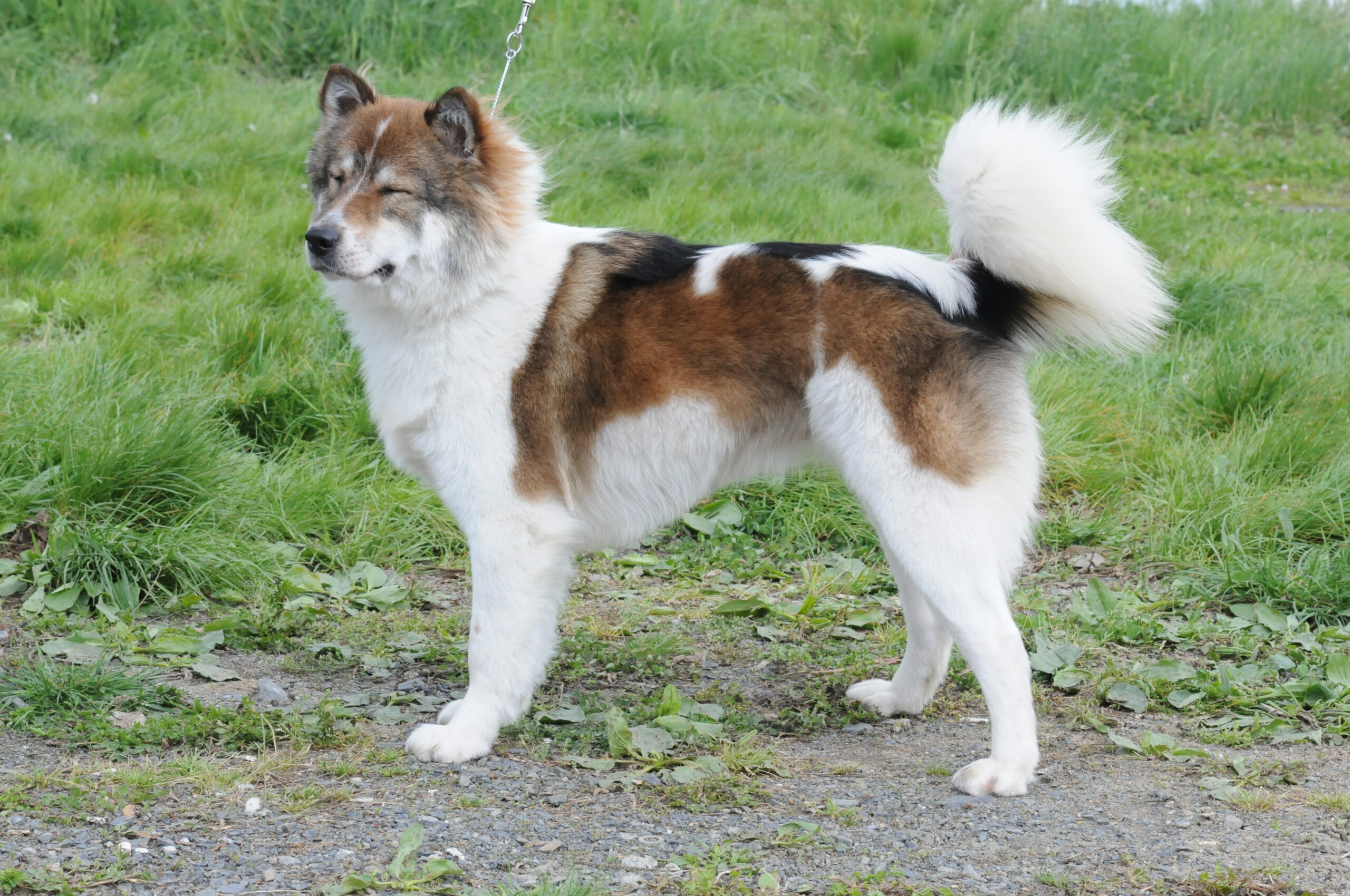
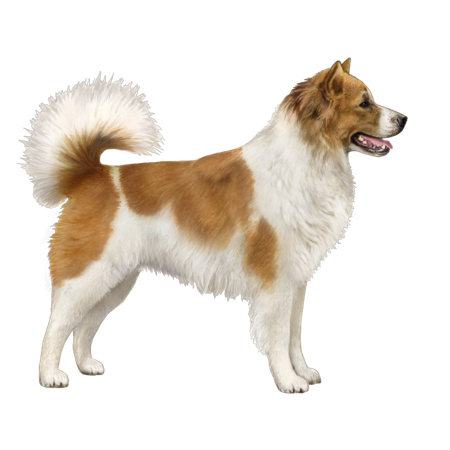
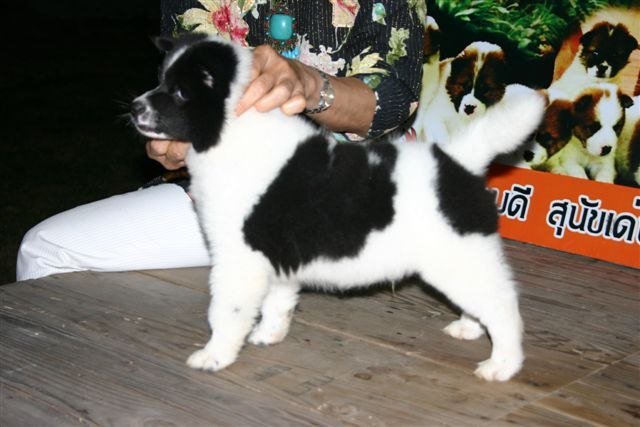
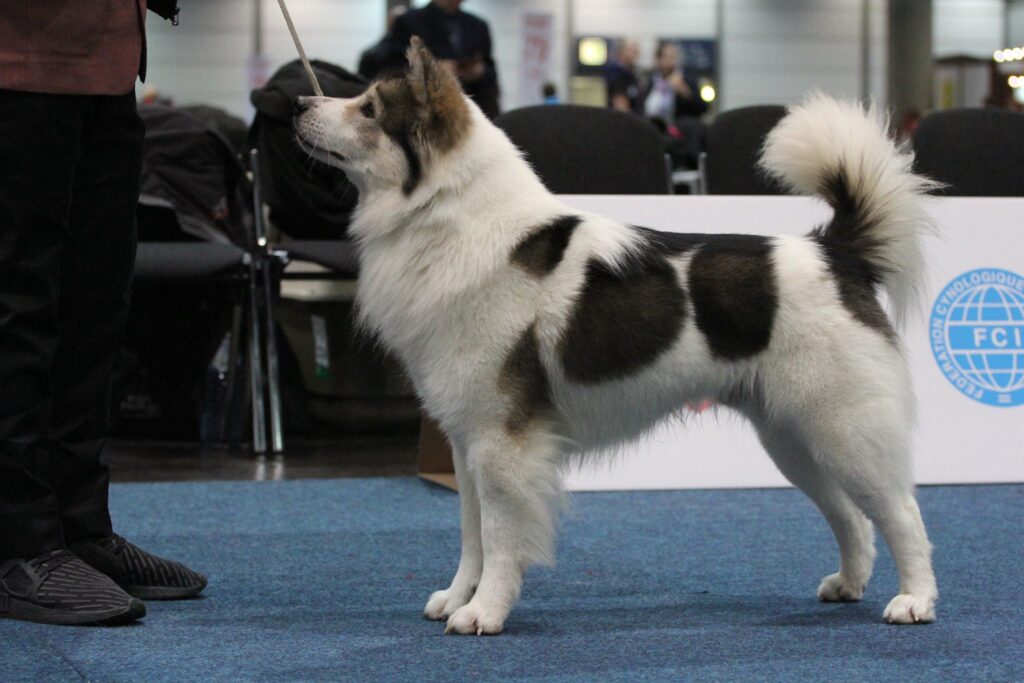
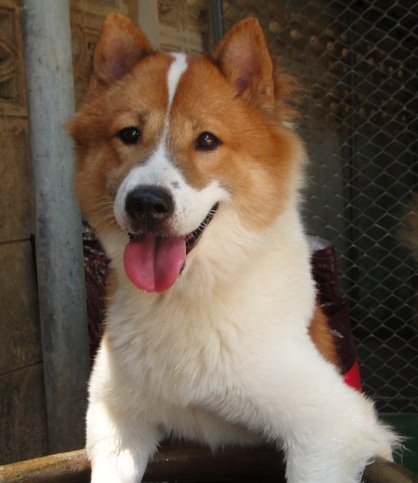
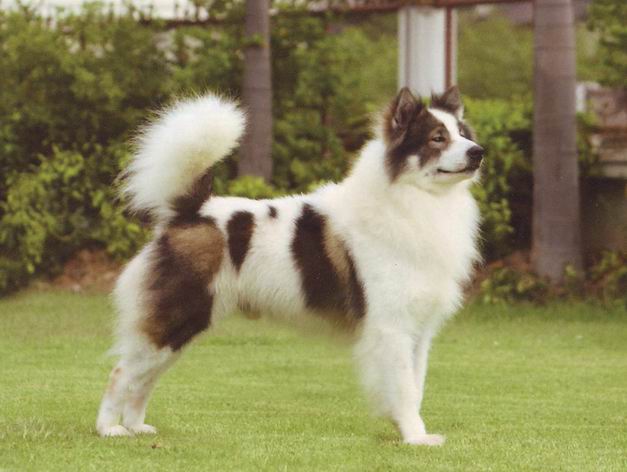
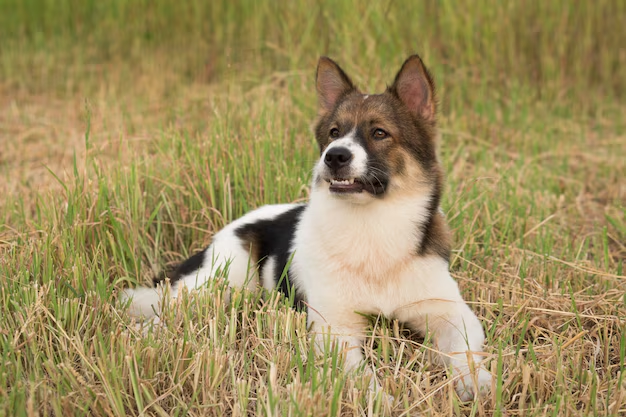
Color in this breed is not a decorative detail but one of the two grounds on which a dog most often leaves the breed ring. The standard puts it this way: a white ground with clearly defined patches. The patches may be any shade of "lemon," red, fawn, tan, or gray, with more or less blackening at the tips of the hair — enough, at times, to read as tricolor; white with solid black patches is separately allowed.
The shape and placement of the patches are immaterial — the standard does not restrict them.
Symmetrical markings on the head covering the eyes and ears are desirable, with or without a dark mask.
A white marking around the muzzle is desirable.
Slight ticking in the white is tolerated if the rest of the dog is of excellent quality.
Now for the two boundaries that popular write-ups usually mash into one line: "pure white and solid colors are not allowed." In fact the standard files these cases under different sections, and the consequences are not the same.
Case
Status under standard No. 358
All-white coat, or white with ticking only
severe fault
Solid color with small white markings
disqualification
Short or smooth coat
disqualification
Slight ticking in the white on an otherwise excellent dog
tolerated
The difference is fundamental: a severe fault is a heavy minus in the ring, while a disqualification means the dog drops out of judging. So a white dog with barely visible ticking is a bangkaew that is poor in color, whereas a red or black dog with white "socks" is a dog the standard removes from the breed ring altogether.
Faults, severe faults, and disqualification: how to read the judging
Standard No. 358 builds its assessment on three levels, and a puppy buyer benefits from seeing the whole ladder at once — it shows which traits the breed treats as fundamental. The general principle is stated at the head of the section: any departure from the description is to be considered a fault, and the seriousness of a fault should be in proportion to its degree and to its effect on the health and welfare of the dog.
Ordinary faults
Muzzle too broad; lightened nose.
Large round eyes; light eyes; large ears.
Roach back; sway back.
Tail pressed flat to the back; tail falling off to one side.
Absence of the collar and of the feathering on the back of the front legs.
Paddling, or throwing the feet outward.
Height above or below the norm.
Severe faults
Absence of more than three teeth.
All-white coat, or white with ticking only.
Disqualifying faults
Aggressive or overly shy dogs.
Any dog showing clear physical or behavioral abnormalities.
Overshot or undershot bite.
Drop ears.
Congenitally short tail; curled or kinked tail.
Short or smooth coat.
Solid color with small white markings only.
Look closely at the first line of that last list. Aggression in this breed is not a "working quality" and not a "heightened guarding drive" but grounds for disqualification, on the same footing as excessive shyness. The standard adds the usual FCI note: males must have two apparently normal testicles fully descended into the scrotum, and only functionally and clinically healthy dogs of breed-typical conformation should be bred. No specific mandatory testing of the parents — hip X-rays, eye screening, DNA tests — is prescribed by the document. That is a common feature of young, numerically small breeds, and a buyer should understand that a breeder's rigor here is that breeder's own choice, not a requirement of the standard.
The Thai Bangkaew and the Thai Ridgeback are different breeds
The two Thai breeds get confused regularly, partly because both sit in FCI group 5. Past that they share little: different sections, different utilizations, a different look, and a different show history.
The Thai Bangkaew and the Thai Ridgeback are different breeds · 6
Thai Bangkaew
Thai Ridgeback
FCI standard
No. 358
No. 338
Section of group 5
Section 5 — Asian spitz and related breeds
Section 6 — primitive type, hunting dogs
FCI provisional recognition
April 14, 2011
March 6, 1993
FCI definitive recognition
June 21, 2022
May 26, 2003
Coat
double, moderately long, with collar and feathering
short, with a ridge along the spine
Height of males per the breed standard
46–55 cm
see standard No. 338
The difference shows up even in the genetic work. In the 2020 ISSR study mentioned earlier, the breed dendrogram put the bangkaew in one cluster with the chow chow and the northern sled breeds, while the Thai ridgeback landed on a different branch. And in a 2025 paper in Biochemical Genetics devoted to the ridgeback (105 dogs from various establishments in Thailand), the authors note separately that the exchange of animals among owners preserved diversity in that breed. In short, the two Thai breeds are studied in separate papers with separate samples — and their data must not be swapped around.
Among the breeds that resemble the bangkaew visually, the one mentioned most often is the Japanese Spitz — for the white fluffy coat and the spitz type, though the bangkaew is bigger and entirely different in build. For its degree of watchfulness toward strangers the bangkaew is sometimes compared to the American Akita, which sits in the same section 5 but is considerably larger.
Interesting facts about the Thai Bangkaew
The only Thai spitz in its section. In section 5 of FCI group 5 (Asian spitz and related breeds) the bangkaew is the only breed from Thailand; its section-mates are the chow chow, the eurasier, the Japanese breeds, and the Korean jindo.
One date for the whole history. The FCI standard names 1957 as the start of targeted selection in the breed.
A province's heritage. The FCI document calls the bangkaew the heritage of Phitsanulok province, not of the country as a whole.
The tail is not a doughnut. A curled or kinked tail is a disqualifying fault, spitz looks notwithstanding.
Its own vision norm. A 2015 Thai study showed that the prolonged ERG implicit time in the bangkaew is a breed norm, not a sign of retinal degeneration.
A DNA panel. An optimized panel of 10 microsatellite loci has been developed for the breed for individual identification.
Rare away from home. Outside Thailand the bangkaew turns up far less often than even the Akita Inu.
History: the village of Bangkaew, the monastery, and the year 1957
The FCI standard is one of those rare cases where the official document retells the breed's history itself, and that is where to start. The "Brief historical summary" says the bangkaew is an old breed originating in the village of Bangkaew, in the locality of Tha Nang Ngam, Bang Rakam district, Phitsanulok province. This is central Thailand, the lowland of the Yom River — country that floods in the rainy season and that lived relatively closed off for centuries.
The pivot of the story is the Buddhist monastery of Wat Bangkaew. In the version recorded in the standard itself, the breed descends from a cross between a black-and-white local bitch belonging to the monastery's abbot and a wild canid that is extinct today. That wording is worth memorizing verbatim: the document speaks of an extinct wild canid, not of any named species.
The standard then supplies the one hard date in the breed's entire history: 1957. From that year on, breeding became deliberate — the generations we see today came out of selection from individual litters. So "a breed that formed without human intervention" is a half-truth: what formed without intervention was the native population, but the breed in the cynological sense dates itself from 1957, and that is under seventy years of purposeful work.
One more line of the standard usually gets retold inaccurately. The FCI calls the bangkaew the precious heritage of Phitsanulok province — the province, not the country. The document then adds that the dogs are widely bred in that province, and that the breed became so well known nationally that it is now bred in all parts of Thailand. The distance between "the pride of a province that became known countrywide" and "a national treasure of Thailand" is small to the ear, but these are two different statements, and the primary source carries the first one.
The scientific literature adds another detail. The Thai authors who measured normal retinal parameters in four breeds common in Thailand in 2015 write in their introduction that the Thai ridgeback and the Thai bangkaew are recognized by the Kennel Club of Thailand as the country's national dogs, and that the FCI registered the ridgeback in 1993 and the bangkaew in 2011. That lines up with the dates on the FCI site: provisional recognition of the bangkaew in April 2011, definitive in June 2022.
The breed's show history is correspondingly short. The dog you might see in a European ring under standard number 358 was, within the working memory of today's judges, a local Thai dog with no international status at all.
Appearance under standard No. 358
The standard describes the bangkaew as a square-built dog, well balanced, never cobby, with a fairly broad and deep chest. One proportion is spelled out directly: body length to height at the withers is 1 : 1, and leg length is slightly greater than chest depth. Males carry heavier bone than females. The double coat should form a collar around the neck and shoulders, and the tail should be well furnished; both features are more pronounced in males.
Skull: wedge-shaped, strong, fairly broad but not coarse, in proportion to the body. The stop is clearly defined but moderate.
Nose: black, in proportion to the muzzle. A lightened nose is a fault.
Muzzle: medium in length, broad at the base, tapering toward the end; the bridge of the nose is straight.
Lips: dry, with dark and complete pigmentation.
Jaws and teeth: strong, full dentition. Scissors bite; a level bite is acceptable.
Eyes: medium in size, almond-shaped, black or dark brown. Large round eyes and light eyes are faults.
Ears: small, in proportion to the head, set rather high but not close together; triangular, with slightly pointed tips, erect and carried forward, only slightly "hooded."
Neck: strong, muscular, blending smoothly into the shoulders, proudly carried.
Body: the back in profile is straight and level, the loin strong and broad, the croup moderately sloping, the chest fairly broad and deep, let down to the elbows, the ribs well sprung but not barrel-shaped; the belly is only slightly tucked up.
Limbs: the shoulder is moderately oblique and well muscled, the forearm straight and strong, parallel from the front; the pastern is short, with a slight slope; the feet are round, arched, and tightly knit. The thigh is well muscled, the stifle well angulated, the hock set low, and the rear pastern perpendicular to the ground from behind.
The tail: the biggest trap in bangkaew write-ups
Here is where most popular texts go wrong, and go wrong on principle. The bangkaew is a spitz, so authors reflexively write about a "tail curled in a ring over the back." Standard No. 358 asks for something else: the tail is moderately long, well furnished, thick at the base, well set on, and carried with a moderate upward curve over the back. And the list of disqualifying faults contains, on its own line, a curled or kinked tail. In other words, the very "spitz doughnut" detail that write-ups present as a breed hallmark is the thing that takes a bangkaew out of the ring. A tail pressed flat to the back, and a tail that falls off to one side, the standard treats as ordinary faults.
Gait
The standard calls the gait supple and strong, with good reach and drive, but without exaggeration: no excessive extension or speed, with the topline level and the head and tail proudly carried. Front and rear legs move parallel, and as speed picks up the feet converge toward a single track. Paddling, or throwing the feet outward, is a fault.
Character and temperament
The "Behaviour/Temperament" section of standard No. 358 runs two lines, and those two lines cut against the familiar picture of "a Thai guard dog with a low threshold of distrust." Word for word, the breed is described as watchful, intelligent, devoted, alert, and obedient; the text then says the breed is easy to train and may be somewhat reserved with strangers. The utilization in the same document is: companion dog.
This correction matters, and it cuts both ways. On one side, the bangkaew genuinely does not fling itself at visitors: reserve with strangers is built into the breed description, and turning this dog into the neighborhood park's universal favorite is not the plan. On the other side, everything written about "a born guardian that needs no protection work" has no footing in the standard: neither guarding nor protection appears among the breed's utilizations, and an outsized reaction to a stranger is a disqualifying trait, not a breed virtue.
Reserve is not aggression
Here is the practical difference. A reserved dog notices the stranger, flags them with voice or posture, keeps its distance, and comes back to its owner. A dog with a problem cannot hold that distance: it moves in, locks on, will not switch off. The first is normal in a bangkaew and has to be read correctly; the second is a reason to work with a professional, not to explain things away by "the breed." A breed with marked watchfulness forgives a socialization mistake less readily than a placid one does, and that is where the real difficulty of the bangkaew for a first-time owner lies.
In the family
Among its own people the bangkaew is a sociable, human-oriented dog that likes shared activity and does poorly living "alone in the yard." Attachment to one person runs stronger than in many groups of breeds — a frequent observation among owners of primitive and landrace dogs, though nobody has measured it as a breed norm. With children, as with any medium-sized dog, the ordinary rule applies: play under adult supervision, and the dog gets a spot the child does not enter.
Voice
The bangkaew is a breed that reaches for its voice readily. That is not a "training failure" but the way alert landrace dogs communicate, and it has to be redirected rather than forbidden: teach the dog to stop barking on cue, remove the trigger (a view of the entryway, noises in the hall), and give it enough to do. In dense city housing this will be the most noticeable difficulty of living with the breed.
Training and upbringing
The standard says it outright: "The breed is easy to train" — and obedience is listed among the breed's traits. That is one more reminder of how careful you have to be with the popular image of "a stubborn primitive no amount of drilling will move." Landrace origin affects motivation, not the ability to learn: this kind of dog asks "what for," gets bored faster with mechanical repetition, and works better once it understands the point of the exercise.
Early socialization. This is the main investment in a breed with marked watchfulness. Introduce the puppy to people, surfaces, sounds, traffic, and steady adult dogs, dosing the impressions so the puppy has time to settle in between.
Positive reinforcement. Treats, play, and praise get you further than pressure. An alert dog under pressure does not get more obedient — it gets more closed off.
Short, varied sessions. Several short sessions a day instead of one long one; change up routes, add searching and scent games.
Work the triggers. Barking at the door, reacting at the fence, guarding the bowl — these are worth catching early in this breed and unpacking with a professional before the behavior sets.
Predictable rules. The dog needs a calm, consistent owner, not a "pack leader." Rules that shift with your mood damage the relationship faster than any flaw in technique.
For its level of independence the bangkaew is often set alongside the other Thai breed — the Thai Ridgeback. The resemblance is in the type of motivation rather than in the pedigree, and there is a separate section on that below.
Pros and cons of the breed
Pros (+)
Cons (−)
A watchful, people-oriented companion.
Reserve with strangers takes early, systematic socialization.
Easy to train according to the standard.
Gets bored fast with mechanical repetition.
Compact size: male 46–55 cm, female 41–50 cm.
Reaches for its voice readily — tough in dense housing.
All-weather double coat, moderate grooming.
Heavy seasonal shedding.
Reference ERG values have been described for the breed.
The breed is scarce outside Thailand; breed health data are thin.
Caring for the Thai Bangkaew
The standard describes the coat in detail, and nearly the whole grooming routine follows from that description. The coat is double: straight, harsh guard hair and a soft, dense undercoat. Length is moderate on the body and longer around the neck and shoulders, where a collar forms — more pronounced in males. The back of the front legs carries feathering that tapers off toward the pastern; the back of the hind legs carries long hair down to the hocks. On the head and on the front of the legs the coat is short. The standard adds a separate warning: the length must never be so excessive that it hides the outline of the body.
Brushing: once or twice a week normally, daily while the dog is shedding. The working kit is a metal comb with coarse and fine teeth plus a slicker brush; pay close attention to the collar, the "pants," and the area behind the ears, where mats show up first.
Shedding: seasonal and heavy. The undercoat comes out in sheets, and in that stretch brushing is not cosmetic — it is prevention of hot spots under matted hair.
Bathing: infrequently, as needed. Frequent washing with a harsh shampoo dries out the skin; after a bath, dry the dog all the way down to the undercoat, because a damp undercoat is a ready-made medium for dermatitis.
Nails: trim about once a month if they do not wear down on their own. Overlong nails change how the foot sets down and how the joints are loaded.
Ears: erect and well ventilated, but still worth checking after walks through grass and woods — for ticks and seeds.
Teeth: the standard requires full dentition and counts the absence of more than three teeth as a severe fault; regular brushing is both hygiene and a way to notice a lost tooth early.
The claim that the bangkaew's coat is "self-cleaning" and that dirt simply falls off once dry travels through breed write-ups as a breed trait. Dried dirt falling away is typical of any harsh guard coat over a dense undercoat, and building a grooming routine on it is a mistake: in a warm, humid climate a dense undercoat is exactly where skin problems start without being noticed.
Nutrition
Feeding: what to give a Thai Bangkaew
Health and risks
Health and veterinary specifics
Frequently asked questions about the breed (FAQ) · 7
Is the Thai Bangkaew a good fit for beginners?
The standard calls the breed easy to train, so the problem is not the dog's capacity to learn. The difficulty is elsewhere: the built-in reserve with strangers takes systematic socialization from the first weeks, and mistakes at that stage are hard to undo. If this is your first dog, plan on working with a trainer from day one, not "if something goes sideways."
Is it true that a jackal was the bangkaew's ancestor?
The FCI standard does trace the breed's pedigree to a cross between the monastery abbot's bitch and a wild canid, but it calls that canid extinct and names no species. Thai tradition names the jackal or the dhole — both are alive, so neither fits the standard's wording. We present this story as breed tradition, not as the result of genetic analysis.
How tall should a bangkaew be?
Males run 46 to 55 cm at the withers, females 41 to 50 cm. These are separate ranges and must not be merged into one. Weight standard No. 358 does not regulate at all.
Do they bark much?
Yes — voice is part of the package. It is the normal way alert landrace dogs communicate, but in an apartment building it becomes the most noticeable difficulty, so a cue to stop barking is worth teaching early.
Do bangkaew get along with cats and other animals?
A puppy raised with a cat usually accepts it as family. With unfamiliar animals outdoors everything depends on socialization and training; counting on automatic tolerance toward small creatures is a bad bet in any landrace breed.
What should you check with the breeder?
Standard No. 358 prescribes no mandatory testing of breeding stock, so it all rests on the breeder. A sensible minimum: were the parents' hips X-rayed, were they seen by an ophthalmologist, are there DNA profiles, how do the parents' tail and color read against the disqualifying faults, and how are the puppies socialized before they go home.
How much walking does a bangkaew need?
This is an active medium-sized dog: two full walks a day with scent work and exercises, not a quick trip outside to potty. In hot weather the work shifts to morning and evening.
Video about the breed
FAQ
Where does the Thai Bangkaew come from?
From the village of Bangkaew in the Tha Nang Ngam locality, Bang Rakam district, Phitsanulok Province (Thailand), around the Buddhist monastery of Wat Bangkaew. FCI standard No. 358 names 1957 as the start of targeted selection.
Is it true that the ancestor of the Bangkaew was a wild jackal?
The FCI standard does trace the breed's ancestry to a cross between the monastery abbot's bitch and a wild canid, but calls it extinct and does not name the species. Thai tradition names the jackal or the dhole — both species are alive today. We present this story as breed tradition, not as the result of a DNA analysis.
Is the Bangkaew suitable for a novice?
The standard calls the breed easy to train, but the reserve with strangers demands systematic socialization from the first weeks. For a first dog it is worth planning work with a trainer straight away.
How tall is the Thai Bangkaew?
A male stands 46 to 55 cm at the withers, a female 41 to 50 cm. These are different ranges and must not be merged into one. Weight is not regulated by standard No. 358 at all.
What should the vet be warned about?
According to a Thai study from 2015, the prolonged implicit time of the electroretinogram in the Bangkaew is a normal reference parameter of the breed, not a sign of retinal degeneration. Checking it against the general canine norm can produce a false conclusion.
Is the Bangkaew really a born guardian?
The utilization of the breed under the FCI standard is: companion dog; neither guarding nor protection appears among the utilizations. Alertness and reserve with strangers are proper to the breed, while aggressiveness and excessive shyness are disqualifying faults.