A charming clown of a companion with a huge heart, made for an apartment: affectionate, devoted, excellent for the home and for low-activity people. The flip side of the flat face is serious breathing problems (BOAS), overheating and snoring, so heat and exertion are dangerous.
The Pug is a breed often described by the Latin phrase "multum in parvo," which means "a lot in a little." This refers to both their compact yet muscular build and the huge personality hidden inside that small body. Regardless of training and commands, he will undoubtedly try to snuggle up on his owners' bed. Once you make peace with the warm, soft ball of fur next to you, you'll fall asleep to the gentle snoring of this stubborn little guy. He would never trade a treat for a walk and will never refuse to snack on something tasty. Read more on Tvaryny.
The Pug: A Brief Breed Overview and Characteristics
The Pug: A Brief Breed Overview and Characteristics · 6
Characteristic
Stats for Males
Stats for Females
Country of Origin
Great Britain / China (patronage)
Great Britain / China (patronage)
Weight
14–23 lbs (6.5–10.5 kg)
13–19 lbs (6.0–8.5 kg)
Height at Withers
12–14 inches (30–36 cm)
10–12 inches (25–30 cm)
Lifespan
12–15 years
12–15 years
Coat Type
Short, smooth, dense
Short, smooth, dense
FCI Group
9 (Companion and Toy Dogs)
9 (Companion and Toy Dogs)
What Does a Pug Look Like: Detailed Description
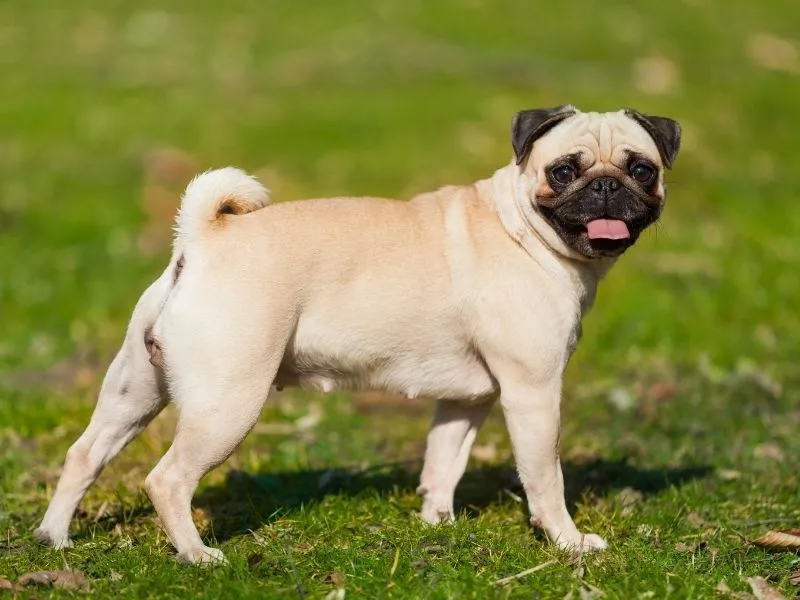
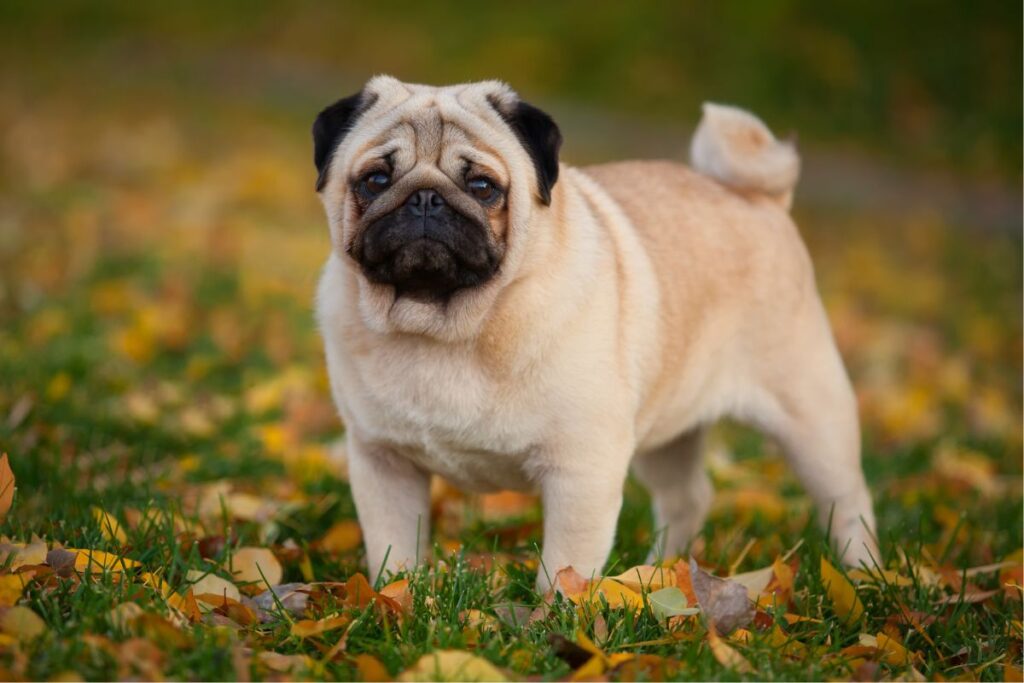
The Pug is a short, sturdy dog whose appearance replicates massive forms in a small size. He should look square and cobby. This isn't a "chubby" dog, but a muscular athlete, just very compact.
Head and Muzzle
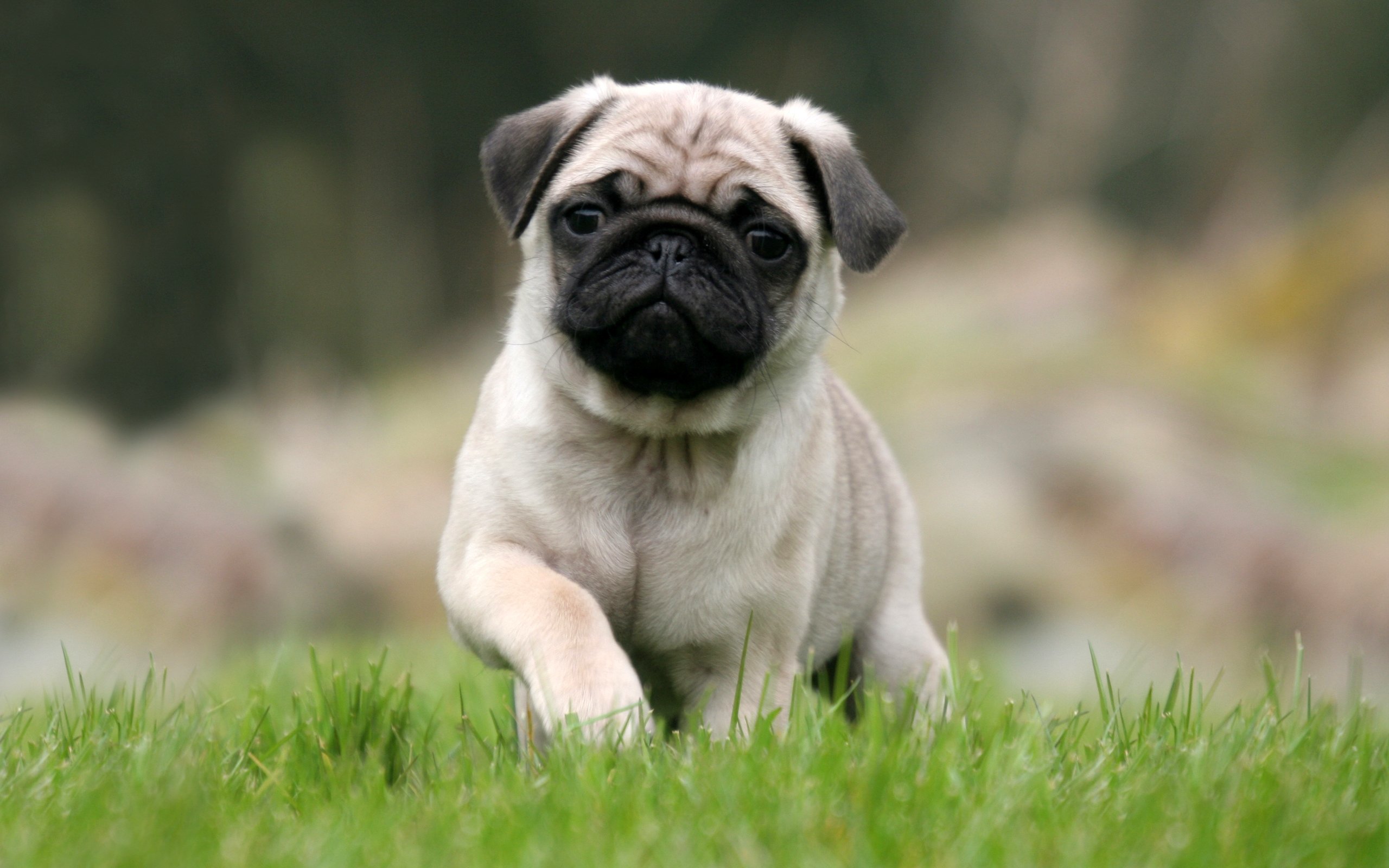
The first thing that catches the eye is the deep skin folds on the Pug's wide forehead, which should be distinct and deep, but not excessive so as to interfere with vision. A Pug's eyes are a separate universe: dark, round, quite large, with an indescribable gentle longing and a wet shine. A Pug's gaze is always full of the question, "Isn't it time for us to eat?"
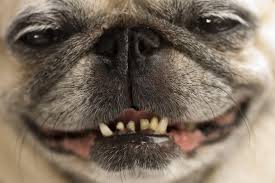
The muzzle is short, blunt, square, and not upturned. A characteristic feature is a slight undershot jaw (the lower jaw protrudes slightly forward), which adds a certain seriousness to the facial expression. If you like this type of look but are looking for a dog with a slightly different temperament or size, it is worth paying attention to the French Bulldog, which has a similar skull structure but upright ears.
Body and Coat
The Pug's neck is thick, strong, and slightly arched, resembling a crest, which allows them to proudly hold their heavy head. The smooth tail curls into a tight ring (ideally a double ring) and lies flat against the back. The rear part of the body sways slightly while walking, creating the signature "Pug roll."
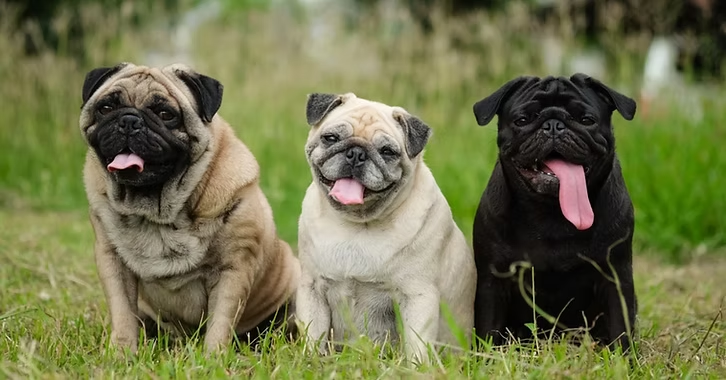
The short, shiny coat covering the little guy's athletic body is very soft to the touch. The breed standard recognizes several colors:
Silver;
Apricot;
Fawn;
Black.
Light-colored dogs must have a clearly defined "mask" - black coloring on the muzzle, ears, on the forehead in the shape of a diamond, and moles on the cheeks. A dark stripe ("trace") running from the back of the head to the tail along the spine is also desirable.
Interesting Facts About Pugs
Napoleon's Wife and Her Pug. Josephine Bonaparte had a favorite Pug named Fortune. When Josephine was imprisoned, she passed secret notes to Napoleon hidden under the collar of her dog, who was the only one allowed to visit her. Rumor has it that on their wedding night, Fortune bit Napoleon on the leg.
Secret Society. In the 18th century, Catholic Masons (whom the Pope forbade from being Masons) created the Order of the Pug. They chose this animal as a symbol of loyalty and reliability.
A Group of Pugs. In English, a group of Pugs is called "a grumble of pugs." This very accurately describes the sound accompaniment when several such dogs gather.
Movie Stars. Pugs often star in movies. The most famous movie Pug is Frank from the film "Men in Black."
History of the Breed: From Emperors to Modern Day
The history of the Pug is ancient and shrouded in legend, and the exact genetic family tree of these cute creatures is still not known for certain. Most researchers lean towards the idea that the Pug's homeland is Ancient China. The first mentions of "short, square dogs with a short muzzle" date back to the Shang Dynasty (1700s BC). Back then, they were called "Lo-Sze."
These dogs lived in luxury inaccessible to mere mortals. Imperial Pugs had their own servants, guards, and even their own chambers. The Chinese considered the wrinkles on a Pug's forehead to be an imperial sign, seeing in them the outlines of hieroglyphs carrying secret mystical meaning. It is assumed that they share a common ancestor with Pekingese and Japanese Chins, which is easy to agree with given the appearance of these three little guys. These breeds were formed over centuries exclusively as decorative companion dogs.
In the 16th century, with the development of trade links, Pugs traveled from Asia to the Netherlands with merchants of the Dutch East India Company. Here they received the European name "Dutch Mastiff" (due to the skull structure resembling large mastiffs) and became the symbol of the Royal House of Orange. Legend has it that a Pug named Pompey saved the life of Prince William I by waking him with barking during an assassination attempt at night.
Later, when William III of Orange ascended the English throne, he brought his favorites to Great Britain. It was English breeders who gave the breed the look we know today, making them even stockier and flatter. The sound of the name "Pug" (possibly from the Old English pugg - a playful little devil or monkey, or from the Latin pugnus - fist) links them to their compact shape or funny, monkey-like expressions.
Character Traits and Temperament
Pugs have an extremely friendly and affectionate character, thanks to which they settle in well with any family. This is not a dog that will guard the yard or hunt. His mission is to be nearby. Pugs often act as the owner's "shadow": where you go, he goes. To the kitchen, the bathroom, the bed. If you value personal space, a Pug will teach you to share it.
The playful little guy will gladly spend time with children, patiently tolerating their antics (within reason, of course). But the greatest happiness for him will be a family evening on the couch next to his owner. If you are looking for a breed that combines the same love for comfort but with more refined spaniel manners, look at the Cavalier King Charles Spaniel or his close relative, the King Charles Spaniel. Unlike active terriers, the Pug has a balanced psyche.
This very "domestic" pet requires a lot of affection and attention, so if you stop petting your Pug and giving him time, he may resort to jealousy or even fall into depression. They do not like to be left alone for long periods. The calm temperament of these communicative and friendly dogs makes them excellent companions even for less active owners and seniors.
Training and Education: How to Deal with a Stubborn Guy?
Cute little Pugs are quite stubborn creatures, so make sure the dog immediately accepts the owner's leadership and authority. They are smart, but often ask themselves the question: "Why should I do this if I can just lie down?" Training is recommended to begin at six months of age or even earlier (from the first days of the puppy's appearance in the house), and conduct classes in short sessions of 5–10 minutes twice a day - before meals.
Pugs react badly to drilling and shouting. They may get offended, withdraw into themselves, and ignore you. Encourage the little guy with positive reinforcement and verbal praise, eventually moving away from the frequent use of tasty treats so as not to overfeed. It is very important to socialize the puppy: introduce him to other dogs, people, street sounds. This will help raise a confident dog.
The Toilet Issue. Potty training a Pug may take longer than with other breeds. Due to anatomical features, it is diffcult for them to hold it for a long time. Be patient and do not scold the little guy for "accidents" if he has not understood how to properly ask to go out.
Pros and Cons of the Breed
Before getting a dog, it is important to weigh all the pros and cons. The Pug is not the ideal dog for everyone.
Pros (+)
Cons (-)
Ideal for apartments, doesn't need much space
Sheds heavily all year round
Does not require long physical exertion
Snores, wheezes, makes various sounds
Very affectionate, loves children
Prone to many diseases and allergies
Almost never barks without reason
Hard to tolerate heat and cold
Funny appearance that lifts the mood
Stubborn in training
How to Properly Care for a Pug?
Of course, the Pug, sensitive to climate fluctuations, requires exclusively indoor living. He cannot live in a doghouse or an enclosure. Caring for a Pug is a daily ritual that ensures him a comforatble life.
Fold Hygiene
The main object of care is the folds on your pet's face. Inside them, it is warm and damp, dust, tears, and food debris get in there - an ideal environment for bacteria. Every week (and daily in hot weather), carefully clean the skin under the dog's wrinkles with a cotton pad and a special lotion or chlorhexidine. After cleaning, be sure to wipe the fold dry! This way you will save him from the risk of inflammation and fungus, as well as possible bad smell.
Coat Care and Shedding
Don't let the short coat fool you - Pugs shed, and they do it intensely. Owners joke that a Pug has only one shedding period per year - lasting 365 days. Brush the little guy weekly or more often with a rubber mitt or a natural bristle brush (use a Furminator carefully so as not to damage the delicate skin). Pugs usually love this procedure, perceiving it as a massage.
You should not bathe a Pug often, about once a month or as it gets dirty, using hypoallergenic shampoos. After bathing, thoroughly dry the dog, especially in places where the coat fits tightly, to avoid the "greenhouse effect."
Nutrition
Nutrition: Menu and Weight Control
Health and risks
Health: Typical Diseases and Weak Points
Frequently Asked Questions (FAQ) · 3
Do Pugs snore a lot?
Yes, most Pugs snore in their sleep, and sometimes even while awake (grunting). This is due to the structure of their nasopharynx. If the snoring becomes too loud or the dog gasps for air, this is a reason to see a veterinarian.
Can a Pug be kept outside?
Absolutely not. The Pug is a decorative indoor breed. In winter, he will freeze in a matter of minutes, and in summer he will overheat. In addition, they are emotionally dependent on humans.
Do they get along with cats?
Yes, Pugs are usually very peaceful and get along well with other pets, including cats. The main thing is to make sure that the cat does not damage the Pug's large eyes with its claws.
Video About the Breed
FAQ
Why do pugs snore and breathe heavily?
Because of the flat face (brachycephaly) the airways are shortened — this is BOAS. Snoring, breathlessness and intolerance of heat are typical signs; in severe cases surgery is needed.
Can you walk a pug in the heat?
No — the pug overheats easily, even to a life-threatening degree. Walk early morning or evening, avoid exertion and stuffiness, and always carry water.
Is the pug suitable for an apartment?
Yes — it is one of the best apartment dogs: quiet, affectionate, with no need for much exercise.