

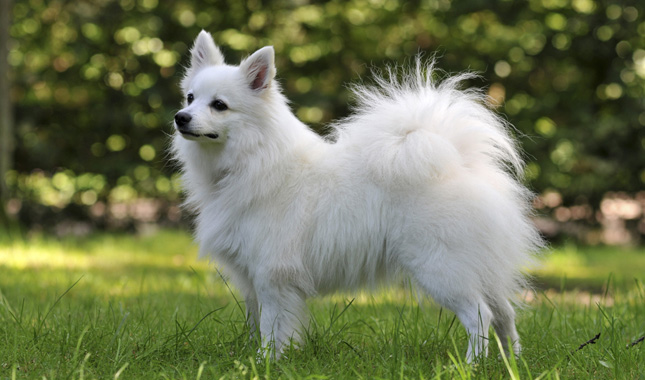
| Height | 25–30 cm |
| Weight | 4–6 kg |
| Lifespan | 14–16 years |
| FCI group | 5 · spitz |
| Origin | Italy |
Exact ratings
- Primary lens luxation (PLL)
- Luxating patella
- Eye conditions
- Dental disease
- Generally a healthy, long-lived breed
A quality food, with weight control (compact — easy to overfeed). The dense coat needs regular brushing; look after the teeth.
The Volpino Italiano is a small dog belonging to the European Spitz family and is a true point of pride for Italian dog breeding. Sometimes referred to as the Florentine Spitz or the “dog of the Italian palaces,” this breed is unfortunately quite rare today, both in its homeland and around the world. However, in recent years, there has been a slow but steady resurgence of interest in these dogs. They are loved because, despite their small size, they possess excellent watchdog qualities and the big personality of a large dog trapped in a small body. Read more on Tvaryny.
Volpino Italiano: A Brief Breed Overview
| Feature | Data |
| Country of Origin | Italy |
| FCI Classification | Group 5 (Spitz and primitive types), Section 4 (European Spitz) |
| Year of Recognition | 1903 (first standard), recovery – 1965 |
| Life Expectancy | 12-15 years (often reaching 16) |
| Height (Males) | 10.5-12 inches (27-30 cm) |
| Height (Females) | 10-11 inches (25-28 cm) |
| Weight | 9-12 lbs (4-5.5 kg) |
| Coat Type | Long, thick, straight, with a dense undercoat |
| Main Colors | White (classic), Red (rusty), rarely Champagne |
History of the Breed
The Volpino Italiano is a breed with incredibly ancient roots, boasting a history that spans millennia. This isn’t just another decorative lapdog; it is a direct descendant of the European Spitz that existed in the central region of our continent as far back as the Bronze Age. Images of simlar dogs have been discovered on Etruscan art and ceramics dating back to the 9th century BC. This means the ancestors of the modern Volpino were running around the Apennine Peninsula even before the rise of the Roman Empire.
The uniqueness of the Volpino lies in its universal appeal across social classes. In Italy, it was known as the dog of “the Quirinal and the carts.” This implies the breed was equally popular in the luxurious palaces of Roman nobility and in the yards of ordinary farmers and teamsters. Peasants valued them for their incredible attentiveness. While the large Mastiffs slept or rested, the small Spitz would always timely warn of approaching strangers with loud barking, waking the large guards. This tandem work was key to farm security.
Interesting Historical Fact: It is known that the great Renaissance sculptor, painter, and poet Michelangelo Buonarroti owned a dog of this very breed. There are accounts that a small Spitz was the master’s faithful companion while he worked on painting the Sistine Chapel, sitting on a cushion and watching the creator.
The breed “Volpino Italiano” received official recognition at the beginning of the 20th century. In 1901, the breed was entered into the studbook, and the standard was approved in 1903. However, after World War II, for unknown reasons—perhaps due to economic hardship or a trend toward foreign breeds—interest in these dogs began to fade rapidly. The breed found itself on the brink of total physical extinction.
The situation became critical in 1965 when only five purebred dogs were recorded in the Italian studbook. The breed was effectively considered extinct. Salvation came thanks to the enthusiasm of cynologists Enrico Franceschetti and Solaro. As part of the “Lanci” (Rebirth) project, they began searching for typical representatives of the breed that had survived on remote farms and in villages where the fashion for “city” dogs had not influenced local traditions.
They selected robust and healthy dogs that retained their working qualities and exterior. The population was saved literally at the last moment. Unfortunately, there are currently not many representatives of this breed in the world—estimates suggest about 3,000 to 4,000 individuals. However, interest in these wonderful Volpino Italianos is beginning to revive, with kennels appearing not only in Italy but also in Scandinavia, the US, and the UK.
What Does the Volpino Italiano Look Like?
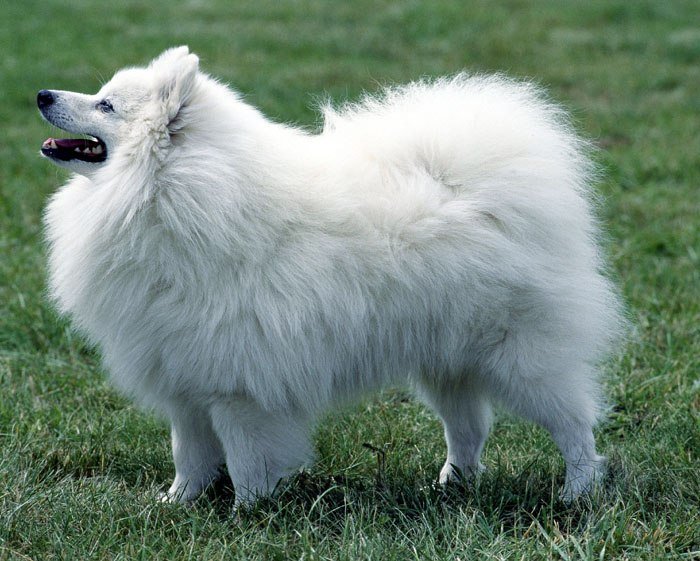
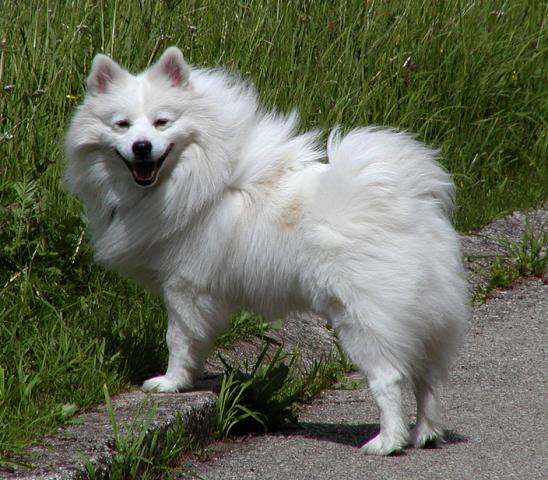
The Volpino Italiano is a compact dog with a square build. This means the dog’s height at the withers is almost equal to the length of its body. Such a build ensures harmonious movement and the typical “collected” look of the Spitz. It is important to note that this is not a toy breed with signs of degeneration, but a scaled-down copy of a normal dog with a sturdy bone structure.
Head and Muzzle: The head is pyramid-shaped, with the muzzle length slightly shorter than the skull length (a ratio of approximately 4:6). The skull is rounded, the forehead slightly domed, and the stop (transition from forehead to muzzle) is quite clearly defined. The bridge of the nose is straight, and the muzzle itself is pointed, giving it that characteristic “foxy” expression. The lips fit tightly to the teeth, have black pigmentation, and the corners of the mouth do not droop.
Eyes and Ears: The eyes are medium-sized, wide-open, and round. The eye color is dark ochre, giving the gaze depth and intelligence. A characteristic feature is the black rims around the eyes, creating an “eyeliner” effect. The ears are set high, close together, triangular, and always stand vertically. The ear length is roughly half the length of the head.
Body: The neck is of medium length, carried proudly, and covered with a thick ruff. The back is straight, and the loins are short and strong. The chest is deep, reaching the level of the elbows, and the ribs are well-sprung. The belly is moderately tucked up, but not as severely as in greyhounds. The tail is set high, carried over the back, and curls in a ring. The tail is extremely bushy with long hair.
Limbs: The front and rear legs are straight, parallel to each other, with moderate angulation. The feet (“cat feet”) are small and oval with tightly closed toes. Pads and claws must be black (on white dogs, this creates a beautiful contrast).
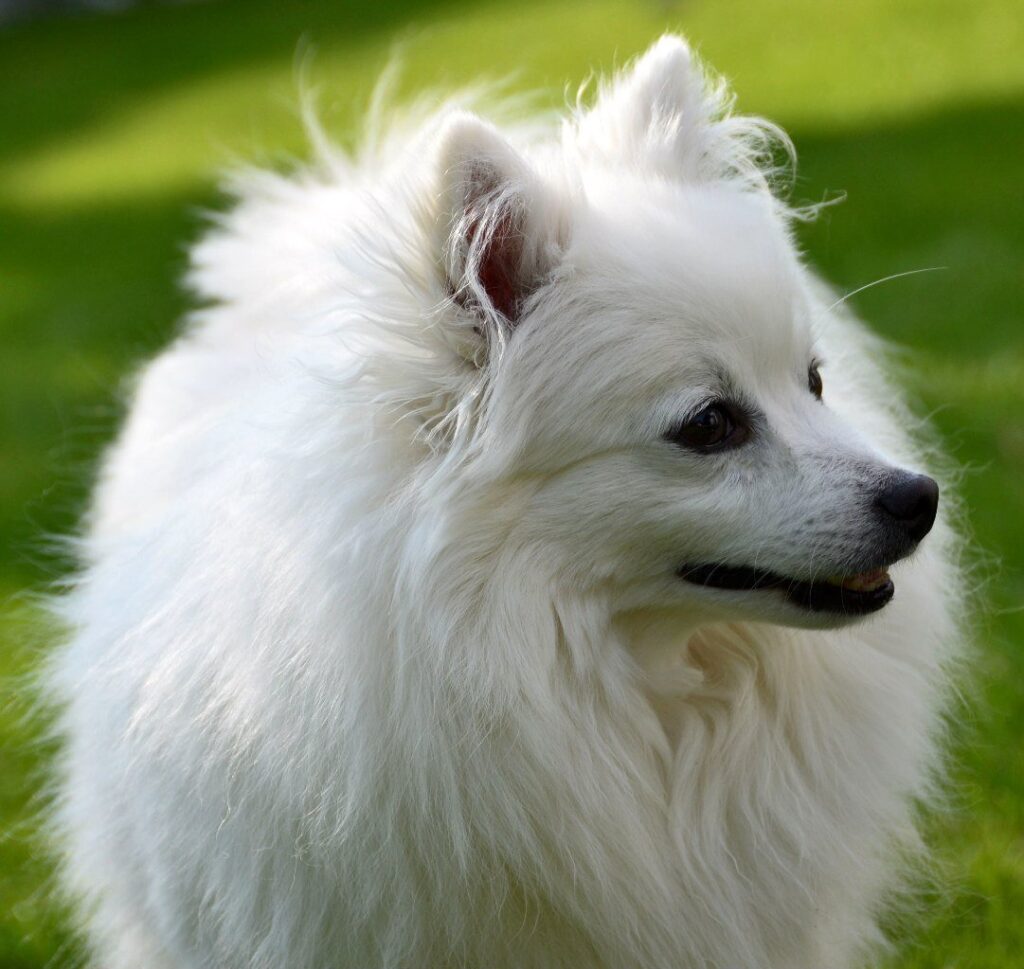
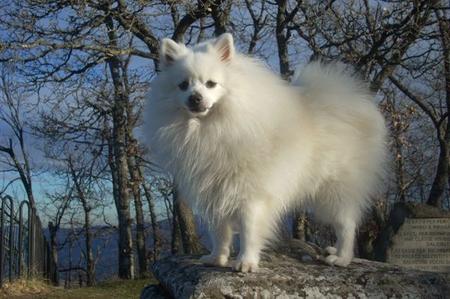
Coat and Color: The coat is the Volpino’s main adornment. It is very thick, long, straight, and harsh to the touch (guard hair). Thanks to the dense undercoat, the guard hair does not lie flat against the body but stands off, enveloping the dog like a muff. On the neck, the hair forms a lavish collar. The texture of the coat should be glassy and shiny.
Permissible colors:
- Solid White: The most common and valued for its “milky” whiteness.
- Solid Red: Resembles the color of a deer; less common but very striking.
- Champagne: A pale fawn color is accepted but considered less desirable.
It’s important not to confuse the Volpino with similar breeds. For example, the Pomeranian has a more “toy-like” appearance and is often smaller, while the Japanese Spitz (Nihon Supittsu) is usually larger than the Volpino and comes exclusively in white.
Character: Temperament and Behavior
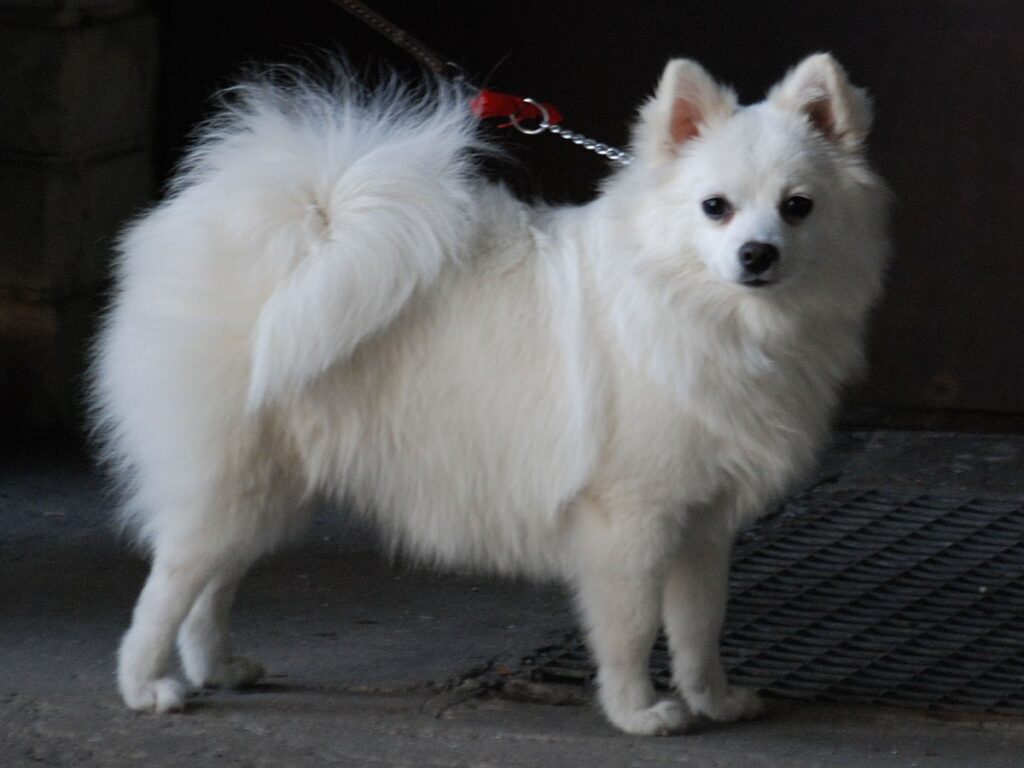
Volpino Italianos have an extremely lively, sanguine character. These are not couch potatoes, but fully-fledged personalities with big egos. They are energetic, cheerful, and vocal dogs that always want to be at the center of the action. Psychologically, Volpinos become very strongly attached to their owner and the whole family, sometimes even showing jealousy.
Watchdog Qualities: This is a key feature of the breed. They treat strangers with innate suspicion. They aren’t aggressive without cause, but they are ready at any moment to raise the alarm with loud barking. If you are looking for a dog that will greet guests silently, the Volpino is not for you. They bark at the doorbell or suspicious sounds in the hallway, and this is normal breed behavior that should be corrected rather than completely suppressed.
In terms of behavior, they are sometimes compared to other vigilant breeds. For example, their activity levels remind people of the Miniature Pinscher, which is also known for its bravery and energy.
Volpinos get along wonderfully with children, especially if the kids respect the dog and don’t treat it like a toy. Volpinos are tireless in play and can chase a ball for hours. However, given their small size, you need to ensure very small children don’t accidentally injure the dog. With other animals (cats, dogs), Volpinos coexist well if socialized from puppyhood, although they may try to dominate larger dogs.
Intelligence: These dogs are very smart, but not always “obedient” in the classical sense like a shepherd. They might think about a command before executing it. You need to negotiate with them, not drill them. Of all the Spitz breeds, the Volpino Italiano is perhaps the most active and emotional.
Pros and Cons of the Breed
| Pros (+) | Cons (-) |
| Compact size, ideal for apartments and travel. | Tendency toward frequent and loud barking (needs control). |
| Robust health and longevity. | Intense shedding; coat requires regular care. |
| Devotion to family and love for children. | Can be stubborn during training. |
| Excellent guardin qualities (living alarm). | Tolerate loneliness poorly; may howl or destroy things out of boredom. |
| Striking appearance, no trimming needed. | Rare breed; puppies are hard to find and expensive. |
Health: Typical Diseases and Prevention
The Volpino Italiano descends from rural farm dogs, thanks to which it has retained a “rustic,” very robust health. The breed is sturdy overall but not problem-free — the cautions are listed below. They have excellent immunity and are resistant to colds.
However, future owners should be aware of specific nuances characteristic of small Spitz breeds:
- Primary Lens Luxation (PLL): A genetic eye disease that can occur in the breed. Responsible breeders perform DNA tests on parents before breeding to rule out the birth of affected puppies.
- Patella Luxation: A typical problem for all small breeds. It is important not to overload the puppy’s joints with jumps from high couches while the skeleton is forming.
- Tartar: Due to the tight spacing of teeth in a small jaw, Volpinos are prone to plaque and tartar formation. Tooth brushing should become routine.
Also, don’t forget to vaccinate your dog on time and treat for parasites (ticks, fleas, worms), as their thick coat is an ideal hiding place. If you suspect your pet’s health is deteriorating (lethargy, refusal to eat), contact a specialist immediately.
How to Care for the Volpino Italiano’s Coat?
Caring for the Volpino’s luxurious coat requires time but is not overly complicated if done regularly. This dog adapts very quickly to life in an apartment, but its hair will be everywhere if you don’t make friends with a comb.
Brushing: The coat on these dogs is long and harsh; it is not as prone to matting as soft hair, but the undercoat can get compacted. You need to brush the dog often—at least 2-3 times a week, and daily during shedding seasons (spring and fall). Use a slicker brush and a metal comb with long teeth. You should get the dog used to this process from early puppyhood, rewarding the little one with a treat.
Trimming – TABOO! Trimming dogs of this breed is categorically forbidden (except for hygienic trimming of the paws and the area under the tail). After trimming, especially short cuts, the coat structure changes—it becomes cottony and soft, and it stops protecting the dog from moisture and dirt. Moreover, clipping a Spitz “like a lion” or “like Boo” disrupts thermoregulation, which can lead to heatstroke in summer and hypothermia in winter. The Volpino’s coat works like a thermos.
Bathing: Frequent washing of the Volpino Italiano is not recommended. Doing so once every 1-2 months or as needed is sufficient. After bathing, the coat suffers and the skin dries out as the natural protective layer of oil is washed away. Representatives of this breed are distinguished by their cleanliness and rarely get dirty; their harsh coat has self-cleaning properties (mud dries and falls off). If you decide to wash the dog, be sure to use special moisturizing shampoos and volumizing conditioners.
Nail care is also important. Lightweight dogs don’t wear them down enough on asphalt, so they need to be trimmed once a month. Eyes should be wiped daily to remove tear stains, which are particularly visible on white fur.
Training and Socialization

The Volpino Italiano lends itself perfectly to training but requires the right approach. Even an attentive beginner can handle its upbringing if armed with patience. Thanks to their quick wits, these dogs understand instantly what the owner requires of them, but they may test the boundaries of what is permitted.
Interestingly, dogs brought from Italy begin to understand commands in a new language extremely quickly—this testifies to their high adaptability. During lessons, the owner must be persistent and consistent, but affectionate. Harsh methods, yelling, or physical punishment are absolutely unacceptable; the Volpino will withdraw into itself or begin to defend itself. These dogs react negatively even to a raised voice. The best method is positive reinforcement (clicker training, treats, toys).
Physical Activity: The Volpino Italiano does not require exhausting marathons like a Husky. They adapt to the owner’s rhythm of life. They can happily lie on the couch all day if you are sick, and this won’t harm their health. But you shouldn’t abuse this. They will never refuse long walks and fun games in the fresh air. They also show excellent results in agility courses, specifically in the “mini” category. Their speed and maneuverability are impressive.
An important aspect of socialization is meeting other dogs. It is worth introducing the puppy to different breeds so that it doesn’t fear big dogs. For example, the company of a calm Norwegian Buhund (another relative from the Spitz group) would be beneficial for building self-confidence.
Feeding the Volpino Italiano: Key Recommendations
When it comes to food, Volpino Italianos are generally not picky, but they have an excellent appetite, which can lead to obesity. Excess weight for such a small dog is critical for the heart and joints. Breeders recommend feeding them ready-made super-premium or holistic dry food formulated for small breeds.
Advantages of dry food:
- Balance of vitamins and microelements.
- Mechanical cleaning of teeth by kibble (tartar prevention).
- Convenience of dosing.
The food composition should contain only high-quality meat (lamb, turkey, salmon), and not “meat by-products” of unknown origin. Avoid foods with high corn and wheat content, which often cause allergies in white dogs (this shows up as redness on the paws and eyes). If the food doesn’t list meat as the first ingredient, it is a poor choice.
If you choose a natural diet, the ration should consist of:
- Lean meat (beef, rabbit) – 60-70%.
- Vegetables (zucchini, carrots) – 20%.
- Grains (rice, buckwheat) – 10-15%.
- Fermented milk products (cottage cheese).
If your pet eats high-quality ready-made food, it does not need additional vitamin supplements. Hypervitaminosis can be more dangerous than a vitamin deficiency.
Comparison with Other Spitz Breeds
People often hesitate between several breeds. Here is a short comparison to help you:
| Breed | Size | Character | Coat |
| Volpino Italiano | Medium (up to 12 in) | Energetic guard, very loud | Harsh, straight |
| Pomeranian | Miniature (up to 9 in) | Glamorous, decorative, capricious | Softer, more undercoat |
| German Spitz Small | Similar (9-11.5 in) | Calmer, classic companion | Similar structure |
| Japanese Spitz | Slightly larger (12-15 in) | Silent (barks rarely), reserved | White only |
Interesting Facts About the Volpino Italiano
- The name “Volpino” comes from the Italian word “volpe” (fox), which perfectly describes the expression on their muzzle.
- There is a legend that the barking of a Volpino once saved Rome from a surprise enemy attack, warning the guards earlier than the geese did.
- Queen Victoria, known for her love of Pomeranians, was actually enchanted by the Volpino during a visit to Florence in 1888. She even brought several dogs back to England, although her heart was later completely taken by the orange Poms.
- In the US, this breed is sometimes confused with the American Eskimo Dog (Toy size), although they are genetically different.
Frequently Asked Questions (FAQ)
Do they shed a lot?
Yes, Volpinos shed. Seasonal shedding (twice a year) is very intense; there will be a “snowstorm” of fur all over the apartment. At other times, with regular brushing, the amount of hair is moderate.
Are they suitable for allergy sufferers?
No, the Volpino is not a hypoallergenic breed. Their coat, saliva, and dander can trigger allergies.
Can they be kept outside in a doghouse?
No, absolutely not. Despite the thick coat, this is a companion dog. Without constant contact with humans, they suffer psychologically and become wild and excessively noisy. Furthermore, their size does not allow them to effectively defend themselves against predators or large stray dogs.
Video About the Breed
- Affectionate, devoted, long-lived
- Compact, ideal for an apartment
- A brave "doorbell" watchdog
- Easy to teach, eager to please
- Inclined to bark
- The dense coat needs brushing
- Dislikes being alone
- Needs early socialization
| Pomeranian | Japanese Spitz | German Klein Spitz | |
|---|---|---|---|
| Height | 18–22 cm | 25–40 cm | 23–29 cm |
| Energy | 3 | 3.5 | 3 |
| Apartment | 4 | 4 | 4 |
| Beginners | 3.5 | 3.5 | 3.5 |
How does the Volpino differ from the Pomeranian?
Is the Volpino good for an apartment?
Is the Volpino Italiano healthy?
FCI Standard No. 195 · The Kennel Club
For apartments · For kids · For beginners · Active · Smartest · Hypoallergenic · All rankings →