

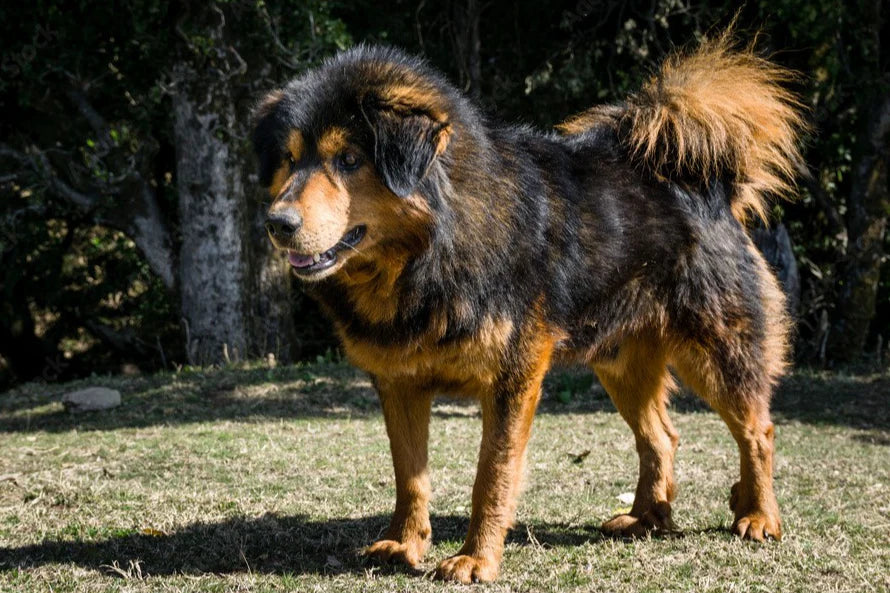
| Height | 61–76 cm |
| Weight | 25–45 kg |
| Lifespan | 10–12 years |
| FCI group | not recognized by the FCI (Himalayan landrace) |
| Origin | Himalayas (India / Nepal) |
Exact ratings
- Sturdy overall — but with the cautions listed below
- Hip dysplasia
- Gastric torsion (deep chest)
- Ear infections (drop ears)
- Grooming the dense coat prevents matting
A moderate, quality diet for a large working breed, with weight control; feed small portions (bloat risk). Plenty of space and moderate exercise; regular brushing of the dense coat.
The Himalayan Sheepdog — the Bhotia in Uttarakhand and Nepal, the Gaddi Kutta in Himachal Pradesh — is a landrace livestock guardian from the highest working pastures on earth. No kennel club made this dog. Snow leopards, wolves, and centuries of migrating flocks did. If you run stock in wolf or coyote country you already understand the job description; if you live on a cul-de-sac, this article is mostly going to talk you out of it. Learn more on Tvaryny.
Himalayan Sheepdog: A Brief Breed Overview
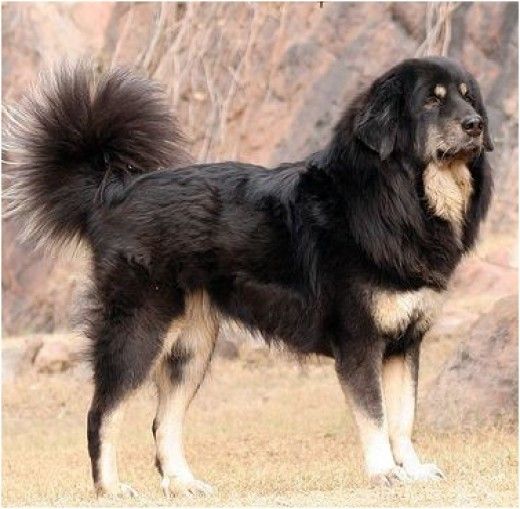
| Country of Origin | India, Nepal (Himalayan region) |
| Size | Large (20-26 inches at the shoulder) |
| Weight | 60-88 lbs (some individuals are heavier) |
| Coat Type | Long, coarse, with a thick undercoat |
| Living Conditions | Private house with a yard only |
| Lifespan | 10-13 years |
Two things trip up American readers on the first pass. The name, first: depending on the valley and the reference book, this dog is the Himalayan Sheepdog, the Bhotia, the Gaddi Kutta, the Bangara, or the Pahadi Kutta — and the locals themselves do not agree on whether those words describe one dog or several. Then the word “sheepdog,” which in American usage conjures a Border Collie sweeping a field. Wrong picture entirely: this dog does not move sheep, it lives inside the flock and drives off whatever comes for it. Get those two straight and everything else follows — the mass, the arched neck, the mane, the night barking, the flat refusal to take orders from across a pasture.
One Dog or Four? Untangling the Names
Reference works treat the following as synonyms for one Himalayan guardian. Shepherds on the ground are less tidy about it, and some of them will argue with you.
| Name | Where it is used | What it means |
|---|---|---|
| Himalayan Sheepdog | English reference books | The umbrella label; the one this article uses |
| Bhotia / Bhutia / Bhote Kukur | Uttarakhand, Nepal | From the root “Bhot,” meaning Tibet — “the Tibetan dog” |
| Gaddi Kutta / Gaddi dog | Himachal Pradesh | The dog of the Gaddi shepherds; nicknamed “Gaddi Leopardhund,” “Indian Panther Hound” |
| Bangara | Tehri Garhwal | Treated by some sources as a separate, heavier type |
| Pahadi Kutta | The hill districts generally | Simply “mountain dog” — a description, not a breed name |
| Himalayan Mastiff | Marketing and puppy ads | A commercial coinage; treat any listing using it with suspicion |
The Gaddi–Bhotia split is the one worth knowing. Where people separate them, the Gaddi is the more massive animal, with a thicker, distinctly arched neck and a lion-like ruff; the Bhotia is the leaner hill dog of the eastern ranges. Whether that is two breeds or one breed with regional variation stays unsettled, because no registry is keeping the book. And when a listing says “Himalayan Mastiff,” that is a sales word, not a breed — usually a Tibetan Mastiff, a cross, or an unknown large dog from the region. All hat and no cattle.
Where This Breed Stands With the AKC — and Why It Cannot Get In
Blunt, because vague answers here get people burned. The Himalayan Sheepdog is not recognized by the American Kennel Club — not in the Miscellaneous Class, not in the Foundation Stock Service. Nor by the United Kennel Club, The Kennel Club in Britain, or the Fédération Cynologique Internationale, which has no standard number, no group, and no section for it. Any ad quoting an “FCI number” for a Himalayan Sheepdog, Bhotia, or Gaddi is quoting a number that does not exist.
| Registry or body | Status of the Himalayan Sheepdog / Gaddi / Bhotia |
|---|---|
| American Kennel Club | Not recognized; not in the Miscellaneous Class; not in the Foundation Stock Service |
| AKC Canine Partners | Open — the one AKC door that is not locked |
| United Kennel Club | Not recognized |
| The Kennel Club (UK) | Not recognized |
| Fédération Cynologique Internationale | Not in the nomenclature — no number, no group, no section |
| ICAR–NBAGR (India) | Gaddi registered in early January 2025 as an indigenous genetic resource — not a kennel standard |
The interesting part is why the door is shut, because it is not snobbery. The Foundation Stock Service is the AKC’s front porch for rare breeds — record-keeping for purebreds not yet registrable. To be admitted, a breed must have been recognized by an acceptable foreign or domestic registry for forty years, with three-generation dogs on record, and must arrive with a written history, an official standard, and photographs. Advancement past that takes roughly 150–200 dogs with complete three-generation pedigrees and a national breed club of about a hundred members.
Read that against a landrace. No forty-year foreign registry. No closed studbook to draw three-generation pedigrees from. No parent club in the United States. The Himalayan Sheepdog does not fail the AKC’s test — it cannot sit for the exam. Its recognized cousins already cleared that bar: the Caucasian Shepherd Dog and the Central Asian Shepherd Dog are both recorded in the Foundation Stock Service, and the Tibetan Mastiff went the whole way, becoming eligible for AKC registration on September 1, 2006 and entering the Working Group on January 1, 2007.
One door is open. AKC Canine Partners, launched in 2009 for dogs ineligible for full registration — mixed and rare breeds alike, listed as “All-American Dogs” — will enroll a dog like this. Enrolled dogs must be spayed or neutered as adults and cannot be wolf hybrids, and they can earn titles in most AKC events, including stand-alone Agility, Rally, and Obedience trials. Will your Himalayan guardian want to run an agility course? Almost certainly not. But it is the only AKC paperwork that will ever carry this dog’s name.
January 2025: What India Registered, and What It Did Not
In early January 2025 — sources give the 6th or the 9th, and at least one says 2024, so treat the exact date as unsettled — the ICAR–National Bureau of Animal Genetic Resources in Karnal registered the Gaddi as a distinct indigenous breed. American readers should be clear about what kind of paperwork that is, because the headlines blurred it badly.
NBAGR is an agricultural research body, and its register catalogs India’s animal genetic resources — the same instrument that documents indigenous cattle, buffalo, goats, and sheep. Registration there is a conservation act: this population is genetically distinct, it belongs to this country, it is worth protecting. It is not a kennel standard, it creates no studbook, and it issues no pedigrees. The nearest American analogy is a livestock conservancy listing or a germplasm designation — not an AKC registration.
The Gaddi was the fourth dog admitted to that register and the first Himalayan one; earlier entries were the Rajapalayam and Chippiparai from Tamil Nadu and the Mudhol Hound from Karnataka. Real science sits behind it: the veterinary college at Palampur has run phenotypic and molecular characterization of the Gaddi since 2019 and forwarded its data to NBAGR in 2022. Nepal has a separate thread — in 2025 an organization calling itself the International Kennel Club announced recognition of the Bhote Kukur, and the Bhote Kukur Club of Nepal has been drafting a standard. Worth reporting, worth reading skeptically: that is not a leading federation, and a standard written by a young single-breed club is a starting point, not a settled fact.
History: From Ancient Times to the Present Day
A working calendar shaped this dog, not a show ring. The Gaddi shepherds practice transhumance — seasonal vertical migration — and the dog’s year is the flock’s year. Winter in the Shivalik foothills, in the Kangra, Mandi, and Hamirpur districts, where grazing holds and snow does not. April and May climbing through the passes of the Dhauladhar and Pir Panjal. Summer on alpine meadow above the tree line. Autumn, the whole operation comes back down.
Every stage of that route has a predator attached. High up, the snow leopard and the Himalayan wolf; in the forest belt, the Himalayan black bear; lower down, the common leopard. A dog that flinched did not stay in the gene pool, and neither did one that could not walk fifteen miles at altitude wearing a coat like a haystack. Nobody selected for head shape or coat color — wolves, cold, thin rations, and the shepherd’s judgment about which pup was worth carrying did the selecting. That is what “landrace” means, and it is the most useful word in this article.
One genetic footnote is worth having. Dogs living at Tibetan-plateau elevations carry high-altitude variants of the gene EPAS1, and the published work indicates those variants did not arise in dogs at all: they came by introgression from the Tibetan gray wolf, on a timescale placed at roughly twenty-four thousand years, with a separate hemoglobin adaptation arriving through gene conversion. The dog borrowed its lungs, so to speak, from the wolf it now fights. The caveat matters — that research was done on Tibetan Mastiffs and other plateau dogs, and the Himalayan Sheepdog is not a study population in those papers. The same adaptations are a reasonable inference from geography and working altitude, but an inference is all it is.
Appearance and Breed Standards
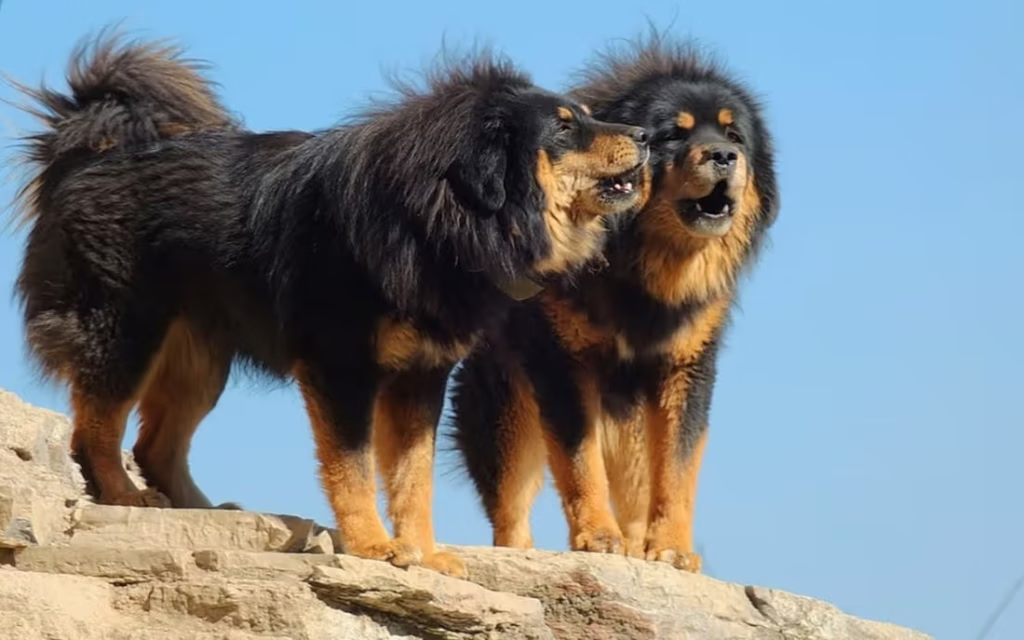
“Standard” is a loose word here, since no recognized body has written one. What follows is the consensus of field descriptions, not a document you can hold a dog against in a ring.
Large and heavy-boned, with real muscle and none of the exaggeration seen in show-bred giants. Broad, massive head; strong jaws. Triangular ears that hang and lift slightly at the base when the dog switches on. Deep-set dark eyes, watchful rather than friendly. A heavily furnished tail, often curled over the back — a signature of mountain breeds across Asia. The coat is a true double coat: long, coarse guard hair over an undercoat dense enough to make a blizzard a non-event. Black and black-and-tan dominate, usually with white flashes on chest, feet, and tail tip.
| Parameter | Characteristic |
|---|---|
| Height at Withers | Males: 22-26 in; Females: 20-24 in |
| Weight | 66-100 lbs (depending on gender and condition) |
| Coat Type | Long, thick, coarse, with a very dense undercoat |
| Color | Black and tan (most common), golden, cream, gray |
| Lifespan | 10-13 years |
How Big Is It, Really? The Sources Disagree
Here honesty beats precision. Published figures vary widely because different people measured different populations — reference compilers, Indian field researchers, and Nepali club members are not looking at the same animals. Rather than average them into a fake number, here is what each kind of source says.
| Source type | Height | Weight |
|---|---|---|
| General reference books | about 20–30 in | about 50–90 lbs |
| Gaddi, field measurements | males 26–30 in; females 24–28 in | males about 86 lbs; females about 73 lbs |
| Gaddi, Indian reports | — | 88–99 lbs |
| Bhote Kukur, Nepal | — | males 66–99 lbs |
| Bakharwal (related type) | 24–30 in | — |
| Realistic working range | about 24–30 in | about 77–99 lbs |
Which disposes of the claim you will meet online: the “150-pound Himalayan Mastiff.” A dog at that weight is a Tibetan Mastiff, a cross, or badly overfed — nothing in the field literature supports it, and a guardian carrying that mass would not survive a season of climbing passes. Litters run four to eight puppies; expect ten to twelve years, some sources stretching to thirteen.
Built for the Fight: Neck, Mane, Ears, and Voice
Read this dog’s anatomy as a set of instructions and it gets much harder to sell you a bill of goods.
- The heavy, arched neck. Big cats kill by taking the throat. A thick, distinctly crested neck is armor over the exact spot a leopard aims for — the feature most often cited to separate a good Gaddi from a generic big hill dog.
- The mane. The ruff on a mature male pads that same vulnerable area and makes the dog look considerably larger to something deciding whether the sheep are worth it.
- The double coat. Insulation on open meadow, and a physical buffer against teeth.
- Drop ears. A trade-off, not an accident: hanging ears offer less surface to tear than pricked ears. The bill comes due later as ear infections.
- The voice. A deep, carrying bark is a stand-off weapon. Most guardian work happens at a distance, in the dark, with sound — the predator that turns around at the fence line never becomes a fight. Remember that when you reach the section on neighbors.
One item on that list is folklore and should be labeled so. The pale markings above the eyes, common in black-and-tan dogs, are called “false eyes,” and mountain tradition holds they let the dog keep watch while asleep. A lovely story. Not anatomy.
Guardian, Not Herder: The Distinction That Decides Everything
American dog culture is saturated with herding breeds. Border Collies, Aussies, and Heelers are the default mental image of a “sheepdog,” and every one of them is the wrong model here. A herding dog runs a redirected predatory pattern — stalk, eye, gather — under human direction, in daylight. A guardian does something categorically different.
| Herding dog | Livestock guardian dog |
|---|---|
| Moves stock from point A to point B | Stays with stock and repels threats |
| Works on command, handler present | Works autonomously, often with no human for miles |
| Primarily a daytime job | Primarily a night job |
| Predatory drive redirected at stock | Predatory drive toward stock deliberately absent |
| Bonded to the handler | Bonded to the flock, from roughly eight weeks old |
| Rewarded for responsiveness | Rewarded for judgment |
That bottom row is the whole story: not an employee who takes instruction, a contractor who makes calls without you. One caveat other guardians do not carry — several descriptions report Himalayan dogs used for driving stock and even for hunting alongside guarding. In the Himalaya the roles were never separated the way American LGD literature separates them. Expect a guardian, but do not be shocked by more initiative than the textbook allows.
The American Bridge: We Already Run Dogs Like This
Good news for an American reader: no exoticism required. The United States runs one of the largest working livestock-guardian populations on the planet, and it works the same way. Walk onto a sheep outfit in Wyoming, Idaho, Montana, or west Texas and you will find Great Pyrenees, Anatolian Shepherds, Akbash, Maremmas, Kangals, and Karakachans out with the band, sleeping through the afternoon and going to work at dusk. Swap the snow leopard for a mountain lion and the Himalayan wolf for a coyote and the job is line-for-line identical.
Institutional weight sits behind that tradition. USDA APHIS Wildlife Services runs a congressionally funded Nonlethal Initiative built to expand nonlethal responses to large-carnivore depredation of livestock — fiscal year 2024 was its fifth year, and placing livestock protection dogs with western producers is part of the work. Wildlife Services has also partnered with the American Sheep Industry Association on livestock guardian dog signage for private and public land: the sign at the gate telling hikers not to pet the white dog. A 2010 American Sheep Industry survey put guard dog use second only to shed lambing among effective ways of reducing depredation.
Extension services teach it too. Texas A&M AgriLife Extension publishes a guide for the neighbors of livestock guardian dogs whose language could have been written about a Gaddi on a Himachal meadow. It calls LGDs “independent problem-solvers, not pets,” tells the public not to approach, pet, feed, or call them, and states plainly that LGDs “often bark at night to warn off predators” and that this barking “is preventative, not a nuisance.” It names fifteen guardian breeds — among them the Tibetan Mastiff and the Caucasian Shepherd, this breed’s nearest recognized relatives.
The economics have caught up. After Colorado voters passed Proposition 114 in 2020 and wolves returned to the western slope, the legislature created a Wolf Depredation Compensation Fund in 2023 that reimburses producers for losses of livestock and of livestock guard and herding animals killed by wolves. American law now treats a guardian dog as a working ranch asset with standing of its own. That is exactly the frame in which a Himalayan Sheepdog makes sense in this country — and exactly the frame that is missing in a subdivision.
How the Himalayan Sheepdog Compares
| Breed | FCI | AKC status | Origin and role |
|---|---|---|---|
| Himalayan Sheepdog (Bhotia / Gaddi) | Not recognized | Not recognized; not in FSS | Himalaya (India, Nepal); landrace flock guardian |
| Tibetan Mastiff (Do-Khyi) | No. 230, Group 2 (molossoid, mountain type) | Fully recognized; Working Group since January 1, 2007 | Tibet (China); camp and property guardian |
| Caucasian Shepherd Dog | No. 328, Group 2 | Foundation Stock Service | Caucasus; flock and property guardian |
| Central Asian Shepherd Dog | No. 335, Group 2 (definitively recognized January 25, 1989) | Foundation Stock Service | Central Asia; flock guardian |
| Great Pyrenees | Recognized (Group 2) | Fully recognized 1933; Working Group | Pyrenees; the default American ranch LGD |
| Anatolian Shepherd Dog | Recognized (Group 2) | Miscellaneous 1996; full recognition, Working Group, effective June 1, 1999 | Turkey; heat-tolerant American ranch LGD |
| Akbash | Not recognized | Not AKC; UKC Guardian Dog Group since January 1, 1998 | Turkey; works American ranches without AKC papers |
| Maremma Sheepdog | Recognized (Maremmano-Abruzzese) | Not AKC; UKC Guardian Dog Group | Italy; works American ranches without AKC papers |
| Bakharwal | Not recognized | Not recognized | Jammu and Kashmir; closely related landrace guardian |
Look at the bottom half of that table. Two guardian breeds doing serious work on American ranches right now — the Akbash and the Maremma — have no AKC recognition at all. American stockmen never treated AKC papers as a prerequisite for a competent dog. That is the honest context for this breed’s status: in the world it belongs to, papers were never the point. What papers do provide is health-testing infrastructure, and that absence is a real problem.
Character and Temperament: A Warrior with a Philosopher’s Soul
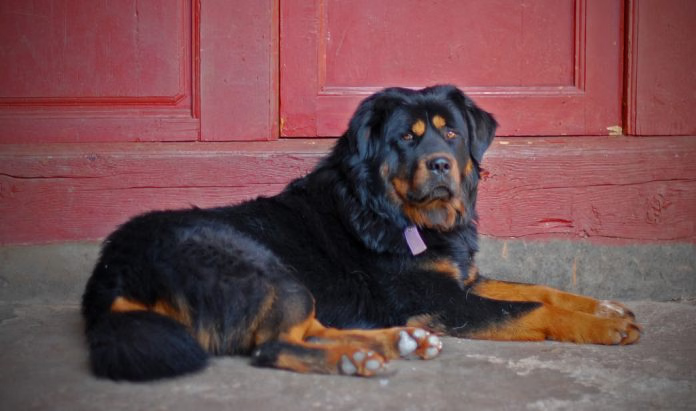
If you want a dog that brings the newspaper and loses its mind with joy at every passerby, keep shopping. This is a serious guardian with a pronounced territorial instinct and a firm opinion about who belongs.
- Independence. Alone on a mountainside, the dog worked out what a shape in the dark was and what to do about it. That machinery does not shut off because you moved it to Ohio.
- Loyalty to its own. Toward the family it accepts, the Himalayan Sheepdog is patient, steady, and often startlingly gentle, children included. It will put itself between its people and a threat without being asked.
- Distrust of strangers. Not a flaw to train out — it is the breed working correctly. Early, broad socialization keeps suspicion from curdling into indiscriminate aggression, but no amount of it produces a Labrador.
It is worth noting that different survival strategies exist in the world of wild canines. The African Wild Dog (Painted Dog) relies on the pack and on collective hunting in open country, with intense social signaling. The Himalayan Sheepdog is the opposite pole: a solitary sentinel, or a pair, relying on position, mass, voice, and willingness to escalate.
Ranch or Subdivision? An Honest American Reality Check
Read this section twice, because it is where most American placements of landrace guardians go wrong. None of it is fixable with training. It is what the dog is.
- Territoriality has no off switch. The dog decides where the property line runs and enforces its own version of it — on the meter reader, the delivery driver, and your brother-in-law.
- Night is a shift, not downtime. Barking at two in the morning is not a behavior problem; it is the job. On six hundred acres nobody hears it. On a quarter-acre lot with neighbors forty feet away, you will be in front of code enforcement inside a month.
- It needs something to be responsible for. Sheep, goats, poultry, a homestead with a real perimeter. A guardian with nothing to guard invents a job, and you will not like the one it picks.
- Recall is unreliable by design. Off-leash control at distance is weak in this breed. Assume the recall fails at the worst possible moment and manage around that.
- There is no support system here. No parent club, no breed rescue, no trainer with fifty of these dogs behind them, no vet who has seen a hundred. With a Great Pyrenees you can call somebody. With this dog, you are the somebody.
One American temptation deserves calling out. Coyotes now live in all forty-eight contiguous states and have moved into Chicago, Denver, Los Angeles, and the New York suburbs, and every year somebody loses a cat and starts googling guardian breeds. Buying a Himalayan Sheepdog for suburban coyotes is a bad trade: you swap an occasional wildlife problem for a permanent liability, a noise complaint, and a hundred-pound dog that treats the sidewalk out front as contested ground. That dog won’t hunt.
Fencing and Containment
Containing a guardian is not the same problem as containing a pet. The dog is not trying to escape; it is trying to expand its patrol, calmly and methodically. Six feet minimum, taller where ground rises to meet the fence. Woven wire or no-climb field fence with a solid privacy barrier on the street side — chain link is climbable and lets the dog rehearse everything that passes. Bury the base or fit a horizontal apron, because guardians dig under long before they climb over. Gates self-closing, latched, locked: a gate left open by a landscaper is the most common way these dogs reach the county shelter. Never rely on an underground electronic fence — it will not reliably hold a determined guardian in, and it does nothing to keep a child out. Post the gate, too; LGD signage of the kind Wildlife Services developed with the sheep industry is evidence you took reasonable steps.
The Legal Picture: No Federal Breed List, Fifty States, Thousands of Ordinances
Owners arriving from countries with national dangerous-dog schedules expect one list to check. The United States does not have one — no federal statute names restricted dog breeds. Regulation is layered, local, and inconsistent, and for an unrecognized landrace guardian that cuts both ways.
| Level | What it can do to you | What to check |
|---|---|---|
| Federal | No breed list; controls importation only | CDC dog importation rules |
| State | May preempt local breed laws, or leave cities free to write them | Whether your state prohibits breed-specific local ordinances |
| County / city | Breed-specific laws, dangerous-dog designations, leash and at-large rules, kennel permits, noise ordinances | Municipal code and county animal control |
| HOA / CC&Rs | Weight caps, breed lists, animal-number limits, fence height and material rules | Recorded covenants — before you buy the property |
| Landlord / insurer | Lease pet clauses; homeowner and renter policies may exclude or surcharge guardian types | Policy language and underwriting questions |
| Agricultural exemptions | Right-to-farm and working-dog provisions can shield legitimate LGD practice | State ag code and county right-to-farm ordinance |
Breed-specific legislation. Estimates put the number of American cities with breed-specific laws above seven hundred. On the other side, roughly a dozen states — California, Colorado, Florida, Illinois, Maine, Massachusetts, Minnesota, New Jersey, New York, Oklahoma, Pennsylvania, Texas, Virginia among them — statutorily prohibit local breed-specific ordinances, and a wider group restricts breed criteria inside dangerous-dog laws. The practical wrinkle: American BSL aims overwhelmingly at pit bull–type dogs, so a Himalayan Sheepdog will almost never be named on a list. What it can catch is a “vicious” or “dangerous dog” designation applied after an incident — behavior-based, not breed-based, so it reaches your dog in every state.
Working-dog carve-outs. Where American law does speak to dogs like this, it usually speaks favorably — provided they are genuinely working. Texas is the clearest case: the restraint statute at Health and Safety Code §§ 821.102–821.102A excepts agricultural working dogs; the dangerous-dog provisions at §§ 822.041–822.042 turn on unprovoked attacks outside an enclosure rather than on breed; and a 2024 expansion of the right-to-farm statute at § 251.004 shields agricultural operations from nuisance claims where accepted practices are followed. Vermont goes further in a small but telling way: under its cruelty statute at 13 V.S.A. § 365, a shelter structure is not required for a healthy livestock guardian dog kept outdoors in an enclosure — a legislature acknowledging that this kind of dog lives with the stock.
The lesson is consistent across jurisdictions: a Himalayan Sheepdog on a working operation is legally comfortable in most of the United States. The same dog on a residential lot has no exemptions, no protections, and every ordinance in the book pointed at it.
Importing from India or Nepal: What the CDC Requires
There is no meaningful domestic source for this breed, so an American buyer is looking at importation — and this is usually where the plan dies. India and Nepal are both on the CDC’s list of countries at high risk for dog rabies, which puts any dog coming from there into the strictest track in the U.S. system.
| Requirement | Detail |
|---|---|
| Minimum age | At least 6 months old at U.S. entry — no puppies |
| Microchip | Universal-scanner readable, implanted before the rabies vaccination; a vaccine given first is invalid and must be repeated |
| CDC Dog Import Form | Receipt required for every dog; from high-risk countries each receipt covers a single entry on the stated arrival date |
| Rabies vaccination | Given at least 28 days before entry |
| Certification of Foreign Rabies Vaccination | Government-endorsed, completed within 30 days of travel |
| Rabies serology (titer) | From a CDC-approved laboratory — this is what lets you skip quarantine |
| If no valid titer | Revaccination on arrival plus a 28-day quarantine, by reservation |
| Port of entry | Only airports with a CDC-registered animal care facility, and only with a reservation there |
Run the calendar and the picture is clear. Microchip first, vaccinate second, wait, draw blood for the titer, run it through an approved laboratory, obtain the endorsed certification inside the travel window, book the animal care facility, and only then fly — with a dog that must already be six months old. You are not importing a puppy that will bond to your goats at eight weeks; you are importing an adolescent guardian that formed its attachments on somebody else’s mountain. Rules change, so verify every line above against current CDC guidance.
Which raises the obvious question, and it deserves a straight answer: if what you need is a working guardian for American stock against American predators, an Anatolian, a Pyrenees, an Akbash, or a Maremma pup from a working outfit two states over will do the job better, sooner, and with a support network behind it. The case for a Himalayan Sheepdog here is a case about this particular dog and these particular mountains — not a case about superior guarding.
Care and Maintenance Features
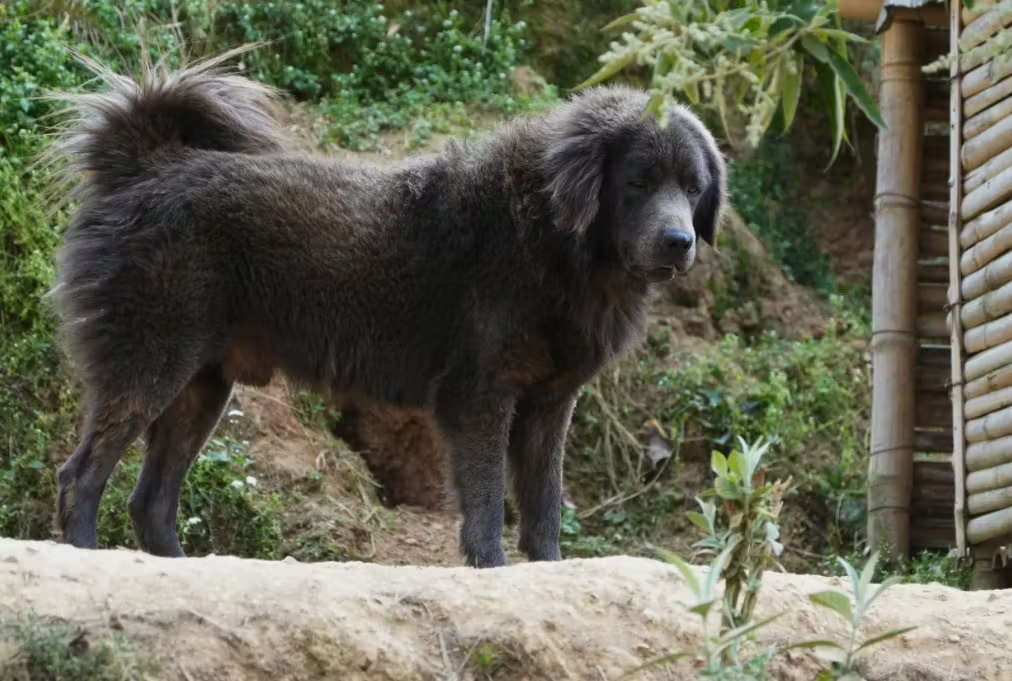
This breed is absolutely unsuitable for apartment life. It needs room, cool air, and a perimeter to patrol. Acreage with a securely fenced yard is the floor, not the ideal.
Coat Care
The dense double coat needs regular brushing, and daily attention during the spring and fall blowouts. Neglect produces mats, and mats produce hot spots and skin infections underneath where you cannot see them. One hard rule: never shave this coat. The undercoat insulates in both directions, so a shaved guardian in July is more vulnerable to heat and sunburn, not less — and it frequently grows back wrong.
| Procedure | Frequency | Notes |
|---|---|---|
| Brushing | 1-2 times a week | Daily with a slicker brush during shedding |
| Bathing | 2-3 times a year | Frequent washing strips the protective oil layer |
| Ear Check | Weekly | Moisture can accumulate due to the drooping shape |
| Nail Trimming | As needed | With sufficient activity, they wear down naturally |
Physical Exercise
Moderate but regular movement is the target. Not a sprinter — a plodder with enormous range. Long walks over rough ground beat any amount of ball chasing, and patrolling a real perimeter beats both. Not a jogging partner, and emphatically not a dog park dog — two facts that kill most urban exercise plans on the spot.
In America, Heat Is the Enemy — Not Cold
This is the climate inversion that catches American owners. This dog’s ancestors worked summers at around sixty degrees Fahrenheit on alpine meadow above ten thousand feet. A Minnesota January is a vacation. An August afternoon in Dallas, Atlanta, Phoenix, or the Central Valley — heat index over a hundred, humidity that makes panting useless — is a genuine threat to life.
- Move work and exercise to dawn and dusk from May through September across the southern half of the country. Texas ranch LGDs already run that schedule.
- Deep shade and moving air matter more than a doghouse; a shaded, dug-out spot with a breeze beats an insulated box in still air every time.
- Water in several places, refreshed, in shade. A stock tank the dog can stand in is not a luxury in the Sun Belt.
- Know the early signs of heat stroke — frantic panting, brick-red gums, wobbling, vomiting — and treat them as an emergency, because in a double-coated hundred-pound dog they escalate fast.
Honest conclusion: the northern tier, the Mountain West, the Great Lakes, and New England suit this breed. The Gulf Coast and the desert Southwest work against it every summer of its life.
Health and Genetic Predispositions
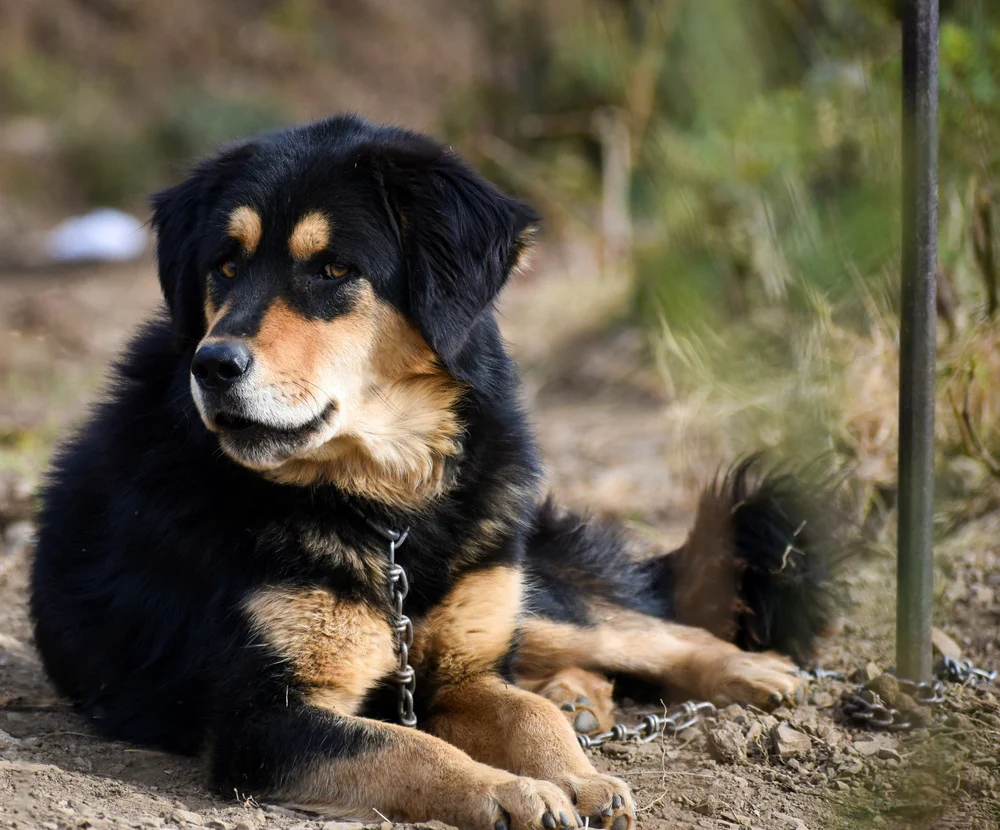
Landrace health has to be reasoned about differently, so set the usual list-of-inherited-diseases format aside. There is no closed studbook here, and no popular sire ever flooded a national population, because there has never been a national population. The predictable result: breed-specific hereditary disease is essentially undescribed in the Himalayan Sheepdog. That sounds like great news. It comes with two traps.
- “Not described” is not “not present.” Almost no targeted health research has been done on this population. The breed is sturdy overall but not problem-free — the cautions are listed below.
- There is no infrastructure to lean on. No OFA or PennHIP evaluation scheme applied to the breed, no health database, no panel of breed-relevant DNA tests, no parent-club health survey. An American buying a Golden Retriever can ask for hips, elbows, eyes, and heart. A buyer here has nothing to ask for — the paperwork does not exist to be produced.
What remains are the ordinary risks of any large working dog, and they are real:
- Orthopedic problems. Hip and elbow dysplasia, cruciate rupture, arthritis — all worsened by overfeeding a growing puppy or hammering a young dog with hard exercise.
- Gastric dilatation-volvulus (bloat). A deep-chested giant is a candidate. Feed two meals, keep the dog quiet before and after eating, and know the route to your emergency clinic before you need it.
- Ear infections. The price of hanging ears. Check weekly, especially in humid regions.
- Skin trouble under mats, almost always a grooming failure rather than a genetic one, and obesity, the most common and most fixable problem in the breed.
- Heat stroke. In the United States, statistically the likeliest thing to kill this dog before old age does.
It is very interesting to compare the adaptation mechanisms of different breeds. The rare Aruba Cunucu Dog evolved in Caribbean heat, with short hair and a completely different approach to thermoregulation. The Himalayan Sheepdog is its mirror image, engineered to hold heat in thin, freezing air — which is exactly why the American Sun Belt is such a hostile posting for it.
Feeding: From Shepherd’s Flatbread to the American Bowl
The historical ration was not what Americans picture when they hear “mastiff”: unleavened flatbread, milk, whey, and whatever came out of the shepherd’s pot. For the closely related Bakharwal, sources describe a near-vegetarian diet — bread from rice husk and corn, plus milk. These dogs evolved on thin, low-protein food at high altitude and high workload. Drop that metabolism into an American feed room and the result is predictable.
- Two measured meals a day for an adult. No free feeding, and no leaving the bowl down.
- Quiet before and after eating — the bloat rule, non-negotiable in a deep-chested dog.
- A large-breed growth formula for the puppy, with controlled calcium and controlled growth rate. Pushing a guardian puppy to grow fast is how you buy hip surgery.
- Judge condition by hand, not by eye. That undercoat hides ten pounds. Run your fingers along the ribs; you should feel them under a thin layer, without pressing.
- Adjust seasonally: a dog working winter range needs more than the same dog idle in July.
Training: How to Find Common Ground
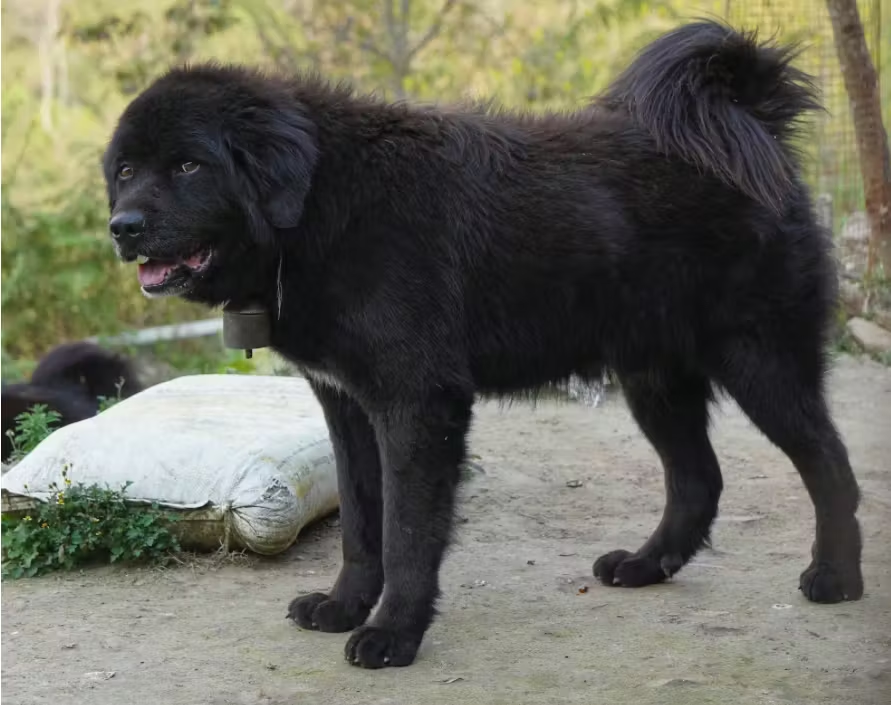
Intelligent and stubborn in equal measure, and standard obedience drilling gets you nowhere. This dog was selected for centuries to size up a situation and act without a handler; asking it to do something for no visible reason reads, to it, as noise. What works is fair, consistent leadership and a reason — positive reinforcement, short sessions, and a household where the rules do not change from Tuesday to Thursday. What does not work is force: physical correction with a guardian breed produces either a dog that shuts down or one that answers in kind, and neither is recoverable in an animal this size.
Priorities, in order: socialization from the day the puppy arrives — people, vehicles, livestock, machinery, kids, the delivery truck; a reliable leash manner, because you will need to move this dog past strangers eventually; a solid “leave it” and a settle; and a crate the dog accepts calmly, since vet visits and travel are not optional. Treat recall as a bonus, never a safety system.
Working placement is a separate discipline. A guardian puppy meant for stock is raised with the stock from about eight weeks, human contact limited, supervision heavy through the first year while the dog learns the difference between a lamb and a chew toy. Extension services and experienced LGD producers publish protocols for exactly this; a house-raised guardian dropped into a pasture at a year old is a far harder project.
Pros and Cons of the Breed
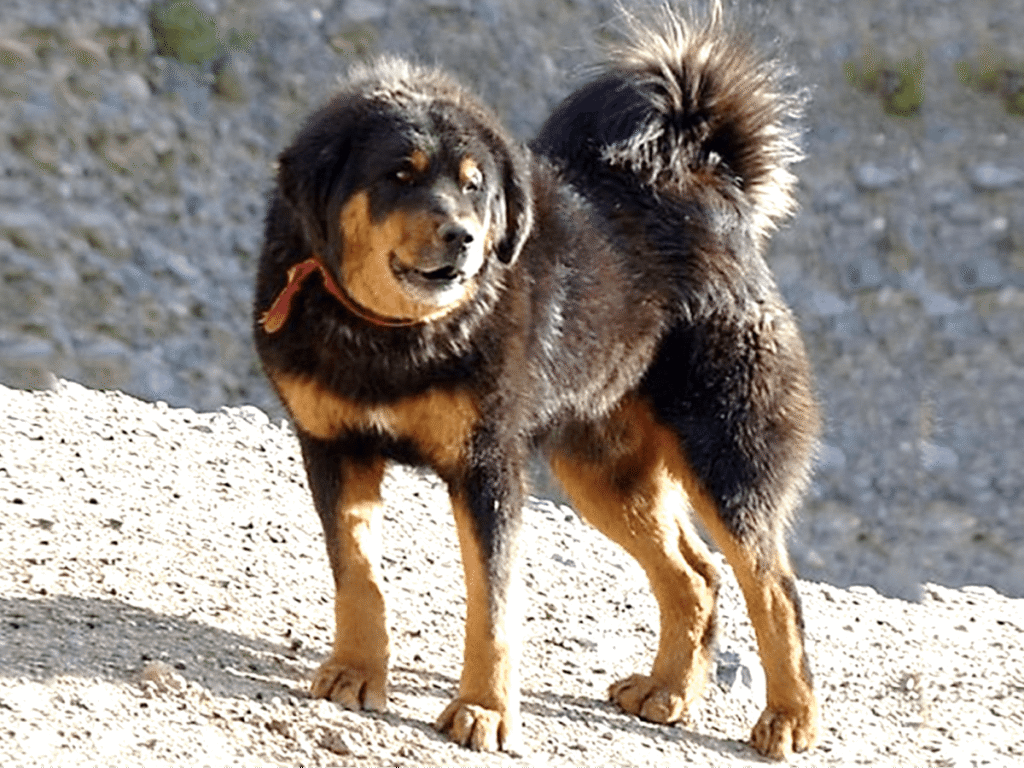
| Pros (+) | Cons (-) |
|---|---|
| Incorruptible and reliable territory guard | Tendency to bark loudly (especially at night) |
| Strong health and endurance | Heavy shedding, fur all over the yard |
| Devotion to family and tolerance of (own) children | Tendency towards dominance and stubbornness |
| Unfussy about food | Not suitable for apartment living |
| Withstands extreme cold | Requires an experienced owner |
Add the two items specific to the American situation: no health-testing paperwork exists for this breed, and no support network exists for it in this country. Neither shows up in a temperament description, and both will shape your decade with the dog more than temperament will.
Will the Breed Survive? The Status Today
Researchers estimate fewer than a thousand pure Gaddi dogs remain, and the reasons involve no villains. Roads, schools, and wage labor pulled families off the migration routes, and a guardian breed with no flock has no reason to be bred well. Free-ranging landrace populations dilute fast once other breeds arrive in the valleys. For most of the twentieth century nobody was keeping records. And for the related Bakharwal specifically, sources record hundreds of dogs killed during the conflict period beginning in the 1990s.
The counter-effort is real but small: Palampur breeds puppies and distributes them to shepherds, the NBAGR registration puts the Gaddi on India’s conservation map, and the club in Nepal is at least writing things down. An ecological argument has also grown stronger. Work published in 2025 on nonlethal predator deterrence in the northwestern Himalaya identified the Gaddi as the most effective nonlethal strategy available for protecting livestock — which lowers human-predator conflict, which in turn benefits the snow leopard. The dog bred to fight the snow leopard may end up one of the better arguments for keeping snow leopards alive.
Interesting Facts
- Locals in the Himalayas believe these dogs can see spirits. Their “false eyes” — light patches above the eyes, common in black-and-tan individuals — supposedly let them watch the world even while asleep.
- The nickname “Indian Panther Hound” comes from its reputation for standing up to leopards — not from any hound ancestry whatsoever.
Frequently Asked Questions (FAQ)
Can I register a Himalayan Sheepdog with the AKC?
Not as a breed. It is not AKC-recognized and not in the Foundation Stock Service, and it cannot qualify for FSS because no forty-year foreign registry or three-generation pedigree record exists behind it. What you can do is enroll the dog in AKC Canine Partners as an All-American Dog — that requires spaying or neutering at adulthood and makes the dog eligible for Agility, Rally, and Obedience titles.
Will my HOA or my insurance company have a problem with it?
Possibly, for reasons unrelated to the breed’s name. Recorded covenants routinely impose weight caps, animal-number limits, and fence restrictions that a hundred-pound guardian behind a six-foot solid fence runs straight into. Homeowner and renter policies commonly ask underwriting questions about large or guardian-type dogs and bite history. Since this breed is on nobody’s list, expect to be judged on size, function, and incident record — and read the covenants before you buy the property, not after.
Is it legal to import one from India or Nepal?
Legal, yes; simple, no. Both countries are on the CDC’s high-risk list for dog rabies, so the dog must be at least six months old, microchipped before its rabies vaccination, vaccinated at least twenty-eight days before entry, covered by a government-endorsed foreign vaccination certificate, and either titer-tested at a CDC-approved laboratory or quarantined twenty-eight days after revaccination — arriving only at an airport with a CDC-registered animal care facility. Confirm current rules with the CDC first.
Would one solve my coyote problem?
On a working operation with stock to guard, a livestock guardian dog genuinely reduces coyote depredation — well established in American sheep production. In a residential yard, no: you trade an intermittent wildlife nuisance for a permanent liability, plus a nocturnally vocal hundred-pound dog. If the problem is a real working one, talk to a producer running Pyrenees or Anatolians before you look overseas.
Is the Himalayan Sheepdog aggressive toward children?
Toward children of its own household it is generally tolerant and often protective. The risk is physical rather than temperamental: a dog this size knocks a small child over without meaning anything by it. Visiting children are another matter — strangers on the property are exactly what this dog is built to challenge. Never leave it with small children unsupervised.
What should I feed such a dog?
Historically, flatbread, milk, and scraps from the shepherd’s pot. Today a quality large-breed diet in two measured meals, with a large-breed growth formula for puppies. The mistake to avoid is overfeeding: this metabolism was built for scarcity and puts on weight alarmingly fast on American rations.
Can I keep it on a chain?
No. Chaining damages a proud, autonomous animal and produces exactly the frustrated aggression you feared. A kennel run works as temporary housing, but this dog needs to move freely inside a securely fenced area. Several states now restrict continuous tethering, with carve-outs written for genuine agricultural working dogs, not backyard convenience.
Is it the same thing as a Tibetan Mastiff?
No, though they share ancestry and a mountain range. The Tibetan Mastiff is heavier and more heavily coated, fully AKC-recognized, Working Group. The Himalayan Sheepdog is lighter, more athletic, unrecognized anywhere, and far likelier to live outdoors with stock. If a seller uses the names interchangeably, walk away.
Video about the Breed
The Bottom Line: Who This Dog Is For
The Himalayan Sheepdog suits a narrow slice of American households, and it suits them extremely well. Acreage in the northern half of the country. Stock that needs guarding — sheep, goats, poultry, alpacas. Real predator pressure from coyotes, lions, bears, or wolves. Neighbors far enough off that a two-in-the-morning bark is a comfort rather than a complaint. An owner who has run a guardian breed before and does not confuse independence with disobedience. If that is you, you get a dog with a thousand years of judgment behind it: gentle with its own people, indifferent to weather that would flatten other breeds, utterly serious about the animals in its care.
If it is not you — a fenced suburban lot, a first big dog, an HOA, and a plan to socialize the guarding out of it — this breed will make you both miserable, and there are American guardians with parent clubs, health testing, breed rescue, and mentors two states away who will do the same job better. Either way, respect what the paperwork does and does not tell you. This dog never had papers and never needed them; the mountain kept the studbook. Just understand that when the mountain keeps the studbook, nobody hands you the file.
- Fearless guardian of flock and home
- Very robust "natural" health
- Gentle and patient with the family
- Adapted to cold and altitude
- Formidable and wary of strangers
- Independent, hard to train
- Not for an apartment or a novice
- Dense coat sheds heavily
| Tibetan Mastiff | Caucasian Shepherd | Gampr (Armenian Wolfhound) | |
|---|---|---|---|
| Height | 61–76 cm | 64–75 cm | 63–77 cm |
| Energy | 2.5 | 3 | 3 |
| Apartment | 1.5 | 1.5 | 1.5 |
| Beginners | 1.5 | 1.5 | 1.5 |
What does the Himalayan Sheepdog guard the flocks against?
Does the Bhotia bond with the whole family?
Is the breed suitable for the city?
Will my HOA or my insurance company have a problem with it?
Is it legal to import one from India or Nepal?
Would one solve my coyote problem?
Is the Himalayan Sheepdog aggressive toward children?
What should I feed such a dog?
Can I keep it on a chain?
Himalayan landrace (Bhotia / Gaddi) · regional sources
For apartments · For kids · For beginners · Active · Smartest · Hypoallergenic · All rankings →