Tvaryny ›
Dogs ›
American Akita (Great Japanese Dog)
Group 5. Spitz and primitive types. Section 5. Asian Spitz and related breeds. · Japan/USA (breed development)
American Akita (Great Japanese Dog)
A bear-like giant of Japanese roots in an American format: massive, devoted, dignified and dominant. The American Akita is the more powerful, bonier relative of the Akita Inu; a serious guardian that needs a confident owner and early socialization.
Height
61–71 cm
Weight
88–130 lbs males, 70–100 lbs females
Lifespan
10–13 years
FCI group
Group 5. Spitz and primitive types. Section 5. Asian Spitz and related breeds.
Apartment · not suitableKids · with caveatsCats · not suitableOther dogs · not suitableBeginners · not suitable
The American Akita, also known as the Great Japanese Dog, has a knack for stealing hearts. In no time at all, this dog will earn your trust and become a fully-fledged member of your family. Moreover, the Akita serves as an excellent guardian for your property and a protector for your children, whom it will love and care for deeply. Physically, these dogs are absolute powerhouses; they require long daily walks and plenty of exercise, so they aren't the best fit for inactive lifestyles. Find out more on Tvaryny.
American Akita: A Brief Breed Overview
American Akita: A Brief Breed Overview · 9
Parameter
Value
Origin
Japan/USA (breed development)
Year of Recognition (FCI)
1999 (as Great Japanese Dog)
Life Span
10–12 years
Height (Males)
26–28 inches (66–71 cm)
Height (Females)
24–26 inches (61–66 cm)
Weight
88–130 lbs (40–59 kg) males, 70–100 lbs (32–45 kg) females
FCI Group
Group 5. Spitz and primitive types. Section 5. Asian Spitz and related breeds.
Purpose
Companion, Guardian
Interesting Facts About the American Akita
Two Different Breeds: The American Akita and the Akita Inu are officially recognized as separate breeds in most of the world (according to the FCI standard). Key differences: The American Akita is larger, has a more massive head, and any color is allowed (including a mask), whereas the Akita Inu has a limited set of colors and lacks a black mask.
Soldier's Dog: The modern American Akita descends from dogs that US military personnel brought out of Japan after World War II, mostly from the Dewa line, which had signs of crossing with German Shepherds and Mastiffs.
A "Tidy" Dog: Akitas are known for their cleanliness. They often groom themselves like cats and really dislike dirt, which makes caring for them much easier.
Akita's Voice: The American Akita is generally a dog of few words. It only barks when there is a real threat, making it an ideal watchdog that won't disturb the neighbors without reason.
A Head-Turner: While gaining popularity, this breed still stands out in the crowd compared to other common working breeds.
History of the Breed
The history of the American Akita is inextricably linked to its Japanese ancestor, the Akita Inu. Thanks to archaeological excavations, we know that dogs of the Akita type have lived on the Japanese islands since ancient times. They were used as hunters for large game (bears, wild boar); they were excellent swimmers and helped people catch fish. Starting in the 18th century, the Japanese nobility took a special interest in these dogs, acquiring them to guard their wealthy estates. Back then, the Akita breed was held in particularly high regard. In the early 20th century, dogs of this breed were declared a natural monument. However, World War II nearly wiped out these magnificent animals; they were killed for their valuable fur, which was used to line warm clothing for soldiers. Fortunately, a few Akita Inus were saved during that dark time.
Development of the American Akita in the USA
After the war, only three types of Akita remained in Japan: Matagi Akita hunting dogs, fighting dogs, and Shepherd mixes. Japanese breeders strove to return to the original, pure-blooded look of the Akita Inu, focusing on the Matagi type. In contrast, US soldiers took a liking to the larger, more robust dogs that came from crossing with German Shepherds and Mastiffs (the Dewa line) and brought them back to America. In the US, targeted breeding began in the 1950s, leading to the creation of the Akita Club of America. American breeders aimed for a more powerful dog and paid less attention to specific coat colors, which led to the acceptance of practically any marking. As a result, the American Akita began to differ significantly from its Japanese cousins.
Recognition of the Breed
The Akita from the US became increasingly well-known. Dog lovers from all over the world took an immediate interest after they were first presented at an international exhibition in Hanover in 1963. However, at that time, they were not considered a separate breed. Due to the discrepancies between Japanese and American standards, the Fédération Cynologique Internationale (FCI) recognized the American type as a separate breed in 1999 under the name Great Japanese Dog. In 2006, the FCI officially changed the name to American Akita, highlighting its American origin and development. Interestingly, in Canada and the US, both types are often still registered as a single breed, although the FCI and most global organizations distinguish between the Akita Inu and the American Akita.
Appearance: Description and Standards
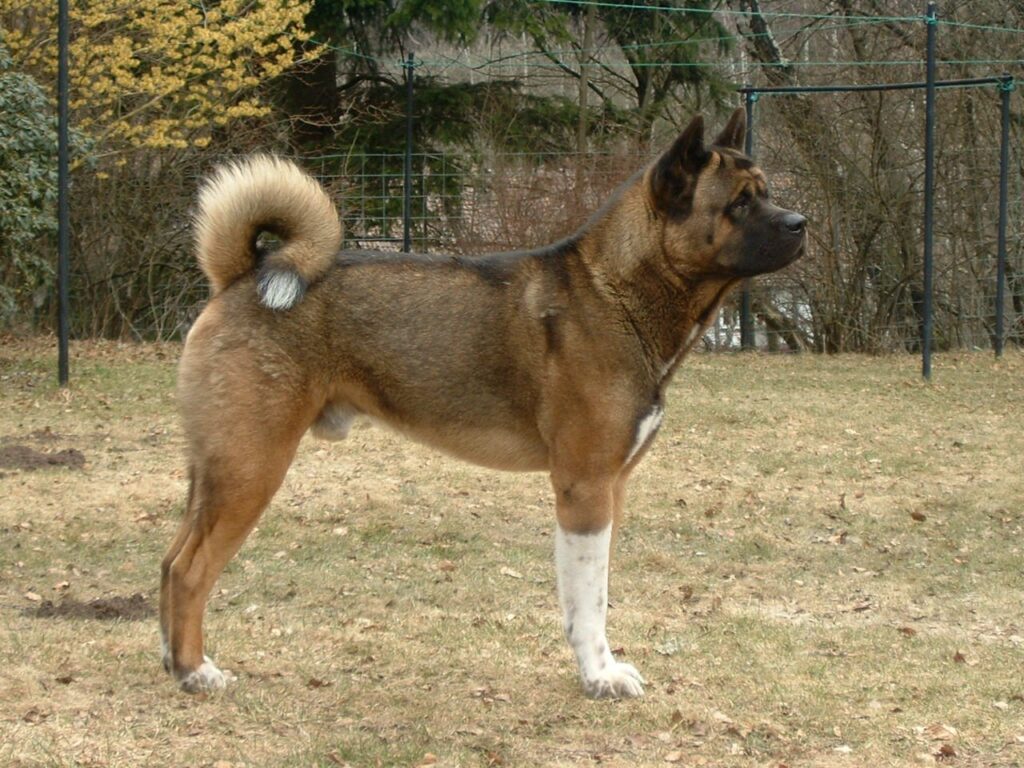
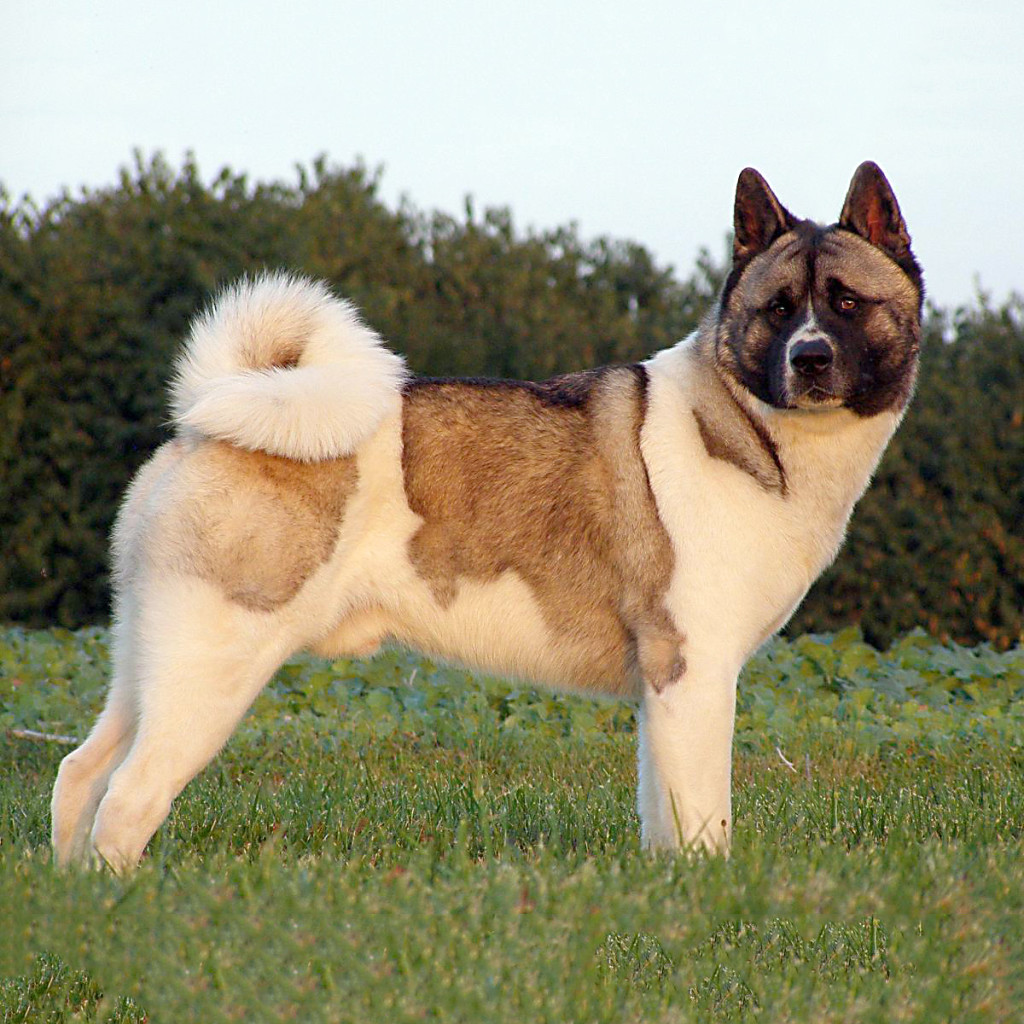
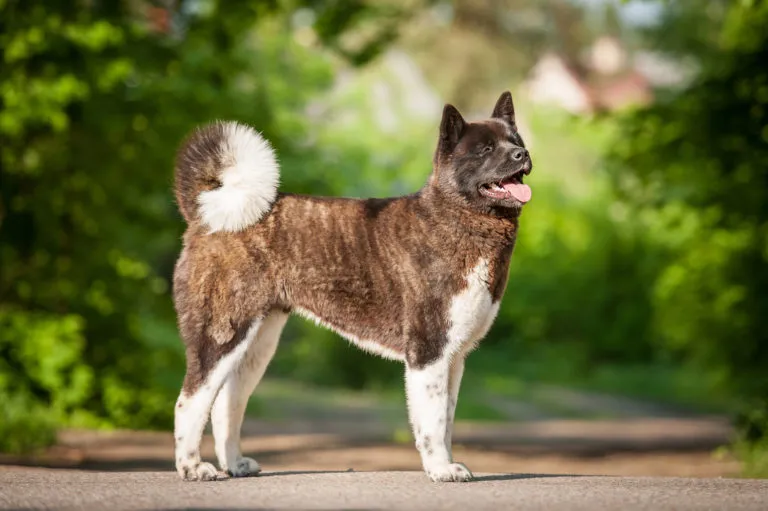
The American Akita is a large, powerful dog with a heavy bone structure, harmoniously built with a square body. Its appearance conveys an impression of strength, dignity, and calm. While they share some distant ancestry with other Spitz-type dogs like the Eurasier, the Akita is far more massive and imposing.
Head and Facial Expression
The head of the American Akita is massive and broad with a flat skull, which distinguishes it from the Akita Inu. The jaws are square and powerful, and the muzzle is voluminous. The stop (the transition from forehead to muzzle) is well defined. The nose is large and always black. The lips are thick, tight-fitting, and black. The eyes are deep-set, small, triangular, and dark brown - their expressiveness and depth give the dog a look of intellegence and alertness.
Body, Limbs, and Tail
The neck is relatively short, thick, and muscular. The back is straight and strong. The chest is well-developed, deep, and wide, indicating great strength and stamina. The limbs are straight, parallel to each other, with powerful musculature. The tail is one of the breed's trademarks: it is set high, thick, covered with harsh, dense hair, and is carried over the back in a curl or double curl.
Coat and Color
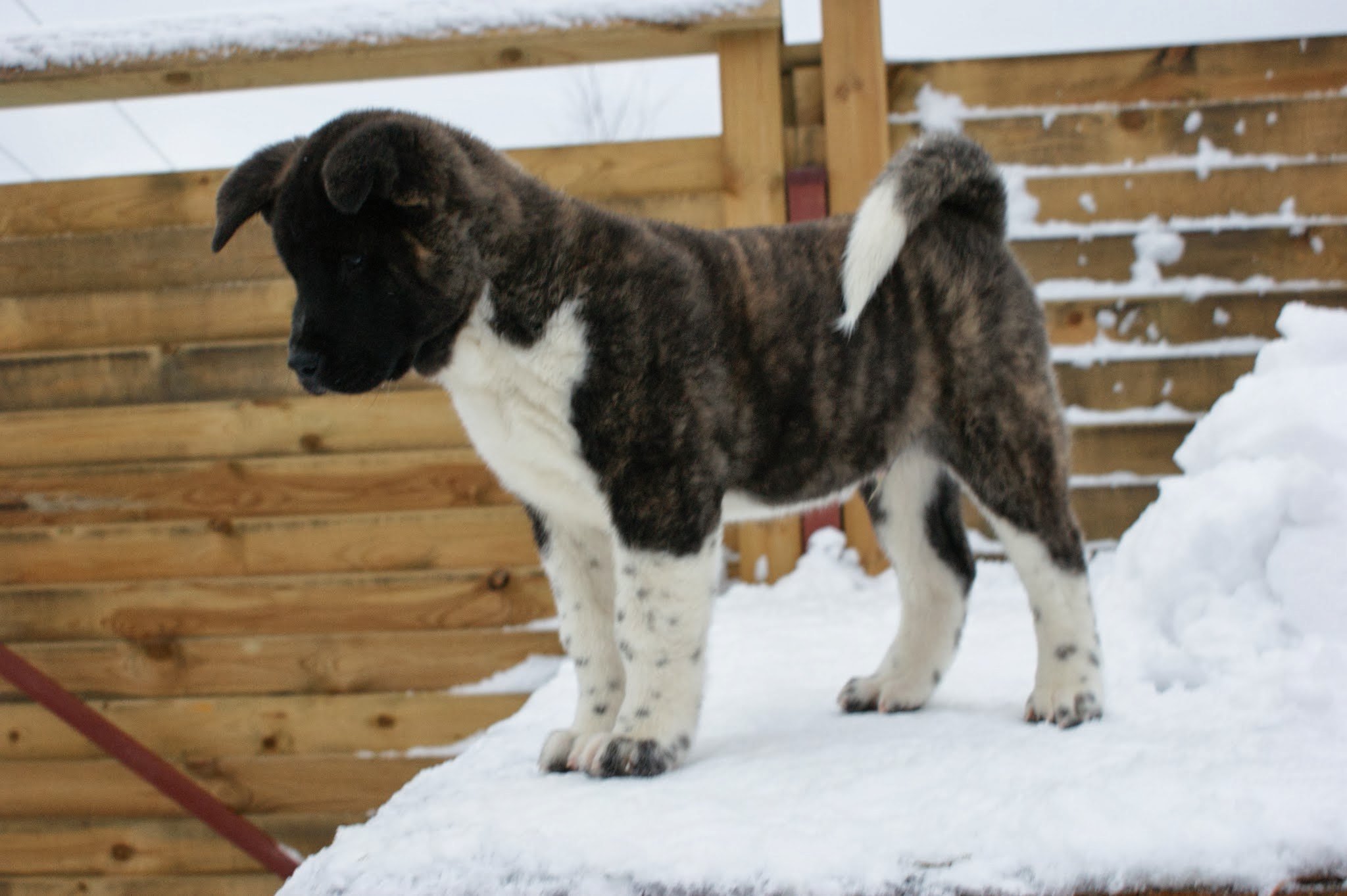
The coat of the American Akita is double: the outer coat is straight and stands off the body, while underneath lies a soft, thick, and dense undercoat that provides excellent protection against the cold. The color can be anything, which is a key difference from the Japanese Akita, where only specific colors are permitted. Acceptable colors include white, fawn, red, pinto, and brindle. A black mask or blaze may be present on the muzzle. In pinto dogs, large spots cover more than one-third of the body.
Character: Temperament, Dominance, and Socialization
The American Akita is a wonderful companion dog that also possesses excellent working qualities. These dogs are strong, brave, resilient, composed, and fearless. Akitas make superb guard dogs that will never bark for no reason; they only raise their voice if strangers attempt to trespass on their territory. They are also very good hunters, capable of tracking prey for a long time, with a keen sense of smell and excellent eyesight. These dogs can work in any weather conditions; neither thunderstorms nor severe sub-zero temperatures scare them.
Loyalty to Family
Akitas are loving, faithful, and loyal dogs that need constant interaction with their owner, to whom they are deeply attached. They always strive to be in the company of their family and are wonderful with children, showing them special care (they are often compared to nannies). However, due to their tendency toward dominance and jealousy, they can be quite suspicious of strangers, requiring thorough and early socialization. Akitas generally do not get along well with other animals.
Tendency to Dominate
These dogs are prone to dominance; they are jealous and always like to be number one. The owner of an American Akita must be a firm, consistent, and strong-willed leader, otherwise, the dog will quickly take charge and start managing its owner. This breed is not suitable for people who have no experience raising serious working dogs. They need clear rules and early exposure to different people, places, and sounds.
Training and Socialization: Difficulty and Approach
Representatives of this breed can be very stubborn; they love to show their independence and autonomy. However, training them is not difficult at all if you find the right approach. These dogs are literally built for work and make excellent service dogs. You must start training an American Akita from an early age.
Key Training Principles
Early Socialization: It is particularly important to allow puppies to interact with their kin and various people so that they do not become overly aggressive or distrustful of strangers in the future. This is necessary to prevent territorial or food aggression.
Respect and Trust: The most important thing is to establish contact with the little Akita. The dog must trust you, and interactions should evoke only positive emotions. The American Akita absolutely does not accept roughness or coercion; they may take offense, retreat to the furthest corner, and completely ignore you.
Positive Reinforcement: The best educational tool for an Akita is praise and treats. They love affection, although they don't always show it. Always carry treats with you to help manage a rebellious Akita.
Firm but Fair Leader: The Akita owner must have a firm and strong-willed character, be inventive, and even a bit cunning to interest their pet in executing a command.
Mood Dependence: Interestingly, much of an Akita's life depends on its mood. If the dog is not in the mood, it couldn't care less what the owner wants. In such a case, it is better not to force the dog into action but try to cheer it up first.
Physical Exercise
The American Akita is a breed that needs daily intense walks and tasks. They are strong, resilient, and energetic. However, heavy and intense loads (running, jumping) are only allowed after the skeleton has fully formed (approximately up to 18 months). Until then, the focus should be on moderate walks and games to avoid joint injuries.
Daily Activity: At least two long walks a day (total 1.5–2 hours), including elements of training and play.
Types of Activity: Akitas love running, long hikes, ball games, and tug-of-war. Given their strength and thick coat, they can also participate in dog sports like weight pulling or sledding, similar to the powerful Alaskan Malamute.
Collar and Leash: Due to their tendency to dominate and potential aggression towards other dogs, especially unneutered males, the American Akita should always be walked on a strong leash.
Pros and Cons of the Breed
Pros and Cons of the Breed · 6
✅ Pros (Advantages)
❌ Cons (Disadvantages)
Excellent guard and family protector.
Complex and demanding socialization (necessary from an early age).
Incredible loyalty to the family (bonded for life).
Tendency to dominate and aggression toward other dogs.
Calm, balanced temperament at home.
Intolerance to certain types of anesthesia.
High intelligence, learns easily with the right approach.
Heavy seasonal shedding (needs daily brushing).
Cleanliness (often compared to cats).
Not suitable for inexperienced owners.
Adapts well to various climatic conditions.
Requires a lot of space and intense physical exercise.
Care: Coat, Hygiene, and Housing
The American Akita is a strong and enduring dog of significant size. Although these dogs are often kept in a yard or a spacious run, it is very important for them to be around people. They cannot be left alone for long periods becuase they are strongly attached to the family. They adapt well to any weather conditions thanks to their thick coat, but they must have shelter to protect them from excessive heat. Naturally, the life of an American Akita should not be limited to a kennel; such a dog requires intensive physical exertion.
Coat Care Specifics
The American Akita's coat needs to be brushed weekly. Twice a year, these dogs shed heavily (seasonal blowing of the coat). During this time, they require daily brushing with special tools (like a Furminator) to remove the large amount of dead undercoat and prevent matting. You only need to bathe representatives of this breed with special shampoo when necessary (1–2 times a year), as frequent washing can damage the protective layer of the skin and coat. Don't forget to trim your pet's nails monthly, clean their ears, regularly wash their eyes with strong tea or a special lotion, and brush their teeth with a dog toothbrush and paste.
Nutrition
Nutrition: Diet and Requirements
Health and risks
Health: Typical Diseases, Genetics, and Prevention
Frequently Asked Questions · 3
Is the American Akita suitable for apartment living?
Theoretically, yes. If you provide the dog with enough daily, intense physical exercise (at least 2 hours of active walking) and training. At home, the Akita is calm and sleeps a lot. However, due to its size, thick coat (shedding), and need for space, a private house with a large, well-fenced yard is the better option. The main thing is not to chain the dog or isolate it, as they need the constant presence of the family.
Can an American Akita be left alone with children?
The American Akita generally loves the children in its family and acts protectively toward them. It is an incredibly reliable and loyal dog. However, as with any large breed, adult supervision is mandatory. A dog of this breed needs to be taught respect for the child from an early age, and the child must learn respect for the dog. Due to its strength, an Akita may unintentionally knock a small child over during play.
Does the American Akita shed a lot?
Yes, very much so. The American Akita has a thick double coat. It sheds moderately throughout the year, but twice a year (in spring and fall) a heavy seasonal shed occurs when the dog "blows" a large amount of undercoat. Daily brushing is required during this period. Otherwise, hair will be absolutely everywhere.
Video About the Breed
FAQ
How does the American Akita differ from the Akita Inu?
The American is larger, heavier and bonier, with a wider range of colors (including a black mask); the Akita Inu is lighter and allows fewer colors. The temperament is similar — dominant and devoted.
Is the American Akita suitable for a novice?
No — it is a powerful, dominant breed with possible dog aggression; it needs experience and early socialization.
Does the American Akita get on with other dogs?
Often difficult, especially with the same sex; socialization and control are needed.