not recognized by the FCI (working type) · Great Britain
Patterdale Terrier
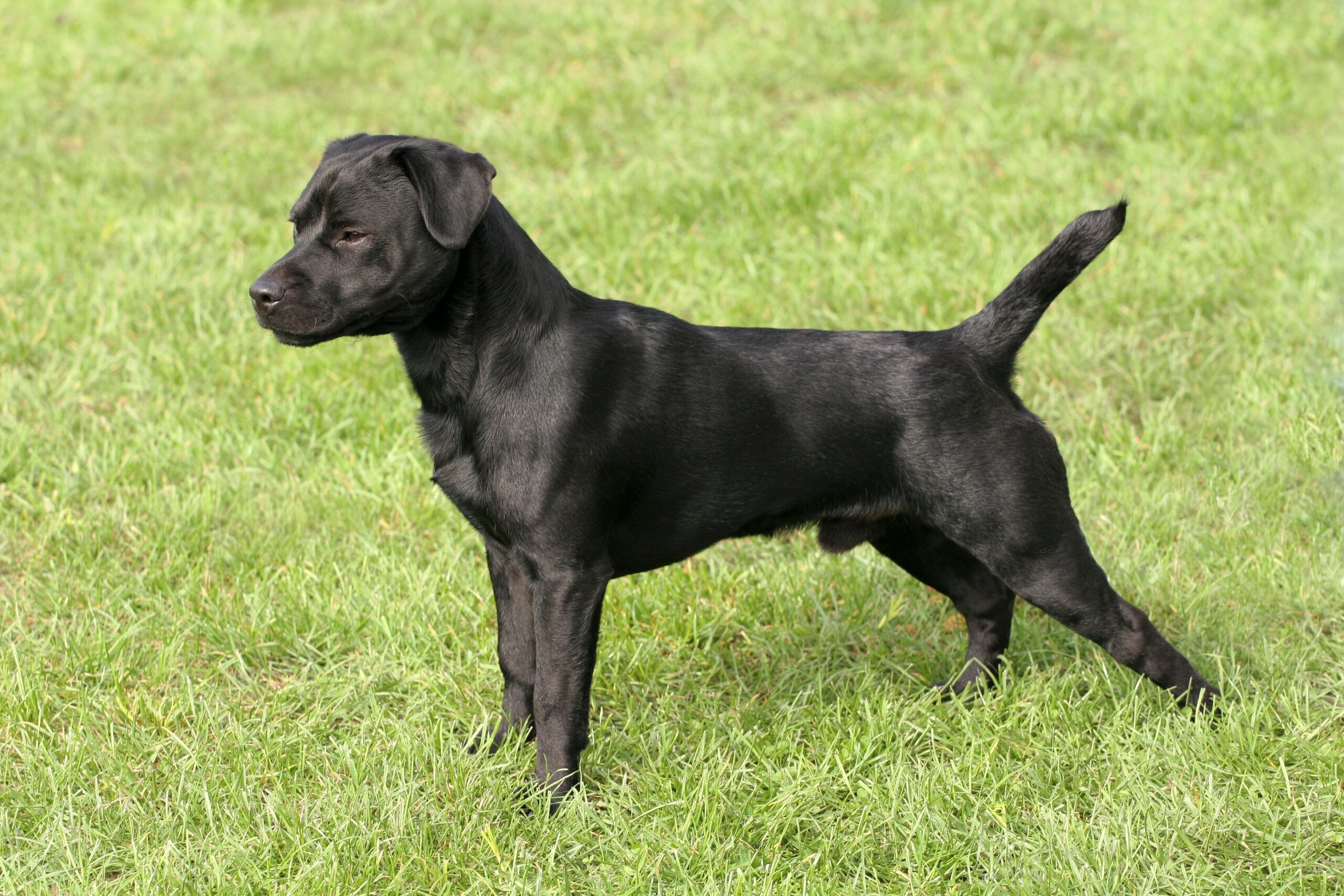
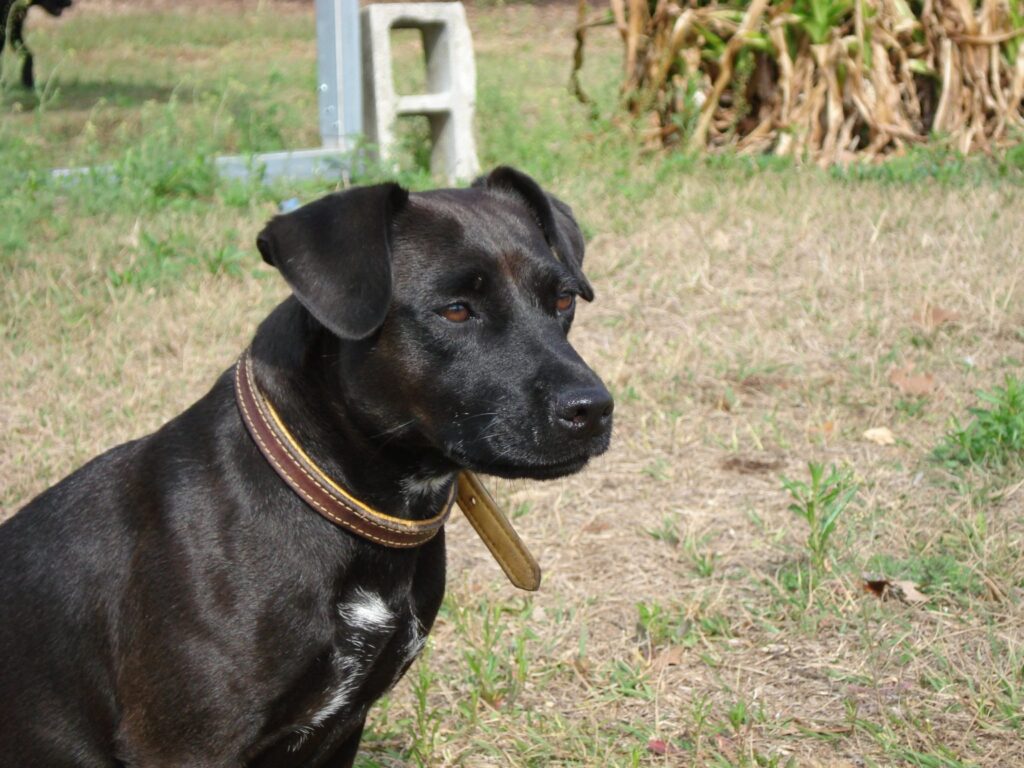
The Patterdale Terrier is an English working terrier from the Lake District, bred for work underground. Not recognized by the FCI: the full standard comes from the United Kennel Club (since 1995), the PTCA breed club publishes one of its own, and the two differ in the details. A tireless, strong-willed dog for active owners rather than a decorative companion: energy level and prey drive both run very high, which makes cats and a first-time owner a hard fit.
Prone to digging under fences and taking off after quarry
Size
ToySmallMediumLargeGiant
Compatibility
Apartment · with caveatsKids · with caveatsCats · not suitableOther dogs · with caveatsBeginners · not suitable
The Patterdale Terrier is a compact working terrier from the Lake District in northwest England. The thing that matters most about him shows up before any description of his looks: this is not a breed in the registry sense but a working type — one that most of the big canine organizations do not describe at all, and the few that do describe it differently from one another. That is why this page says, every single time, whose requirement is being quoted. Find similar breeds at Tvaryny.
Who Actually Describes the Patterdale — and Why the Descriptions Differ
The question of what the Patterdale standard says has no single answer, because no single standard exists. The breed is absent from the nomenclature of the Fédération Cynologique Internationale (FCI). It is absent from the breed list of the American Kennel Club (AKC) as well — even though that same list contains the Lakeland Terrier, the Border Terrier and the Parson Russell Terrier, which are the Patterdale's closest neighbors. It is missing in the same way from both the list of standards and the breed list of the British Kennel Club, where the Lakeland, the Bedlington, the Border and the Parson all hold their places.
Absence from a list that includes the neighbors of the same group is a meaningful fact, not a gap in our search. It means exactly what it means: in those registries the Patterdale has no standard, no number and no show class.
Two organizations, on the other hand, have indeed described the breed, and they are the ones worth citing.
The United Kennel Club (UKC, USA) recognized the Patterdale Terrier on 1 January 1995 and placed it in the terrier group. The current revision of the official UKC standard is dated 1 December 2014. It is a full show standard — with a list of faults, serious faults and disqualifications.
The Patterdale Terrier Club of America (PTCA) is the breed club, and it publishes a written standard of its own with requirements of its own.
Two documents are not “the right one and the wrong one”. They are two different criteria for inclusion, and each of them applies at its own events. The differences between them are entirely specific:
Feature · 7
Feature
UKC standard (2014 revision)
PTCA standard
Height
10–15 inches at the withers
10–15 inches at the shoulder
Weight
Names no figure whatsoever: “weight should be in proportion to height”
In proportion to height; “twelve to twenty pounds would be average”
Color
Black, red, chocolate, grizzle, black and tan, and bronze
Black, red, chocolate, black and tan — with an explicit statement that other colors are not registered
Tail docking
If docked, just a quarter or a third is taken off
If docked, no more than a quarter
Eye color
In harmony with the coat, but never blue
Brown or hazel; in chocolates, any shade of amber
Ears
Triangular, folded closely, set slightly above the skull
“Button” ears with a tight fold
Disqualifications
Four: cryptorchidism, viciousness or excessive shyness, albinism, any white patch on the body or head
Two: cryptorchidism, shyness or viciousness
The practical conclusion for a buyer is simple: the question “does this dog conform to the standard” is empty without saying which one. The very same grizzle or bronze dog passes under the UKC standard and is not registered under the PTCA color list.
Working Qualities — and Why the Law Matters More Here Than Tradition
Interesting Facts About the Breed
Recognized, but not everywhere. The UKC recognized the breed on 1 January 1995, while the AKC and the British Kennel Club still do not have it on their lists today.
The name once belonged to another breed. In 1921 the name “Lakeland” was introduced precisely in order to cover with it several local names, among which “Patterdale” was one; in a book of 1922 the same dog in a photograph is captioned with both names at once.
The dog is judged by touch. Feeling the rib cage with both hands is not an owners' custom but a judging procedure written into the UKC standard.
Scars are not a fault. The UKC standard calls the marks of working injuries honorable and forbids penalizing them; teeth broken at work are not punished either.
A Bedlington in the pedigree. In the 1903 letter a stud dog by the name of Blondin, a “dwarf pedigree Bedlington”, is named as a dog that was widely used to improve the mountain terriers.
History of Origin: What Is Documented and What Is Oral Tradition
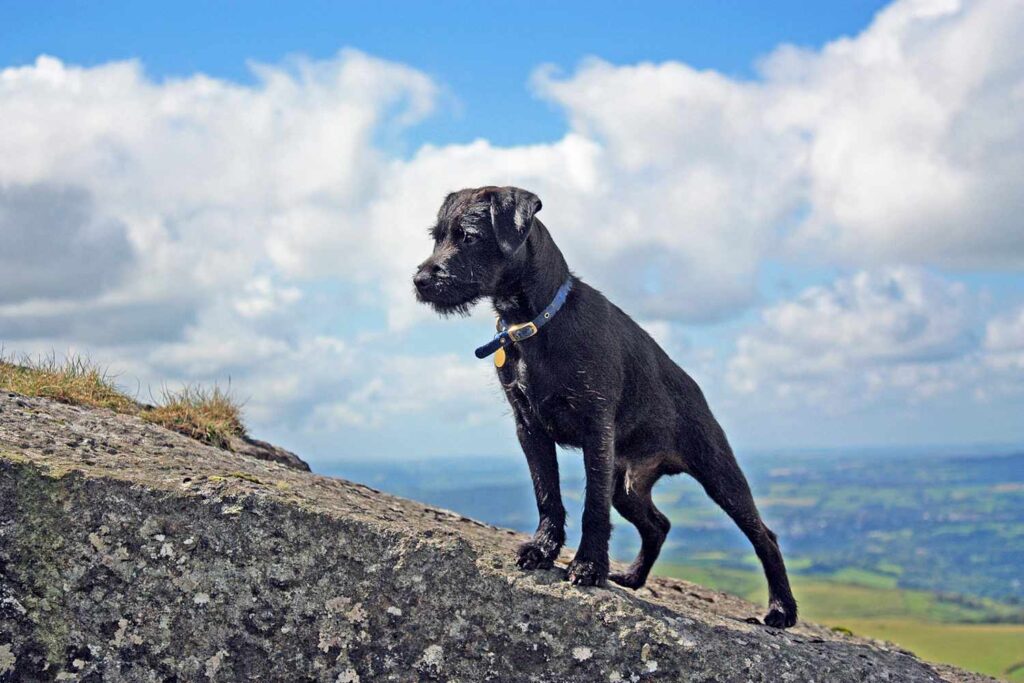
The name comes from the village of Patterdale in the county of Cumbria. The Lake District means steep slopes, stony scree, fog and constant rain, and the local farmers needed not a handsome dog but one that would go into a rock pile after a fox and come out of it alive. The main criterion of selection was gameness — the willingness to work against the quarry and not to give ground; the word is still used untranslated.
After that it becomes more complicated. The history of working types is almost always oral, and the Patterdale is a textbook case: what is retold most often is the worst supported by documents.
The first trap is the name itself. At the beginning of the twentieth century “Patterdale Terrier” did not mean the dog that is called that today. The clearest proof is Richard Clapham's book “Foxes, Foxhounds and Fox-hunting” (1922): the caption under a photograph there reads “A Lakeland Working Terrier. One of the ‘Patterdale' Breed” — that is, the same dog carries both names at once, and in the picture the dog is light-colored and shaggy, not at all like today's black smooth-coated Patterdale.
The matter was settled in 1921, when the Lakeland Terrier Association was founded and fixed the name “Lakeland” precisely in order to cover with it all the local names that had been in parallel use until then — Patterdale, Ennerdale, Fell, Cumberland and Westmorland terriers. So the modern Lakeland Terrier absorbed the name “Patterdale” as well; and the name thus freed later attached itself to the working type that remained outside the registries. That is why old books and articles containing the word “Patterdale” have to be read with care: they are not necessarily about today's black dog.
The earliest detailed description we are able to quote is a letter from Lord Decies under the heading “The Patterdale Terriers”, printed in the magazine The Field on 18 April 1903; the PTCA reproduces its text on its website. The author writes that he kept a notebook on his terriers for twenty years, and describes the type a fell terrier needs: very active, rather leggy, “narrow in the chest, weighing about 15 or 16 pounds”, with a weather-resistant coat. The same letter names Red Tinker — “the ancestor of many of today's Patterdale Terriers” — and Blondin, described as a “dwarf pedigree Bedlington”, which was widely used at stud “to improve the mountain terriers”. So the part played by the Bedlington in the forming of the type is not a guess but something a participant in the events states outright.
The second trap is Joe Bowman. The name of this huntsman of the Ullswater Foxhounds is mentioned in most popular descriptions as the “creator” of the Patterdale — it was he, so the story goes, who crossed the blue-black Border Terrier with the black and tan fell terrier. The trouble is that the modern sources describe different dogs from the ones the sources of his own time describe. That same Clapham writes in 1922 about the terriers of the “Patterdale breed” at Bowman's that they have “a good deal of Bedlington blood” and weigh from 14 to 16 pounds, while the dogs he names individually are red, brown wire-haired, blue. There is no black smooth-coated dog among them. So Bowman did indeed keep terriers that were called Patterdales — but they were dogs of the type that later became the Lakeland.
The 1903 letter reads the same way: its author lists terriers that he lent to Bowman over sixteen years. What matters is that two decades later Clapham independently mentions the same dogs — Sweep, which belonged to Lord Decies, and Corby, and Blondin — and this confirms that the letter is not a late invention. In this picture Bowman is an outstanding user and popularizer of working terriers, not the man who created the modern type.
The most interesting part here is how exactly the legend gained weight in the retelling, because that can be followed step by step. Several present-day pages repeat one and the same sentence, which carries no reference to a source; and with every retelling the details shift. The age at which Bowman is supposed to have taken up the post moves about. The post itself moves about too: popular accounts make him the Master of the Ullswater Foxhounds, whereas a source from his own time calls quite another man the Master and Bowman the huntsman, the man who handles the pack. And the one page among them that carries footnotes lists by name everyone who held the post of Master — and Bowman is not in that list.
That is the practical lesson of this section, and it is worth carrying over to any other breed: the sheer number of sites repeating a story adds no weight to it if all of them are retelling one sourceless sentence. The sign to watch for is details that drift: when the age, the post or the color change from one version to the next, nobody involved ever had the document in their hands.
When the modern black Patterdale appeared. Here the sources agree on the names and disagree on the dates. Modern accounts unanimously name Cyril Breay and Frank Buck, who worked with the type purposefully in the 1950s, and Brian Nuttall, whose lines from the end of the 1950s and the 1960s stand behind many of today's dogs. But these are modern accounts and not documents of that era. That is why the range of dates that various authors give for the beginning of the modern breed is stretched over half a century — from the 1910s to the 1960s — and none of these dates should be presented as established.
Why there are so few primary documents — and this is an explanation, not an excuse. The gap here has at least three concrete causes, and each of them is checkable. First, nobody registered the working terriers of the Lake District, because no registry existed for them: the first registry of the breed — the PTCA club — was founded as late as 1993, and in America at that. Second, records were kept and preserved privately: Lord Decies writes outright that for twenty years he kept a book on his terriers — so the point is not that nobody wrote anything down, but that those records never entered public circulation. Third, the nineteenth-century author Rawdon Lee, describing the terriers of Cumberland and Westmorland, noted outright that they were not bred consistently and that the type was not fixed — so in those decades there really was nothing to record as a “breed”. An absence of documents that has been explained is a checkable statement, and it is far more useful than a vague “the sources disagree”.
The fate of the next version is telling as well — the claim that the name was put into wide circulation by Brian Nuttall. Asked directly, he replied that rough, smooth and broken-coated terriers in his part of the country “were always called Patterdales or fells, depending on who you are talking to”. So this version, too, fails to survive a check with the participant himself.
The UKC's own historical note puts the origin more cautiously and more broadly: the breed “descends mainly from the black smooth-coated fell terrier bred in the harsh conditions of northern England”, kept against predators dangerous to sheep. It is worth remembering that the historical section of a standard is the registry's position rather than an independently established fact; but it is precisely this more cautious version that agrees with the documents best.
Appearance: Function Above Everything
Temperament and Character: Little Devil or Devoted Friend?
This is the section that matters most to a future owner, and the UKC standard states its view here unusually bluntly for a document of the genre: Patterdales are “very willing workers with a strong desire to please”, but this is not a dog for the ordinary pet owner, and the owner needs a sense of humor and an understanding of true terrier character. It is a rare thing for a registry to warn a buyer this directly.
At home the Patterdale is mostly gentle and affectionate, sometimes to the point of clinginess. But his switch into working mode is instantaneous, and in intensity and refusal to compromise he is noticeably harder than the Border Terrier, which is often regarded as the softer alternative.
In manner of work and level of arousal Patterdales are closest to the German Hunting Terrier (Jagdterrier). Both are inclined to overestimate their own strength and to attack an opponent considerably larger than themselves. The practical consequence in town is a single and very concrete one: a walk off leash where there are cats, squirrels or a street is a risk with nothing to justify it, because the chase switches on faster than obedience takes hold.
Towards people Patterdales are usually loyal; the UKC standard requires the dog to be calm with people, livestock and other dogs, and viciousness or excessive shyness are on the list of disqualifications. In practice, however, males often clash with one another, so it is wiser to take a second dog of the opposite sex into the house. Small animals — hamsters, rats, rabbits — do not live alongside a Patterdale: the hunting instinct here is too strong to rely on socialization.
Unlike the ODIS, which was bred first of all as a companion with a moderate temperament, the Patterdale needs consistent rules and a serious workload. This is not a dog with which soft vagueness in upbringing works.
Pros and Cons of the Breed
Pros (+)
Cons (−)
Compact size: easy to haul around, to take along on trips, to keep in a small home.
Need for exercise: without daily work for head and body he becomes destructive.
Simple grooming: the coat needs no complicated trimming.
Dog aggression: males often clash with other males.
Quick wits: learns fast when there is motivation.
Hunting instinct: bolts after cats and small wildlife; incompatible with rodents.
Devotion: attaches strongly to his own person.
A digger: an ordinary fence will not hold him.
Stamina: a true working dog with a large reserve of strength.
Stubbornness: independence at work turns into independence at home.
Maintenance and Care: Simple Yet Complex
Grooming a Patterdale asks very little — the UKC standard notes outright that very little care is needed to keep the coat in order. What makes the breed hard to live with lies in an entirely different place.
Smooth-coated. It is enough to go over the dog once a week with a damp cloth or a rubber mitt to gather up the dead hair.
Rough-coated and broken. These need stripping (plucking) several times a year. It is not merely a matter of looks: old coat does not fall out by itself and can cause itching.
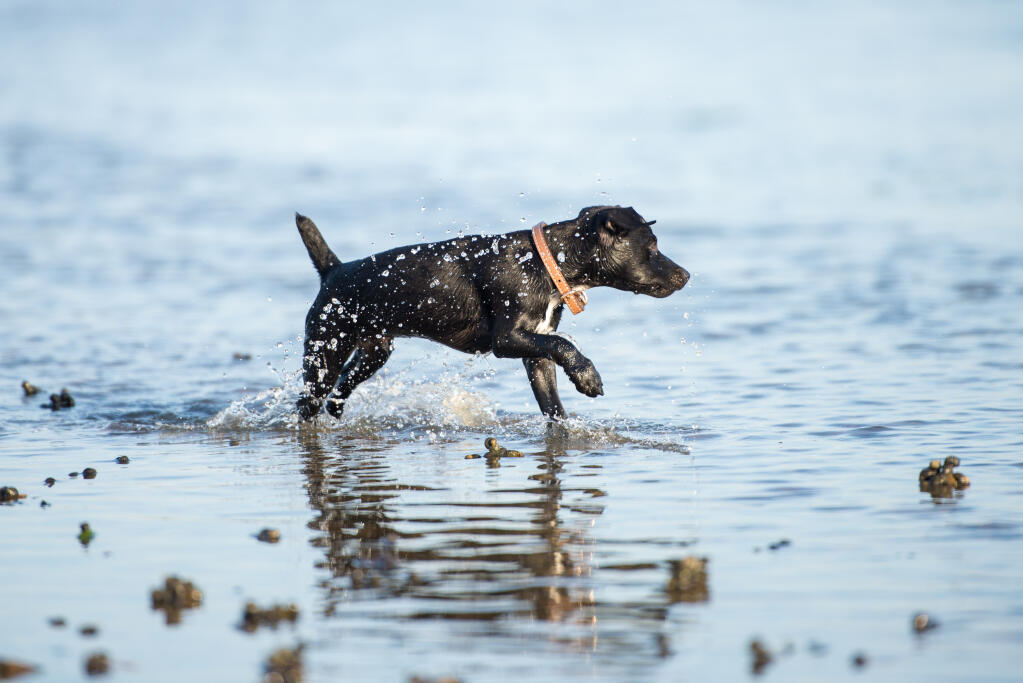
The real work for the owner is finding an outlet for the dog's energy. A quarter of an hour around the yard does nothing for a Patterdale. He needs to run, to search, to dig and to solve problems, and without that he will find himself a job: holes under the fence, wrecked furniture and shredded wallpaper are the typical result of boredom rather than of a bad character. Any activity with a searching or a speed component suits — nose work, agility, flyball; the UKC, incidentally, runs coursing and nose work competitions that are open to the breed. The stamina of these dogs really is noticeable: they are able to accompany a bicycle for kilometers.
The tendency to take off has to be figured in separately. Patterdales climb well and dig even better, so the fence has to be tall and dig-proofed at the bottom — otherwise the hunting instinct will sooner or later take the dog beyond the perimeter.
Nutrition
Nutritional Needs: Fuel for a Working Dog
Health and risks
Health and Genetic Features
Frequently Asked Questions About the Breed (FAQ) · 3
Is a Patterdale suitable for an apartment? Size is not what stands in the way; the owner's way of life is. The dog needs several hours of activity a day, including work for the head. If that time is not there, the breed will not work out no matter how many square feet you have.
Do they shed much? Moderately. Smooth-coated dogs shed seasonally; rough-coated and broken ones are hand-stripped regularly, and then there is almost no hair around the house.
How are they with children? Usually fine, as long as the kids respect the dog's boundaries. Patterdales are glad to play and to run, but they will not put up with rough handling or pain, so for families with very small children the breed is not the best choice.
Video About the Breed
FAQ
Is the Patterdale a breed or a type?
It is a working type of terrier from the Lake District. The FCI, the AKC and the British Kennel Club do not describe it; the full standard belongs to the United Kennel Club (recognized on January 1, 1995), and the PTCA breed club publishes one of its own — and their color lists and requirements do not agree.
Is a Patterdale a good fit for a first-time owner?
It is a hard fit. The UKC standard says outright that this is not a dog for the ordinary pet owner: experience, consistency and serious daily exercise are needed.
Does he get along with cats?
Usually not — a strong prey drive makes living with cats and small animals risky.