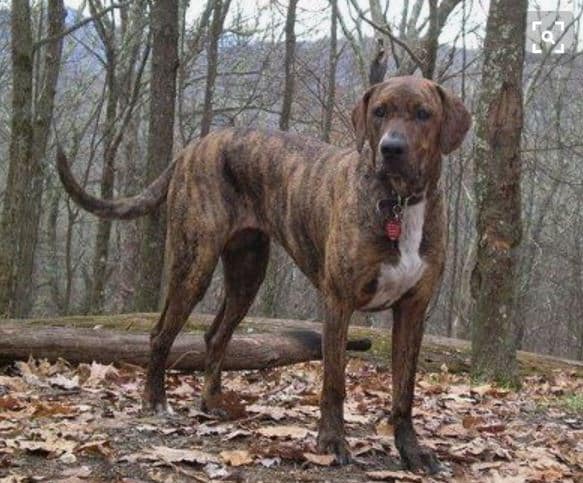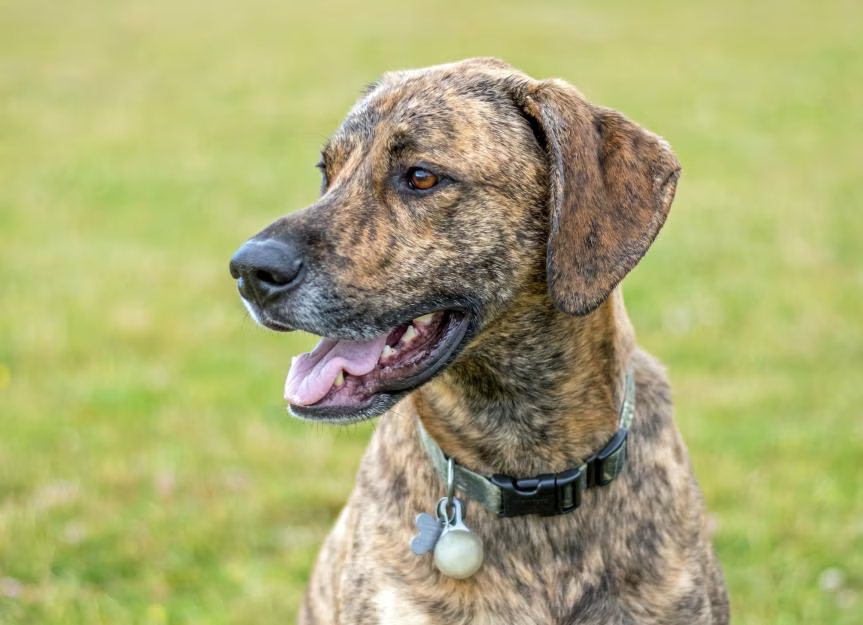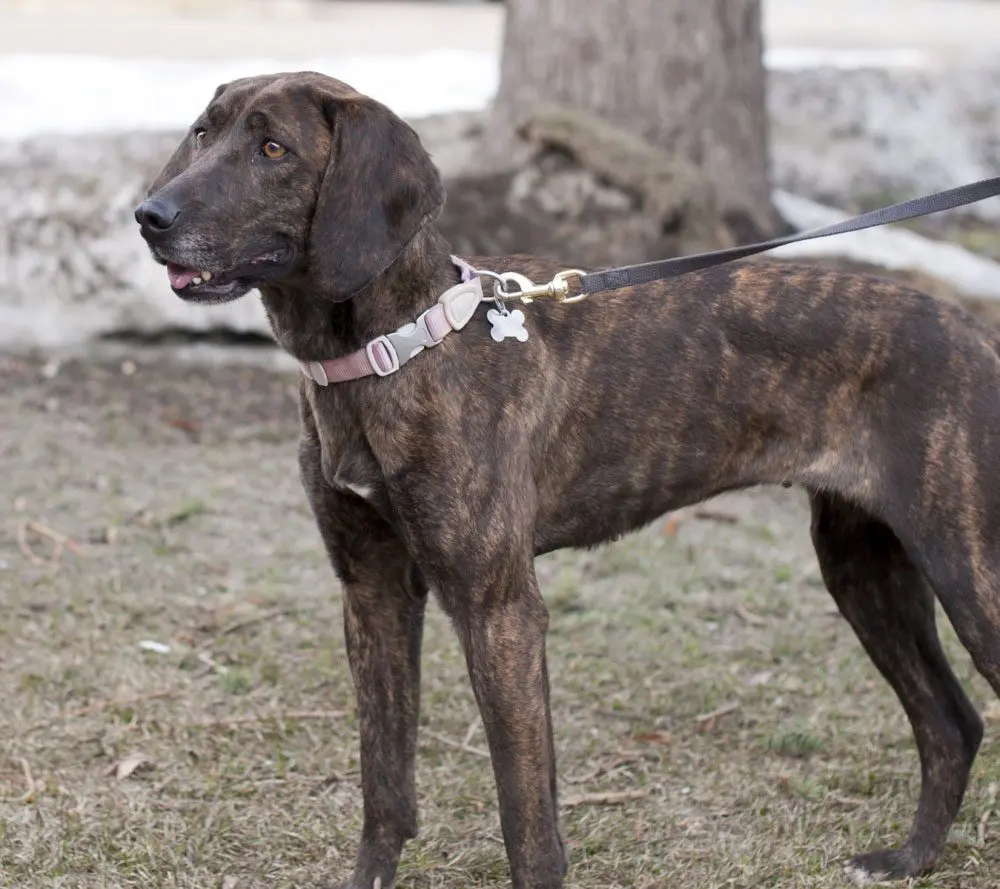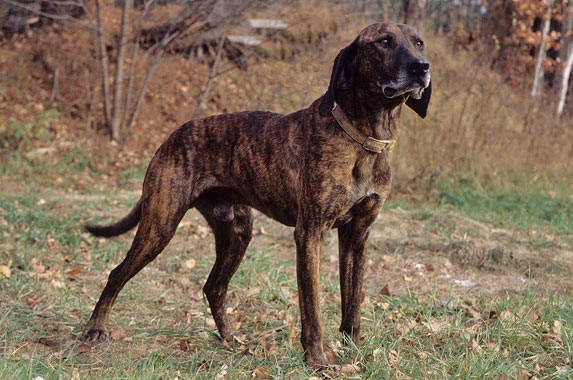
The Plott Hound is the only American coonhound whose ancestry is traced not to English Foxhounds but to German scenthounds brought to North Carolina in the middle of the eighteenth century. That is no decorative detail of its biography: the breed was shaped for bear and boar rather than raccoon, and that is where its endurance, its voice, its grip and the streak of independence that beginners mistake for stubbornness all come from. What follows rests on first-hand sources — both standards in force (UKC and AKC), the text of the state law, and the veterinary literature on the breed. Learn more on Tvaryny.
What "Two Hundred Years of a Family Line" Actually Means
This is the most interesting place in the breed's history, and the most often misrepresented. The claim that "the family kept the line for more than two centuries" is true in one sense and overstated in another — both are worth unpacking.
The duration is true. From the arrival in 1750 to national fame in the 1930s and 1940s, the dogs remained above all a Plott family affair in western North Carolina — roughly seven human generations. Few breeds can claim such continuity, and it is what gave the Plott a recognizable type long before any written standard existed.
But "kept" does not mean "recorded." NCpedia notes it explicitly: the Plott family kept no written records of their dogs. Those two centuries of line are therefore an orally transmitted family tradition and a reputation among hunters, not a preserved written pedigree. When you read "a documented two-hundred-year line" somewhere, it credits the breed with more than the source allows.
And "pure" comes with reservations too. Here the two standing registries tell different stories, and that is worth knowing:
- The UKC version. Plott supposedly "kept the strain entirely pure, with no outside blood." In 1780 the pack passed to Henry Plott. Soon afterward a hunter from Georgia who bred his own strain of spotted "leopard" bear dogs came to see the Plotts — and borrowed one of the best stud dogs for a year for his own bitches. The UKC presents this as the only known infusion of new blood in the breed's entire history in America.
- The AKC version. In the AKC's account that same Henry Plott crossed the family pack with local dogs — and out of that came the big-game hunter first called "Plott's dog," then the Plott Hound, then simply the Plott.
- An episode around 1900. The UKC mentions G. P. Ferguson, a neighbor of the family, whose influence on the breed was major and who studied the Blevins and Cable strains of the day closely. How far he used that blood in his own breeding program, the UKC honestly marks as unknown.
The formula that survives checking looks like this: a German base, plus more than two centuries of family selection in the mountains, plus at least one acknowledged infusion of outside blood and a few episodes the registries themselves call unknown. It explains why the Plott stands apart among coonhounds without turning the breed into a genetic reserve it never was.
The Registries: UKC, AKC, and the FCI Question
The breed lives inside two American systems, and that affects everything — from the name to the figures in the standard.
- UKC — 1946. The oldest and still the principal "working" registration. The revision in force dates from January 1, 2020; the text itself carries a 1982 copyright. The breed sits in the Scenthound Group.
- AKC — two dates that are often confused. The official AKC standard was approved in June 1998 and took effect on October 1, 1998. But the year the AKC recognized the breed is 2006, in the Hound Group. Sources that give 1998 as "the year of AKC recognition" are in fact giving the year of the standard. These are two different events — both dates are correct, they simply describe different things.
- FCI. The nomenclature of the Fédération Cynologique Internationale contains no Plott Hound standard. The only American coonhound with its own FCI number is the Black and Tan Coonhound (no. 300, group 6, country of origin USA). In Europe the Plott is therefore handled through the UKC/AKC and national clubs rather than through the FCI system.
One more detail about the name: the title of the official AKC standard is simply "Plott", while the AKC breed page and the UKC use the full form "Plott Hound". Both are correct.
Sizes: Why a Single Figure Does Not Work Here
A very common mistake is to give "the Plott's height" as one range. There are in fact four ranges: each of the two registries has its own figures, and each of them sets males and females separately. The UKC describes a noticeably larger dog than the AKC. Hence the table below, where every number has one meaning and one source.
Sizes: Why a Single Figure Does Not Work Here · 6
| Parameter | UKC standard (rev. 01.01.2020) | AKC standard (appr. 06.1998) |
|---|---|---|
| Height at withers, males | 22–27 inches (56–69 cm) | 20–25 inches (51–64 cm) |
| Height at withers, females | 21–25 inches (53–64 cm) | 20–23 inches (51–58 cm) |
| Weight, males | 50–75 lb (23–34 kg) | 50–60 lb (23–27 kg), in hunting condition |
| Weight, females | 40–65 lb (18–29 kg) | 40–55 lb (18–25 kg), in hunting condition |
| Ear spread | not standardized | males 18–20 inches, females 17–19 inches |
| Outside the size limits | eliminating fault (except the puppy class) | assessed as a fault of construction |
The AKC gives a lifespan of 12–14 years. If you see "Plott height 50–63 cm" somewhere with no sex and no registry attached, that is four different norms fused into one, and it is useless as a guide when choosing a puppy.
The Work: Bear and Boar, Not Raccoon
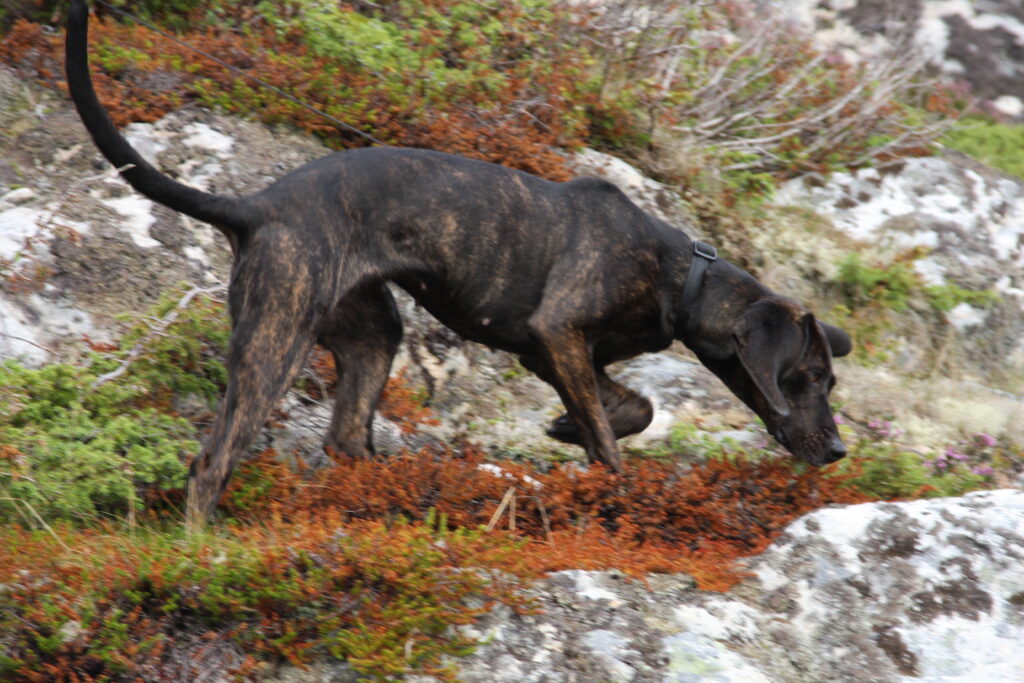
Here lies the main difference between the Plott and the other coonhounds, and it explains almost everything about keeping one. The classic coonhound specializes in raccoon: find the trail, catch up, tree the quarry, report with the voice, and wait. The Plott was formed differently. The UKC says so in as many words: there were no wild boar in the America of that time, so Plott put his boar dogs on bear. The preamble to the state law describes a legendary hunting breed, known as the most courageous of fighters and a tracker that never lets go.
The AKC frames the breed's task as bringing big game to bay or treeing it, and among its marks it names endurance, stamina, agility, determination, and drive at work. The UKC adds two traits owners often underestimate: a strong treeing instinct and a natural willingness to enter water. A Plott will go into water by itself, without invitation.
The difference between "raccoon" work and "bear" work is a difference of distance, duration, and risk. A bear chase lasts longer, goes over harder ground, and ends in direct contact with an animal that can fight back. Hence the physical type: a streamlined body, well-marked angulation, a long muscular thigh, and feet that converge into a single line at speed — all of it described in the standards as requirements of movement. Hence, too, that obstinacy at work which hunters value and city owners complain about: the dog was selected for centuries for the ability not to quit.
A comparable uncompromising streak exists in breeds of an entirely different size. The small but brave Patterdale Terrier also works "on contact," underground. For the owner it means the same thing in both cases: heightened attention to the animal's safety, because a dog that cannot back off will not spare itself.
The breed's working culture also shows in how its competitions are arranged. The UKC runs not only conformation rings for coonhounds but also nite hunts, water races, and field trials — and spayed and neutered dogs are admitted to all licensed coonhound events. The working format is therefore open to owners who do not breed.
What That Means for a Dog That Does Not Hunt
Plotts are not taken only by hunters — and that is where most problems begin. The breed does not decay without hunting, but it does not idle either: the endurance, the nose, and the drive do not go anywhere, and if they are not given a job they will find one themselves.
- Exercise — daily and long. A walk around the block is simply not exercise for a hound built for hours of casting through mountain forest. What is needed is long routes over varied ground, running beside a bicycle, swimming.
- The nose beats the ball. The surest way to tire a Plott is to let it work its nose. Search games, mantrailing, tracking, and nose work drain such a dog faster and deeper than plain running.
- Fence and leash are not formalities. A dog that has taken a fresh trail stops hearing. A solid fence, and the leash wherever the space is not safe, are basic conditions rather than over-caution.
- A yard without a job does not help. A large yard is a place, not an activity. Left alone outside, a Plott usually starts announcing everything it sees and hears — and that is exactly how conflicts with the neighbors start.
In short: this is a working breed and it needs a workload, and an honest answer to "is a Plott right for me?" starts with the owner's schedule, not with a photograph of a brindle coat.
Interesting Facts About the Breed
- State dog — and a criminal clause in the same law. The Plott Hound was officially adopted as the state dog of North Carolina on August 12, 1989 (Session Laws, 1989, c. 773, Senate Bill 832). The most curious thing is the act's full title: it did not merely proclaim a state dog, it also made dog theft a Class J felony and the temporary taking of a dog a misdemeanor. The honor paid to the breed thus arrived in the same package as a tightening of penalties for dog theft in general.
- The only breed developed in North Carolina. That is NCpedia's formulation; the preamble to the 1989 law likewise states that this is the only breed known to have originated in the state, and places it among four breeds of American origin — exactly as the legislature of the time saw it.
- Without a British ancestor — but not alone. The common claim "the only coonhound with no English Foxhound in its ancestry" is accurate only within the AKC, which counts six coonhound breeds. The UKC counts seven, and there are then two: the Plott Hound and the American Leopard Hound.
- The mark on the rump. The AKC standard begins not with a description of the dog but with a permission: a hunting identification mark on the rump must not be penalized in the ring.
- The family on the map. Plott Valley, Plott Balsam mountain, and Plott Creek in North Carolina are named after that same family.
- The standard is still changing. The UKC revision in force since January 1, 2020 removed the disqualification for a solid coat — a single-colored Plott is no longer out of the game.
- A contribution to medicine. The model of mucopolysaccharidosis type I on which approaches to treating the human disease were tested goes back to three Plott Hound puppies from one litter, described in 1983.