

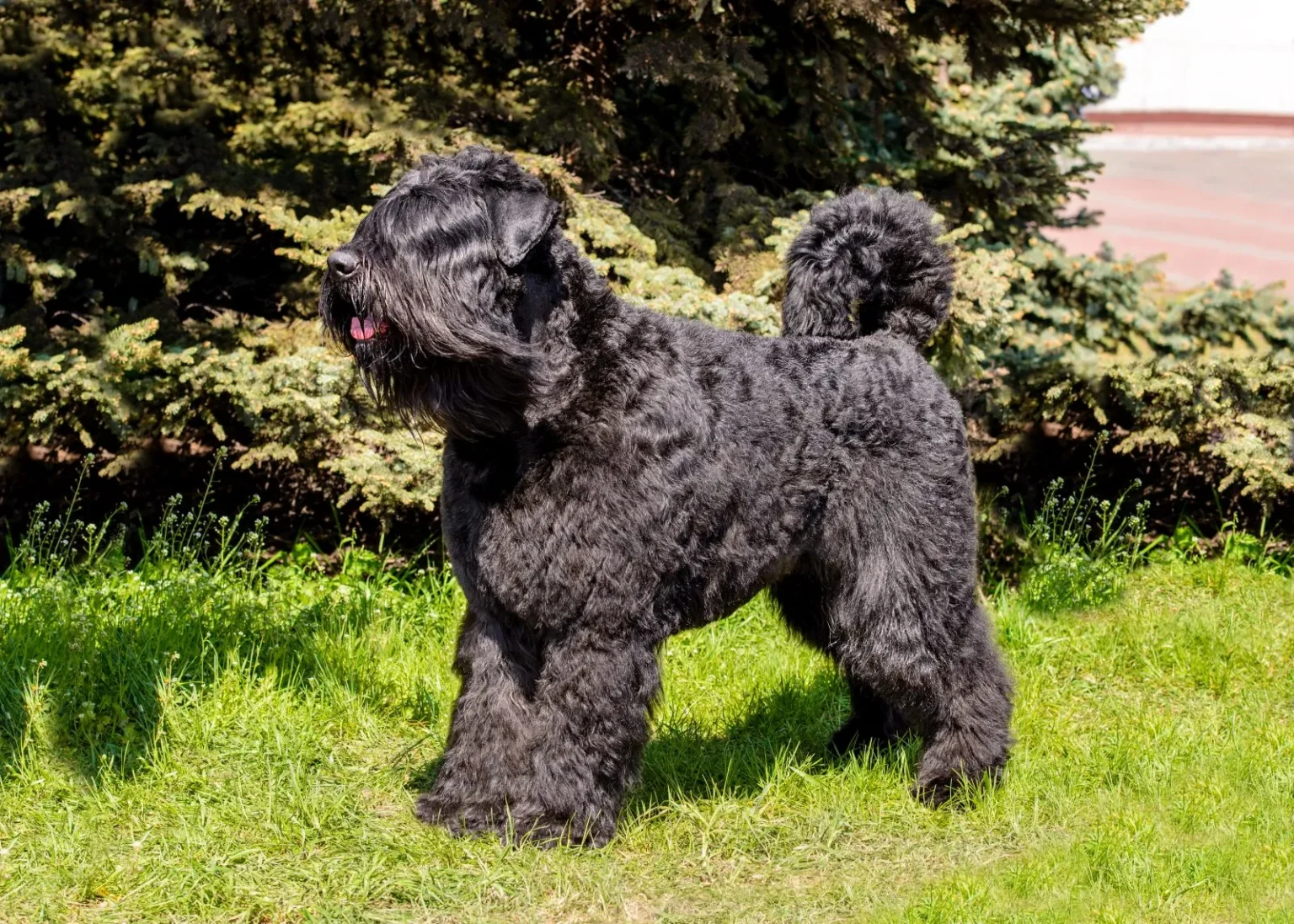
| Height | 59–68 cm |
| Weight | 27–54 kg |
| Lifespan | 10–12 years |
| FCI group | 1 · herding dogs |
| Origin | Belgium |
Exact ratings
- Hip dysplasia
- Glaucoma (hereditary, young age)
- Cataract and entropion (in-rolling eyelids)
- Gastric torsion (bloat)
- Hypothyroidism
Quality protein for an active breed, with weight control; feed small portions (bloat risk). Regular grooming of the dense "bearded" coat.
The Bouvier des Flandres (Flanders Cattle Dog) is not just a dog – it’s a living legend of Flanders that has survived wars, worked tirelessly on farms, and evolved into an elite companion. If you are looking for a canine that combines the power of a bodyguard with the gentleness of a nanny, this review is exactly for you. But are you ready for the challenges this serious breed presents? Read more on Tvaryny.
Bouvier des Flandres: Brief Overview and Breed Characteristics
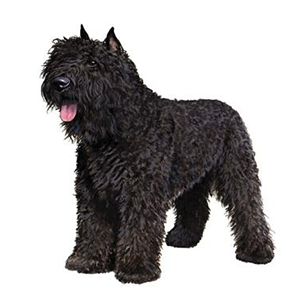
| Parameter | Characteristic |
|---|---|
| Origin | Belgium / France (Flanders) |
| FCI Group | 1 (Sheepdogs and Cattle Dogs) |
| First Mentioned | Late 19th Century (current standard since 1955) |
| Lifespan | 10-12 years |
| Height at Withers | Males: 62-68 cm (24.5-27 in), Females: 59-65 cm (23-25.5 in) |
| Weight | Males: 35-40 kg (77-88 lbs), Females: 27-35 kg (59-77 lbs) |
| Coat Type | Rough, double coat, requires stripping |
| Activity Level | High, needs a job to do |
There is great diversity in the world of herding dogs. For instance, if we compare them to other breeds, the Australian Stumpy Tail Cattle Dog is lighter and more agile, built for speed, whereas the Finnish Lapphund is a classic Spitz-type herder with a completely different temperament. Against this backdrop, the Bouvier des Flandres looks like a heavyweight contender, built specifically for power work.
History of the Breed: A Journey Through Centuries
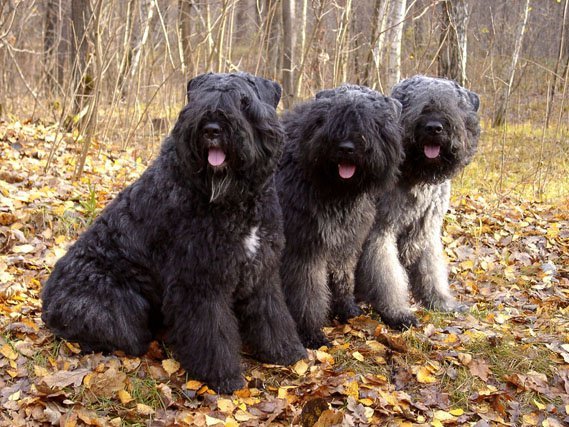
The history of this breed is tightly interwoven with the history of the Flanders region itself, which geographically spans parts of modern-day Belgium and France. In the Middle Ages, this was one of the most economically developed regions in Europe, where agriculture demanded powerful helpers.
Origins and Early Years
It is believed that the ancestors of the modern Bouvier appeared thanks to the monks of the Ter Duinen Abbey. They crossed local farm dogs with Deerhounds and Irish Wolfhounds brought from Britain, and later, likely added the blood of local Mastiffs. There is also a theory about the influence of Spanish dogs brought in during the Spanish rule in the 16th-18th centuries.
Until the early 20th century, there was no single type of “cow dog.” In every village, working qualities were valued above appearance. These dogs had to:
- Drive cows and bulls (hence the name “Bouvier” – ox drover).
- Pull carts loaded with milk and cheese to the market.
- Guard the farm against wolves and thieves.
By the way, the closest relative of our hero is the lesser-known Bouvier des Ardennes, which has retained an even more primitive and rugged look characteristic of old Belgian dogs.
Military Glory and Revival
World War I was a tragedy for the breed, but simultaneously its finest hour. Flanders turned into a field of brutal battles. Bouviers were actively used by the army as ambulance dogs, messengers, and draft power for machine guns. They hauled the wounded out under fire, displaying miracles of bravery. A legendary dog named Gamen even recieved a Red Cross medal.
After the war, the breed was nearly wiped out. Recovery began thanks to a few survivors and the enthusiasm of Belgian veterinarians. A National Club was established in 1922, but disputes between the French and Belgians regarding the standard (especially regarding coat color) continued until 1965, when the FCI approved the final standard uniting both types.
What the Bouvier des Flandres Looks Like: Detailed Exterior Description
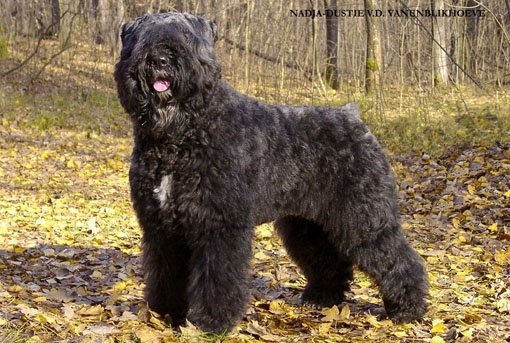
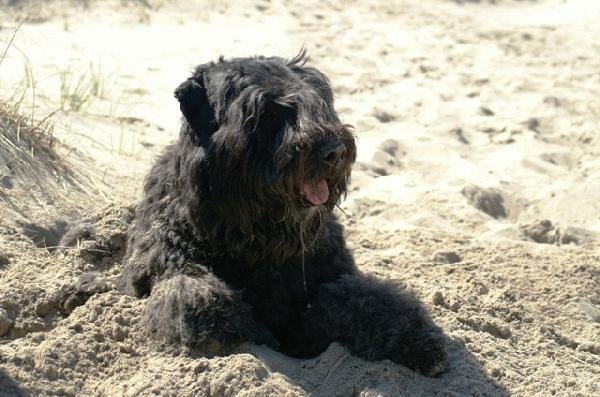
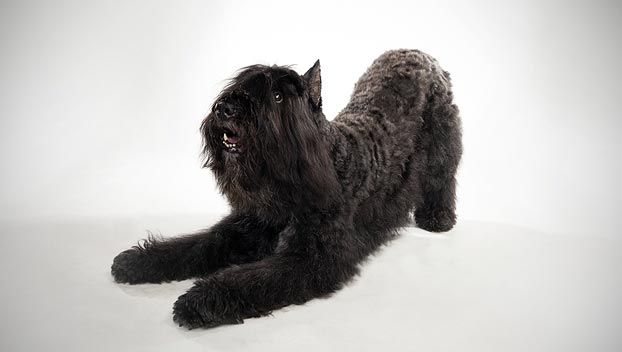
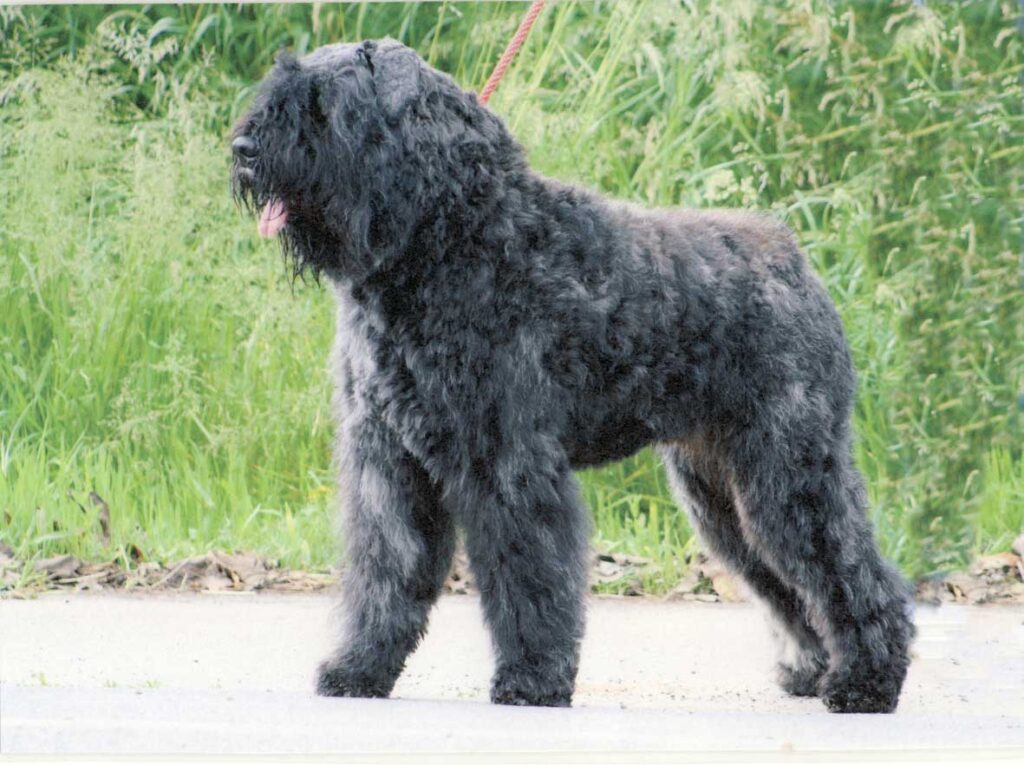
The appearance of the Bouvier des Flandres radiates primal power. This is a compact, square-built dog that seems to stand firmly on the ground with all four paws. You wouldn’t call it elegant in the classical sense, like a Doberman, but there is a distinct aesthetic in its rough strength.
- Head: Massive, proportional to the body. The skull is flat and wide. A characteristic feature is the “beard” and “mustache,” which make the muzzle look visually squarer and more formidable. The eyes are oval, dark, with an intelligent and bold gaze.
- Body: The back is short, broad, and muscular. The chest is deep, reaching down to the elbows. This is a dog with a powerful “engine” – a wide croup and strong thighs.
- Coat: This is the Bouvier’s main armor. The topcoat is very coarse, dry to the touch, and about 6 cm (2.5 in) long. Beneath it lies a dense, soft undercoat that protects against rain and cold. The fur should not feel silky to the touch.
Inexperienced people often confuse this breed with other large black dogs. For example, the Giant Schnauzer has a more elongated silhouette and a narrower head, while the Black Russian Terrier is significantly larger and has a different coat structure. The Bouvier remains unique in its “squareness” and compactness.
Character and Behavior: What Hides Behind the Stern Gaze?
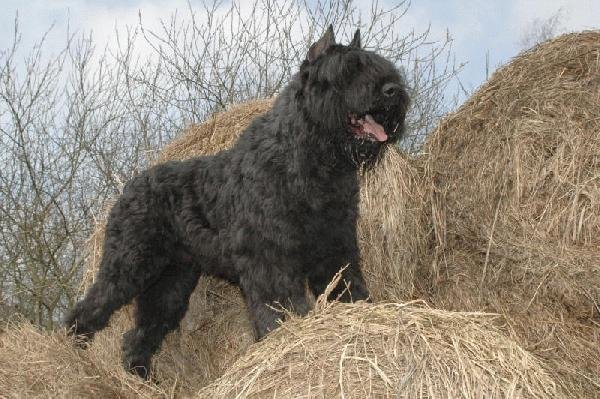
The Bouvier des Flandres is a personality. This is not the kind of dog that will stare into your eyes awaiting a command every single second, like a Border Collie. They have their own opinions, a sense of dignity, and high intelligence.
Family Relations
In the family circle, the “Belgian Bear” turns into a huge kitten. They become extremely attached to their owners. The Bouvier doesn’t choose just one master; he loves the entire “pack.” These dogs usually behave very carefully and patiently with children, allowing the little ones to get away with a lot. However, given the dog’s size, playtime with very small children should be supervised.
Guarding Qualities
This is a natural-born territory guardian. He doesn’t need special training to understand that a stranger on the property is a potential threat. Yet, the Bouvier is not a “nuisance barker.” He rarely barks, but if he does voice his opinion – it means something serious has happened. He typically attacks silently and swiftly, usually blocking the intruder first.
Pros and Cons of the Breed
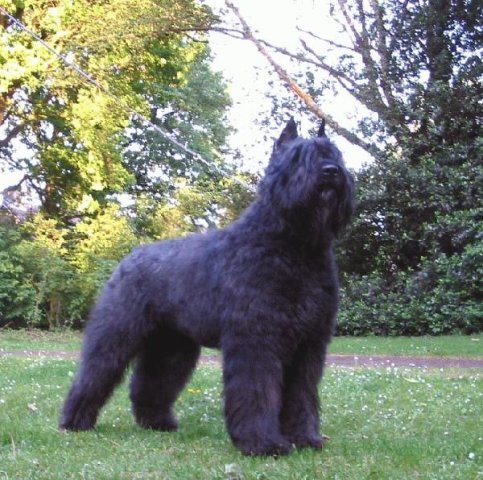
When choosing a dog, it is important to soberly assess not only its advantages but also the difficulties you will have to face. The Bouvier is not for everyone.
| Advantages (+) | Disadvantages (-) |
|---|---|
| Balanced psyche, stress resistance | Requires serious coat care (grooming) |
| Excellent guarding qualities without excess aggression | Can show stubbornness and dominance |
| Love for children and devotion to family | Characteristic “doggy smell” if poorly maintained |
| High intelligence and learning ability | Prone to gas (flatulence) |
| Robust health and endurance | Matures slowly (psychologically a puppy until 2-3 years old) |
| Can live both indoors and in a kennel | Beard is constantly wet and dirty after eating/drinking |
Coat Care Features
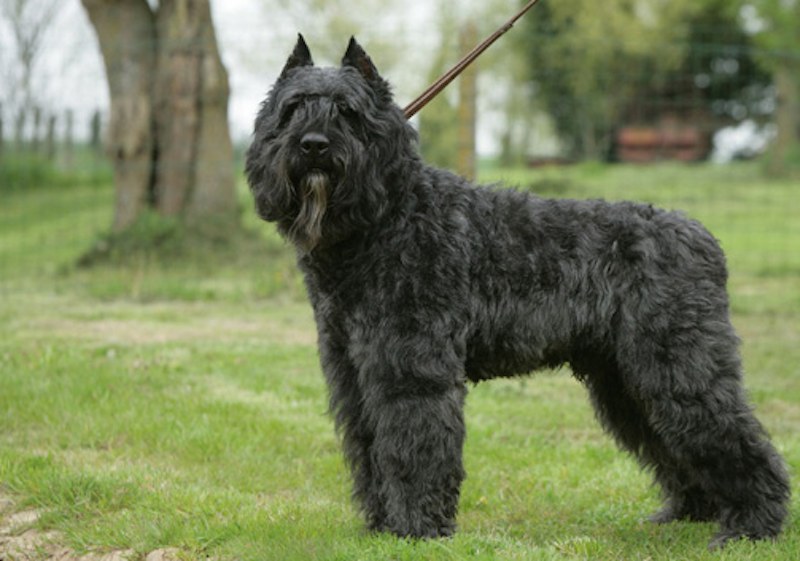
The coat is both the beauty and the main headache for a Bouvier owner. If you are not ready to dedicate time to grooming or pay professionals, you’d better consider another breed. The hair grows constantly and doesn’t shed in the usual way like shepherds. Dead hair gets stuck in the undercoat, forming mats.
- Brushing: At least 1-2 times a week. You need to use a slicker brush and a metal comb with long teeth to comb the wool right down to the skin. Superficial brushing will only worsen the situation, creating a felt-like mat near the skin.
- Stripping and Trimming: Since the coat is coarse, it is ideal to perform light stripping (plucking) of dead hair. However, most pet owners choose to clip with scissors and a machine once every 2-3 months. It is important to maintain a natural, slightly messy silhouette without turning the Bouvier into a Poodle.
- Beard Hygiene: This is a critical point. After every meal or drink, it is advisable to wipe the beard. Food scraps get stuck in it, which can lead to unpleasant odors and fungus development.
Health and Typical Diseases: What to Look Out For?
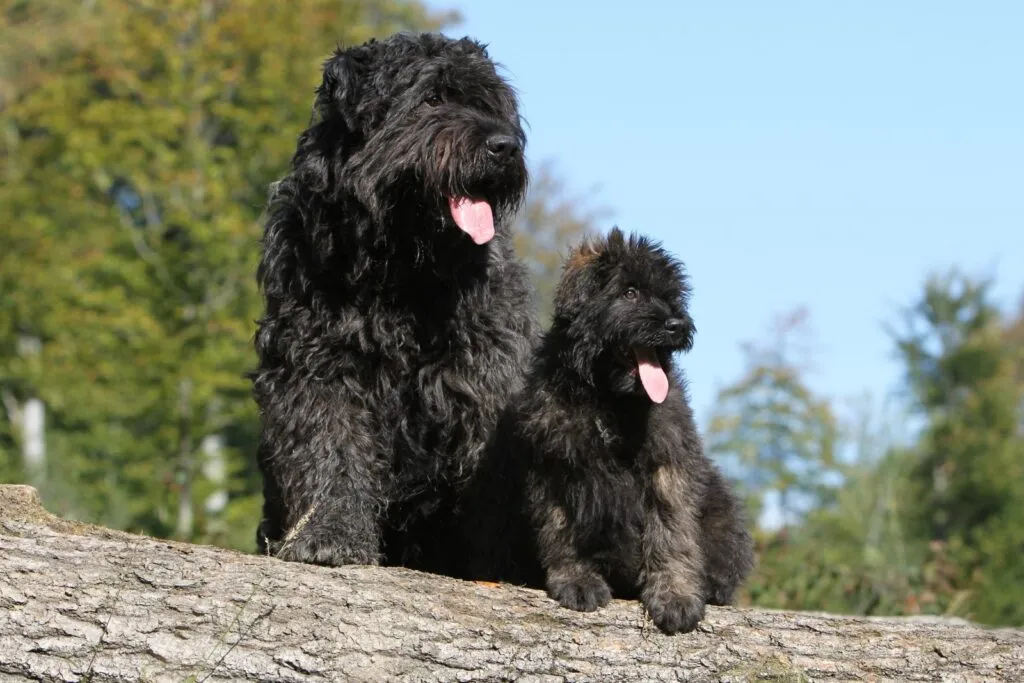
The Bouvier des Flandres is a breed with a high pain threshold. This means the dog can tolerate pain for a long time without showing that something is bothering him. Therefore, the owner needs to be very attentive to changes in behavior.
Main problems owners face:
- Hip and Elbow Dysplasia: A hereditary disease of large breeds. Be sure to demand test results of the puppy’s parents from the breeder.
- Gastric Torsion (Bloat): A deadly condition. To avoid this, do not feed the dog immediatley before or right after physical exertion.
- Eye Diseases: Glaucoma and entropion (inversion of the eyelid).
- Hypothyroidism: Dysfunction of the thyroid gland, leading to obesity and skin problems.
Training and Upbringing: Who’s the Boss?
Raising a Bouvier is a process that requires patience, consistency, and an “iron hand in a velvet glove.” Cruelty is unacceptable with this breed – the dog will withdraw into itself or start defending itself. But excessive softness will lead to the 88-pound dog deciding he is the pack leader.
Important Training Aspects:
- Early Socialization: This is critically important. The puppy must see other dogs, people, vehicles, and hear city noise. An isolated Bouvier will grow up aggressive or fearful.
- Motivation: They won’t work “for free” or just because, repeating a command 50 times. They need to be interested. Use play methods and treats.
- Sports: The Bouvier des Flandres performs excellently in IGP (obedience, protection, tracking), obedience, and even agility (if the course is adapted for large dogs).
Remember that Bouviers mature slowly. At 1.5 years old, he looks like an adult dog on the outside, but inside, he is still a teenager who might test the boundaries.
Nutrition: How to Feed the Athlete?
A healthy diet is the key to longevity. Given the predisposition to bloat, the daily ration should be divided into 2 equal parts (feed in the morning and evening) and ensure the dog rests for at least an hour after eating.
Raw Feeding vs Dry Food
If you choose dry food, it should be Super Premium or Holistic grade for large breeds. Pay attention to the protein content (at least 25%) and chondroprotectors for joints.
With natural feeding, the basis of the diet (about 60-70%) is raw meat (beef, turkey) and organ meats. Be sure to add:
- Medium-fat fermented milk products.
- Vegetables (zucchini, carrots, pumpkin).
- Sea fish (boneless, once a week).
- A small amount of grains (rice or buckwheat).
Forbidden: Tubular bones, sweets, smoked meats, pork, legumes, and grapes. Special care is needed for bowls – they should be on a height-adjustable stand so the dog doesn’t have to bend down too low, although veterinarians’ opinions on this are split.
Interesting Facts About the Breed
- Presidential Dog: The 40th US President Ronald Reagan had a Bouvier des Flandres named Lucky. The dog was so energetic and strong that she often dragged the president across the White House lawn, which is why she was eventually sent to the ranch.
- Movie Star: In the famous anime and adaptation “A Dog of Flanders,” the main character is a dog of this breed (although in early illustrations he was depicted differently).
- Versatility: This is one of the few breeds that can compete in Herding, Protection (IPO/Schutzhund), and Carting competitions simultaneously.
Frequently Asked Questions (FAQ)
Is the Bouvier des Flandres suitable for an apartment?
Theoretically yes, if you are ready for long, active walks (at least 2 hours a day). Indoors they behave calmly, mostly sleeping. But the best option is a private house with a fenced yard.
Do they shed a lot?
With proper care (regular brushing and stripping), there is almost no hair in the house. If you neglect the dog, “tumbleweeds” of fur will gather in the corners.
Are they aggressive toward other dogs?
Males can be dominant toward members of their own sex. They usually live peacefully with smaller pets (cats) they grew up with.
Video About the Breed
- Barely sheds
- Clever and trainable
- A reliable guardian and herder
- Calm, level-headed
- Needs regular grooming
- A great need for exercise and work
- Guarding instinct — early socialization
- Risk of gastric torsion
| Airedale Terrier | Giant Schnauzer | Bearded Collie | |
|---|---|---|---|
| Height | 56–61 cm | 60–70 cm | 51–56 cm |
| Energy | 4.5 | 4.5 | 4.5 |
| Apartment | 3 | 3 | 3 |
| Beginners | 2.5 | 2 | 3 |
Does the Bouvier des Flandres shed?
Is the Bouvier suitable for a novice?
What does the Bouvier des Flandres suffer from?
FCI Standard No. 191 · The Kennel Club
For apartments · For kids · For beginners · Active · Smartest · Hypoallergenic · All rankings →