


| Height | males 60–65 cm, females 55–60 cm |
| Weight | males 30–40 kg, females 22–32 kg |
| Lifespan | median 10.3 years (VetCompass, UK) |
| FCI group | 1 · herding dogs (as the GSD; color not in the standard) |
| Origin | USA (KIT mutation in a GSD line) |
Exact ratings
Common health issues
Nutrition
The Panda German Shepherd is not a breed. It is a German Shepherd carrying a white-spotting mutation: the same build, the same mind, the same aptitude for work, but with large white areas where the breed standard does not provide for any. The mutation has been mapped, sequenced and published in a peer-reviewed genetics paper, so the “panda” is one of those rare cases where the origin of an unusual appearance can be discussed by naming a gene and an exact position within it, rather than by repeating hearsay. For more breed profiles, see Tvaryny.
The “panda” is not a breed, it is a mutation in the KIT gene
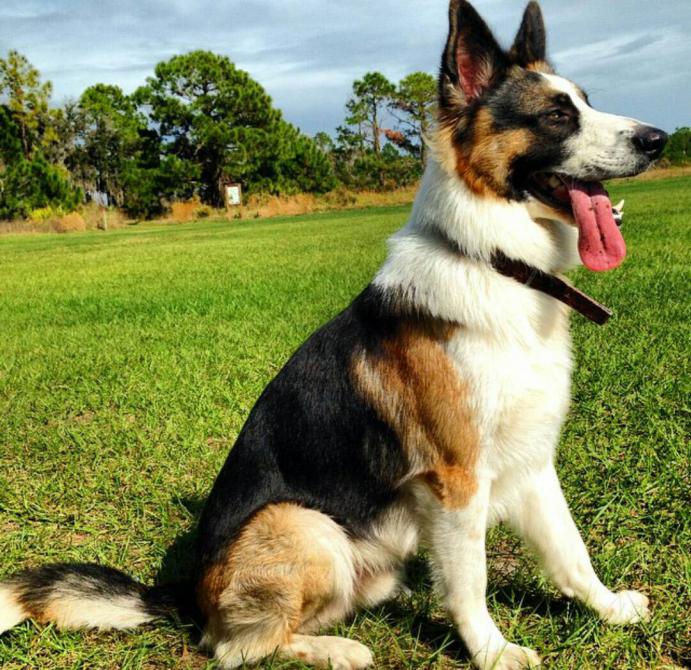
Let us begin with the fact that determines everything else on this page. The dogs called “pandas” are not a separate breed, not a designer hybrid, and not a Border Collie cross. They are German Shepherds that inherited a single change in the KIT gene — the gene of a receptor tyrosine kinase that governs the migration and maturation of melanocyte precursor cells. When that signal is weakened, some areas of skin simply receive no pigment cells, and the hair there grows white. So the white on a “panda” is not a different pigment and certainly not albinism: it marks the places the pigment cells never reached.
The mutation arose spontaneously — de novo, in one line of German Shepherds, in a dog whose parents carried no such pattern. Among owners, the founder is said to be a bitch named Lewcinka’s Franka von Phenom, born in October 2000 in the United States; every later “panda” is traced back to her. That name lives in breed circles and in kennel presentations, and we give it with exactly that status — the version accepted within the community, not a line from a scientific paper.
What is genuinely recorded in the scientific literature is the mutation itself. The international database of inherited traits in animals, OMIA, gives it its own entry: OMIA:001737-9615, “Coat colour, white spotting, KIT-related” in the dog, gene KIT, chromosome CFA13. What is officially catalogued, therefore, is not a “panda breed” but the trait “white spotting, KIT-related”, documented in two breeds — the German Shepherd and the Weimaraner.
How it was proved: linkage, exon 2 and ninety-five dogs
There is a single primary source here, and it deserves to be quoted in full: Wong A. K., Ruhe A. L., Robertson K. R., Loew E. R., Williams D. C., Neff M. W., “A de novo mutation in KIT causes white spotting in a subpopulation of German Shepherd dogs”, Animal Genetics, 2013, volume 44, issue 3, pp. 305–310 (published online on 8 November 2012). The first author worked at the Veterinary Genetics Laboratory of the University of California, Davis — the laboratory popular articles refer to as “UC Davis”.
The approach was the classic one for mapping a trait. First a genome scan: 95 German Shepherds and 143 microsatellite markers. The signal converged on a single point — one locus on chromosome 13, the one that holds the KIT gene. Linkage strength: LOD = 15. To a geneticist that is not “this looks likely”; it is a question of location that is effectively closed.
Next the exons of KIT were sequenced, and the cause emerged: the insertion of a single nucleotide — an adenine — 70 bases from the start of the second exon. That one extra letter shifts the reading frame; premature stop codons appear soon after, and instead of a complete receptor of 974 amino acid residues the cell builds a fragment of 55 residues. This is loss of function in its purest form. In current nomenclature the variant is written c.140_141insA, p.(L48Vfs*10) (equivalently c.140dup); on the CanFam3.1 genome assembly it corresponds to g.47144513_47144514insA on chromosome 13. In OMIA it is variant no. 570.
The final step was verification across the whole sample. Genotyping showed a perfect match between the insertion and the pattern: 64 spotted dogs and 31 normally colored littermates, without a single exception in either direction. When a trait and a variant never separate across nearly a hundred animals, the “it must be something else” hypothesis exhausts itself.
There is one more point that is easy to miss and that is precisely what makes this work notable. Until then KIT was regarded as a gene “foreign” to canine spotting: in the pig, the cow, the horse, the cat and the human, white patches caused by KIT had long been described, but not in the dog. The authors state explicitly that they showed a loss-of-function mutation in KIT reproduces in the dog the same coat phenotypes observed in other species. The “panda”, then, is not a curiosity: it is the first documented canine case of a mechanism well known elsewhere.
Why the Border Collie theory does not hold

The suspicion is understandable: a white collar, a white blaze on the face, white feet — visually this really does suggest a herding dog from an entirely different corner of cynology. But genetics separates these cases more reliably than the eye does.
In dogs, “ordinary” white spotting belongs to the S locus, and a completely different gene is responsible for it: MITF. That gene produces Irish spotting, piebald and extreme white in dozens of breeds. Merle is a third gene again, PMEL. The “panda” belongs to none of these mechanisms: in its case it is KIT — a different chromosome, a different protein, a different kind of breakage. Had the white come from a Border Collie, it would have arrived with the “collie” variant and would have segregated together with a whole stretch of foreign genome. The study shows the opposite: one new insertion, absent from the preceding generations.
The second support is segregation. An infusion of another breed does not behave like a single dominant allele: it drags dozens of linked segments with it and produces a blurred variety of types. Here the trait behaves as a single locus: 64 spotted against 31 normal littermates, with a perfect match between genotype and phenotype.
The third support is the repeatability of the mechanism. Independently of the American work, a German group described an analogous case in another breed: Gerding W. M., Akkad D. A., Epplen J. T., “Spotted Weimaraner dog due to de novo KIT mutation”, Animal Genetics, 2013, 44(5), pp. 605–606. KIT again, a newly arisen mutation again — only a different one: a deletion of three nucleotides in the thirteenth exon, p.(L646del), right inside the tyrosine kinase domain. Two independent episodes in two different breeds mean that KIT can “break” in the dog on its own, without any outside blood.
Inheritance: a dominant color — and the quiet side of the same mutation
As far as color is concerned the mutation behaves as autosomal dominant: a single copy is enough for a puppy to be born a “panda”. Hence a simple piece of Mendelian arithmetic — from a “panda × ordinary shepherd” mating, about half the puppies are expected to inherit the allele and carry white, and half not. That is an expectation, not a guarantee for a given litter: in small numbers the ratios always fluctuate.
And now the crucial point, the one popular articles get wrong most often. The same paper reports a second observation: no dog homozygous for this mutation was obtained across several intercrosses (P = 0.01). The authors interpret this as follows: in the homozygous state the allele is most probably recessive lethal at the embryonic stage. And they add that this is consistent with the behavior of KIT null alleles in other species. The OMIA database states the mode of inheritance in exactly two halves: dominant for coat color and recessive lethal for viability.
What that means in practice, without dramatizing:
- Every living “panda” is a heterozygote. Dogs with two copies of this mutation were not obtained in the family studied, so a “double panda” is not a breeding goal but a class that was simply never observed.
- Mating two “pandas” does not produce “more panda”. Under dominant inheritance the visible effect of one copy is not reinforced by a second, and by the authors’ observations the expected share of homozygous conceptions does not reach birth.
- This is an argument against deliberate breeding “for rarity”. The safest scheme in the light of the published data is the one in which only one of the two partners carries the mutation.
Important: the absence of observed homozygotes concerns embryos, not dogs that have been born. Nothing follows from it about the health of a heterozygous “panda” already born — these are two different questions, and they should not be confused in either direction.
Hearing and white patches: why the “panda” is not that case
The question is legitimate: in dogs, white patches genuinely are sometimes linked to reduced hearing. The classic examples are the Dalmatian, the white Boxer and the merle breeds. The mechanism is the same as for color: the inner ear needs cells related to melanocytes, and where those are missing, hearing suffers.
But “spotting” is not one single thing. In dogs, pigment-associated deafness is traditionally tied to the piebald locus (gene MITF) and to merle (gene PMEL). The “panda” is neither.
What the literature says about these dogs specifically: the peer-reviewed review Strain G. M., “The Genetics of Deafness in Domestic Animals”, Frontiers in Veterinary Science, 2015, vol. 2, article 29 describes a family of German Shepherds carrying a loss-of-function mutation in KIT that produced a white pattern on the face, the ventral abdomen, the feet and the tail tip, and states that all affected dogs had normal hearing on BAER testing — the recording of brainstem auditory evoked responses. BAER is not “the owner called and the dog came”: it is an objective test that also catches unilateral deafness, which an owner may fail to notice for years.
That is the honest answer in full: in that family of dogs hearing was measured instrumentally and described as normal. The sensible position for an owner is not to treat the check as superfluous, but to have it done if the puppy is intended for work or sport: BAER is performed in neurology departments and does not take long.
Size and appearance according to the standard

Since the “panda” is a German Shepherd, every parameter of build is taken from the breed standard. The current FCI Standard No. 166 “Deutscher Schäferhund” (official version of 11.08.2010) describes a medium-sized dog of slightly elongated format, strong and well muscled, with dry bone. The format is given as a figure: the length of the body exceeds the height at the withers by roughly 10 to 17 %. The head is wedge-shaped, its length about 40 % of the height at the withers, and the cranial and facial regions are in a 50-to-50 proportion.
Sizes are given separately for males and females — and they must not be merged into a single range, they are different figures.
| Characteristic | Males | Females |
|---|---|---|
| Height at the withers (FCI No. 166) | 60–65 cm | 55–60 cm |
| Weight (FCI No. 166) | 30–40 kg | 22–32 kg |
| Height under the AKC standard | 24 to 26 inches | 22 to 24 inches |
| Coat type (FCI No. 166) | Double coat or long double coat — both with undercoat | Double coat or long double coat — both with undercoat |
| Median lifespan | 10.3 years (interquartile range 8.0–12.1) | 10.3 years (interquartile range 8.0–12.1) |
The FCI standard recognizes two coat varieties: the double coat and the long double coat, both of which must have an undercoat. Long outer hair without undercoat is listed by the standard among the disqualifying faults, and that applies to any color. The coat structure of a “panda” has nothing distinctive about it — it is the same as that of the shorthaired German Shepherd, with part of the hair simply growing without pigment.
As for the pattern itself, the most precise description available in a peer-reviewed source has already been quoted above: the white is distributed on the face, the ventral abdomen, the feet and the tail tip. These areas of white hair have nothing to do with albinism: the standard requires a black nose in every color variety, and in “pandas” it stays black.
What the standards say about color, word for word
This is the most useful part for anyone planning to take such a dog anywhere. Both key standards are publicly available, and they do not speak of a “panda” — they list what is permitted. It is that list which has to be read.
FCI No. 166. The color section permits: black with reddish-brown, brown, yellow to light gray markings; single-color black; gray with darker shading; black saddle and mask. Then comes the only mention of white: “Small white marks on chest as well as very pale color on inside of legs are permitted but not desirable.” The section closes with the sentence “White color is not permitted.” Among the serious faults there is a separate line for “significant pigmentation deficiencies”. Among the disqualifying faults, exactly two points concern color: albinism and white coat color (even with dark eyes and nails).
AKC (standard approved 11 February 1978, reformatted 11 July 1994; the same text is published by the breed club, GSDCA). The color section reads: “The German Shepherd Dog varies in color, and most colors are permissible. Strong rich colors are preferred. Pale, washed-out colors and blues or livers are serious faults. A white dog must be disqualified.” The full list of disqualifications in the AKC standard: cropped or hanging ears; dogs with noses not predominantly black; undershot jaw; docked tail; white dogs; any dog that attempts to bite the judge.
Put together, this gives a precise picture rather than an approximate one. Neither standard describes the white-spotted pattern as a separate category, and neither utters the word “panda”. The FCI explicitly limits permitted white to “small marks on the chest”, so the “panda” pattern falls outside the list of permitted colors and under the wording about significant pigmentation deficiencies. In the AKC text the situation is different: disqualification is written for a white dog, not for a dog with white patches, so the “panda” does not literally fall under that line — but neither is it among the strong rich colors the standard prefers.
Registration and the show ring are two different systems
This is where half the arguments online originate: people debate as if “recognition” were a single procedure. In reality there are at least two, and they run on different rules.
The first is the registry — entering a dog in the stud book as a representative of the breed. The second is conformation judging in the ring, where compliance with the standard is assessed. The clearest proof that these are not the same thing comes from the AKC itself: its list of registration color codes for the German Shepherd contains eleven entries — black (007), black and cream (010), black and red (014), black and silver (016), black and tan (018), gray (100), sable (164), white (199), liver (123), blue (037) and bi-color (454). White is on that list — even though the same AKC disqualifies a white dog in the breed standard. The registry records a fact; the ring judges conformity. They are parallel things.
There is no code of its own for the white-spotted pattern on that list: in registration papers the “panda” goes under one of the existing entries. And one more detail worth keeping in mind: nowhere is registration a statement about the quality of a dog. It says only that the parents are entered in the same book.
What follows for the owner. Working and sporting disciplines — obedience, tracking, agility, search — assess behavior and performance, not the drawing of the coat. The conformation ring assesses precisely the match with the breed description, and a color outside the list will always be a problem there. This is not a “conspiracy against pandas”: it is the literal content of the document the judge works to.
Character: a service dog under an endearing name

The name deceives: behind the word “panda” stands a full-blown service dog. The KIT mutation governs the migration of pigment cells — it has nothing to do with temperament, trainability or reactivity threshold. Character is therefore described by the breed standard, and by nothing else.
The wording of FCI Standard No. 166 rewards slow reading: the German Shepherd “must be well-balanced (with strong nerves) in terms of character, self-assured, absolutely natural and (except for a stimulated situation) good-natured as well as attentive and willing to please”. The standard then requires “instinctive behavior, resilience and self-assurance” so that the dog is suitable “as a companion, guard, protection, service and herding dog”. The utilization line at the head of the standard reads: “versatile working, herding and service dog”.
The practical consequence is simple, and unwelcome for anyone choosing a dog from a photograph: this animal needs a job. A German Shepherd left without work finds one for itself — and the owner rarely likes the result. This applies to the “panda” exactly as much as to any other shepherd.
One more figure, better known before buying than after. In a British study of primary veterinary care, aggression appeared as a recorded diagnosis in 4.76 % of German Shepherds and was more common in males than in females. This is not a verdict on the breed: it is an argument for early socialization, clear rules at home and work with a trainer — not for “he’ll grow out of it”. Compared with other rare herding breeds — the Brazilian Shepherd Ovelheiro Gaucho, for instance — the German Shepherd is far more oriented toward people and fits noticeably better into an urban rhythm; but it is precisely that closeness that makes it “read” mistakes in upbringing all the faster.
Health: the breed’s baseline in figures
Bloat: what the risk studies actually showed
Gastric dilatation-volvulus (GDV) is a condition that can kill a large, deep-chested dog within hours. A great deal of advice circulates about preventing it, and part of that advice contradicts the data, so it is better to rely on specific studies.
In a prospective cohort of large and giant breeds (Glickman L. T. et al., Journal of the American Veterinary Medical Association, 2000, 217(10), pp. 1492–1499) four things were significantly associated with the risk of torsion: increasing age, having a first-degree relative with a GDV episode, a fast rate of eating and — the most unexpected of them — a raised feeding bowl. The authors estimated that the raised bowl accounted for approximately 20 % of cases in large breeds and approximately 52 % in giant breeds. In other words, the widespread advice “feed from a stand so the stomach does not twist” has the opposite sign in this study, and we shall not repeat it.
A second paper by the same group (JAVMA, 2000, 216(1), pp. 40–45) gave the scale of the phenomenon: an incidence of 23 cases per 1,000 dog-years for large breeds and 26 for giant ones, a cumulative incidence of 5.7 % over the study period, and of the 105 dogs that developed torsion, 28.6 % died. A third (Raghavan M. et al., Journal of the American Animal Hospital Association, 2004, 40(3), pp. 192–203) concerned diet: risk was higher in dogs that consumed a larger volume of food per meal, regardless of the number of meals per day, and highest in those given that large volume once daily.
An important caveat about the reach of these data: the German Shepherd was not among the breeds studied — those were the Akita, Bloodhound, Collie, Great Dane, Irish Setter, Irish Wolfhound, Newfoundland, Rottweiler, Saint Bernard, Standard Poodle and Weimaraner. The correct formulation is therefore this: these are regularities established for large and giant breeds in general. The practical conclusion is simple — smaller portions more often, no raised bowl, slow down eating that is too fast, and know the signs of torsion by heart. The AKC breed reference describes it as a sudden, life-threatening swelling of the abdomen and advises owners to learn the symptoms and the plan of action in advance.
Grooming, coat and shedding

The coat of a “panda” is built exactly like that of any German Shepherd: dense outer hair and an undercoat, which the standard requires in both coat varieties. White hair has no different structure — it is simply without pigment.
The AKC breed reference describes the grooming regime briefly and realistically: medium-length, double coat with a somewhat harsh, close-lying outer hair and a softer undercoat; grooming is uncomplicated and usually amounts to a quick brush-through every few days to remove dead hair; once or twice a year the dog sheds far more heavily, and then brushing has to be more frequent. Bathing is needed only occasionally. Nails should be trimmed or ground monthly if they do not wear down naturally — nails that are too long cause pain and spoil the stance.
The only respect in which a “panda” differs from its breed-mates in daily life is purely cosmetic: white areas show dirt more visibly. That is not a reason to bathe the dog more often than the breed requires — it is a reason to wipe the feet and belly after a walk.
And one more thing that follows from the figures above: otitis externa is the most frequent diagnosis in the breed (7.89 %). Ears deserve a regular check, and head shaking or an odor should not be put down to “wax” — it is a reason to visit the vet, because otitis almost always has a cause underneath the symptom.
Exercise, movement and training

The FCI standard defines the German Shepherd with a single word: a trotter. And it explains what that means mechanically: the limbs must be coordinated in length and angulation so that the dog can bring the hindquarters under the body without any noticeable change in the topline, and reach equally far forward with the front. Correct proportions produce a gait that skims low over the ground and looks effortless. The standard warns separately that excessive angulation of the hindquarters reduces firmness and endurance, and therefore working ability.
Hence the exercise regime. A dog built for a sustained trot is not satisfied by a lap round the block on the lead. It needs movement with a task: search games, retrieving, nose work, long steady outings. The sprint is not its strength: where the short burst belongs to the Lurcher or a sighthound, the shepherd wins over distance at an even pace. In a young growing dog, high jumps and long runs on hard ground are given in measured doses — that is a direct investment in the very joints that later top the statistics of causes of death.
Training starts on the first days at home. The breed picks things up quickly, and that is precisely why dull, uniform repetition works against you: the dog either starts “optimizing” the exercise or loses interest. Positive reinforcement gives the most stable result; harsh methods, in a breed this sensitive to contact with people, hit both things at once — behavior and reliability.
A separate word about protection disciplines. The standard explicitly names the shepherd as suitable for guard and protection service, which means the potential is there by default and the only question is who shapes it. A basic obedience course is necessary for every dog; any protection work belongs with a trainer, not with an owner following videos. And the figure once again: aggression is the fifth most frequently recorded diagnosis in the breed, and it is more common in males. This is exactly the ground where early socialization is more reliable than late correction.
Feeding a large working dog
What to ask the breeder
Where the breed itself came from
The context without which the “panda” hangs in mid-air. FCI Standard No. 166 sets out the history of the breed with reference to the official documents of the founding club — the Verein für Deutsche Schäferhunde (SV), based in Augsburg. The club was constituted at its first general meeting in Frankfurt am Main on 20 September 1899, on proposals by A. Meyer and Max von Stephanitz; it is the SV, as founding club, that is responsible for the breed standard.
The standard then states the design with remarkable frankness: the breed was built from the central and southern German herding dogs then in existence, “with the final aim of creating a working dog inclined towards high achievement”, and it was for that aim that the description was drawn up, covering physical construction as well as traits and character. The German Shepherd, then, was never a companion breed with a working past: it is a working program set down in writing as a standard. That explains a good deal — both the restrictive character of the color section and the heat with which any deviation is debated within the breed.
Interesting facts
- One letter of DNA. The whole difference between an ordinary shepherd and a “panda” is one extra adenine in the second exon of the KIT gene. Because of the frameshift, a receptor of 974 amino acids is reduced to 55.
- The first canine case of a known mechanism. Before this work, KIT-related white spotting had been described in the pig, the cow, the horse, the cat and the human — but not in the dog.
- Neither piebald nor merle. In dogs, piebald comes from the MITF gene and merle from PMEL. The “panda” belongs to neither of these loci.
- The mechanism repeated itself in another breed. In that same year, 2013, Animal Genetics described a white-spotted Weimaraner also carrying a new KIT mutation — but a different one: a deletion of three nucleotides in the thirteenth exon.
- Registry does not equal ring. In the AKC’s list of registration color codes for the German Shepherd, white is present (code 199) — even though the standard of that same organization disqualifies a white dog.
- The standard puts a number on the format. The body length of a German Shepherd exceeds the height at the withers by roughly 10 to 17 %, and the head makes up about 40 % of the height at the withers.
Sources
- Wong A. K., Ruhe A. L., Robertson K. R., Loew E. R., Williams D. C., Neff M. W. A de novo mutation in KIT causes white spotting in a subpopulation of German Shepherd dogs. Animal Genetics, 2013, 44(3), 305–310.
- OMIA:001737-9615 “Coat colour, white spotting, KIT-related” in Canis lupus familiaris, variants no. 570 and no. 459. Online Mendelian Inheritance in Animals, University of Sydney.
- Gerding W. M., Akkad D. A., Epplen J. T. Spotted Weimaraner dog due to de novo KIT mutation. Animal Genetics, 2013, 44(5), 605–606.
- Strain G. M. The Genetics of Deafness in Domestic Animals. Frontiers in Veterinary Science, 2015, 2:29.
- FCI Standard No. 166 “Deutscher Schäferhund” (German Shepherd Dog), current official version of 11.08.2010.
- German Shepherd Dog breed standard, American Kennel Club — approved 11.02.1978, reformatted 11.07.1994; the same text is published by the German Shepherd Dog Club of America.
- O’Neill D. G., Coulson N. R., Church D. B., Brodbelt D. C. Demography and disorders of German Shepherd Dogs under primary veterinary care in the UK. Canine Genetics and Epidemiology, 2017, 4:7.
- Glickman L. T. et al. Non-dietary risk factors for gastric dilatation-volvulus in large and giant breed dogs. JAVMA, 2000, 217(10), 1492–1499; Incidence of and breed-related risk factors for gastric dilatation-volvulus in dogs. JAVMA, 2000, 216(1), 40–45.
- Raghavan M. et al. Diet-related risk factors for gastric dilatation-volvulus in dogs of high-risk breeds. JAAHA, 2004, 40(3), 192–203.
- The working qualities and trainability of the German Shepherd, unchanged
- A versatile dog: companion, guard, sport, service
- The origin of the color is established and published, not hearsay
- In the family of dogs described, hearing was measured by BAER and reported normal
- Sheds heavily all year, with two peaks
- Needs a lot of movement and tasks; without work it finds its own
- Color outside the standards' list — the conformation ring is closed
- Hereditary vulnerabilities typical of the German Shepherd
- Mating two “pandas” is not advised on the published data
| German Shepherd (standard) | White Swiss Shepherd | East European Shepherd | |
|---|---|---|---|
| Height | 55–65 cm | 53–66 cm | 62–76 cm |
| Energy | 4.5 | 4 | 4 |
| Apartment | 2.5 | 2.5 | 2 |
| Beginners | 3 | 3 | 2.5 |
Is the Panda Shepherd a separate breed?
Isn't it a Border Collie outcross?
Can two “pandas” be mated?
Are “pandas” born deaf?
Can such a dog be shown?
Does the “panda” differ in character from an ordinary shepherd?
How long do German Shepherds live?
Wong et al., Animal Genetics 2013, 44(3):305–310 · OMIA:001737-9615 · Strain, Frontiers in Veterinary Science 2015, 2:29 · FCI Standard No. 166 · AKC / GSDCA breed standard · O'Neill et al., Canine Genetics and Epidemiology 2017, 4:7
For apartments · For kids · For beginners · Active · Smartest · Hypoallergenic · All rankings →