

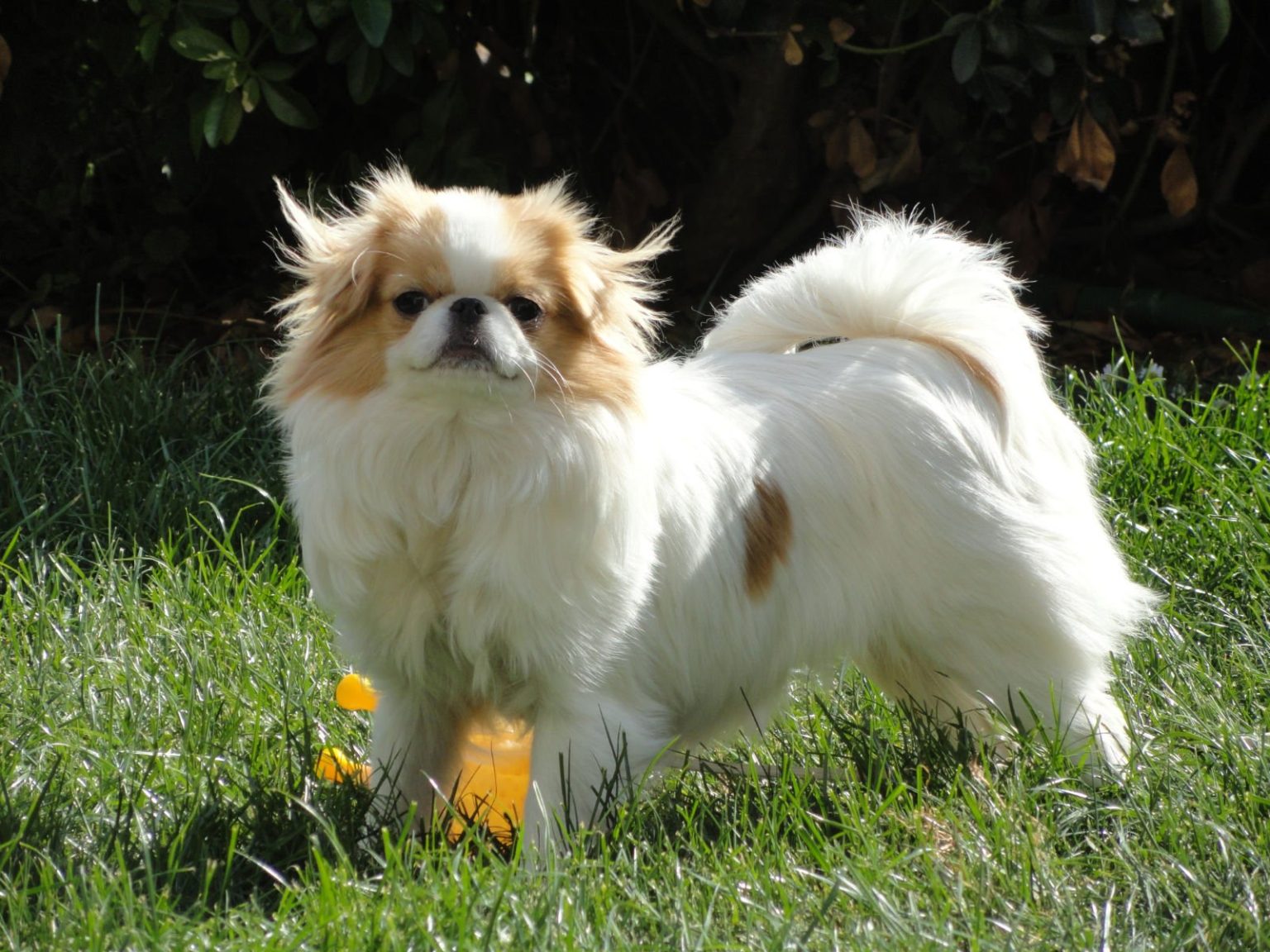
| Height | 20–28 cm (AKC); dogs about 25 cm (FCI) |
| Weight | 1.8–3.2 kg (British standard ideal) |
| Lifespan | 12 years (median age at death, United Kingdom) |
| FCI group | 9 · Section 8 (Chin and Pekingese) |
| Origin | Japan |
Exact ratings
Common health issues
Nutrition
The Japanese Chin is a small Japanese companion dog with silky hair, a broad flat face and large round eyes; the FCI registers it simply as Chin, with Japanese Chin in parentheses. It is the rare breed whose beauty and whose medical problem are the same thing — a shortened facial skeleton that changes how the Chin breathes, sheds heat and comes out of anesthesia. Temperament, coat and daily care all arrange themselves around that one fact. More breeds on Tvaryny.
The Japanese Chin at a glance: what each registry says
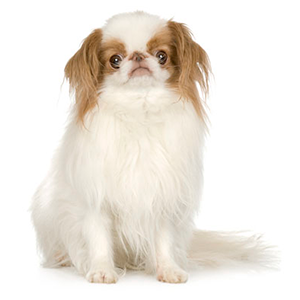
Size figures for the Chin circulate as common knowledge, and none is a position the registries share. The three main organizations describe the breed differently, each silent about what the others measure. What helps is not an averaged line but a record of who wrote what.
| Item | What the documents record |
| Country of origin | Japan (FCI patronage) |
| Official FCI name | Chin, with Japanese Chin in parentheses |
| FCI classification | Group 9 (companion and toy dogs), Section 8 “Japan Chin and Pekingese”, without working trial |
| FCI recognition | Definitively recognized on 2 December 1957; the standard’s authentic language is English |
| FCI standard | No. 206, current version published 4 April 2016 |
| Height | FCI: dogs about 25 cm, bitches slightly smaller. AKC: ideally 8–11 inches (roughly 20–28 cm), no split by sex. The British registry gives no height at all |
| Weight | British standard: ideal 1.8–3.2 kg. FCI and AKC give no weight |
| Coat | Long, straight, silky; the AKC calls it single outright — no undercoat as such |
| Color | FCI and the British standard: white and black or white and red, tricolor not permitted. The AKC also allows black and white with tan |
Throughout the page we name who claims what. The registries diverge widely enough here that folding them into one truth produces a line found in no document.
Brachycephaly: the subject of this page, not a footnote
A brachycephalic dog is one whose facial skeleton has shortened while the soft tissue inside has not. Turbinates, soft palate, tongue and mucous membrane keep roughly their old volume but must now fit a shorter space. The result is a narrowing at every turn of the airway.
The extent of the shortening is expressed as the craniofacial ratio — how much of skull length the muzzle accounts for. The smaller the number, the more radical the shortening. The Chin averages below 0.1, among the flattest-faced breeds there are, alongside the Pekingese, the King Charles Spaniel and the Belgian Griffon. The Pomeranian, in the same study, averaged 0.33 in dogs free of respiratory signs and 0.28 in dogs that showed them.
None of this is cosmetic trivia. It is why breathing, heat, anesthesia and eyes each get a section below, worth reading before a puppy arrives rather than after.
What a survey of 898 brachycephalic dogs found
For a long time, brachycephalic obstructive airway syndrome — BOAS — was studied almost entirely in the Pug, the French Bulldog and the English Bulldog; everything else flat-faced was assumed to behave the same way. A Cambridge group in PLOS ONE applied the same functional respiratory grading method to fourteen further breeds, examining 898 dogs in the British pet population.
The sample held 46 Japanese Chins, and only 17.4% of them graded clear on respiratory function — grade zero. That is the second-worst figure of the fourteen; only the Pekingese, at 10.9%, sits lower. The authors placed Chin and Pekingese in the high-risk group: on the share of unaffected dogs neither differs statistically from the Pug or the two Bulldogs. Nostrils tell the same story: fully open nostrils were found in 5.8% of the Chins examined, and the Chin was one of only six breeds in which severe stenotic nostrils were recorded at all.
A further finding matters just as much. Within the breed, muzzle length explained almost nothing: between Chins at grade zero and Chins at grades one through three, the difference in craniofacial ratio never reached significance. Picking a Chin with a slightly longer face is therefore not a strategy: the breed already sits at the extreme end of the scale, with nothing to choose between inside it. The model built on body condition, nostril stenosis and craniofacial ratio accounts for roughly 20% of the variation; much that it cannot see is also at work on breathing.
An earlier British study in the same journal reached that conclusion independently. Its authors invited the clubs of breeds they considered at risk on conformational grounds; of 10 Chins examined, 80% showed signs of the syndrome, and the median craniofacial ratio was 0.04. One sentence in the discussion closes off any hope of a safer line: the highest ratio recorded in a Japanese Chin across both studies was 0.13 — and even for that dog the model predicted a syndrome probability of 0.83.
The answer also depends on the instrument. Between 2017 and 2022, 12 Japanese Chins took the Finnish national exercise tolerance test, and all 12 passed. That is no refutation of the British figures: the Finnish authors conclude that the exercise test alone misses too many dogs with moderate and severe signs, and propose grading exercise tolerance, respiratory signs and nostrils together. When two numbers from two countries disagree, ask first what each measured.
The sound itself deserves a note. In large, heavy breeds labored breathing carries as a loud pharyngeal rattle; in small ones, the Chin among them, a quieter nasal stridor predominates — so the owner of a small breed has less chance of catching it by ear. “He just snuffles in a funny way” is the commonest form in which BOAS in a Chin goes unrecognized.
Turbinates and miniaturization: the anatomy in numbers
A German morphological study in the Anatomical Record compared the nasal skeleton of five flat-faced breeds — Pug, Japanese Chin, Pekingese, King Charles Spaniel and Cavalier — on macerated skulls, one juvenile and 17 adults, by micro-computed tomography with three-dimensional reconstruction.
The result is not the intuitive one. Flat-faced breeds carry the same number of principal turbinates as long-muzzled dogs: three frontoturbinates and three ethmoturbinates. What contracts is their complexity, not the inventory — interturbinates grow fewer, and the turbinates lose surface area and stand less densely. The authors read this as spatial constraint, not anatomy going missing.
Turbinates are the surface over which inhaled air is humidified and cooled and exhaled air gives its heat back, so less surface area means less heat lost through the nose. A dog that cannot cool through the nose compensates by panting — which in a brachycephalic dog runs into that same narrowed throat.
Swedish researchers described one more link, in toy breeds specifically. In dogs that have been through extreme miniaturization — the Japanese Chin, the Chihuahua and the Pomeranian are named — the wings of the vomer can end up too large for the lumen, narrowing the passage at the nasopharyngeal meatus to a millimeter or less. Neither external examination nor an ordinary radiograph shows that region.
Heat: a closed car is not the only danger
The largest British primary-care study of heat-related illness in dogs went through the records of 905,543 animals and identified 1259 events. The breakdown by trigger does not match the public-awareness poster: 74.2% followed physical exertion, 12.9% came from simply being in a hot environment, and only 5.2% involved a closed car. Death rates after exertional overheating were no lower than after the vehicle kind.
Brachycephalic skull conformation raised the odds of all three types against normal conformation — by 1.32 for the exertional type, 2.36 for the environmental and 3.07 for the vehicle type. The Chin is not among the breeds named individually there: the sample was built by popularity, and rare breeds never entered the breed-level models. So the risk attaches to skull conformation — and on skull conformation the Chin sits at the far edge of the group.
Day to day, the hazard is not the forgotten car but an ordinary lively walk on a warm afternoon. The dog is tiny, excites easily, takes off after a butterfly and cannot stop in time. In warm weather walks move to early morning and late evening, and outdoor play in the heat is not shortened but canceled. Breathlessness that does not settle at rest, bright red or bluish mucous membranes, an unsteady gait, vomiting — these call for a veterinarian within the hour, not watching at home.
Anesthesia and any planned procedure
A retrospective cohort study set 223 brachycephalic dogs under general anesthesia against 223 non-brachycephalic dogs matched by type of procedure. During the anesthesia itself the groups barely differed: complications in 49.8% of the brachycephalic dogs and 48.4% of the rest. The gap opened afterward — post-anesthetic complications in 13.9% against 3.6% of controls.
The dangerous stretch for a flat-faced dog is therefore not the operating table but recovery, once the tube is out and pharyngeal tone has not come back. In the same study risk fell as body mass rose — and a Chin weighs a few kilograms.
The other half of the picture belongs here too. A recent analysis of 54,542 anesthetics found higher mortality in brachycephalic dogs in the raw numbers — 0.82% against 0.65% — but once baseline health status was accounted for, the difference stopped being statistically significant (adjusted relative risk 1.19). The authors are plain about the consequence: the elevated risk comes mostly from the condition brachycephalic dogs are in by the time they reach the table, not from facial conformation. The emphasis shifts from “avoid anesthesia” to “bring the dog to surgery in good shape and do not postpone problems.”
For an owner this reaches as far as a dental cleaning under sedation. Ask the clinic beforehand whether it watches a brachycephalic dog until swallowing has fully returned, and whether the means to re-establish an airway are within reach. A clinic used to these breeds answers without irritation.
Brachycephaly and the rules: what changed in 2025 and 2026
A few years ago, regulatory attention to flat-faced dogs meant the Pug and the two Bulldogs. No longer: the Japanese Chin now appears in lists by name. What applies where differs sharply by country, so what follows is what the documents say.
United States. Here the route runs through a private registry and is voluntary: the animal orthopedic foundation that licensed the British respiratory grading scheme for North America added the Japanese Chin in April 2026 to the breeds able to earn an official certificate, citing the Cambridge study directly. The instrument exists; the obligation does not. So the parents’ grading result is a thing to ask a breeder for rather than to assume.
The scheme itself. Developed by the British national kennel club with Cambridge, it has been extended, and the Chin is now among the 17 breeds it covers. A dog is assessed from 12 months and reassessed every two years: the veterinarian listens at rest, puts the dog through three minutes of movement, listens again, and assigns a grade from 0 to 3. In the same club’s monitoring of show breeds, meanwhile, the Chin still sits in the first category — no breed-specific points currently identified for judges to watch. The two measure different things: a judge sees a standing dog in the ring; the scheme turns on what a veterinarian hears after exertion.
The Netherlands. A ministerial guideline on brachycephalic dogs signed on 17 August 2023 names no breed at all — it describes features of the individual animal. One is enough for breeding to count as a violation: abnormal sound on breathing at rest; moderate or severe narrowing of the nostrils; a craniofacial ratio below 0.3; a nasal fold whose hair touches the cornea, or is wet, or goes with inflammation of the eye; an eye showing white in two or more quadrants; an eyelid that does not close completely. Three further features — mild narrowing of the nostrils, a ratio between 0.3 and 0.5, a nasal fold without contact with the eye — count when two or more are present. And separately: a feature corrected surgically still counts as present.
Set that against the Cambridge measurements: the mean craniofacial ratio of the Japanese Chin is below 0.1. The breed is not approaching the threshold, it lies well past it.
The Netherlands, 4 June 2025. On a claim by an animal welfare organization against the Dutch kennel body, the Amsterdam court held it unlawful to issue pedigrees to brachycephalic puppies without a veterinary statement that both parents meet those criteria. The court’s list runs to 24 breeds, the “Japanse spaniel” — the Dutch name of the Japanese Chin — among them. The body has two months to comply, and the judgment is immediately enforceable.
Finland. The national kennel union runs its own exercise tolerance test, open to 12 breeds with the Chin among them. Dogs are admitted from 18 months; those whose airways have already been corrected surgically are not admitted at all.
European Union. Regulation 2026/1818 of 17 June 2026 introduces a shared rule for the first time: a breeder may not breed from an animal whose extreme conformational features create a high risk to its own welfare or that of its offspring, and must involve a veterinarian before selecting a questionable animal. The word “brachycephalic” never appears in it — the Commission is to adopt the list of features separately by 30 June 2030, and the rule applies from 1 July 2030.
The buyer’s jurisdiction therefore weighs less than it looks. Where there is no rule, a conscientious breeder can still produce the parents’ respiratory results; where the rule is strict, a careless one produces nothing if nobody asks. “What were the parents’ respiratory grading results” works the same everywhere.
Three standards, three different dogs on paper
The Chin is a rare breed whose main registries part company not over trifles but over features anyone can see. The divergences below come from the standards in force, not retellings.
| Feature | FCI (standard No. 206) | AKC | British standard |
|---|---|---|---|
| Ears | Long, triangular, hanging, set wide apart | Hanging, small, V-shaped, set slightly below the crown of the skull | Small, V-shaped, high on the head, carried slightly forward |
| Eyes | Large but “without exaggeration”, round, set wide apart | Large, round; visible white in the inner corners named a breed characteristic | Moderately large, size in proportion to the skull; directed forward |
| Bite | Level bite preferred; scissor bite and undershot permitted, overshot a fault | Jaw broad, slightly undershot | Level or slightly undershot preferred |
| Tricolor | Disqualifying fault | Permitted color (black and white with tan) | Not permitted |
| Size | Height: dogs about 25 cm | Height: ideally 8–11 inches | Weight: ideally 1.8–3.2 kg, height not specified |
The loudest divergence is the tricolor. A black and white dog with tan on brows, cheeks and inside the ears is a normal representative of the breed in an American ring; under the FCI system the same dog is disqualified. Not one registry’s mistake and not an outdated text: two ideas of what the breed ought to be, coexisting for decades.
The second divergence is finer and says more. The FCI writes of eyes large “without exaggeration”; the British standard asks that the eye be in proportion to the skull; the American names the visible white in the inner corners a breed characteristic giving the astonished expression. What one text treats as a defining trait, another quietly limits — and for a breed with prominent eyes that is no abstract argument: an eyeball protruding further from the orbit is less well covered by the lids.
The AKC standard also carries a clause found almost nowhere else: judges are told that the Chin is very sensitive about having its mouth examined, and that if the dog hesitates the handler should show the bite. A breed whose feelings about strangers’ hands earned an amendment in the official text is a rarity.
What the Japanese Chin looks like
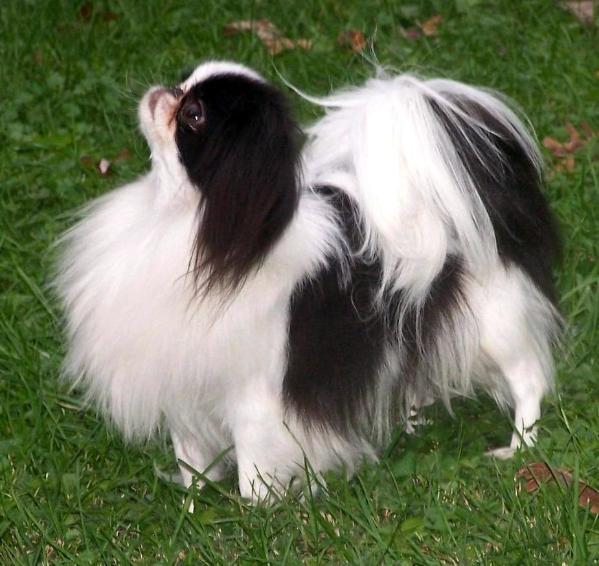
The outline is square: under the FCI, height at the withers equals body length, though in bitches the body may run slightly longer. The bone is fine, the forelegs straight, the feet hare-like — elongated, with tufts of hair between the toes. The gait is light and pointedly proud, noted separately by both the FCI and the British text.
Head and face. The skull is broad and rounded, the stop deep, the bridge of the nose very short and wide; the FCI puts the nose on a line with the eyes, the AKC at mid-eye level and tipped up. The nostrils should be well open — a requirement the Cambridge survey found rarely met in the living population.
Coat. Straight, long and silky; the British standard is categorical — absolutely free from curl or waviness. Face and the front of the legs carry short hair, the rest of the body long. The furnishings: a profuse ruff at neck and chest, feathering behind the forearms, “trousers” on the thighs, a cascade on the tail carried over the back. A single coat means none of the seasonal undercoat blowout of double-coated breeds, but the dog sheds steadily all the same.
Color. White and black or white and red, and “red” in the British text takes in every shade of sable, lemon and orange. Symmetrical head markings and a broad white blaze from face to crown are desirable in all three systems — a rare instance of full agreement.
Origins: the document, the registry’s position, and the legend
The Chin’s history reads best in three layers, because they are constantly mixed together.
The first layer is what the FCI standard says. Its historical summary holds that ancient documents suggest the Chin’s ancestors were presented to the Japanese court by the rulers of Silla-period Korea in 732; that over the following century dogs of this type reached Japan in quantity; and that envoys to China and to the northern Korean state of Po Hai brought such dogs back too. Under the shogun Tsunayoshi Tokugawa the breed was kept as a chamber dog in Edo Castle. The standard names two dates for the passage west: 1613, when a British captain named Searles brought a Chin to England, and 1853, when the American commodore Perry brought several dogs to the United States and two were presented to Queen Victoria. From 1868 the Chin was a fashionable chamber dog among ladies of high society.
The second layer is what that summary is. The historical section of a standard is a registry’s position, not an established fact: it opens with a word of supposition and never says which ancient documents it means. Normal enough for a kennel-club text, but it should be quoted as the FCI’s position, not as archaeology.
The third layer is the lore that never entered the standard. Here belong the tales of a death penalty for owning a Chin, of gilded bamboo cages and servants with fans. They travel from one popular description to the next with no checkable source behind them, and we do not repeat them as fact.
On the name. In Japanese the breed is written with a single character, 狆. The gloss common in European texts, “chin means jewel”, is folk etymology rather than a dictionary entry, so we pass it on as a widespread version and no more. In English the breed was long called the Japanese Spaniel, and under that name it appears in the earliest scientific descriptions of its hereditary disease and in the British corneal study below. The FCI today uses the short form Chin, with Japanese Chin in parentheses.
Chin, Pekingese, King Charles: three breeds whose facts keep swapping places
These three resemble one another closely enough that a description of one regularly turns up inside the description of another. The Cambridge survey gave them markedly different numbers — the convenient way to keep them apart.
The Pekingese shares its FCI section with the Chin — Section 8 of Group 9 is named “Japan Chin and Pekingese”. On respiratory function it proved the most affected breed in the sample, grade zero in only 10.9%. The Chin follows at 17.4%; statistically neither differs from the Pug and the Bulldogs.
The King Charles Spaniel produced an unexpected result in the same study. By craniofacial ratio it is one of the flattest of all, averaging around 0.05 — lower even than the Chin. Yet 39.8% reached grade zero, four times the proportion in the Pekingese. The authors call it unexpected outright and draw the paper’s central conclusion from it: every breed needs assessing on its own terms, because the same flat face does not mean the same breathing.
The Chin and the Tibetan Spaniel are often bracketed together under a shared monastery origin. The commonality is typological, not documented: both are small East Asian companions, but the FCI standard names no shared descent for the Chin — it traces the line through Korea and China, not Tibet.
Temperament: why the Chin gets compared to a cat
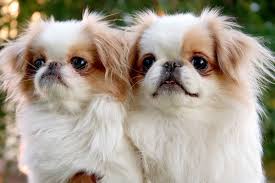
The comparison with a cat is not decoration but the shortest description of observable behavior. The Chin washes with a front paw, likes high vantage points — a sofa back, a windowsill, an armrest — and picks its own moment for contact instead of soliciting attention. The standards put it more soberly: the FCI calls the temperament intelligent, gentle and endearing, the British text merry, happy, gentle and good-natured, and the American adds what matters most — responsive and attached to its own people, but reserved with strangers and in new circumstances.
That reserve is a practical detail. The Chin is not timid in the clinical sense — the FCI counts timidity among the faults — but it does not hand out affection to strangers and tolerates familiarity poorly. The AKC clause about examining the mouth grows from the same root.
The breed gives voice rarely, one of the quieter small dogs. The flip side matters after the section on breathing: in a quiet dog any new persistent sound — snuffling, rattling, a whistle on the inbreath — deserves a veterinary visit rather than fond amusement.
The Chin in the family: children, other pets, time alone
The dog weighs a few kilograms and has fine bone — by itself reason enough not to recommend the breed to families with very small children. The problem is not temperament but physics: a fall from someone’s arms, a careless step, a tight hug all mean injury at this size. With older children who understand that a dog is allowed to walk away, the Chin gets along well.
With other animals the breed is usually free of conflict: it neither competes over resources nor leans on its housemates. If you want a companion of roughly the format of the Continental Toy Spaniel Papillon but calmer and less demanding of exercise, the Chin fits.
Long stretches alone it takes badly. If nobody is home most of the day, the breed is worth considering only alongside a decision about company — a second dog, a cat, or a realistic walking arrangement. Boredom and anxiety here surface not as wrecked furniture but as apathy and refusal of food, signs easily mistaken for illness.
GM2 gangliosidosis: the story of one diagnosis
This is the most useful genetic page in the breed’s file, and it took nearly forty years to turn.
1985. Acta Neuropathologica described a two-year-old dog of the breed then called the Japanese Spaniel, with progressive neurodegeneration. The ganglioside GM2 was accumulating in the neurons, yet total activity of the enzyme beta-hexosaminidase in the test tube came out raised rather than reduced. The authors called it a paradox.
1987. A biochemical workup in the Journal of Neurochemistry showed enzyme activity in the affected dog’s brain about 12 times above normal, and only fourfold against another substrate. The fault, that group concluded, lay not in the enzyme but in the activator protein — the counterpart of the rare human AB variant. The breed kept that diagnosis in the reference works for more than a quarter of a century.
2013. Two independent studies changed the picture. A group in Molecular Genetics and Metabolism sequenced the activator gene in affected Chins and found nothing but neutral polymorphisms. They then checked the HEXA gene and found the homozygous substitution c.967G>A, producing the amino acid change p.E323K. Position 323 belongs to the catalytic site, so the substitution predicts a complete loss of activity. The same year, the Journal of Veterinary Internal Medicine published the first magnetic resonance picture of this disease, in two Japanese Chins.
Causality was tested on more than affected dogs: among 128 healthy Japanese Chins and 92 dogs of other breeds tested by the authors, not one was homozygous for the variant.
2024. OMIA, the international register of inherited traits in animals, moved the Japanese Chin entry from the “AB variant” section to “GM2 gangliosidosis, type I (B variant)” — the canine counterpart of Tay-Sachs disease. In that entry the Japanese Chin is the only dog breed listed.
What matters here for an owner. Inheritance is autosomal recessive: only a dog that received the defective variant from both parents falls ill, and carriers look healthy. By the register’s description the disease begins between one and two years of age as progressive cerebellar ataxia, changed behavior and failing sight. Most useful in practice: this is precisely the disease that shows normal or even raised enzyme activity on the standard test. Enzyme assay misleads here and cannot in principle separate a carrier from a clear dog. The only route is a DNA test for the specific variant — whether the puppy’s parents were tested is a question for the breeder directly.
Knees and fine bone
Patellar luxation is the classic orthopedic problem of small breeds, and the Japanese Chin is not exempt. The mechanism in toy dogs is typical: the kneecap slips out of the trochlear groove toward the inside, the dog carries the leg a few steps, then it goes back into place and the owner concludes nothing happened. In fact every slip wears the cartilage down.
Many miniature breeds share it — the Russian Toy Smooth-haired, for one. Since a veterinarian grades the condition on examination, ask for a knee assessment of the puppy’s parents, and repeat the examination on your own dog at routine visits rather than waiting for a limp.
On daily life: fine bone and a few kilograms make ordinary household heights dangerous, since for an adult Chin a jump off the sofa is several times its own height. A ramp or step up to the favorite spot, a rug on a slick floor and a rule against carrying the dog near stairs remove most of the injury risk.
Eyes: the daily and the urgent
A large eye in a shallow orbit is covered less well by the lids and sits closer to everything the dog meets face first. A British study of corneal ulceration in primary care covered 104,233 dogs; 834 had a confirmed diagnosis, so prevalence came to 0.80%. The highest prevalences were in the Pug (5.42% of the breed), the Boxer (4.98%), the Shih Tzu (3.45%), the Cavalier King Charles Spaniel (2.49%) and the Bulldog (2.41%).
Now the detail worth knowing before those numbers are carried over to the Chin. The work uses two conformation types: “brachycephalic”, with odds 11.18 times those of crossbreeds, and “spaniels”, with odds 3.13 times higher. The Japanese Chin landed in the second, not the first: the authors built the spaniel group on the word “spaniel” in the breed name, and the Chin went in under its old English name, Japanese Spaniel. It is absent from that paper’s brachycephalic list, which holds the Pug, the Pekingese, the Shih Tzu, the Boxer and the Bulldogs.
So the sentence “brachycephalic dogs have 11 times the odds of corneal ulceration, and the Chin is brachycephalic” reports that study wrongly. Correctly: the Chin was counted inside a group with three times the odds, and has no figure of its own. That substitution is what turns careful statistics into a horror story.
Every day — look at the eyes in daylight and wipe the tear tracks away with a clean damp swab, a separate one for each eye. Not grooming for looks: a damp fold under the eye inflames easily in a flat-faced breed.
Straight to the veterinarian — if the dog squints or holds an eye shut, if copious clear discharge appears, if there is clouding or redness of the white, if it rubs its face with a paw or against furniture. Squinting in a brachycephalic dog is not “something got in it” but the typical first sign of corneal damage, and hours matter. One scenario is specific to shallow orbits: proptosis of the eyeball on injury or too hard a pull at the collar — that means the clinic at once, not in the morning.
One side note from the veterinary literature rarely reaches breed descriptions: in reports of complications after eye removal in brachycephalic dogs the Japanese Chin is singled out, because of the nasolacrimal duct anatomy in a short face. If such an operation ever comes up, put that question to the surgeon in advance.
The upper airway with age
A Swedish insurance study followed roughly 450,000 insured dogs across 2011–2014, covering 327 breeds. Overall incidence of upper respiratory tract disorders came to 50.56 cases per 10,000 dog-years, and the Japanese Chin was among the five breeds with the highest rate, next to the English Bulldog, the Pomeranian, the Norwich Terrier and the Pug.
For the Japanese Chin, the authors note, this was new: no predisposition of the breed to upper respiratory disorders had been described before. They offer three readings — a regional peculiarity, a real rise in frequency, or simply that predispositions in rare breeds surface late for want of dogs. Median age at first such diagnosis across the sample was 6 years, so this belongs to maturity, not puppyhood.
One more detail from the same work: the Chin is among the breeds in which epiglottic retroversion has been described — the epiglottis folds back into the laryngeal opening and blocks the inbreath. Its symptoms are easily confused with “ordinary” brachycephalic snoring, so a new breathing disturbance in an adult Chin should not be written off as the breed.
How long a Japanese Chin lives, and what follows
Here, unusually for this breed, there is data to lean on instead of club tradition. A British analysis of life expectancy published in 2024 covered 155 breeds; the Japanese Chin made the sample, and the supplementary tables carry its row: median age at death 12.5 years, confidence interval 12.2–13.3, calculated on 142 dogs that had died.
The most interesting thing in that row is the comparison with crossbreeds: the hazard ratio for the Chin came to 0.88 and did not reach statistical significance. In these data the breed does not live noticeably less long than an average crossbred dog.
That refutes nothing above and is no reason to relax. The airway syndrome is about the quality of breathing every day, not necessarily the length of life; a dog can live out its years and spend all of them breathing with effort. The opposite exaggeration goes too: these data do not show that the Chin lives a short life because of brachycephaly. Both halves stand side by side.
What breeders watch for: the breed club’s list
Coat care and hygiene
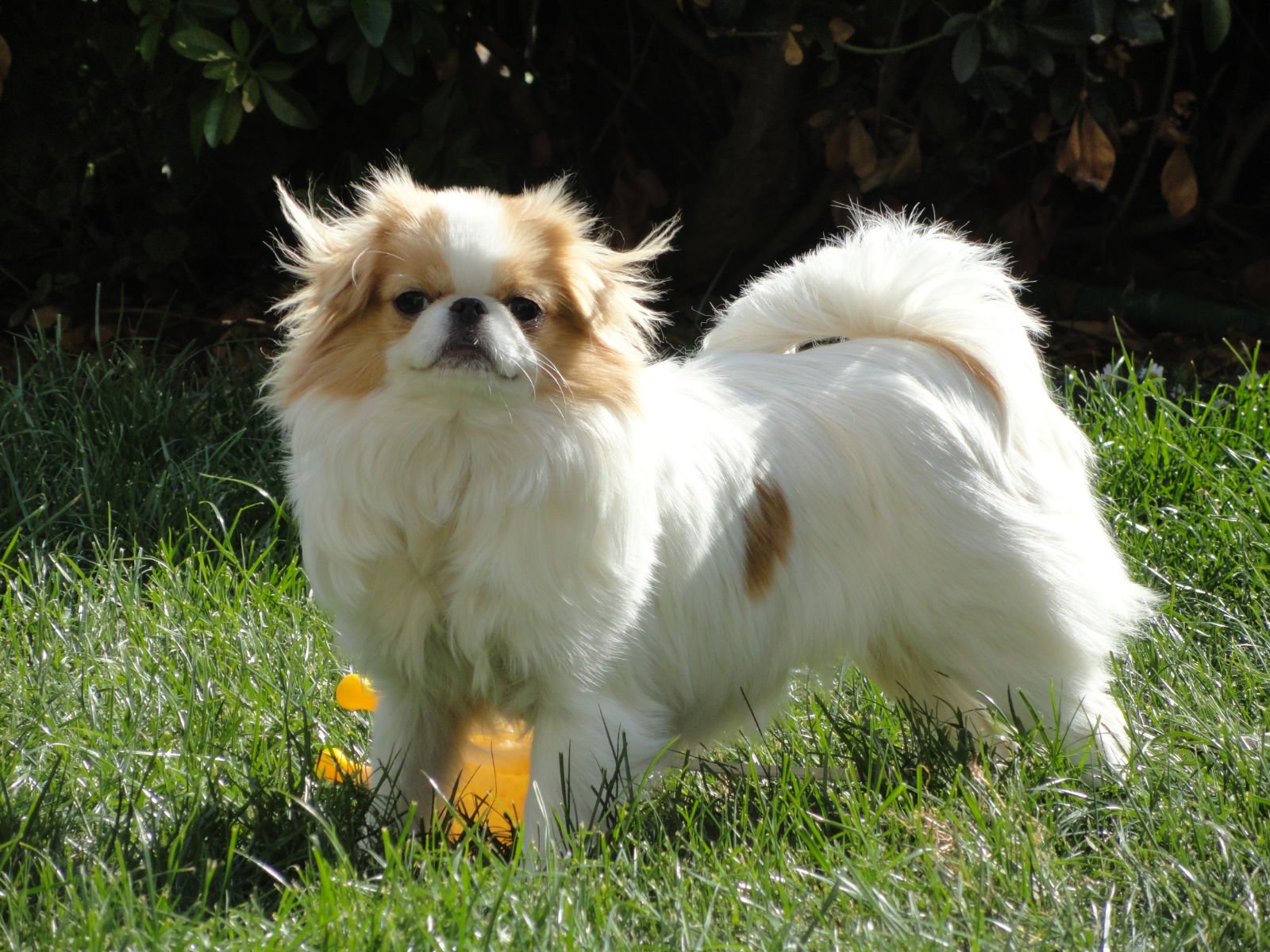
The Chin’s coat is single and silky, so the breed needs no clipping and mats less than breeds with a dense undercoat. That is not the same as no grooming: the hair is long and fine, and without regular combing knots form where the coat is softest.
Combing. Several times a week with a long-toothed metal comb, with separate attention behind the ears, under the forelegs, on the “trousers” and between the toes. Fine hair should not be combed dry — a light misting keeps the strands from breaking.
Bathing — as needed, with a moisturizing shampoo and conditioner. Better not to dry with hot air: a flat-faced dog sheds heat poorly, so a dryer on a high setting is more unpleasant and riskier than for an ordinary breed.
Ears. Hanging, hair-covered and poorly ventilated — inspect regularly without going deep into the canal. Redness, an odor, or head-shaking are grounds for a veterinary look.
Nails and feet. A small breed wears its nails down little on walks, so they need shortening on a schedule. The hair between the pads is trimmed back — it collects dirt and cuts traction on a smooth floor.
Teeth. Toy breeds with crowded teeth are prone to fast plaque buildup, and the Chin is no exception — it was, as it happens, among the participants in a clinical trial of oral hygiene products in small breeds. Brushing at home matters because the alternative is a dental cleaning under sedation, and sedation in a brachycephalic dog, as shown above, carries more risk.
Feeding and weight
Training: short, quiet, and without a raised voice
The Chin learns beautifully, but not by mechanical repetition. Long uniform strings of commands bore it, and rather than resist it stops taking part. What works is several very short sessions a day, a few minutes each, with frequent changes of task and a reward for every success.
Shouting and physical coercion do not work on this breed literally: the dog shuts down and stops cooperating, and rebuilding trust takes longer than teaching a command from scratch. Positive reinforcement here is not an ideology but the only method that produces a result.
Two things are worth teaching without fail. The first is a reliable recall, because a small dog outdoors moves fast and unpredictably. The second is calm acceptance of having the face, eyes and mouth examined — for a breed facing regular eye checks and likely dental visits, that is not a trick but years of stress removed in advance. The AKC standard, which asks judges not to look into a Chin’s mouth themselves, shows how innate the trait is.
Socialization starts early and in measured doses: the Chin needs experience of new places and people, but without force and without “let everybody pet him”.
Who the Chin suits and who it does not
A breed with a very narrow profile of suitability — not a flaw, but the reason to choose it deliberately.
| Suits | Does not suit |
|---|---|
| An apartment of any size, a small one included | A household where the dog is left alone most of the day |
| A quiet home where a quiet dog is an advantage | A family with preschool children |
| An owner ready for a daily eye check | Anyone wanting a partner for running or long hikes |
| A temperate climate, or the means to keep the home cool in summer | A hot climate without air conditioning |
| Readiness to plan anesthesia and checkups as a concern of their own | The assumption that a small dog means little trouble |
What to ask the breeder
The Chin in its homeland today
The idea of the Chin as a Japanese national breed is worth refining with the registry’s own figures. According to the Japan Kennel Club, 386 Chins were registered in 2025 — 35th in the breed ranking. For comparison, 4,284 Pekingese were registered the same year, more than ten times as many, and the leader, the Poodle, gathered over 69,000.
Two often-confused categories are worth separating too. Japan officially recognizes the nihon-ken — six native breeds holding natural-monument status. The Chin is not one of the six: it developed as a court chamber dog rather than a working native breed, and its history was tied from the start to importation and the court, not rural Japan.
What the popular stories do not survive
A great deal of colorful material has been written about the Japanese Chin. Below is what we deliberately do not present as fact, and why. How striking a claim is signals risk, not grounds for belief.
- “The Chin is a healthy breed.” The commonest sentence in breed descriptions and the worst. The Cambridge survey contradicts it directly: fewer than two dogs in ten graded clear on respiratory function. We give no blanket verdicts on a breed’s health — they mean nothing and lull attention to sleep.
- “Owning a Chin was punishable by death.” It travels from text to text, is absent from the FCI standard and has no source anyone can check. Lore, not history.
- “Chins have more webbing between the toes than other breeds.” Not one of the three standards says so; all three describe a hare foot with tufts of hair between the toes. Those are different things.
- “The Chin descends from Tibetan temple dogs.” The FCI standard traces the line through Korea and China and never mentions Tibet.
- “Snoring is just a charming quirk.” It is the very sound that separates grade zero from grade one in the respiratory function study. Charming it may be; neutral it is not.
And here is what the documents do support, and what genuinely sets the breed apart: the Japanese Chin is the only dog breed in the international register of inherited traits under GM2 gangliosidosis type I; with the Pekingese it makes up a section of the FCI classification all its own; and it was on those two that the Cambridge group recorded the highest BOAS figures among the fourteen breeds examined.
Video about the breed
- Quiet, clean, almost cat-like in behavior
- No need for long exertion — an apartment suits it
- Single coat: the breed needs no clipping
- Affectionate and deeply attached to its own person
- Pronounced brachycephalic: breathing, heat, anesthesia
- Large eyes exposed to injury and corneal ulceration
- Takes long stretches alone badly
- Fine bone — household injuries in a small dog
- Reserved with strangers, tolerates familiarity poorly
| Pekingese | Cavalier King Charles Spaniel | Continental Toy Spaniel (Papillon) | |
|---|---|---|---|
| Height | 15–23 cm | 30–33 cm | 20–28 cm |
| Energy | 2.5 | 3 | 3.5 |
| Apartment | 4.5 | 4.5 | 5 |
| Beginners | 3.5 | 4 | 4 |
Is the Japanese Chin really a healthy breed?
Why does the Japanese Chin get compared to a cat?
How serious is brachycephaly in the Chin?
What is GM2 gangliosidosis, and can it be tested for?
What height and weight does the Japanese Chin have?
Can you walk a Chin in summer?
Does the Japanese Chin suit a family with children?
How does the Chin differ from the Pekingese and the King Charles Spaniel?
FCI standard No. 206 · AKC and The Kennel Club standards · OMIA:001461-9615 (HEXA) · Tomlinson et al., PLOS ONE (Cambridge survey of 898 brachycephalic dogs) · Packer et al., PLOS ONE · Dimopoulou et al., Scientific Reports · McMillan et al., Scientific Reports (life expectancy) · Hall et al., Animals (heat-related illness) · Acta Neuropathologica (first description of GM2 in the breed) · Journal of Neurochemistry (hexosaminidase activity) · Molecular Genetics and Metabolism (HEXA variant) · Journal of Veterinary Internal Medicine (MRI picture) · British primary-care study of corneal ulceration (104,233 dogs) · Swedish insurance study of upper respiratory disorders (327 breeds) · retrospective anesthesia cohort (223 against 223) · analysis of 54,542 anesthetics · Dutch guideline on brachycephalic dogs and the Amsterdam court judgment · EU Regulation 2026/1818 · The Kennel Club respiratory function grading scheme · Japan Kennel Club · Japanese Chin Club of America
For apartments · For kids · For beginners · Active · Smartest · Hypoallergenic · All rankings →