

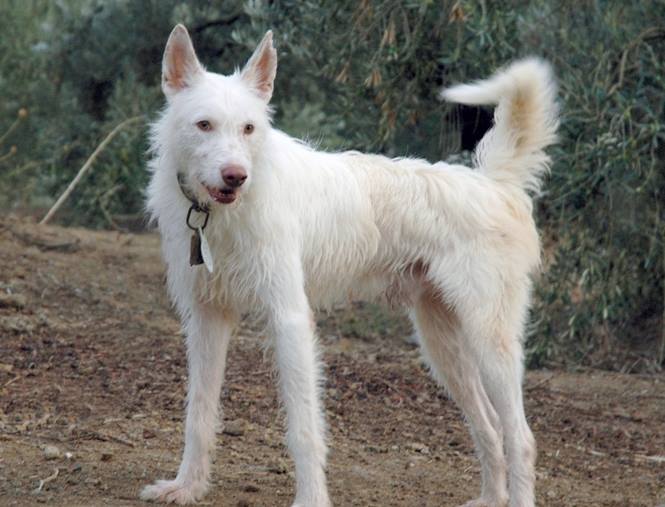
| Height | 45–55 cm |
| Weight | 12–20 kg |
| Lifespan | 12–14 years |
| FCI group | not FCI-recognized (Canary type) |
| Origin | Canary Islands (Spain) |
Exact ratings
- A robust aboriginal breed overall
- Injuries while running and hunting
- Anesthetic sensitivity (as in sighthounds)
- Eye disease
- Sunburn on pale skin
Quality protein for an active breed and weight control. As a primitive island type it is generally robust in health; the key is enough exercise and space to satisfy the hunting instinct.
The Podenco Campanero is a dedicated guardian that will jealously protect both the property and the little ones in the family. However, deep inside this white giant lives a dream of wanderlust and open spaces. That’s why it is best to keep this dog in a fenced yard of a country house, ensuring you don’t deprive it of the chance to show off its active nature under supervision. The pet’s coarse white coat won’t cause owners too much trouble, as it has a remarkable ability to self-clean. Learn more on Tvaryny.
Podenco Campanero: A Brief Breed Overview
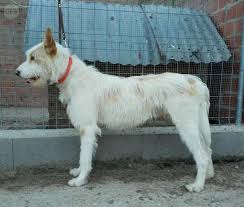
| Characteristic | Description |
|---|---|
| Origin | Spain (Andalusia) |
| Group | Primitive hunting dogs (not separately recognized by FCI) |
| First Mentioned | Formed as a type in the 20th century, ancient roots |
| Coat Type | Wire-haired, rough |
| Color | Predominantly white (small spots possible) |
| Height at Withers | 21-26 inches (53-65 cm) |
| Weight | 44-66 lbs (20-30 kg) depending on sex/condition |
| Purpose | Big game hunting, guarding, companion |
History of the Breed
The dog breed with the melodious name – Podenco Campanero – has deep Spanish roots. For a long time, they served local farmers in southern Spain as guardians and indispensable assistants during hunts. The name “Campanero” itself can translate to “bell ringer” or relate to something visible from afar. One theory suggests that due to their bright white color, these dogs “shone” in the fields like beacons for hunters, or perhaps their bark was as loud and resonant as a bell.
With a pet like this, you could head out for hare or go after bigger game – wild boar or deer. This strong and loyal dog would always stand in defense of its master. At the same time, it doesn’t display unnecessary aggression toward people, making it unique among working breeds. Often, this breed is viewed as a large, wire-haired variety of the Andalusian Podenco, but the Campanero has unique traits that distinguish it as a separate group for enthusiasts.
These excellent characteristics helped the Podenco Campanero gain popularity beyond its historical homeland. Today, it’s not hard to find them in various European countries where they have become beloved companions. Despite popular recognition and fame in narrow circles of “rehaleros” (owners of hunting packs), the main Fédération Cynologique Internationale (FCI) has not yet officially recognized the ancient Podenco Campanero breed as a separate unit, classifying them within the Andalusian Podenco group.
What the Podenco Campanero Looks Like
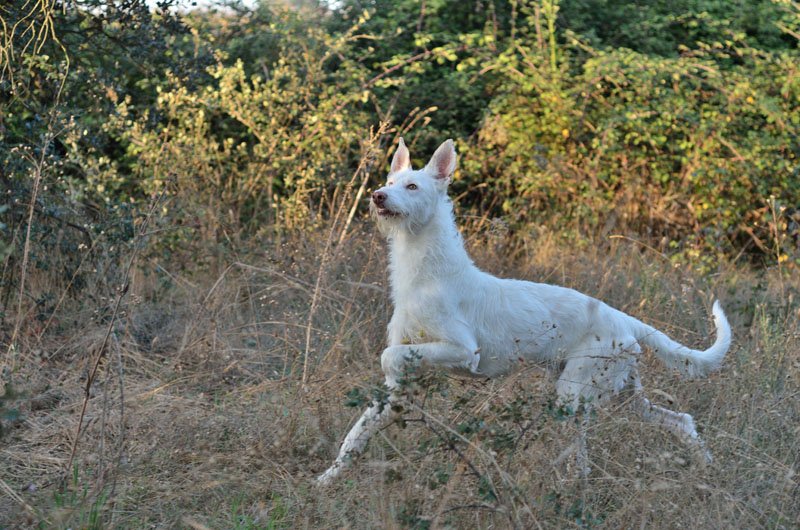
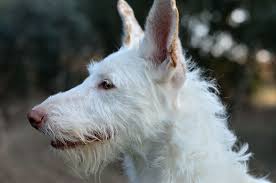
This is a large white dog with a sturdy but elegant build and a characteristic rough coat. The appearance of the Podenco Campanero clearly proves its family ties to another Spanish breed – the Podenco Andaluz. However, the Campanero is usually more massive and has a more “rustic,” country-style look.
- Head: Shaped like a truncated cone, typical for sighthounds and Podencos. It is elongated but not too narrow.
- Ears: Large, triangular, and erect. When the dog is alert, they point straight up or forward. When resting, they might splay slightly to the sides.
- Coat: An important distinction is the structure of the coat. It is wiry and rough to the touch. The hair falls in strands that aren’t too short, forming a characteristic “beard” on the muzzle and a hairy “frill” on the chest. This protects the animal from thorny bushes while running.
- Color: Predominantly pure white. This makes it easy to spot the dog in thick brush. You can also occassionally find representatives of the Podenco Campanero breed with light-toned spots (lemon or cinnamon).
- Body: The back is straight and muscular, and the chest is deep but not too wide, ensuring excellent aerodynamics.
Character: Temperament and Behavior
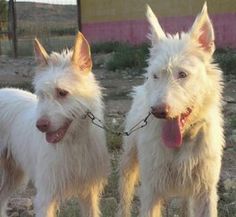
An energetic temperament marks the Podenco Campanero as a true Spaniard. It knows the thrill of the hunt, takes its duties as a guardian seriously, and knows how to truly love. Unlike more fragile breeds, such as the Podenco Canario, the Campanero has a more balanced psyche, although it remains a passionate hunter.
The dog’s active nature shifts to something surprisingly gentle when children are around. It behaves tenderly with little ones and happily joins in their games. A friendly character, obedience, and high intelligence have turned this four-legged hunter into an excellent companion. However, there are a few nuances to keep in mind:
- Independence. This dog is used to making decisions on its own during a hunt, so it can sometimes seem stubborn.
- Tendency to Escape. A notable trait of the Podenco Campanero is a wanderlust spirit. The scent of game can lead it far from home. Fences must be high and secure.
- Guardian Instinct. Although the dog is loyal to its owners and considers it a duty to protect them from danger, it rarely attacks first without provocation.
Coat Care and Grooming
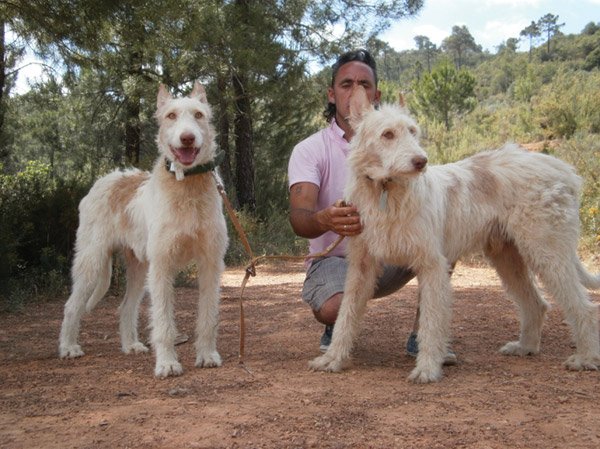
You shouldn’t house a representative of this breed in a cramped city apartment. Sure, long daily walks and exercise will help burn off natural energy, but that’s not much compensation for limited living space. The Podenco Campanero is primarily a farm dog; it needs plenty of movement, action, and freedom. Country landscapes will delight this dog much more than a city sidewalk.
Besides, having a yard will save owners a significant amount of time on walks. In general, the Podenco Campanero is a low-maintenance pet:
- Brushing: The rough coat doesn’t require frequent brushing. Going over it once a week with a special brush or Furminator is enough to remove dead hair.
- Bathing: The characteristic white color doesn’t require constant washing. The coat structure allows dirt to dry and simply fall off. You shouldn’t bathe the dog with shampoo more than 3-4 times a year.
- Paws: After active runs, check the paw pads for cuts or thorns.
Training and Socialization
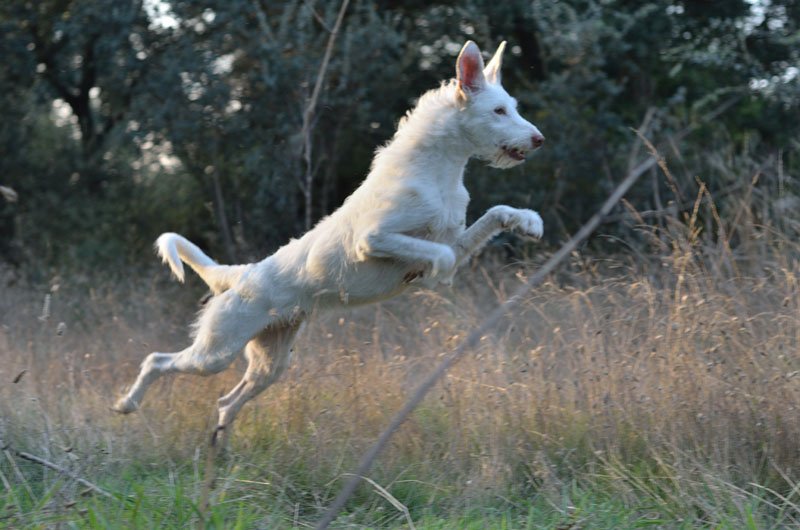
The natural intelligence of the Podenco Campanero aids in successful training, but it has its quirks. This isn’t a Shepherd that will stare into your eyes waiting for a command. This is a partner.
Keep in mind that these pets can’t live without work and physical activity. To prevent the dog from running off at the call of its hunting instinct, you must provide enough tasks and training. If you don’t plan on hunting, try coursing (chasing a mechanical lure) or agility. Similar training methods are used for the Spanish Hound (Sabueso Español).
The cleverness inherent in these white gun dogs, along with their sociability and active nature, helps in learning. In Spanish, “campanero” means “bell ringer,” which suggests that lessons with a Podenco Campanero are unlikely to be quiet. Use only positive reinforcement – treats and praise. Harshness can cause the dog to shut down.
Nutrition: Key Recommendations

The active Podenco Campanero requires a balanced diet, especially during periods of high activity. This dog’s menu consists largely of protein, with the rest made up of complex carbohydrates and vegetables.
Diet Basics
When alternating between meat and fish dishes, remember that the nutritional value of fish is lower. Poultry, on the other hand, is more nutritious than a piece of beef of the same weight. Dogs digest boiled eggs well, and they can be given fermented dairy products (cottage cheese, kefir).
| Product | Recommendations | Frequency |
|---|---|---|
| Meat (Beef, Turkey) | Raw (deep-frozen) or boiled. The menu staple. | Daily |
| Fish (Sea) | Boneless, boiled. Source of Omega-3. | 1-2 times a week |
| Grains | Buckwheat or rice. | Supplement to meat |
| Vegetables | Carrots, pumpkin, zucchini (fibrous). | Daily |
| Oils | Flaxseed or salmon oil. | Add to grain mix |
A little oil in your pet’s food will significantly improve the look of its coat. Important: The Podenco Campanero should not be taken out for an active walk or work sooner than 4-5 hours after a hearty meal to avoid bloat (gastric torsion), which all deep-chested dogs are prone to.
Health: Common Issues and Prevention
Its working past has gifted this farm breed iron stamina and adaptability to various weather conditions. A close relative of the Podenco Campanero, the Andalusian Podenco, can go without food for several days in extreme conditions. But that doesn’t mean a domestic pet with hot Spanish blood should be subjected to such stress or that you should skip vet visits.
What should you look out for?
- Musculoskeletal System: Like all large dogs, Campaneros can be prone to joint problems as they age, although dysplasia is less common than in Mastiffs.
- Ears: Large, open ears need regular checks for ticks and dirt after walks in the woods.
- Sensitivity to Anesthesia: Like many sighthounds, Podencos have a low percentage of body fat, which affects how they metabolize drugs. Vets need to account for this.
Preventive check-ups are the best guarantee for detecting diseases early. In general, the active and life-loving Podenco “bell ringer” rarely gets sick and lives to a respectable age of 12-14 years.
Pros and Cons of the Breed
| Advantages (Pros) | Disadvantages (Cons) |
|---|---|
| Excellent health and stamina | Requires a lot of physical activity |
| Gentle with children, patient | May run off if it catches a scent |
| Coat doesn’t require complex care | Not suitable for apartment living |
| Good guarding qualities without excess malice | Loud bark (hence the name “bell ringer”) |
| High intelligence and smarts | Can be independant during training |
If you are looking for a less active pet for an apartment, perhaps the Mi-Ki or the exotic Moscow Dragon would be a better fit, since the Podenco Campanero demands space.
Fun Facts About the Breed
- Teamwork: Campaneros often work in packs (rehalas), so they get along very well with other dogs and rarely start fights.
- Versatility: Unlike classic sighthounds that rely on vision, the Podenco uses three senses: sight, smell, and hearing.
- “Tough” Protection: Their rough coat serves as evolutionary armor against thorns and insect bites in the dry Spanish climate.
- Ancient Roots: It is believed that the ancestors of these dogs were brought to the Iberian Peninsula by the Phoenicians thousands of years ago.
Frequently Asked Questions (FAQ)
Is this dog suitable for beginners?
Not exactly. Although they aren’t aggressive, their hunting instinct and need for heavy physical loads can be a challenge for an inexperienced owner.
Do Podenco Campaneros bark?
Yes, and quite loudly. They use their voice during the hunt to alert the master about prey.
How do they handle the cold?
Thanks to their rough coat and undercoat, they are hardier than smooth-coated Podencos, but in severe freezing temps (below 14°F or -10°C), it’s better to keep them in an insulated shelter.
- A hardy, athletic hunter
- Robust “natural” health overall
- Devoted and sensitive to the family
- A distinctive, rare primitive type
- Strong prey drive
- Needs space and lots of exercise
- Rare — hard to find and socialize
- Independent, reserved with strangers
| Podenco Canario | Ibizan Hound (Podenco Ibicenco) | Portuguese Podengo (Medium) | |
|---|---|---|---|
| Height | 55–64 cm | 56–74 cm | 40–54 cm |
| Energy | 4.5 | 4.5 | 4 |
| Apartment | 2 | 2 | 3 |
| Beginners | 2.5 | 2.5 | 3 |
Why is the Podenco Campanero called a “bell-ringer”?
How does the Campanero differ from the Podenco Canario?
Is the breed suitable for an apartment?
Canarian aboriginal type · Spanish regional clubs
For apartments · For kids · For beginners · Active · Smartest · Hypoallergenic · All rankings →