

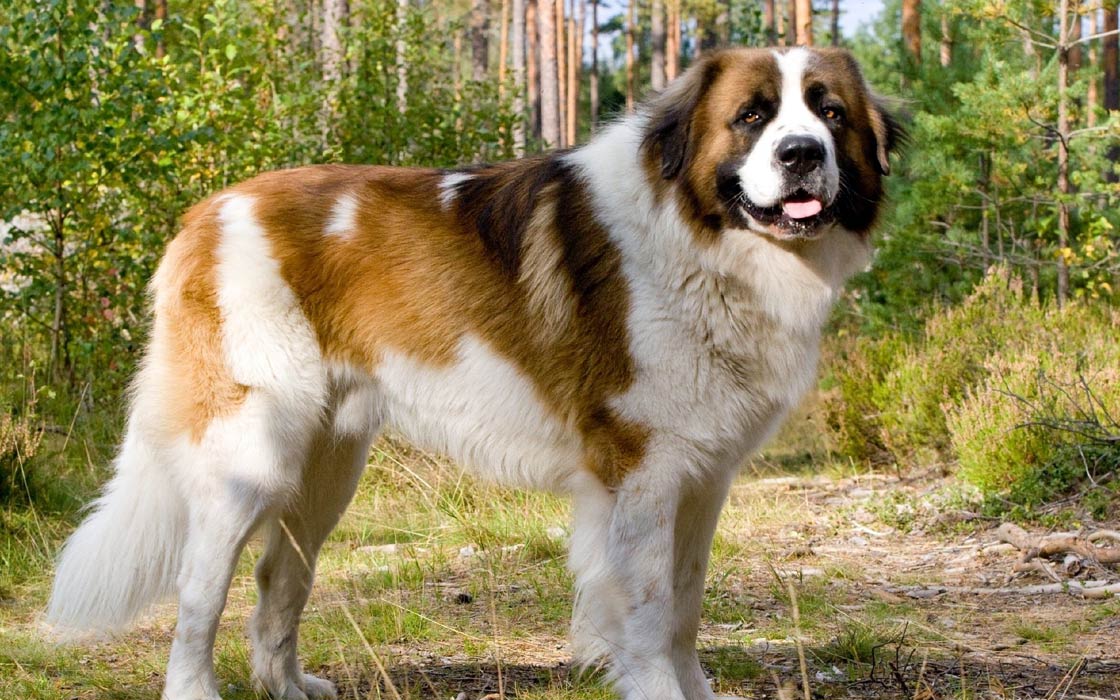
| Height | males 77–78 cm · females 72–73 cm |
| Weight | males from 55 kg · females from 45 kg |
| Lifespan | 9–11 years |
| FCI group | not recognized by the FCI · RKF national breed |
| Origin | USSR / Russia |
Exact ratings
Common health issues
Nutrition
The Moscow Watchdog is one of the few breeds where we know not just roughly where it came from, but who built it, on whose order, and to what brief. This purpose-bred working breed came from the “Red Star” kennel of the Central School of Military Dog Breeding, and its paperwork survives in print: the first litters, the measurements of the first sires, five editions of the standard. Everything below leans on those documents, not club lore. Learn more on Tvaryny.
History of the Breed
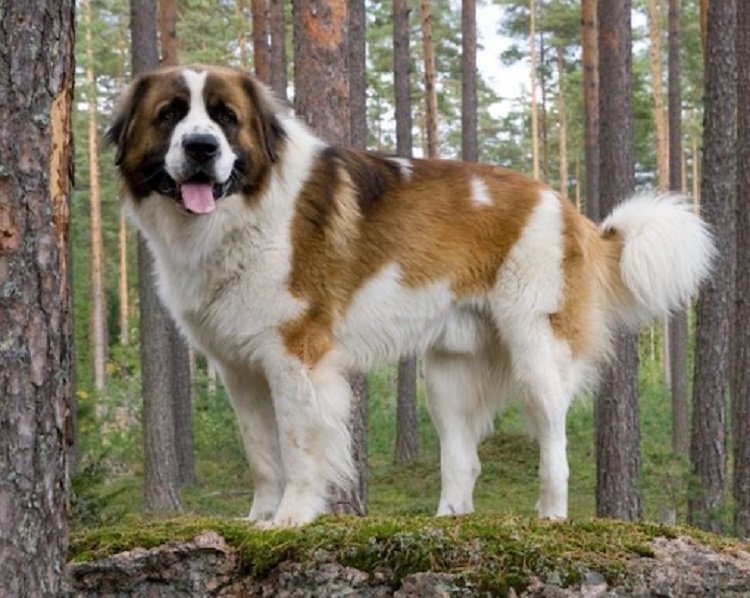
After the Second World War the Soviet stock of service dogs was effectively gone. By order of the USSR Ministry of Defense, rebuilding it and covering the needs of the national economy fell to the Central School of Military Dog Breeding “Red Star,” then at Veshnyaki next to Novogireyevo outside Moscow, today part of the city. In the late 1940s it began crossing whichever breeds on hand suited the assignment.
That reliance on “whatever was on hand” was forced. The breeds brought back from Germany survived as scattered individuals; Saint Bernard and Newfoundland, Rottweiler and Giant Schnauzer counted as exotics. Alongside them worked the German Shepherd and the Caucasian Shepherd Dog, the Russian Borzoi, and the Russian Piebald Hound (in Russian, russkaya pegaya gonchaya). Out of that mixed, thinly spread material, several breeds had to be built at once.
Who Actually Did the Work
The program ran under the biologist Professor N. A. Ilyin and the school’s commander, Major General G. P. Medvedev; the crossing and the choice of sires fell to the kennel’s head, Nikolai Ivanovich Bortnikov. Its cynologist then was Alexander Pavlovich Mazover, an expert of all-Union category, whose 1955–1956 descriptions survive and show exactly what the first generation looked like.
The method was called complex reproductive crossing, “complex” because more than two breeds took part. The brief was dry and concrete: a large, powerful, coarse-type, mobile dog with watch and guard qualities, easy to train and undemanding to keep. Those traits had to pass reliably to the offspring; the target was a breed that reproduces itself, not a few good individuals.
The First Litter and the First Show
In 1950 the kennel brought six littermates born July 12, 1949 to the 14th Moscow City Show of service dogs — five males and one female: Djoy, Don, Dukat, Despot, Divny, Dido. Their parents are named outright: the Saint Bernard Barri and the Caucasian Shepherd bitch Asha. The founding pair is therefore Saint Bernard × Caucasian Shepherd, and the judging reports still call the puppies crossbreds.
The 1950 write-ups read like an engineering test log. Djoy: a solid body and coarse bone, but a “sharply outlined loose lip” and straightened rear angulation. Divny: loose constitution, a light eye, a soft back. Despot: turned-out front feet and nearly straight rear angulation over a short second thigh. Faults were logged so later pairings could account for them, and the type evened out within a few generations.
What the Short Formula Leaves Out
The current standard sets out the origin in three names: Caucasian Shepherd Dog, Saint Bernard, Russian Piebald Hound. The pedigrees the National Breed Club publishes are more tangled. Saint Bernard × Russian Piebald Hound crosses were bred to East European Shepherds and their descendants to Caucasian Shepherds — the pedigree of the bitch Kara, born 1959. The sires also include Karabashka, a Caucasian Shepherd × Newfoundland cross, who in 1951 produced the male Fars by that same Barri. “Saint Bernard plus Caucasian plus hound” is a summary, not an inventory.
Another detail rarely written up: with breeding material limited, and “Red Star” carrying four breeds at once — the Moscow Watchdog, the Black Russian Terrier, the Moscow Water Dog, the Moscow Great Dane — the cynologists deliberately used close inbreeding on specific sires, through first- and second-generation descendants. It fixed the type and it worked; what it left behind is covered in the health section.
Searching for a Silhouette: The Cropping That Was Dropped
For several years the cynologists could not settle on a look that would read as neither Saint Bernard nor Caucasian. During that search the dogs had tails and ears cropped. The practice was abandoned: the breed settled on drop ears and a long, evenly furnished tail, fixed that way in every later edition.
Orslan, the Founder
In 1960 the male Vepkhia (Caucasian Shepherd Dog) was mated to the bitch Tutti (Saint Bernard). Their December 1, 1960 son was Orslan — future breed champion, champion of the 1967 USSR VDNKh exhibition, a dog of the “Elite” class, awarded for offspring excellent in both conformation and working qualities. The standard names him as founder. His 1968 description, written at the 32nd Moscow City Show by republic-category judge Anetta Yakovlevna Arkhangelskaya when he was almost eight, records a typey head with an excellent stop, dark eyes, a deep and broad chest, correct angulation — and, just as honestly, “slightly restricted movement, visibly aging.”
Orslan’s best-known son was Dick; beside him stood Murat, Jack-Dzhenal, Malysh, and Ikar. The National Breed Club states it has restored and preserved the lines of Dick, Murat, Malysh, and Ikar, and that genealogical groups in Russia still run through them. On so narrow a base that matters: the more living lines survive, the fewer forced matings between close relatives.
Five Standards in Half a Century: What Changed
The Moscow Watchdog is a rare case where you can line up the editions of a standard and see where the breed was heading. The first published description came out in 1958, in the catalog of the 22nd Moscow City Show of service dogs (May 24–26, 1958), and still covered a breed group. Then 1985: breed status granted, new standard published. On April 17, 1992 the standard then in force was approved by the Russian Federation of Service Dog Breeding. In 1997 an edition with minor changes went to the RKF and was adopted by the Department of Animal Husbandry and Breeding of the Russian Ministry of Agriculture. The current edition is dated April 23, 2008.
The Breed Physically Grew
The 1958 standard asked males for no less than 66 cm at the withers, females no less than 63 cm. The current standard lifts that floor to 68 cm in males and 66 cm in females, sets the desired height at 77–78 cm for males and 72–73 cm for females, and puts no upper limit on height. Measurements of real sires from the mid-1950s show the starting point: the male Khim at 73 cm and 54.7 kg, the male Kheder at 68 cm and 44 kg, the bitch Khurma at 68 cm and 50.5 kg, the male Arik at 72 cm and 50.6 kg. Across half a century the breed gained roughly five centimeters in desired height and noticeably in mass.
The Origin Formula Changed as Well
The 1958 standard puts the origin plainly: the breed group came from crossing Saint Bernards with Caucasian Shepherds and mating the crosses to one another, with careful selection for type and productivity. The Russian Piebald Hound is absent there — it enters the wording of later editions. Not a contradiction but the ordinary life of a document: in 1958 the compilers recorded what they took to be the main thing, and the formula was refined later.
Dewclaws: A Fifty-Year Storyline
In the 1958 text, the paragraph on feet notes that the phrase “dewclaws are permitted” was struck out by A. P. Mazover. The 1992 standard already requires them removed. The current edition goes further: dewclaws are a disqualifying fault. A single line crossed out in the 1950s became, over half a century, grounds for leaving a dog in the ring with no rating.
Appearance and Breed Standards
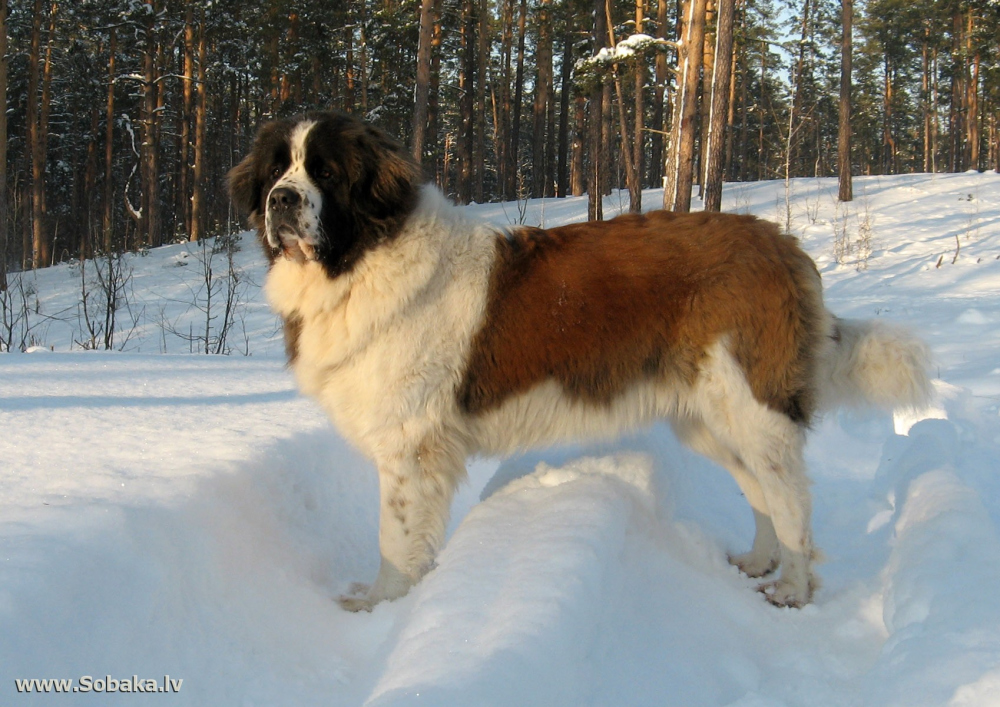
The current standard describes the Moscow Watchdog as harmonious in build, coarse and sturdy in type, large, broad-bodied, with a somewhat elongated frame and well-developed, voluminous musculature — active and mobile. Sexual type is vivid: males are heavier and more masculine than females. Crucially, it does not stop at adjectives; it states the proportions in numbers.
Proportions a Judge Is Expected to Check
Body length against height at the withers runs 104–105% in males and 106–108% in females; bitches are a little longer in body, and that is correct for them. Chest depth is 50–52% of withers height, muzzle length 34–37% of head length, elbow height 50–52% of withers height. That last number matters: the dog should be neither built on stilts nor low-slung — about half its height is leg up to the elbow.
Head and Muzzle
The head is massive, broad and deep through the cranial region, with a wide, slightly convex forehead and a shallow longitudinal furrow. The stop is short, well defined, fairly deep. The muzzle is somewhat shorter than the skull, broad, blunt, deep, well filled under the eyes; skull and muzzle lines are parallel. The lips are thick, fleshy, black — and here the standard draws its line: with the mouth closed they cover the lower jaw completely, yet form no flews and no pendulous folds. That is a direct barrier against Saint Bernard looseness, since a lip forming a “pocket” caps the rating at “good.”
Dentition is full — 42 teeth, a scissor bite, incisors aligned at the base. The working origins show in one concession: broken or knocked-out incisors and canines that still allow the bite to be assessed do not affect the rating. Missing teeth disqualify, and one absent tooth is enough.
Eyes and Eyelids: The Most Closely Watched Feature
The eyes are small, dark, round, deep-set, set wide and straight, the expression calm and confident. The eyelids are black, tight, moderately dry — and “moderately dry” is not cosmetic wording. Serious faults include “loose eyelids” and “strongly developed third eyelids”; brown eyelids disqualify. The 1992 standard held the same requirement (“eyelids black, dry”) and the same fault; the 1958 text was terser: “Eyelids taut.” One structural weakness has stayed in the crosshairs across the breed’s whole history, and the reason becomes clear in the health section.
Coat and Color
The coat is dense, long, thick, with a well-developed undercoat; the guard hair is straight, shorter on the head and the front of the legs. Furnishings are heavier in males, forming a “mane” on the neck and feathering behind the legs, with the tail furnished evenly. A slight wave is tolerated over the loin, croup, and thighs, nowhere else. Curly hair, and very short hair with no furnishings, are serious faults.
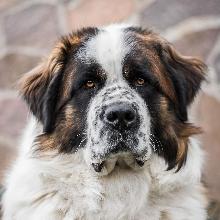
The color is red-piebald and spotted: a white ground with patches red, red-and-black, black-and-red, or sable, a red shade obligatory. White is required on the chest, the front legs to the elbow, the hind legs to the hock, and the tail tip. Ticking on the white, dark “spectacles,” and black on the ears are preferred. The standard’s ideal is a dark head from a black mask, black spectacles, and black ears, against a lighter body with reddish patches separated from the white by distinct sable borders.
The National Breed Club’s commentary on color, prepared with M. N. Sotskaya, candidate of biological sciences, breaks this down into genetics. The piebald pattern is governed by the recessive genes ss; the color of the pigmented patches by ayay, the sable series running from red shades to bright red with sooting; ticking by the dominant gene T. White areas should cover no less than 30% and no more than 85% — on R. Robinson’s ten-point scale of piebald expression (1982) the desirable band is 3 to 7 points, provided head and muzzle are pigmented. “Irish spotting” — small white markings on a pigmented ground — does not meet the standard.
The spectacles are what make the breed recognizable at a glance. Sharp asymmetry, spectacles without a black rim, missing spectacles or a one-sided “monocle,” spectacles that fail to cover the inner corner of the eye — every one caps the rating at “good.” The club’s reasoning: sharp asymmetry is a clearly heritable trait. Ticking brightens with age; barely visible in a puppy, it turns vivid and sharp by two years.
One more consequence of the founding breeds: short-coated dogs with undeveloped furnishings still show up in the ring, carrying the traits of short-coated Saint Bernards and Caucasian Shepherds. Short hair is dominant over long, so the club insists this fault be recorded in every description, since it feeds into breeding decisions. The coat is not fully formed until 1 to 1.5 years, after the second complete shed.
| Parameter (current standard) | Males | Females |
|---|---|---|
| Minimum height at withers | 68 cm | 66 cm |
| Desired height at withers | 77–78 cm | 72–73 cm |
| Upper height limit | none | none |
| Weight | from 55 kg | from 45 kg |
| Body length to height index | 104–105% | 106–108% |
| Chest depth as share of height | 50–52% | 50–52% |
| Coat type | Long, thick, with a developed undercoat | Long, thick, with a developed undercoat |
The disqualifying faults are worth knowing before buying a puppy: timidity or excessive excitability; any deviation from the scissor bite; missing teeth; a wry jaw; brown eyelids and nose; blue or green eyes and odd eyes; dewclaws; unbalanced movement; pacing; males of feminine type; complete or unilateral cryptorchidism. Sick, deformed, or injured dogs are left without a rating.
Recognition Status: What Exists and What Doesn’t
This is where the breed gets credited with more than it holds, so here it is point by point.
What exists. The Moscow Watchdog is a recognized national breed within the Russian Kynological Federation. The current standard, published 04/23/2008, sits in the RKF’s section of second-group standards, and its adoption by the Department of Animal Husbandry and Breeding of the relevant ministry is recorded in the standard’s own text. The breed has a National Breed Club, specialty shows, a title system, and breeding lines running back to Orslan.
What does not. The breed is absent from the nomenclature of the Fédération Cynologique Internationale (FCI). The FCI list under the letter M holds neither “Moscow Watchdog” nor “Moskovskaya Storozhevaya,” and it is missing from the provisionally recognized roster too. The consequence: at FCI shows it cannot take a CACIB or international titles as a recognized breed, and RKF pedigrees for it do not carry the status of pedigrees of an FCI-recognized breed.
The most telling detail. The National Breed Club publishes separately the “standard submitted to the FCI” — an English-language version in FCI format, translated by O. Shebarova under the editorship of E. Yerusalimsky. Its header reads “FCI-Standard Nr.: 000” and “DATE OF PUBLICATION OF THE OFFICIAL VALID STANDARD: 00.00.0000”. The application follows the international template; the standard number on it is a blank placeholder. That is the most precise answer available: the document has been filed, the number does not exist.
One subtlety throws readers off. The Russian text of the standard carries a line reading “FCI classification: Group 2, Section 2.2 Molossoid, without working trial.” That is what the authors proposed in their application, not an entry in the FCI register. Whenever you meet the phrase “the breed belongs to FCI Group 2,” this is its source — the application, not the nomenclature.
“Without working trial” earns its own comment: a working test is not mandatory for show titles, and for a guarding breed that leaves a noticeable gap between stated purpose and what the ring checks. A working class does exist at RKF shows, but entry is voluntary and requires certificates of the single RKF-recognized format: general obedience plus protection, or sentry service.
Character and Temperament: More Than Just a Guard
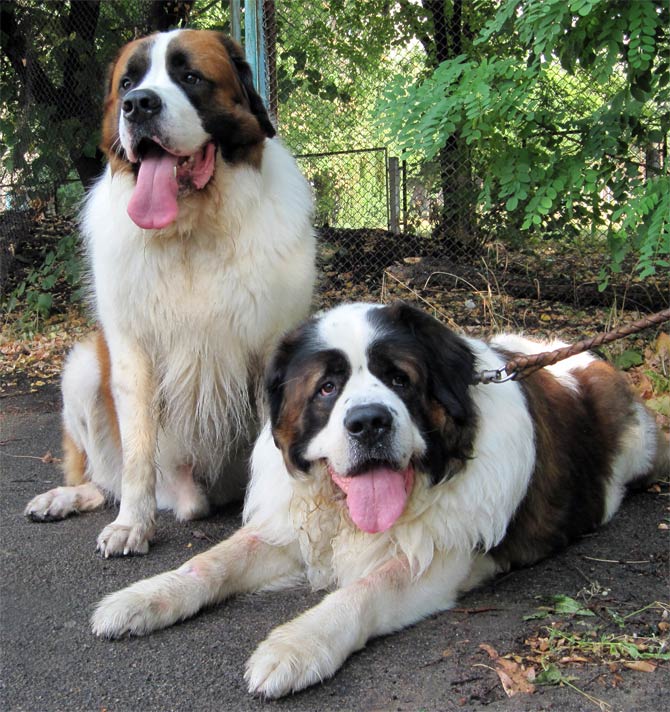
The standard spells out behavior in unusual detail, more than the standards of many guarding breeds. The dog is obedient, self-assured, balanced, “intelligent among watchdogs,” with a pronounced guarding instinct, independent yet sociable, unreservedly devoted to the owner and the whole family, and free of unmotivated aggression. Every word is loaded: “independent” is a warning, not a compliment, and “no unmotivated aggression” sets a floor the dog may not fall below.
From the Saint Bernard the breed took steadiness and the absence of aggression without cause; from the Caucasian Shepherd Dog, distrust of strangers and an instant reaction to danger. On the ground: it does not bark at every passerby behind the fence. It reads the situation and responds once a line has been crossed.
- Self-confidence. This dog is aware of its own strength. It does not fuss — which is why its reaction can come unexpectedly fast to anyone who read it as phlegmatic.
- Territorial instinct. Guarding ground is in its blood. You will not spend long teaching it to watch the yard; it does that instinctively. The flip side: it decides where the boundary runs, and your idea of that line may not match its own.
- Family orientation. Unlike many working breeds, the Moscow Watchdog attaches to the family as a whole. It does not single out one master but takes all “its people” under protection — the standard and the club’s temperament descriptions agree here.
This is a dog of high intelligence, capable of independent decisions — which sets it apart from many other breeds. Compared with decorative dogs like the Chihuahua, which depend entirely on humans and react emotionally, the Moscow Watchdog is an analyst. It evaluates the degree of threat.
Hunting breeds differ in temperament too. The Estonian Hound is focused on pursuing prey and may get carried away by a scent, ignoring commands. The Moscow Watchdog will never abandon its post for a cat or a rabbit. Its priority is the perimeter and the safety of the property.
Who Should Not Take This Breed
Let us be direct: this is not a dog for a first experience. The reason is not “meanness” — unmotivated aggression is not provided for by the standard, and timidity and excessive excitability disqualify. The reasons are structural. An adult male weighs from 55 kg and is physically stronger than a person; he matures psychologically only around 2–3 years and tests the limits that whole time. He is independent by the breed’s own definition, so in a conflict he decides faster than an owner can issue a command. He guards by instinct rather than training, so a handler’s mistake with visitors turns into consequences that cannot be wound back.
The apartment question deserves separate treatment, and our sources part ways, so both readings belong here. The current standard, under purpose, asserts that the breed “gets along excellently in an apartment and in a private house.” The club’s commentary on coat describes a different reality: most of the population is used for its direct purpose, guarding a property, and many dogs kept outdoors turn up at the shows. Our advice is practical. A dog whose coat is engineered for year-round life outdoors sits in constant thermal discomfort in a heated apartment and sheds more heavily. If no other arrangement is possible, plan on long walks of at least 2–3 hours a day and daily brushing.
Training and Education
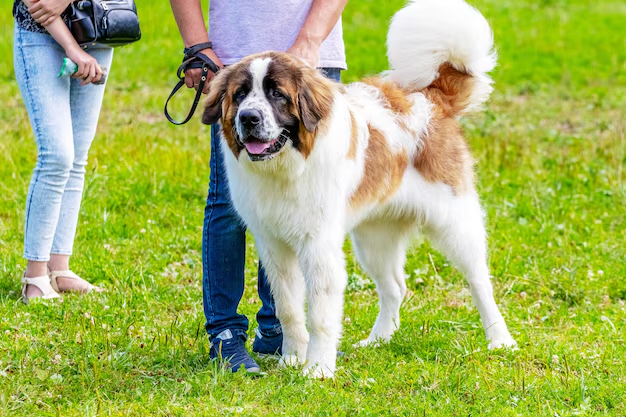
Training this breed asks patience and firmness of the owner, never cruelty. The Moscow Watchdog grows up late: psychologically it is formed by 2–3 years. Schooling still has to begin from the puppy’s first days in the house — not because it “needs to know commands,” but because this is the window in which boundaries get set that cannot be rewritten later.
Core Principles of the Work
The classic beginner’s mistake is trying to “break” the dog by force. With this breed that fails. He is stronger than a person, and if he senses unfairness he may shut down or answer with aggression. Success rests on partnership with the human as unquestioned leader. The kennel’s own history is relevant: it selected sires by more than conformation — every dog retained went through training and screening for working qualities, and those not kept for breeding were assigned to service. Handleability sat in the brief; it was never a side effect.
A general obedience course is the mandatory minimum: a large, unmanageable dog in a city or even a village is a source of heightened danger. Pay particular attention to the stopping commands: “No,” “Stay,” “Come.” Those, and not protection skills, are your real instrument, because this dog can guard perfectly well without you but cannot stop on request without you.
Socialization has to be early and systematic. The dog guards territory instinctively, so every new visitor is not a matter of “getting used to it” but a separate scenario to script and rehearse. If a show career is in your plans, note that the judge assesses temperament in the ring description, and that timidity or excessive excitability disqualify — an unstable psyche closes off breeding too.
Maintenance and Care
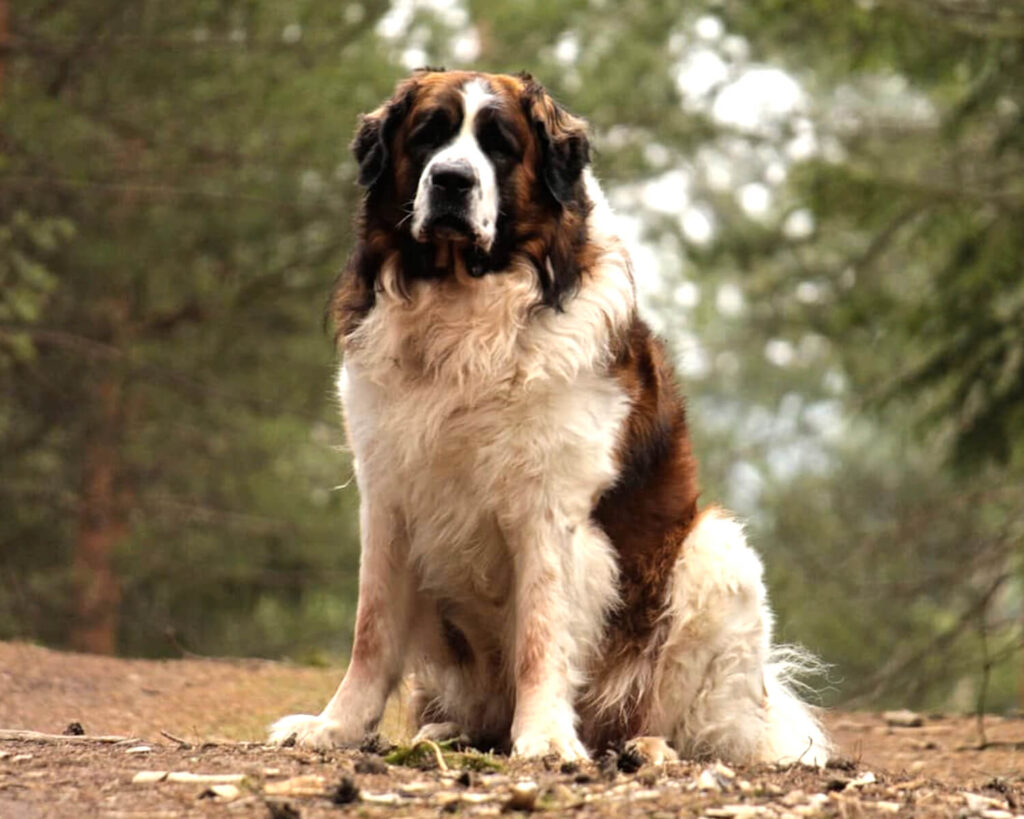
The ideal setup is a spacious run with an insulated doghouse plus free movement across the fenced grounds of a private house. That is not a “spartan” option but the regime the breed was engineered around: indifference to climate was in the brief, and the coat, by the club commentary’s definition, has to make permanent life outdoors possible in any weather, hard winters included.
Coat Care
The coat needs regular brushing: 1–2 sessions a week normally, daily during the shed in spring and fall. A slicker brush and a metal comb with long teeth will cover it. The club adds a practical detail: a correct coat tends to clean itself and needs no cosmetics to reach “show” condition, and dogs clipped or treated with volumizing products are not welcome in the ring.
There is also a diagnostic sign every owner should know. When the undercoat grows longer than the guard hair, the dog looks “fluffy” — a problem, not something cute. The guard hair no longer shields the undercoat from moisture, gives neither ventilation nor insulation, and the coat soaks through and freezes. A wave over the loin and croup means the same: the guard hair is not stiff enough. For a dog living outdoors this is not about looks but about surviving the winter.
Eyes, Ears, Teeth
Inspect the eyes regularly: this is the breed’s weak point by descent, as the next section details. Constant tearing, squinting, or rubbing of the muzzle calls not for a wipe with lotion but for a veterinary ophthalmologist — behind those symptoms there is often an inverted eyelid, treated surgically rather than with hygiene. Ears whose front edge lies against the cheekbones ventilate worse than erect ones, so check them weekly. And since missing teeth disqualify, get the puppy used to having its mouth examined from the first weeks.
Feeding: Key Recommendations
Health and Common Diseases
Interesting Facts About the Breed
- “Red Star” was developing four breeds at once: the Moscow Watchdog, the Black Russian Terrier, the Moscow Water Dog, and the Moscow Great Dane. Two did not survive — the Moscow Water Dog dissolved into the Newfoundland population without ever passing certification as a breed group.
- In the first two generations the stock still carried Caucasian colors: gray, agouti gray, fawn. Bitches of every color were bred, but only red-piebald males. That is how the breed color was fixed within a few generations.
- The obligatory white markings — chest, front legs to the elbow, hind legs to the hock, tail tip — entered the 1985 standard as “preferred” and became “obligatory” only from 1997. The club commentary says it outright: fixing that trait took 12 years of selection.
- The breed is still not recognized by the Fédération Cynologique Internationale (FCI) as a separate breed at the global level. The English-language standard prepared for submission to the FCI carries, to this day, an empty number in its header: “FCI-Standard Nr.: 000.”
- While the young breed searched for a look of its own, its ears and tails were cropped for a time. That was dropped: the modern standard calls for natural drop ears and a long, furnished tail.
Practical Questions from Owners
Is the Moscow Watchdog safe around children?
The standard describes the breed as devoted to the owner and the whole family, with no unmotivated aggression, while timidity and excessive excitability disqualify, filtering an unstable psyche out of breeding. Allow for the size, though: very small children should not be left alone with the dog, which can knock a child over with its body or tail. Safety comes from upbringing and supervision, not from any breed talent for nannying.
Can this dog be kept on a chain?
Categorically not. Permanent life on a chain wrecks the psyche of this intelligent animal: the dog turns embittered or depressed. Temporary tethering is acceptable — when guests arrive, or the gate is open for a car — but most of the time the dog needs to move freely around its run or the yard. The argument is not only ethical: unstable behavior is a disqualifying fault here.
How much does an adult dog eat?
A great deal — this is a dog weighing from 55 kg in males. The routine matters more than the volume: the daily ration is split into at least two meals, the bowl goes on the floor rather than a stand, and the dog is left in peace after eating. In winter a dog kept outdoors needs more energy.
Is eye care difficult?
The eyes are the breed’s weak point, built into its origins: loose, drooping eyelids were described in the founders of the breed group in 1955–1956, and every edition of the standard from 1958 to the current one penalizes “loose eyelids.” Regular inspection is mandatory. Keep the boundary in mind: hygiene handles ordinary dirt, while persistent tearing, squinting, and redness are grounds for a veterinary ophthalmologist, since an inverted eyelid is treated surgically.
What should you ask a breeder before buying?
Four things. First, the parents’ eyelids: loose, and operated on? Second, whether the parents or closest relatives had episodes of gastric torsion, since a first-degree relative with such a history significantly raises the risk. Third, whether joint radiographs with an official reading exist — the RKF admission system does not require them, so it becomes your own separate arrangement. Fourth, the litter’s inbreeding coefficient and the ancestors through which it was accumulated.
Video About the Breed
- Guarding qualities without unmotivated aggression — the standard demands it
- Undemanding about weather: a coat built for year-round life outdoors
- High intelligence; handleability was a line item in the design brief
- Attached to the whole family rather than to a single owner
- A giant — needs space, not a dog for an apartment
- Independent and territorial — not for a first-time owner
- Drools heavily and sheds twice a year
- Matures only at 2–3 years; a giant's shorter life (9–11 years)
- Joint screening is not part of the breeding admission requirements
| Saint Bernard | Caucasian Shepherd Dog | Newfoundland | |
|---|---|---|---|
| Height | M 70–90 · F 65–80 cm | M 72–75 · F 67–70 cm | M ~71 · F ~66 cm |
| Energy | 2.5 | 3 | 2.5 |
| Apartment | 2 | 1.5 | 2 |
| Beginners | 2.5 | 1.5 | 2.5 |
How was the Moscow Watchdog created?
Is the Moscow Watchdog sensible in a family?
Is the breed suitable for a first-time owner?
What are the height and weight under the current standard?
Is the breed recognized by the FCI?
Can a Moscow Watchdog live outdoors in winter?
Breed standard (RKF, ed. 04/23/2008) · National Breed Club "Moskovskaya Storozhevaya" · FCI nomenclature
For apartments · For kids · For beginners · Active · Smartest · Hypoallergenic · All rankings →