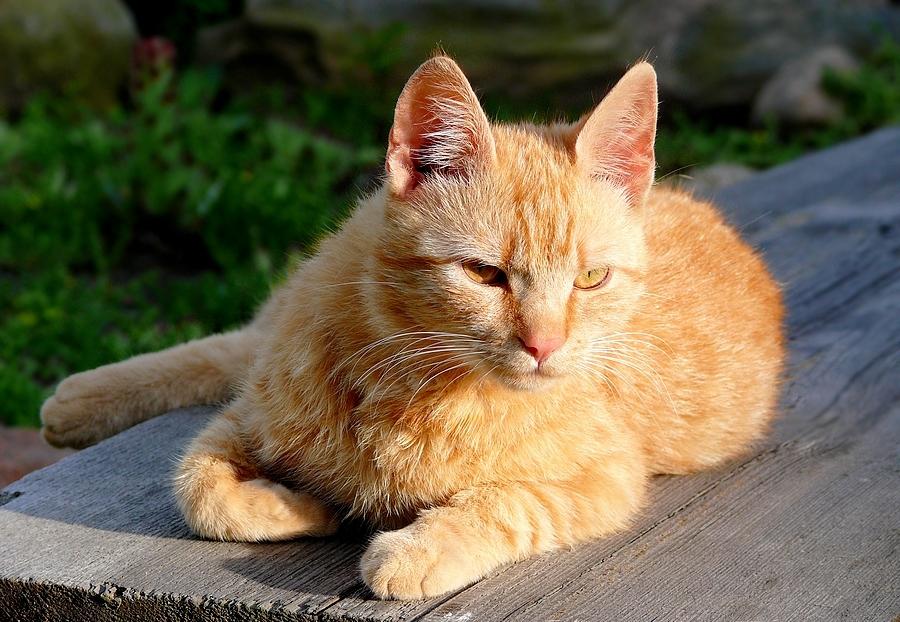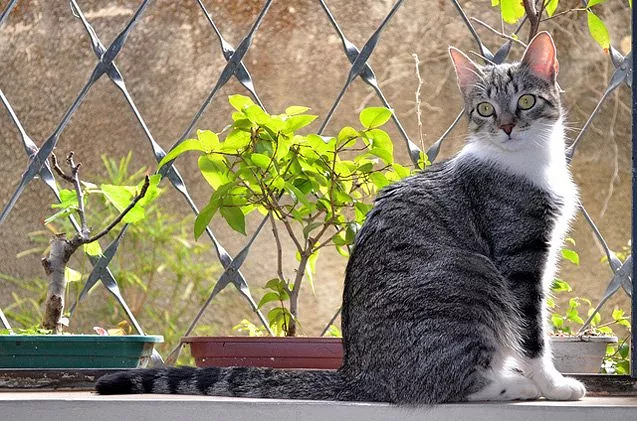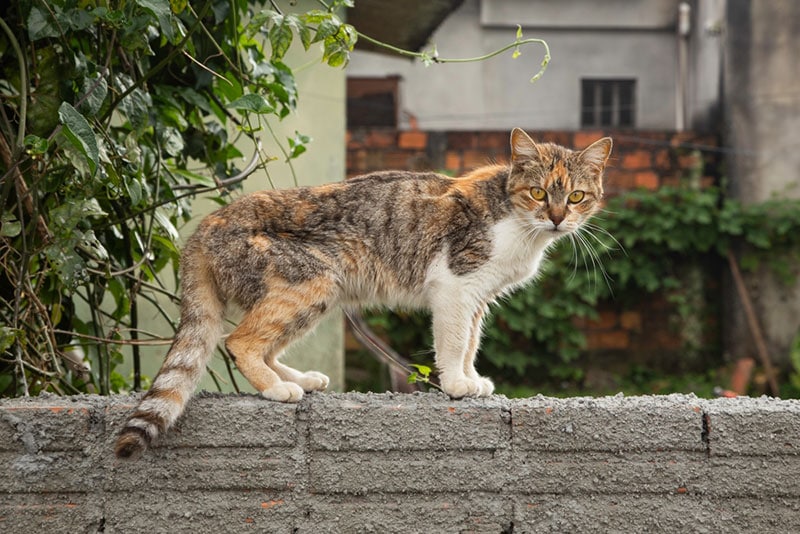
The Brazilian Shorthair cat (Brazilian Shorthair / Pelo Curto Brasileiro) is the first cat breed Brazil gave to world felinology, and one of the few cases where a breed was not created by crossing but carved out of a natural urban population. Its ancestors arrived on Portuguese ships, lived on their own in port cities for several centuries, and in the 1980s received a written standard and pedigrees. That makes the "Brazilian" interesting not only as a house cat but as a rare example of a breed whose boundary between the register and the street is still open. Below is what the registry documents actually say, what genetics knows about the Brazilian cat population, and what follows from it for anyone thinking of taking such a cat. Find out more on Tvaryny.
Brazilian Shorthair Cat: A Quick Overview
Brazilian Shorthair Cat: A Quick Overview · 14
| Criterion | Indicator |
|---|---|
| Homeland | Brazil; founding population — the street cats of Brazilian cities |
| International recognition | World Cat Federation (WCF), 1998 |
| Breed code at the WCF | BSH (do not confuse: at the FIFe those same three letters denote the British Shorthair) |
| Standard version in force | 1 January 2010 |
| Group | Shorthair |
| Size | Medium; indicative adult weight 4–7 kg. The WCF standard itself sets no numerical weight limits: it works by description ("medium-sized, muscular, yet slim and elegant") |
| Lifespan | 14–20 years by the customary reference figures; the median lifespan of domestic cats in a large veterinary sample is 14.0 years (see the health section) |
| Head | Small to medium, moderate wedge, longer than it is wide, profile slightly curved |
| Ears | Large, set high, with tufts |
| Eyes | Large, round, set wide apart — one and a half eye widths between them |
| Coat | Short, glossy, silky to the touch, close-lying, with no undercoat |
| Colors | All colors and patterns except the pointed ones; white in any amount |
| Special provision of the standard | The novice class for this breed is permitted only in Brazil |
| Health | The WCF standard contains no examination requirements for breeding animals. The data that do exist concern the Brazilian cat population as a whole — they are gathered in the "Health" section |
What "A Breed Made from a Natural Population" Means
The phrase "the breed descends from street cats" is written about many breeds, and usually it means nothing. Here it means something, because for the Brazilian population there are measured numbers and not merely a pretty legend.
In 2008 an international team of geneticists published a large study in Genomics, "The ascent of cat breeds" (Lipinski et al.): over 1,100 cats, seventeen free-living populations from five continents and twenty-two breeds, all genotyped with microsatellite markers. The Brazilian free-living population entered that sample as a separate line. Here are its figures alongside the breed averages:
What "A Breed Made from a Natural Population" Means · 6
| Indicator (Lipinski et al., 2008) | Brazilian free-living population | Average of the 17 free-living populations | Average of the 22 breeds |
|---|---|---|---|
| Animals examined | 26 | 35 | 25 |
| Observed heterozygosity | 0.66 | 0.65 | 0.51 |
| Expected heterozygosity | 0.71 | 0.70 | 0.58 |
| Allelic richness | 3.40 | 3.41 | 2.74 |
| Mean number of alleles per locus | 6.82 | 7.48 | 4.71 |
| Inbreeding coefficient | 0.08 | 0.09 | 0.12 |
This is how it reads. Brazilian street cats are in no way an exception among the world's free-living populations: in terms of diversity they sit exactly in the middle, next to the Italian, Singaporean or Texan ones. From pedigree cats, however, they differ markedly: mean heterozygosity in the free-living populations was 0.65 ± 0.03, in pedigree cats 0.51 ± 0.09. The authors summed it up simply: pure breeding is accompanied by a loss of genetic diversity, and the loss depends neither on the popularity of the breed nor on its age. Another slice of the same study — the analysis of molecular variance: in free-living populations 86% of all variability lies within the population, in breeds only 61%.
So when people write of the Brazilian Shorthair that it has "a broad gene pool", the statement has a foundation — but it applies to the founding population, not automatically to every kitten with a pedigree. As soon as breeding closes within a handful of lines, diversity begins to fall by the same laws as in any other breed. The difference lies in whether the breeder has a mechanism to replenish it.
The Novice Class: Why a "Brazilian" Can Be Brought into the Register Straight from the Street — but Only in Brazil
The most interesting line in the WCF standard is not about the eyes or the tail. It sits in the "Special provisions" section and consists of a single sentence: the novice class is not permitted for this breed outside Brazil. This is not a formality but a direct description of how the breed's gene pool is arranged.
The novice class (Novice class, class 17 under the WCF show rules) is the procedure by which a cat without a pedigree is entered into the register on its appearance. The rules are as follows:
- a cat without a registered pedigree may be shown in this class once, from the age of 6 months;
- the show must take place within the owner's own organization and under the supervision of the club's breeding commission;
- the club is obliged to give the judge a written explanation of why this particular cat is being shown in this class;
- to have the cat registered it must receive the grade "excellent" — at least 88 points — with the signatures of two judges;
- no placings are awarded in this class and no title certificate is issued.
The cat does not then go straight into the main studbook. The WCF breeding and registration rules advise clubs to keep two books: the full one, LO (Livre d'Origine), and the supplementary, experimental one, RIEX (Registre Initial et Expérimental). The supplementary book records "all other" cats: outcrosses, novices and unrecognized breeds. To get into the full book a cat must belong to a breed, pattern and color officially entered in the WCF standards, and have at least three generations of the same or related breeds — that is, the kitten itself (generation 0), the parents, the grandparents and the great-grandparents.
Portuguese-language sources describe the same mechanism in everyday words: the Brazilian federation issues an initial registration (RI) to animals that fit the breed type, and a final one (LO) to those that have gained the required show results or descend from generations obtained under the established rules. To get the initial registration, it is enough to bring the cat for assessment.
Put it together and you get a rare construction. The breed's studbook is formally not closed: fresh blood can be added to it straight from the street, from that same population whose figures are given above. But this can only be done in the homeland and only through a procedure with two judges and a threshold of 88 points. A European or American breeder has no such option: outside Brazil their breeding is closed, like that of any other breed, with all the usual consequences — and that is exactly why the question "where were the breeding animals taken from?" weighs more for the "Brazilian" abroad than for a breed with thousands of catteries.
For completeness: the current WCF procedure for recognizing new breeds provides for a preliminary show of 6–10 cats, then a recognition show at which the club must present to two appointed judges at least 15 cats with full four-generation pedigrees, of which no fewer than seven pedigrees must contain three generations of pure breeding. Then come the judges' written reports, approval of the standard by the commission, and a decision of the General Assembly. That is the level of proof standing behind the word "recognized".
Where the Border Runs Between the Breed and Simply a Brazilian Cat
This is the subtlest point of the subject, and online it is blurred. The phrase "Brazilian Shorthair" is used in two different senses: as the name of a registered breed — and as an everyday label for an ordinary Brazilian cat without papers. The confusion is not accidental: the type really is the same, because the breed was made from that type.
Formally the border is simple, and it runs through documents, not appearance:
- The breed is a cat entered in the studbook of a WCF club: either the full one (LO) or the supplementary one (RIEX), with a registration number, the cattery name, the breed, pattern and color, the date of birth and the sex.
- Not the breed — a cat of the same appearance without that entry. At WCF shows there is a separate class 19, "household pets": these are neutered cats that do not match a recognized breed by phenotype. They are judged, but they do not compete in the breed ring.
The practical consequence for the buyer is this. The label "Brazilian Shorthair" means nothing in itself — it may be a cat with a CFB registration, or a kitten from the yard given a pretty name. The questions that remove the uncertainty are: in which organization the cattery is registered, in which of the two books this particular kitten is entered (LO or RIEX), and whether the registration number can be seen. The WCF breeder's code of ethics, incidentally, expressly requires that every kitten born to a member of the federation be registered and not handed to a new owner without a pedigree.
And a separate remark that should be said out loud: "without a pedigree" does not mean "a bad cat". A Brazilian yard cat and a registered Brazilian Shorthair are, by origin, the same animal; the difference is that the second one has a written history of its descent. If you are looking for a companion rather than a show career and a breeding program, the choice between them is a question of your plans, not of the animal's quality.
Fun Facts About the Breed
- In this breed's standard the WCF wrote in a geographical restriction on procedure: the novice class for it is permitted only in Brazil. In effect this means the breed's studbook can be topped up from the street — but only in the homeland.
- At the WCF the code BSH belongs to the Brazilian Shorthair, while the British is coded BRI. At the FIFe, BSH is on the contrary the British Shorthair. One code, two breeds, two organizations.
- The Brazilian free-living cat population entered a large genetic study as far back as 2008 — as a separate line, next to the cats of Istanbul, Cairo and Singapore. Its observed heterozygosity (0.66) turned out to be higher than the average across the twenty-two breeds (0.51).
- A 2022 study that included Brazilian samples confirmed the genetic side of the legend: the cats of the Americas are close derivatives of western European ones, and they simply have not had the time to diverge from them genetically. Domestic cats appeared on the continent only with the Europeans.
- In the Brazilian anatomical literature the breed is denoted by the abbreviation "PCB", from Pelo Curto Brasileiro. It is under that abbreviation that it appears in the comparative craniometry of 2016.
- On the WCF point scale, color and pattern — even though the breed permits almost any coloring — are worth 15 points out of a hundred, that is, half as much as the body.
Comparison with Other Shorthair Breeds
The Brazilian Shorthair is not the only breed made from a "common" cat: the British Isles and the USA went down exactly the same road in their time. A comparison with them shows what makes the Brazilian case different.
| Breed | Origin | Temperament characteristics | Care |
|---|---|---|---|
| Brazilian Shorthair Cat | Brazil; recognized by the WCF in 1998 | Energetic, curious, attached to people, self-reliant | Minimal; no undercoat |
| European Shorthair Cat | Europe; the breed was likewise standardized from a natural population | A calm hunter, more independent | Undemanding |
| American Wirehair Cat | USA; the breed arose from a natural coat mutation | Friendly, playful, with a wiry coat | Occasional brushing to avoid mats |
The Main Points in Brief
- This is the first Brazilian cat breed with international recognition — from the WCF, 1998, code BSH. It is not in the lists of the FIFe, TICA or CFA.
- The standard requires round eyes (not almond-shaped), ears with tufts, a tail not broad at the base, and admits all colors except the pointed ones.
- The breed's studbook can be topped up with cats from the street — but only in Brazil and only through the novice class, with a threshold of 88 points and two judges.
- The broad gene pool of the founding population rests on measured numbers: heterozygosity of 0.66 against 0.51 on average across breeds.
- There are no breed medical studies — and that is a gap in the data, not a certificate of health. What has been measured in the Brazilian population (PKD1, blood types, FIV/FeLV) is worth taking into account when choosing a kitten.