


| Height | 46–56 cm |
| Weight | 20–32 kg |
| Lifespan | 9–12 years |
| FCI group | 5 · spitz |
| Origin | China |
Exact ratings
- Entropion (in-rolling eyelids)
- Hip and elbow dysplasia
- Heatstroke (dense coat)
- Hypothyroidism
- Skin diseases
A moderate diet, with weight control; because of the dense coat there is an overheating risk — keep cool in summer. Regular brushing.
According to legend, when God was creating the heavens, the earth, and all living things, He promised to grant one wish to every creature. A long line formed and moved slowly throughout the day. When night fell and the line reached its end, only one last creature remained. It looked up at the vast, astonishingly beautiful starry sky and wished to touch this magnificent sight. It was allowed to do so. The creature licked the edge of the night sky, and in that instant, its tongue turned blue-black, just like the sky itself. This creature was the most mysterious dog in the world – the Chow Chow. Even the exact origin of such an unusual name remains unknown. In China, it is commonly believed that Chow Chows were named after the first celestial dog, Chu, who was the ancestor of all existing dogs on earth. Read more on Tvaryny.
Chow Chow: A Brief Breed Overview and Characteristics
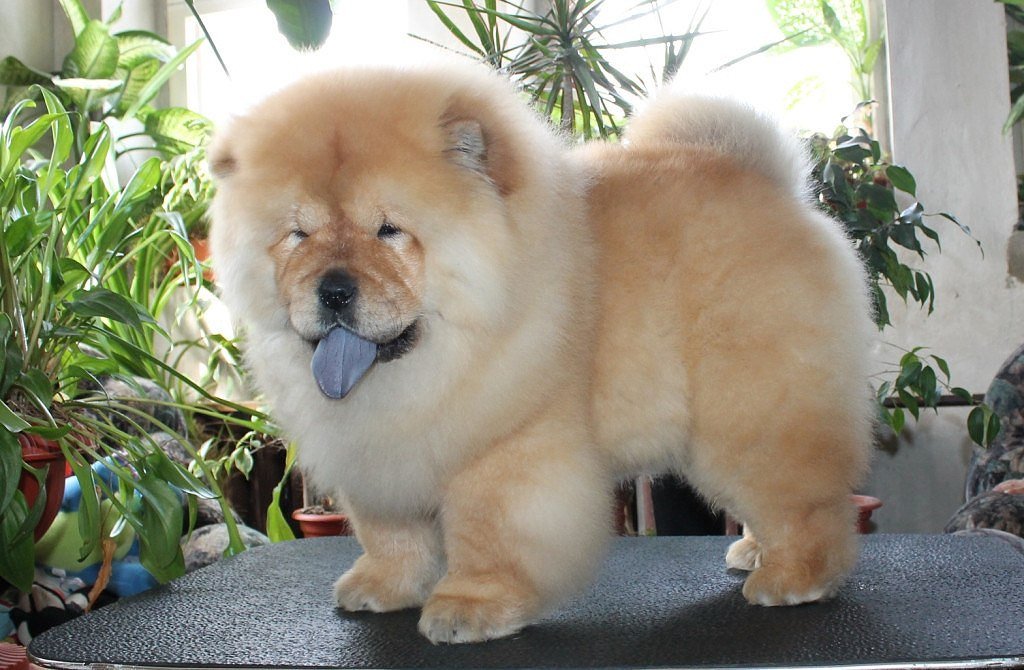
| Origin | China (Ancient times) |
| FCI Classification | Group 5 (Spitz and primitive types), Section 5 (Asian Spitz and related breeds) |
| Year of official recognition | First standards in the late 19th century, mentions from 1904 in Western clubs |
| Life span | 9-12 years (sometimes up to 15 years with good care) |
| Height at withers (Males) | 48-56 cm |
| Height at withers (Females) | 46-51 cm |
| Weight (Males) | 25-32 kg |
| Weight (Females) | 20-27 kg |
| Coat type | Two varieties: Rough (long-haired) and Smooth (short-haired) |
| Main feature | Unique blue-black tongue and stilted gait |
History of the Breed: From Imperial Palaces to Modern Times
You have probably seen these unique dogs on the street, looking like a cross between a lion and a bear, known as the Chow Chow. These animals draw the gaze of everyone around them, and many wonder where they actually come from. Their history is so deep that it has become shrouded in myth. People sometimes jokingly suggest that Chow Chows descended from bears due to their appearance and specific gait. In Korea, there is a legend that Chow Chows were once small bears that loved blackberries so much that their tongues turned that distinct blue-black color.
Of course, these are just beautiful fairytales. It is known for certain that the Chow Chow is one of the oldest dog breeds in the world. DNA analysis confirms that their genotype is very close to primitive wolves, which testifies to their ancient roots. It is assumed that these dogs have lived in Mongolia, Tibet, and Northern China since ancient times, being relatives of other Asian breeds such as the Hokkaido (Ainu) and the more modern Japanese Spitz.
In Ancient China, the fate of the Chow Chow was varied and sometimes harsh. They were all-purpose dogs. Many Buddhist temples bred Chow Chows, using them to guard sacred places. Their strength, stamina, and excellent sense of smell made them wonderful assistants in hunting game and large beasts, including wolves and leopards. There is evidence of a Tang Dynasty emperor who kept a huge kennel with thousands of these dogs for hunting.
However, there was another side to the coin. In some regions of Asia, dogs with such thick coats were bred for their fur, and their meat was considered a delicacy. Fortunately, those times are long gone, and today Chow Chows are valued exclusively as companions and show dogs. It is belived that it was the Chow Chow that served as the prototype for the famous Chinese guardian lion statues (“Foo Dogs”) that stand at the entrances to temples and palaces.
Europe first learned about these dogs thanks to the Italian merchant and traveler Marco Polo in the 13th century, who described them as powerful dogs that pulled sleds and guarded property. But since China was a closed country for a long time, no further information about the Chow Chow was recieved for centuries. In England, these dogs appeared much later, around the 1780s, brought by sailors of the East India Company. Initially, they were even exhibited at the London Zoo in the “Wild Animals” section under the name “Wild Chinese Dog”.
Real popularity came to the breed in the second half of the 19th century when Queen Victoria took an interest in these exotic animals. Local breeders noticed the unusual dogs and set to work on forming the modern type of the breed. In 1895, an exhibition was held in London where Chow Chows were officially presented for the first time. At the same time, enthusiasts of this dog created the first breed club. In 1903, the American Kennel Club (AKC) officially recognized the breed. Today, the Chow Chow is a recognizable and respected breed all over the world.
What the Chow Chow Looks Like: Unique Appearance Features
The Chow Chow is a dog that cannot be confused with any other breed. It is compact, robustly built, harmonious and proportionate, with a proud posture. Its appearance radiates strength and dignity. An important feature is the facial expression, often called a “scowl” due to the specific structure of the eyebrows and skin folds, which makes them similiar to breeds like the Shar Pei.
Head and famous tongue
The head of the Chow Chow is large and massive, with a broad and flat skull. The transition from forehead to muzzle (stop) is pronounced but not sharp. The muzzle is of medium length, broad along its entire length, and does not taper towards the nose (a so-called “blunt” muzzle). The nose is large, wide, usually black, but in cream or white dogs it may be lighter, and in blue and cinnamon dogs – matching the coat color.
The most famous sign of the breed is the mouth. The tongue, palate, and gums of the Chow Chow have a unique blue-black or purple color. Puppies are born with pink tongues, which begin to darken at the age of a few weeks. The lips are also black or dark.
Eyes and ears
The eyes are medium-sized, oval-shaped, and dark in color. They are set quite deep, which, together with the skin folds above them, forms that characteristic “scowling look”. It is important that the eyelids do not turn inwards and injure the eye. The ears are small, thick, erect, triangular in shape, and slightly rounded at the tips. They are set wide apart and tilted slightly forward over the eyes, adding an expression of concentration.
Body and specific gait
The neck is of medium length, powerful, strong, voluminous, with a slight arch that allows the head to be carried proudly. The back is short, straight, and strong. The chest is broad and deep; the ribs are well-sprung but not barrel-shaped. The tail is set high and lies tightly on the back, curled into a ring.
The limbs of the Chow Chow are another unique feature. They are of medium length, straight, with heavy bone. A key point is that the hock joints of the hind legs are practically straight, without pronounced angles of articulation. It is this anatomical feature that determines the breed’s characteristic short, “stilted” gait, which seems a bit unnatural for other dogs but is normal for the Chow. The paws are small, round, compact (“cat-like”), which allows them to move steadily on snow.
Coat types and colors
There are two varieties of Chow Chow based on coat type:
- Rough (Long-haired): They have a very abundant, dense, straight, and relatively coarse outer coat with an extremely soft and dense undercoat. Around the neck, the fur forms a pronounced “mane” or ruff, and on the back of the thighs – thick “trousers”. The tail is also very fluffy. This type most resembles a lion.
- Smooth (Short-haired): They have a shorter, but equally very dense, straight coat that stands upright from the body, resembling plush. The undercoat is also very thick. Smooths look more athletic and less “voluminous” than their long-haired brethren.
The breed standard recognizes only solid colors. Patches or multicolored coats are considered a disqualifying fault. However, it is permissible for the shade to be lighter on the underside of the tail and the back of the thighs.
| Color | Description |
| Red | The most common. Varies from light gold to deep mahogany. |
| Black | Deep, saturated black color without a red tint (although sun-bleached fur may give a brownish hue). |
| Blue | Steel gray color of various shades. Often the nose and lips also have a blue tint. |
| Cinnamon | A rare color. Varies from light beige to a cinnamon color with a pinkish-brown tint. Eyes may be lighter. |
| Cream | From almost white to ivory. Ears often have a darker apricot shade. The nose may be pink or slate (which is acceptable but less desirable). |
| White | Very rare, pure white color. |
Character: The Temperament of a “Cat in a Dog’s Skin”
Chow Chows are truly unusual and peculiar dogs. Probably, to genuinely love a Chow Chow, you need to understand and accept it for what it is, and this is not given to every dog lover. Many people unfamiliar with the breed mistakenly claim that Chows are stupid, disobedient, excessively proud, and aggressive. This is not the case at all. They are simply different. Their intelligence is no worse than that of shepherds, but it works differently – it is directed not at serving, but at analyzing the situation and making their own decisions.
Most often, the Chow Chow’s character is compared to a feline one. They are independent, self-sufficient, calm, and very clean. They will not intrusively demand attention, jump on you when meeting, or try to lick your face. Their love is shown with restraint, but it is deep and devoted. The Chow Chow is not the sort of dog that rejoices at every passerby.
Relationships with the owner and family
The Chow Chow is often called a “one-person dog”. They may treat all family members well, but they usually give true devotion and respect to only one person they have chosen as their leader. If you can find a common language with him, based on mutual respect rather than drills, this dog will be faithful to you until the end of his days. These dogs are very sensitive to the owner’s mood. They may seem insufficiently emotional outwardly, showing no boisterous joy, but inside they feel everything deeply. They are profoundly affected by family quarrels or separation from their owner.
Attitude towards strangers and guarding qualities
Chow Chows treat strangers with marked mistrust and aloofness. They will not allow themselves to be petted by just anyone on the street. They are born guards who control their territory perfectly. Their guarding instinct is based not on hysterical barking, but on observation and readiness to act. Chow Chows rarely bark without a serious reason, so if your dog has given voice – it is worth checking what has happened. They do not attack first, but if they sense a real threat to the owner or territory, they will display a lightning-fast reaction and fearlessness inherited from their combat ancestors.
This trait links them to other spitz-type breeds, such as the Eurasier, which, incidentally, was bred using the Chow Chow, or the majestic Akita Inu. All these dogs need harmony and a calm, confident owner.
Health: Typical Diseases and Prevention
On the whole, Chow Chows are fairly robust dogs with good immunity, which, with proper care, can live a long life. However, like any ancient breed with a specific appearance, they have a predisposition to certain genetic and acquired diseases. A responsible owner should know about them in order to prevent or treat them in time.
Skin problems and allergies
The most frequent problem among representatives of this breed is various dermatological diseases. The thick coat and dense undercoat create a “greenhouse effect” if the dog does not dry out completely after bathing or walking in the rain.
- Atopic dermatitis and eczema (“hot spots”): Often occur as a reaction to food components (especially chicken, corn), flea bites, or external irritants. Severe itching and redness appear, the skin flakes, and the dog scratches itself until it wounds. This disease is very unpleasant for both the pet and its owner, requiring a comprehensive approach to treatment and a strict diet.
Musculoskeletal disorders
The specific structure of the hind legs (straight hock joint) makes Chow Chows vulnerable to joint problems.
- Hip and elbow dysplasia: This is a hereditary disease in which the joint develops incorrectly, leading to pain, lameness, and in severe cases – total immobility. When choosing a puppy, it is extremely important to demand dysplasia tests of the parents from the breeder.
- Cranial cruciate ligament rupture: Also happens due to the peculiarities of the knee joint structure.
Eye problems
Deep-set eyes and skin folds on the muzzle create a risk of ophthalmological problems.
- Entropion (inward turning of the eyelid): A very common problem in Chow Chows. The edge of the eyelid (more often the lower, but sometimes the upper) turns inwards, and the eyelashes begin to rub the cornea of the eye. This causes severe pain, tearing, inflammation (keratitis) and can lead to corneal ulcers and blindness. Usually requires surgical correction.
Other diseases
- Hypothyroidism: Insufficient function of the thyroid gland. Symptoms include weight gain, lethargy, poor coat condition, balding on the flanks and tail.
- Heat stroke: Due to the thick coat and short muzzle, Chow Chows tolerate heat very poorly. In summer, they must not be left in the car, and walks should be moved to the early morning or late evening.
- Myopathy: A hereditary disease that is sometimes found in Chow Chows. It affects muscle tissues and leads to their atrophy; the dog becomes weak and moves with difficulty.
| What to check | Frequency / Age | Note |
| Eye examination (for entropion) | From early puppyhood, regularly | Especially important during head growth |
| X-ray for dysplasia (hips/elbows) | Preliminary at 6-12 months, final after 18 months | For breeding clearance |
| Blood tests (thyroid hormones) | Annually after 2 years | To detect hidden hypothyroidism |
| Skin and coat condition | Weekly during grooming | Search for redness, parasites, eczema |
Coat Care and Hygiene
Chow Chows are perfectly suited for life in an apartment, as they are calm indoors, do not take up much space (despite the volume of their coat), and are very clean. They do not require intense physical exertion, hours of running, or complex training. Two leisurely walks a day of 40-60 minutes are sufficient for them. They adore walking in the cold season when snow lies all around, but in the heat, their activity needs to be kept to a minimum.
The main challenge in caring for a Chow Chow is its luxurious coat. If you are not ready to dedicate time to regular grooming, this breed will not suit you. Caring for the unusual coat must be thorough and systematic. Accustoming a puppy to hygiene procedures must absolutely start from an early age so that later these manipulations do not cause stress. Usually, a Chow Chow that is used to it loves being brushed; it becomes a moment of bonding with the owner.
Tools and brushing technique
To keep your pet’s coat flawless and prevent it from matting, you will need an arsenal of tools:
- Metal comb with long, sparse teeth (for combing through the main volume).
- Metal comb with finer teeth (for the muzzle, legs, areas behind the ears).
- A large slicker brush with long pins for combing out the undercoat during shedding.
- Conditioning spray for detangling (never brush a Chow Chow’s coat dry, this breaks it).
An adult Chow Chow needs to be brushed thoroughly at least 1-2 times a week, and during seasonal shedding (spring/autumn) – daily. It is important to use the “layering” technique: lift the upper layer of hair and comb the undercoat thoroughly from the skin itself, otherwise the dog will look good on top, but a solid “felt” of dead down will form near the skin. Pay special attention to the areas behind the ears, under the armpits, the “trousers”, and the ruff.
Bathing and drying
Bathing a Chow Chow too often is not recommended, as this washes away the natural protective layer from the skin. Usually, bathing once every 1-2 months or as it gets dirty is sufficient. Use only high-quality professional shampoos for dogs with thick undercoats, preferably hypoallergenic ones.
A critically important stage is drying. Chow Chow fur dries naturally very slowly (up to 24 hours), and during this time moisture near the skin can provoke the development of fungus or eczema. Therefore, the use of a powerful hairdryer (preferably a professional grooming blaster that blows out water) is mandatory. Drying starts with the belly and limbs, gradually moving to the body and ruff. The air flow should not be too hot.
Other hygiene procedures
- Eyes: Due to the specific structure, Chow Chow eyes may water. Wipe them every morning with a cotton pad soaked in special eye lotion or weak chamomile tea/strong tea. Ensure that the fur around the eyes is always dry.
- Ears: Check once a week, remove dirt with a special lotion.
- Claws: If they do not wear down naturally on asphalt, they need to be trimmed with clippers every 2-3 weeks.
Training and Socialization: An Approach to an Independent Mind
You need to start educating and training a Chow Chow as early as possible, literally from the moment the puppy appears in the home. There is a misconception that representatives of this breed are stupid and incapable of following commands. However, this is not true. Chow Chows are very intelligent, but they do not have an innate desire to please humans like, for example, Labradors or German Shepherds. They will execute a command only if they see sense in it and respect the person giving it.
The main thing in training a Chow is to find contact and build a trusting relationship. Remember: there are no stupid dogs, there are inexperienced trainers who cannot find the key to a specific dog. With a Chow Chow, methods of forceful pressure, shouting, and physical punishment absolutely do not work. They will respond to aggression either by withdrawing and completely ignoring you, or by active defense. Only positive reinforcement (treats, praise), patience, and consistency will yield results.
Training sessions should be short, interesting, and regular. Chow Chows quickly get bored with the monotonous repetition of the same command. Of course, this dog will not perform circus tricks or dance merrily on its hind legs for a piece of sausage, but perfect obedience in everyday life (commands “Come”, “Heel”, “Place”, “Leave it”) can and should be taught.
The importance of early socialization
Since Chow Chows are naturally mistrustful of strangers and can show aggression towards other dogs (especially of the same sex), socialization is critical. From an early age (from 2 to 6 months), the puppy needs to be introduced to different people, friendly dogs, new sounds, smells, and situations (transport, crowded places).
The puppy must grasp that the world around is safe, and one must not lunge at strangers or other animals if the owner is not in danger. A well-bred Chow Chow usually behaves with restraint and dignity in society: he does not seek contact, but neither does he show unmotivated aggression.
Chow Chows can be very stubborn. It happens that during a walk they simply get bored of walking, or they stare at something interesting – and they will stand rooted to the spot, ignoring your calls. In such cases, physically dragging them is useless. It is better to switch the dog’s attention to a toy or treat, or simply wait calmly for a couple of minutes until he decides to continue the journey himself.
Diet: Key Recommendations for Health
The Chow Chow’s diet must be taken very seriously, as it is the guarantee of the health of their problematic skin and the beauty of their coat. Historically, in their native lands (China, Tibet), these dogs ate rather poor food, often leftovers from the table, rice, and a small amount of fish or meat. Therefore, their organism is evolutionarily adapted to assimilating a smaller amount of protein and fats than the organism of European breeds.
Features of the diet
The main mistake owners make is feeding Chow Chows high-protein foods intended for active working dogs. An excess of protein (especially beef) and fats often leads to severe allergic reactions, weeping eczema, itching, and hair loss.
The basis of the Chow Chow diet is carbohydrates (rice, buckwheat) and a moderate amount of quality protein.
- Natural feeding: If you choose “natural” food, the best sources of protein will be marine fish (boiled, boneless), turkey, rabbit, or lean mutton. Chicken often causes allergies, so one must be careful with it. Be sure to add fermented milk products (curd/cottage cheese, kefir) of medium fat content, boiled vegetables (zucchini, pumpkin, carrot), and a little vegetable oil. Do not forget about vitamin and mineral complexes, especially for skin and coat (with biotin, Omega-3 and Omega-6 fatty acids).
- Ready-made foods: The most convenient option. Choose super-premium or holistic class foods specially designed for dogs with sensitive skin and digestion. Hypoallergenic lines based on fish (salmon, white fish) and rice/potato, or lamb and rice are ideally suited. Avoid foods with a high content of corn, wheat, soy, and chicken. Protein content in dry food should preferably not exceed 22-26%, and fat – 10-15%.
Under no circumstances give a Chow Chow pastries, pasta, sweets, smoked meats, or fatty food from your table. Also, these dogs must not be overfed, as they are prone to gaining excess weight, which puts additional strain on ailing joints. The diet should be monotonous and balanced; frequent changes of food can cause digestive upset.
Pros and Cons of the Breed
| Pros (+) | Cons (-) |
| Incredibly beautiful, exotic appearance. | Complicated coat care requiring a lot of time and effort (or money for a groomer). |
| Calm temperament, not noisy, rarely bark. | Independent, stubborn character, difficult to train for novices. |
| Very clean by nature, have almost no “doggy” smell. | Prone to serious health problems (skin, eyes, joints). |
| Ideal for keeping in an apartment, do not require great exertion. | Can be aggressive towards other dogs and mistrustful of strangers. |
| Devoted and faithful companions for their owner. | Tolerate heat poorly. |
| Good, unobtrusive guards. | Heavy seasonal shedding. |
Interesting Facts About the Chow Chow
- The Chow Chow is one of the few dog breeds in which, instead of the usual 42 teeth, 44 teeth are sometimes found. Although the standard does not require this, such an atavism is considered a sign of ancient origin.
- In the times of Imperial China, Chow Chow breeding was taken very seriously. It was believed that a true thoroughbred dog should possess the following qualities: “Lion’s head, dragon’s eyes, demon’s tongue, bear’s ears, snake’s tail, cat’s paws, camel’s gait”.
- Besides the Chow Chow, only polar bears, giraffes, and Shar Pei dogs have a blue tongue in the animal world.
- The famous American president Calvin Coolidge had two Chow Chows named Timmy and Blackberry. Timmy was so popular that he was considered a kind of symbol of the White House in those years.
Frequently Asked Questions (FAQ)
Is it true that Chow Chows are aggressive and dangerous?
This is a myth. A mentally healthy Chow Chow with a good pedigree, who has undergone early socialization and proper upbringing, is not an aggressive monster. They are restrained, mistrustful of strangers, and can stand up for themselves, but they do not attack first without reason. Problems with aggression most often arise in dogs from “backyard breeding” with an unstable psyche or in those subjected to cruel methods of upbringing.
Why do they have a blue tongue?
The exact scientific cause is unknown. It is a genetic feature of the breed, linked to an increased concentration of the pigment melanin in the mucous membranes of the mouth. It is simply a unique “highlight” that in no way affects the dog’s health or taste sensations.
Is a Chow Chow suitable for a family with small children?
This is not the best choice for the role of a “nanny”. Chow Chows are too proud and independent to tolerate familiarity, pulling of ears or tails, which little ones often do. They might snap, defending their personal space. They are better suited for families with school-age children who already understand how to behave respectfully with a dog.
How do they tolerate loneliness?
Thanks to their independent character, Chow Chows tolerate loneliness better than most other breeds. They will calmly wait for their owner from work, dozing for the greater part of the day, and are unlikely to howl at the door or chew furniture out of boredom. However, this does not mean that they can be left alone for 24 hours.
Video About the Breed
- Clean, almost odorless
- Calm, not hyperactive
- Proud, devoted to the family
- A striking "lion-like" appearance
- Stubborn, hard to train
- Reserved, distrustful of strangers
- Dense coat — lots of brushing
- Copes poorly with heat
| Shar Pei | Akita Inu | Samoyed | |
|---|---|---|---|
| Height | 44–51 cm | 60–70 cm | 50–60 cm |
| Energy | 2.5 | 3.5 | 4 |
| Apartment | 3 | 2 | 2.5 |
| Beginners | 2.5 | 2 | 3 |
Why does the Chow Chow have a blue tongue?
Is the Chow Chow suitable for a novice?
Does the Chow Chow tolerate heat?
FCI Standard No. 205 · The Kennel Club
For apartments · For kids · For beginners · Active · Smartest · Hypoallergenic · All rankings →